Will the Energy Transition Only Benefit The Few?

That’s a question I’ve been wondering about since UK retail electricity prices started rising and suppliers started going bust in droves. And I am not the only one. Here’s Enel CEO Francesco Starace speaking to CNBC back in the summer:

If you look at Europe this [electricity price spike] was quite easy to predict. 2021 is the first year in which the ETS (Emissions Trading Scheme) gets into this mechanism of cutting quotas as the slack shows up, and that’s working, and I think that is something that everyone was expecting to work and it’s doing the job. The question is whether this will become too much, or whether politicians will be able to understand that they have to be part of this game, and use fiscal levers to mitigate the impact on the most vulnerable customers.

No doubt there are also other factors at work, but one way and another we here in the
United Kingdom seem be losing “this game” by many a mile at the moment.

Those “most vulnerable customers” are currently feeling the impact, as indeed are we when perusing our own electricity bills. I’ve been documenting that impact via videos of our own local friendly neighbourhood wind turbine at Upper Tremail when the wind is blowing, thanks to both Storm Arwen:

Continue reading →

Are EV Charging Station Standards Patentable?

Regular readers of the V2G UK blog will be aware that I have just returned from a visit to Rome. I hasten to add that this was for business, not pleasure! However I am happy to be able to report that the venue for day 1 of the IEC 63110 standard committee meeting that I attended was Enel X‘s fairly pleasurable Villa Lazzaroni, situated on the banks of the River Tiber:

2018-01-23_12-44-51_897

What was discussed inside the villa is of course currently confidential. However one issue raised is already in the public domain. In a press release on December 15th 2017 ChargePoint, Inc. announced that:

ChargePoint today filed a patent infringement lawsuit against SemaConnect, a manufacturer of electric vehicle (EV) charging stations, alleging the infringement of four patents focused on networked electric vehicle charging. The complaint was filed in the District of Maryland and seeks injunctive relief and monetary damages.

ChargePoint has invested substantial resources over the years to create EV charging solutions designed with drivers and businesses in mind. With an industry leading patent portfolio, ChargePoint is committed to leading the way in developing the world’s most comprehensive suite of charging technologies that support the transformation to electric mobility. ChargePoint invented networked EV charging and holds the patents related to the technology. A hallmark of the company’s technology portfolio, networked charging is a significant piece of ChargePoint’s offering and a critical ingredient to its business. As with any company, protecting vital IP is imperative to the future success of the organization and its contribution to the marketplace.

The back story to the court case can be perused over at Lexology:

ChargePoint, Inc., a leading provider of Electric Vehicle (EV) charging stations, appears to have lost a bid to provide charging stations to Electrify America and promptly sued the winning bidder for patent infringement. In a lawsuit filed December 15, 2017, in federal court in Maryland, ChargePoint accused SemaConnect, Inc. of infringing four patents directed to networked charging station technology.

Electrify America is a subsidiary of Volkswagen Group of America (VW). Electrify America was established as part of VW’s diesel emissions settlement with the U.S. Environmental Protection Agency. In the settlement, VW agreed to spend $2 billion over ten years on Zero Emissions Vehicle (ZEV) infrastructure and education programs. Electrify America announced plans last spring to partner with EV charging station companies to install and maintain at least 2,800 charging stations at more than 500 locations across the country.

From court documents it appears that Electrify America put out a request for EV charging station partners, and whittled the bids it received down to four finalists. After additional scrutiny, Electrify America selected three partners: SemaConnect, Greenlots, and EV Connect. ChargePoint, which may have been named as one of the four finalists, was not selected as a partner. SemaConnect’s portion of the partnership agreement includes the installation and maintenance of more than 1,400 charging stations.

According to the associated documents courtesy of the Free Law Projects‘s “Court Listener” web site SemaConnect’s attorneys aren’t going to take ChargePoint’s allegations lying down:

A party cannot infringe an invalid patent. Since each Asserted Patent is invalid, SemaConnect does not infringe any Asserted Patent. As explained in SemaConnect’s Motion to Dismiss filed concurrently, the Asserted Patents are invalid under § 101 because they are directed to an abstract idea (turning a switch “on” and “off”) and doing so using a conventional and known “remote server” is not an inventive concept sufficient to confer patent eligibility onto that abstract idea.

Expect the legal eagle’s fees on this one to rise faster than the current US EV charging point predictions!

V2G Explained by the Mainstream Media

V2G is now a hot topic in the UK mainstream media! A few days ago The Times newspaper published an article on vehicle-to-grid technology. According to Edward Lucas:

The hunt is on for cheaper and better storage, which is where electric cars come in. For its owners, the car battery is an unused asset most of the time, just as the engine is for those of us with old-style vehicles. Yet for grid managers dealing with the spikes and troughs in demand, a terawatt hour stored in spare batteries is exactly what is needed. Instead of subsidising standby generators, we can pay car owners to sip power from their vehicles’ batteries.

But making this work on a larger scale requires change. Our existing energy set-up is centralised: big power plants transmit large amounts of electricity over long distances to passive consumers. This arrangement copes with the 115,000 electric cars we have now. But it will not be fit for 2040, when the government intends to ban the sale of new diesel and petrol cars. By then we are predicted to have more than 25 million electric vehicles.

Done wrong, that will resemble something like a vast network of electric kettles. Charging them all at once at home would crash the grid. Consumers will curse, costs will soar and benefits will shrivel. To avoid that, the electricity system of the future will have to look like the internet: decentralised and interactive. Consumers will also be producers — perhaps from rooftop solar panels or by supplying power from their car batteries back into the grid when needed. Demand will be smarter: appliances will adjust their consumption according to price. Electric car owners, for example, will not mind exactly when their vehicle is charged, so long as it is ready when they need it. They will take advantage of cheap electricity just as consumers do already with night storage heaters.

The prospect is both exciting and daunting. Dieter Helm, the energy economist who recently reviewed energy costs for the government, says that the combination of electric vehicles, battery technology and digitisation presents challenges of a scale and magnitude not witnessed since the reconstruction of our electricity system after 1945.

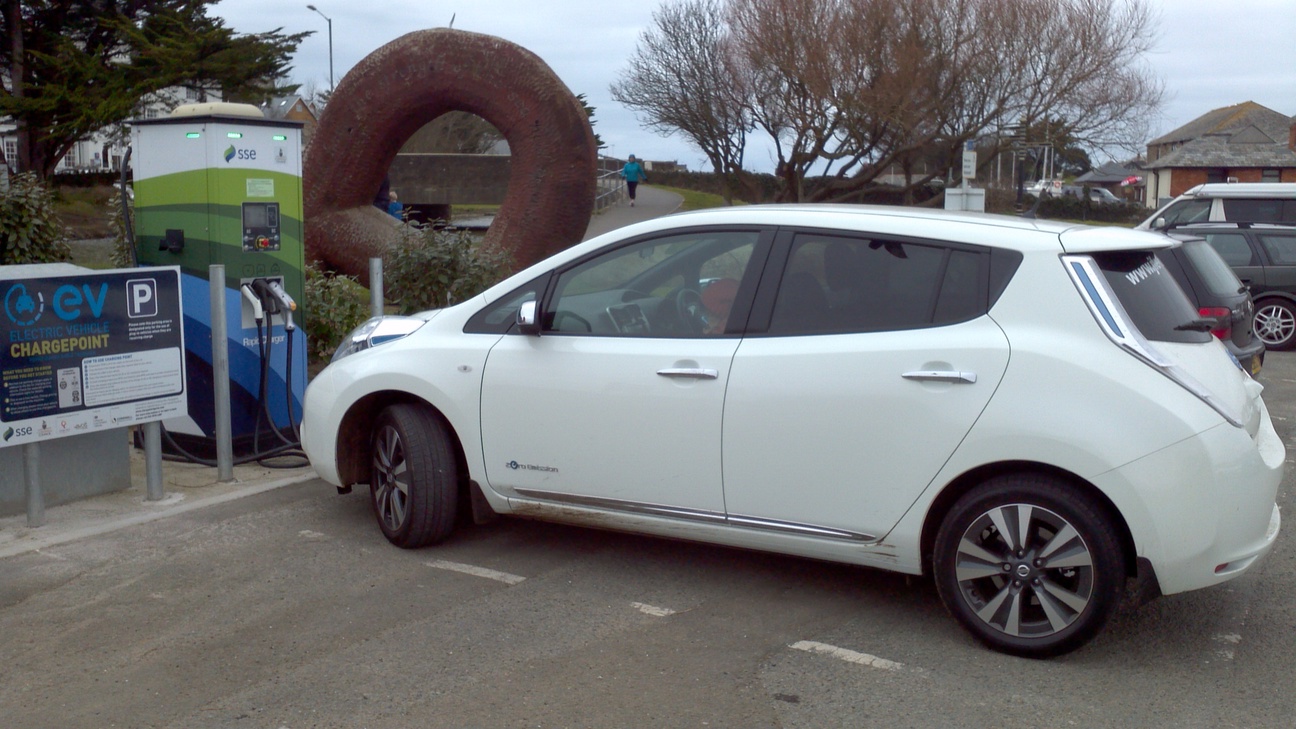
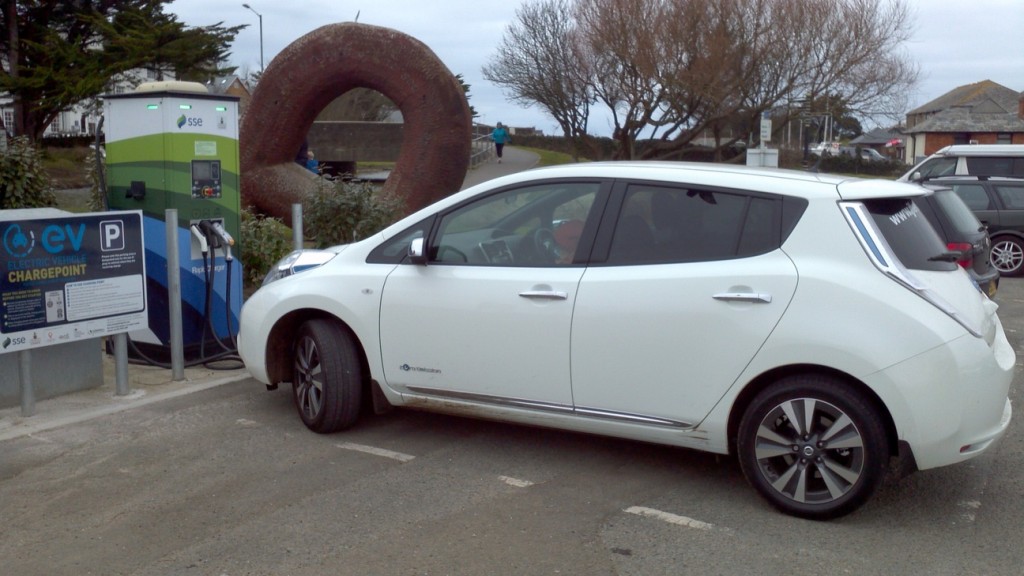
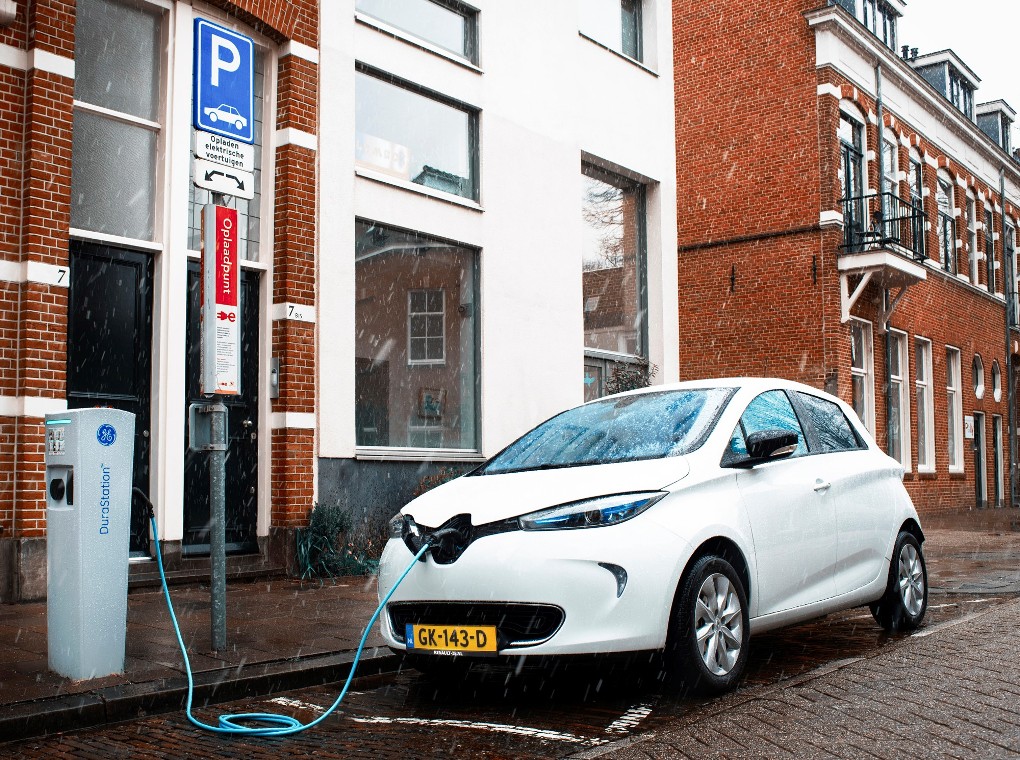
Today the BBC have followed the Times’ lead by publishing an article by Theo Leggett with a slightly different perspective. Unfortunately they included at the top a stock photo of what looks a lot like a Renault ZOE instead of a Nissan LEAF. Here’s one of our stock photos of a 2016 LEAF, which is V2G capable:
2016-03-19_12-56-18_200

However currently the ZOE is not. Here’s what one of those looks like:
ZOE-LomboXnet-1024

Theo points out that:

At the Nissan Technology Centre in Cranfield, Bedfordshire, a number of the company’s electric Leaf models are lined up alongside a bank of chargers. But these cars aren’t just drawing energy from the grid; they’re also putting it back.

The system is called Vehicle to Grid, or V2G. The Japanese company is developing it in partnership with the Italian power firm Enel and is already operating a small trial hub in Denmark.

Electric cars are, in effect, energy storage devices, and because they spend much of their time parked up not doing anything they can help smooth out the peaks and troughs in energy demand.

“Basically, we can consider the car as a battery with wheels,” says Maria Laura Corallini, the engineer in charge of the V2G project.

“You can use the energy storage capability in the battery to provide specific services back to the grid.”

The system uses software to regulate the charging level of multiple vehicles.

When the grid needs extra power, it can draw very small amounts from each individual vehicle. When energy is abundant, it can top them up again. Users will get paid for the electricity they provide.

If thousands of cars are connected together, then the amount of energy given back to the grid can be substantial, and it can be varied on a second-by-second basis.

Initially the plan is to sell it to businesses that operate large fleets, although the company says it will also introduce a residential version. Other organisations are also experimenting with the technology.

I suppose V2G UK must count as one of those “other organisations” in this context! Theo continues by referring to an oft mentioned tale of V2G woe:

Not everyone agrees that V2G makes commercial sense, however. The chief technical officer of Tesla, JB Straubel, for example, has suggested in the past that he doesn’t see it becoming a viable solution, largely due to its cost and complexity.

I am forced to agree with JB that here in the UK V2G currently doesn’t “make commercial sense”, which further forces me to reveal once again this image of a Tesla Model S connected to a V2G capable bi-directional charging station in the Netherlands:
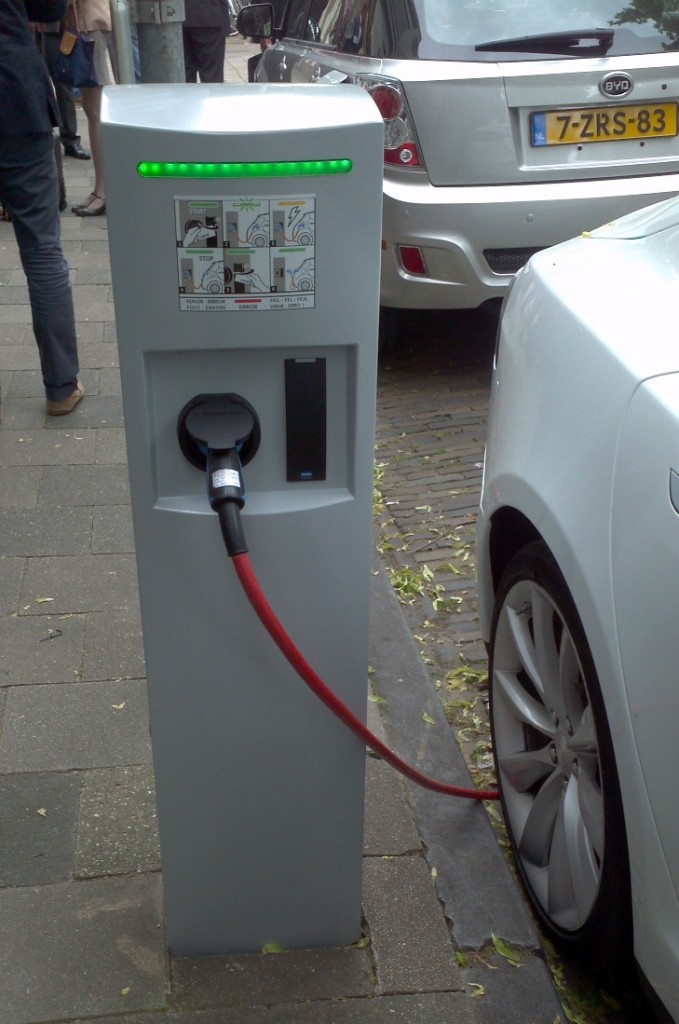
Unfortunately in all the circumstances that particular Tesla was only capable of charging from the kerbside bi-directional charging station. The BYD e6 parked next to it could however also discharge, ultimately to the local distribution grid. Do you suppose that if and when the “cost and complexity” reduces and V2G does “make commercial sense” in Tesla’s view, power will suddenly start flowing in the opposite direction down that stout red cable?

Nissan Installs V2G Chargers in the UK

There’s some extremely interesting news in my inbox this morning! According to a Nissan press release:

Nissan has announced today that its UK-based European R&D facility, Nissan Technical Centre Europe (NTCE) has become the first Nissan entity in the company’s network of European facilities to install vehicle-to-grid technology.

That does rather suggest that Nissan’s previously announced V2G equipped French regional office has yet to materialise. The press release continues:

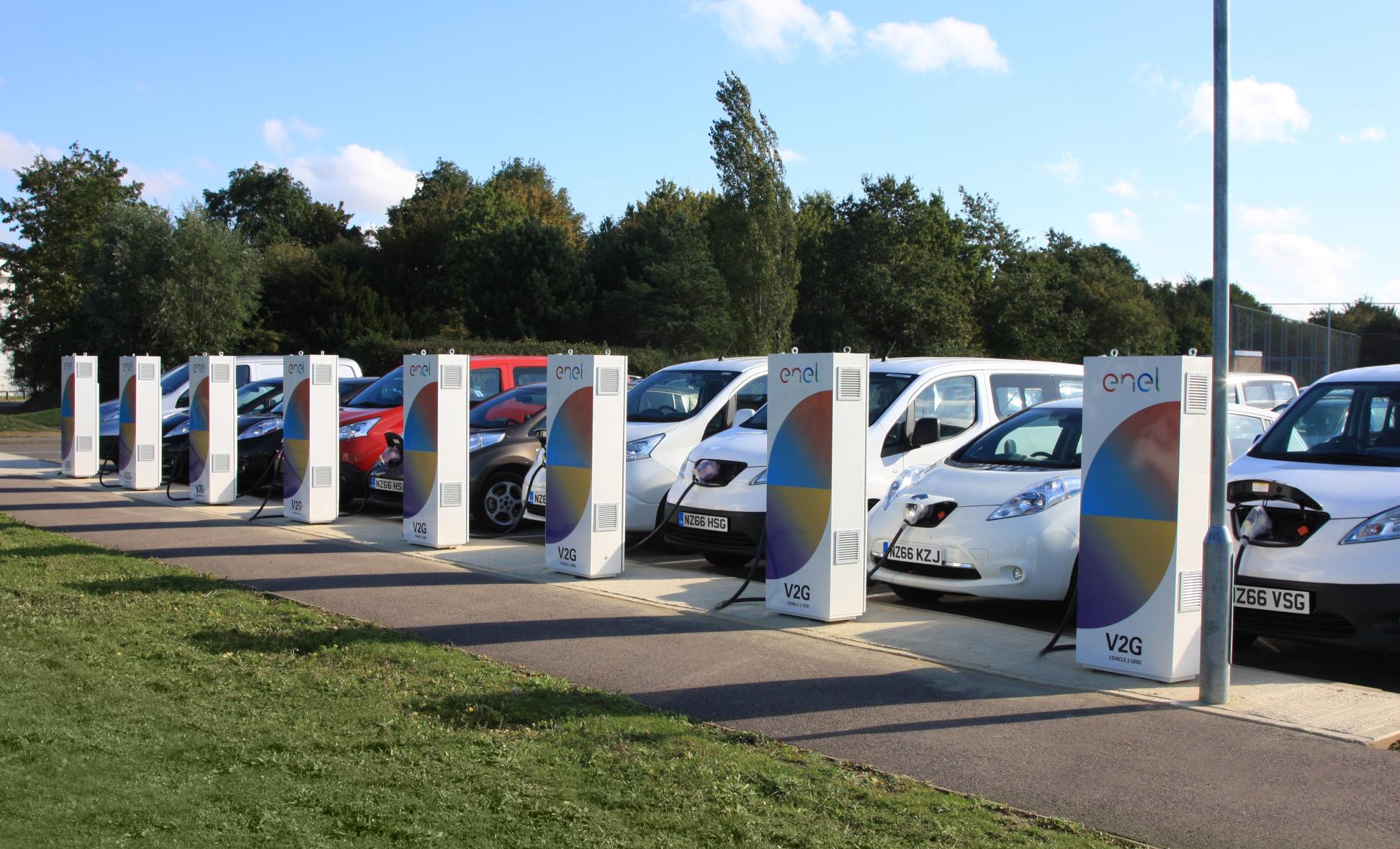
Developed by Nissan in partnership with multinational energy provider Enel, eight V2G chargers have been installed at the site and will be available for all NTCE employees to use. The V2G chargers work with Nissan’s electric vehicles (EVs) to provide an intelligent energy management system capable of both charging the vehicles and allowing the cars to give stored energy from the vehicle’s battery back to the grid to help stabilise demand.

The move marks an important step in the company’s plans to make its Intelligent Mobility vision a reality in Europe. The integration of V2G technology brings to life Nissan’s Intelligent Mobility vision, demonstrating how zero-emission vehicles such as the 100 percent electric Nissan Leaf and e-NV200 and energy management technologies can work in tandem to create a cleaner, more efficient energy network.

Here’s a view of Nissan’s V2G equipped Cranfield car park:

There’s an interesting addendum as well, that I’d previously missed:

Today’s news follows the announcement in August that Nissan and Enel secured their first commercial V2G customer in Europe. Enel has installed ten V2G units at the headquarters of Danish utility company, Frederiksberg Forsyning, making it the first business to commercially integrate and host the V2G units.

Nissan, Enel and National Grid Announce UK V2G Trial

Things seem to be looking up for vehicle-to-grid technology here in the United Kingdom! In a press release Nissan have just announced that:

Automotive industry leader Nissan and multinational power company Enel, today confirmed plans to launch a major vehicle-to-grid (V2G) trial – the first ever carried out in the UK. The trial will work by installing and connecting one hundred V2G units at locations agreed by private and fleet owners of the Nissan LEAF and e-NV200 electric van. By giving Nissan electric vehicle owners the ability to plug their vehicles into the V2G system, owners will have the flexibility and power to sell stored energy from their vehicle battery back to the National Grid.

Technical details of the trial are however conspicuous only by their absence from the announcement. I for one would love to know exactly how “sell[ing] stored energy from [a] vehicle battery back to the National Grid” is going to work in practice. The press release continues:

Today’s announcement heralds an exciting era for energy management in the UK. Not only will Nissan electric vehicle owners be able to play an active role in grid stability, providing an alternate source of income, but it will revolutionise how energy is supplied to the grid. Once scaled up, the V2G technology can become a game-changer for owners of Nissan EV in the UK as they become fully fledged and active participants in the UK energy market.

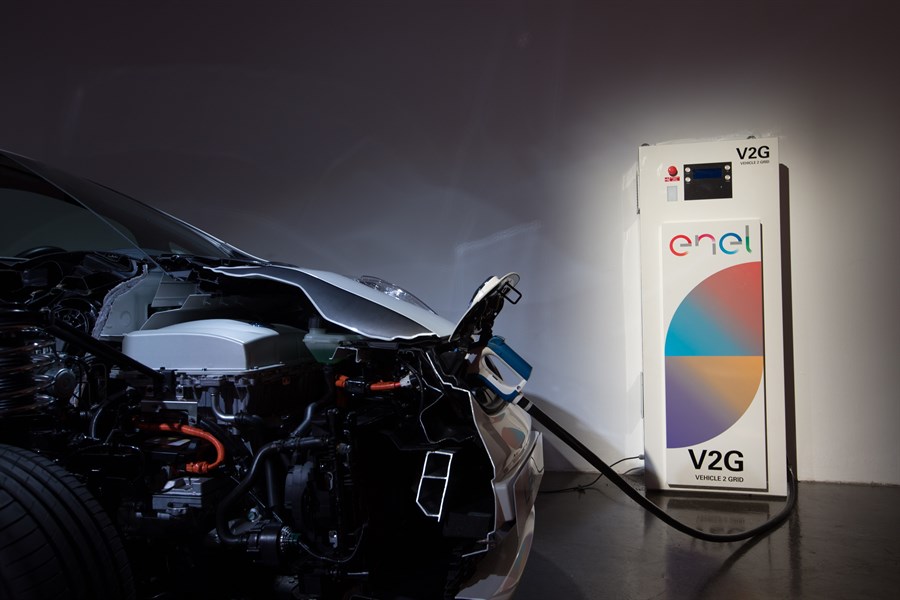
Personally I’d love to be the owner of an electric vehicle that is a “fully fledged and active participant in the UK energy market” but I don’t foresee that happening any time soon. I cannot help but wonder what Nissan UK and National Grid know that I don’t? Whilst I wait to find out the answer to that particular UK energy market conundrum, here’s a publicity picture of the associated hardware:

Perhaps the most pertinent comment in the announcement comes from Steven Holliday, the former CEO of National Grid plc, who points out that:

At National Grid we are constantly looking to the future to ensure we have the capacity to meet national energy demand – it’s our job to future proof the national transmission network.

The rapid uptake of Electric Vehicles is certainly positive yet could also be challenging if we don’t plan ahead to understand precisely what effect this new technology will have on the electricity system. Our Future Energy team predict that there could be up to 700,000 Electric Vehicles in 2020 requiring an extra 500MW of energy. That’s why we support innovative technologies and pioneering projects such as this one that have the potential to make a real difference to the way we manage energy supply and demand.

The press release concludes:

Today’s announcement follows the signing of a partnership agreement between Nissan and Enel in Paris in December 2015 during the 21st UN Conference on Climate Change (COP21) to trial V2G technology in Europe. A trial comprising 40 V2G units began in Denmark in January 2016.

I wonder if any Nissan LEAF owners are already active participants in the Danish energy market?

Nissan’s New Office Will Be Electric Vehicle Powered

Nissan announced at the Geneva Motor Show today that:

Its new regional office in France will house the largest grid-integrated electric vehicle (EV) system and second life battery storage unit ever installed in a building, anywhere in the world.

The new building will feature 100 vehicle-to-grid chargers, from Nissan’s partner ENEL, allowing Nissan’s range of EVs to plug in and draw down energy from the grid at off-peak periods with the ability to “sell back” the stored energy to the grid. It will also feature a 1 MWh energy storage system, from Nissan’s partner EATON, the battery storage experts, powered by 64 Nissan LEAF second life EV batteries combined with solar energy generation.

The company hopes to extend this innovative battery technology to other major Nissan sites and facilities around the world over the next few years. The systems which will be installed at Nissan’s new French office will serve as a live test case of what can be achieved when electric cars are used to their full potential.

By reducing grid dependency and using excess energy stored in EV batteries in a smart way, Nissan believes today’s announcement will be a game-changer in the way people and businesses utilise electric vehicle fleets.

The new technology is expected to slash energy costs at the new France office by reducing drawdown of energy during peak periods in favour of off-peak tariffs. The new energy management system will also decrease the amount of contracted power consumed from the local electricity supplier.

Nissan announced plans to create a viable long-term solution to environmental protection in relation to energy use and storage at the COP21 climate conference in Paris last year. This included a partnership between Nissan and EATON on giving electric vehicle batteries a second life as stationary energy storage units and a partnership with ENEL on vehicle-to-grid integration. Grid integration trials have already begun in Denmark.

Nissan Provide Power to the People! In the UK?

In what sounds a lot like a relaunch of the V2G hardware unveiled at the Geneva Motor Show back in March, a Nissan press release yesterday announced under the headline “Power to the People: Nissan and ENEL launch first smart grid trials” that:

  • Electric car to become home ‘energy hub’, allowing renewable energy to be harnessed and stored by the car
  • Nissan will commence Smart Grid trials in partnership with energy supplier, ENEL
  • More than Nissan 200,000 LEAF sold worldwide

At the 21st UN Conference on Climate Change (COP21) in Paris this week, Nissan has announced the development of an innovative Vehicle to Grid system which will allow drivers to operate as individual ‘energy hubs’ with the ability to store, use or return electricity to the grid.

Nissan will commence Smart Grid trials in partnership with multinational energy manufacturer and distributor, ENEL.

As part of the landmark partnership, Nissan and ENEL have committed to working together, to explore:

Introducing this revolutionary technology to the European market;
The extended use of ‘second life’ electric vehicles batteries for static applications;
Designing and evaluating potential affordable energy and mobility pack offers

Vehicle-to-Grid allows customers to take control of the type of energy they consume – avoiding peak tariffs and generating additional household income during peak times.

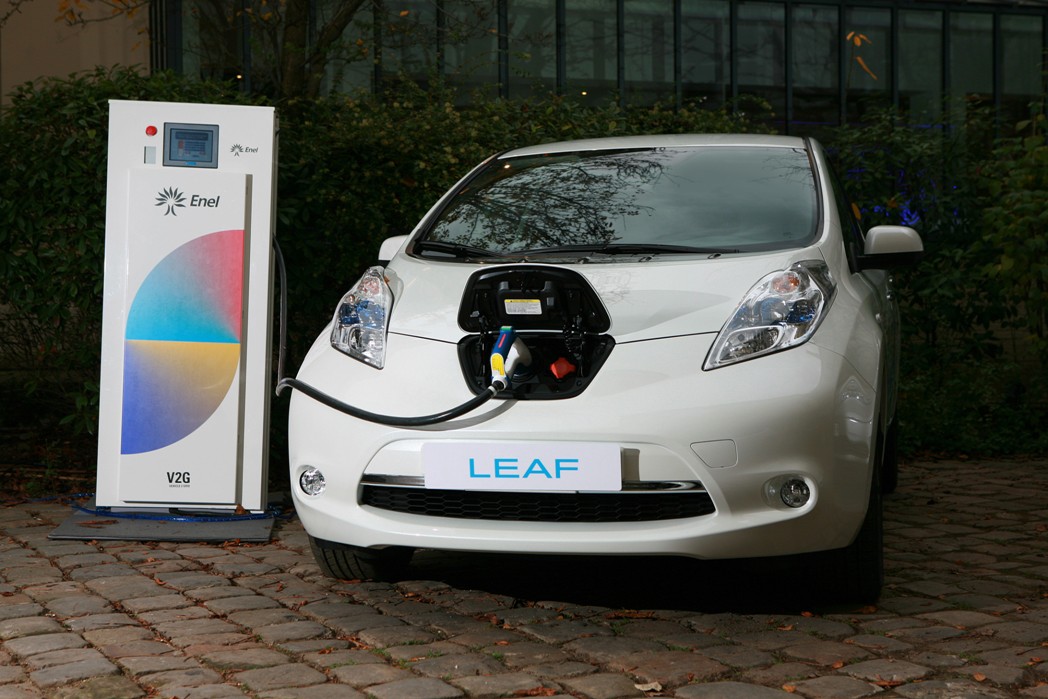
Here’s how the facelifted hardware looks, with an “Enel” badge instead of the original “Endesa” one:

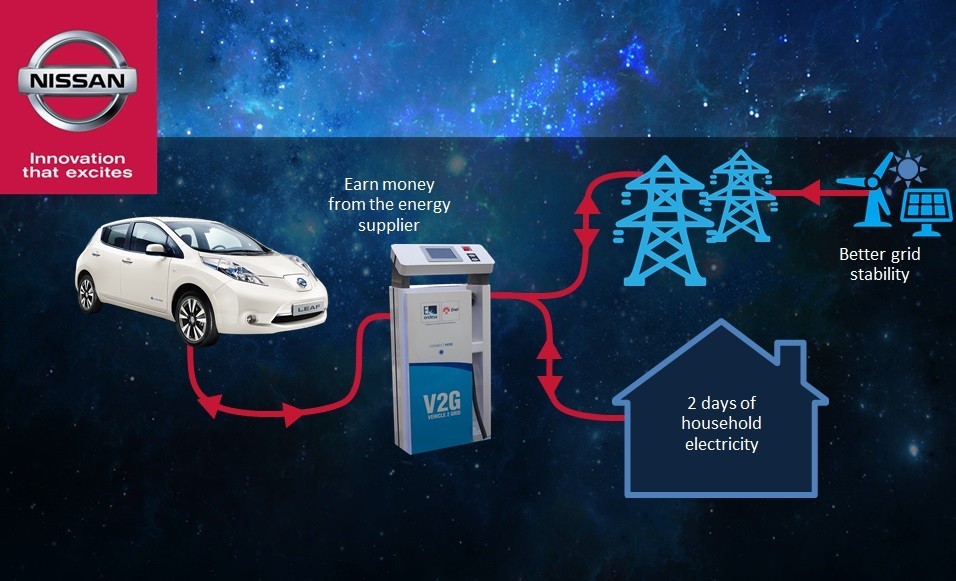
Nissan and Enel also helpfully provide a couple of infographics to help explain how their “revolutionary technology” will work. Here’s the simple version:

which looks a lot like a less colourful version of the V2G banner at the top of this page! Nissan go on to say that:

Using a special two-way charger and energy management system developed by Nissan in partnership with ENEL, LEAF owners can connect to charge at low-demand, cheap tariff periods, with an option to then use the electricity stored in the vehicle’s battery at home when costs are higher, or even feed back to the grid to generate additional household income.

“Our customers are no strangers to great value, with the Nissan LEAF offering unbeatable value motoring from three cents per kilometre. Now, with the introduction of Smart Grid technologies, we can empower motorists to take control of their energy mix – stimulating greater use of renewable power, and offering significant financial rewards for those who make the switch to electric.

“The personal benefits of innovations like this are clear, but moreover, we believe that this technology could help guarantee a cleaner energy infrastructure for generations to come.”

Nissan – the world leader in EV sales with 200,000 Nissan LEAF sold worldwide – is turning a page in zero emission mobility by unlocking the full potential of its electric vehicle batteries with the ENEL two-way charging technology.

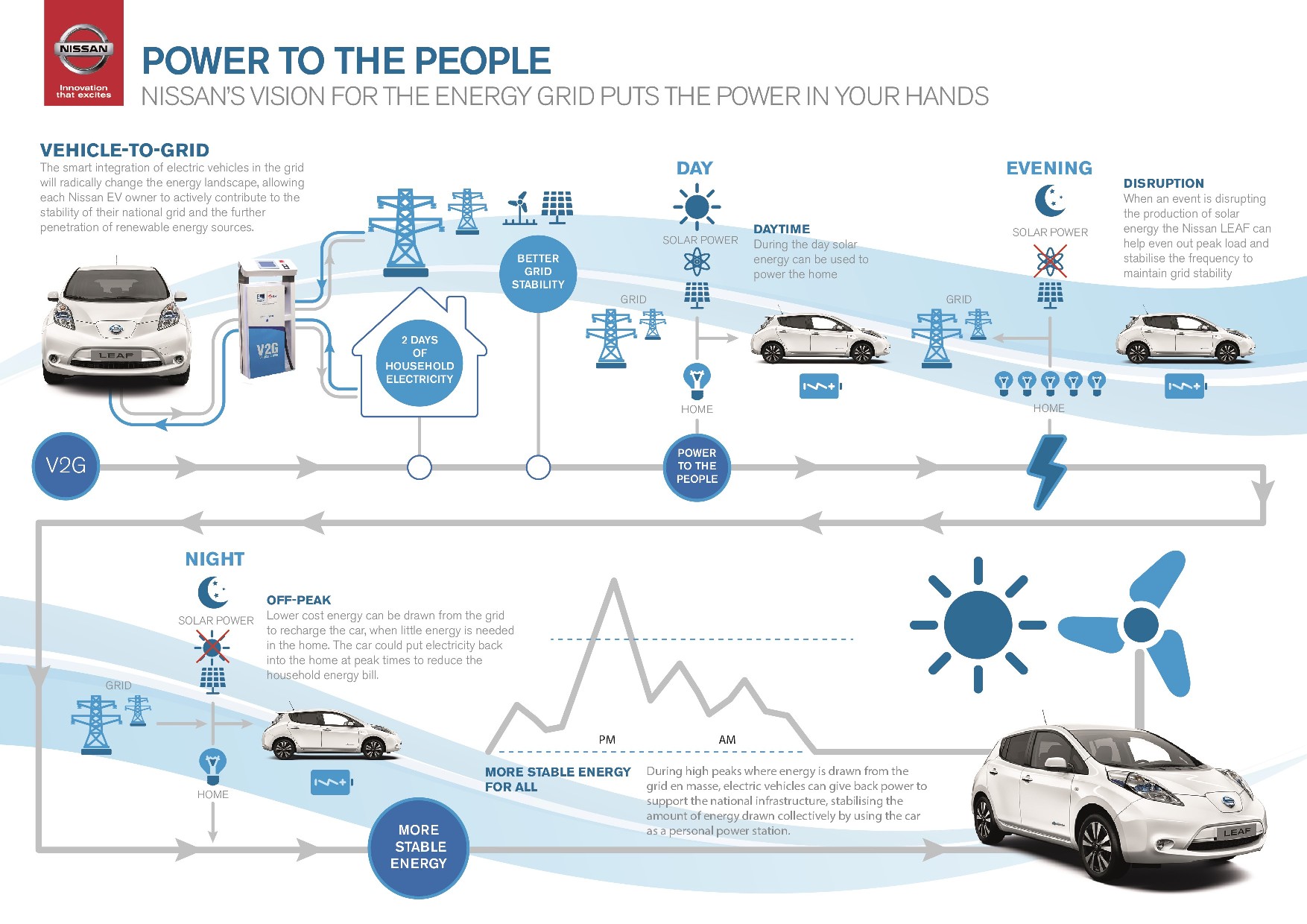
Here’s the other infographic, which shows in more detail how V2G technology might “unlock the full potential of [a Nissan LEAF’s] batteries”. Click on the image to view a larger version:

Another Nissan press release mentions where those “Smart Grid trials” will take place:

The agreement with the ENEL Group will bring the first Grid Integrated Vehicles to countries where regulation allows sufficient value generation. Denmark will host the first set of trials with Germany, Netherlands and other northern European regions following suit. This endeavour is part of Enel’s and Nissan’s commitment to support the entire electric vehicle ecosystem, going way beyond the car itself and delivering new services to the power industry.

I wonder if they could be persuaded to run one here in the United Kingdom? We are a “northern European region” after all! Here at V2G UK we’re rather keen to try out the techniques hinted at by the small print in the bottom right hand corner of the picture, which reads as follows:

During high peaks where energy is drawn from the grid en masse, electric vehicles can give back power to support the national infrastructure, stabilising the energy drawn collectively by using the car as a personal power station.

Nissan and Endesa Pledge to Promote V2G in Europe

Nissan and Spanish utility Endesa have announced in a press release that they

Signed a ground-breaking agreement at the 85th Geneva International Motor Show that paves the way for a mass-market vehicle-to-grid (V2G) system.

The two companies have pledged to work together to deliver a V2G system and an innovative business model designed to leverage this technology.

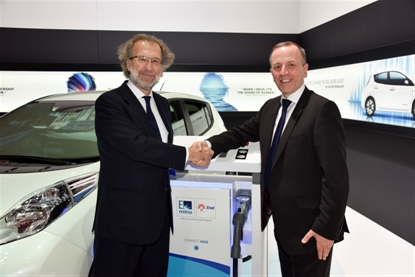
If that sounds a touch unlikely to you, here’s the proof:

The press release goes on to explain that:

The two companies have agreed to collaborate on the following activities:

  • Introduction of V2G services in the European market;
  • Exploring the use of ‘second life’ EV batteries for stationary applications (including households, buildings, grid);
  • Designing and evaluating potential affordable energy and mobility pack offers;

One of the main challenges for electricity management systems is to assure grid stability. This situation is especially relevant in countries with a high level of renewable energy generation, and this will only increase in the future. The longer term zero-emission vision is for EVs to be at the center of a fully integrated system whereby owners can participate in wholesale energy markets using the power stored in the batteries of their electric vehicles, and thus significantly reduce their cost of operation. In a not-so-distant scenario, the EV user not only decides when and where they want to charge their EV, but how best they spend and re-sell the energy stored in their EV; receiving tangible financial benefits in terms of energy savings, while at the same time maximizing the use of green energy.

As is customary on these occasions the press release quotes executives from the two companies. Paul Willcox, Chairman of Nissan Europe said that:

We believe this innovation represents a significant development for Nissan Leaf and e-NV200 customers. Every Nissan electric vehicle battery contains a power storage capability that will prove useful in contributing towards smarter and responsible management of the power demand & supply of local power grids, thus reducing our EV total cost of ownership. Not only does this represent an opportunity for Nissan’s EV private and fleet owners, it could also support grid stability and fully demonstrate that each Nissan EV represents a tangible social asset.

whereas Javier Uriarte, Head of Market Iberia at Endesa, pointed out that:

The flexibility offered by V2G implementation in terms of storing and releasing green energy into the grid will further enhance the already significant and tangible benefits of electric mobility. This is why Endesa, together with its parent company Enel and partner Nissan, have decided to join efforts in promoting this technology.

Moving on to the technology employed:

The Vehicle to Grid (V2G) system consists of the Endesa two-way charger and an energy management system that can also integrate such off-grid, and renewable, power generation as solar panels and wind turbines. Using this equipment, a Nissan LEAF or e-NV200 owner can connect to charge at low-demand, and cheap tariff periods, with an option to then use the electricity stored in the vehicle’s battery at home when costs are higher, or even feed back to the grid with a net financial benefit. Electricity generated by solar panels or wind turbines can be used to charge a vehicle, to power the home or business, or to feed back to the grid.

This unprecedented agreement between Nissan and Endesa means that European countries can now review their current energy management policies in order to respond to the technological innovation of the V2G system.

Endesa has developed the ultimate low-cost V2G technology ready for the mass market after years of real-life testing. The company first showcased its V2G technology in 2008 in Smartcity Malaga, the Enel Group testing ground for smart cities. Later on, in 2012, Endesa presented the evolution of such technology at the ZEM2ALL demonstrator.

On March 12, 2015, as the culmination of the V2G system development, together with Nissan as automotive partner, Endesa will host a full demonstration of the market-ready and low cost system in Madrid.

Of course we’re not content with merely reading press releases here at V2G UK, and we have conducted an in depth interview with Olivier Paturet, who is General Manager of Nissan Europe’s zero emission strategy. Here’s a 2013 recording of Olivier outlining the raison d’être of Nissan’s ZEV plans:


Watch this space!