
PG&E Announce V2G Export Tariff for Commercial EVs

In a press release yesterday the Pacific Gas and Electric Company announced that:

PG&E has received approval to establish the nation’s first “vehicle-to-grid” export compensation mechanism for commercial electric vehicle charging customers in its California service area. The V2G export rate promotes EV adoption by providing upfront incentives to help commercial customers offset fleet costs and delivers an innovative solution for these vehicles to export power back to support the grid during peak energy demand periods.

The groundbreaking settlement agreement with the Vehicle-Grid Integration Council (VGIC), Electrify America LLC and the Public Advocates Office at the California Public Utilities Commission (CPUC) was adopted by the CPUC on Oct. 20, 2022. The rate is expected to increase participation from V2G school buses and other electric vehicles in response to near-real-time grid conditions and will be available to charging equipment paired with stationary energy storage systems, which can support the grid and provide backup power to charge vehicles during grid outages.

More than 420,000 EVs have been sold in PG&E’s service area, representing one in six EVs in the country. As large vehicles like school buses and commercial fleets continue to electrify, the opportunity grows for these vehicles to serve as crucial, flexible grid resources to support a more reliable, affordable and efficient energy system. Greater volumes of these vehicles on the road comes at a critical time, as peak energy demand challenges California’s grid and novel solutions like V2G emerge…

As part of PG&E’s 2030 targets, the company is aiming to proactively prepare the grid for 12,000 GWh of EV-related electric load and improve processes to enable rapid, safe EV energization and interconnection. It’s also working to enable 2 million EVs to participate in vehicle-grid integration applications, allowing EVs to be a cornerstone of both reliability and resilience.

Are EV Charging Station Standards Patentable?

Regular readers of the V2G UK blog will be aware that I have just returned from a visit to Rome. I hasten to add that this was for business, not pleasure! However I am happy to be able to report that the venue for day 1 of the IEC 63110 standard committee meeting that I attended was Enel X‘s fairly pleasurable Villa Lazzaroni, situated on the banks of the River Tiber:

2018-01-23_12-44-51_897

What was discussed inside the villa is of course currently confidential. However one issue raised is already in the public domain. In a press release on December 15th 2017 ChargePoint, Inc. announced that:

ChargePoint today filed a patent infringement lawsuit against SemaConnect, a manufacturer of electric vehicle (EV) charging stations, alleging the infringement of four patents focused on networked electric vehicle charging. The complaint was filed in the District of Maryland and seeks injunctive relief and monetary damages.

ChargePoint has invested substantial resources over the years to create EV charging solutions designed with drivers and businesses in mind. With an industry leading patent portfolio, ChargePoint is committed to leading the way in developing the world’s most comprehensive suite of charging technologies that support the transformation to electric mobility. ChargePoint invented networked EV charging and holds the patents related to the technology. A hallmark of the company’s technology portfolio, networked charging is a significant piece of ChargePoint’s offering and a critical ingredient to its business. As with any company, protecting vital IP is imperative to the future success of the organization and its contribution to the marketplace.

The back story to the court case can be perused over at Lexology:

ChargePoint, Inc., a leading provider of Electric Vehicle (EV) charging stations, appears to have lost a bid to provide charging stations to Electrify America and promptly sued the winning bidder for patent infringement. In a lawsuit filed December 15, 2017, in federal court in Maryland, ChargePoint accused SemaConnect, Inc. of infringing four patents directed to networked charging station technology.

Electrify America is a subsidiary of Volkswagen Group of America (VW). Electrify America was established as part of VW’s diesel emissions settlement with the U.S. Environmental Protection Agency. In the settlement, VW agreed to spend $2 billion over ten years on Zero Emissions Vehicle (ZEV) infrastructure and education programs. Electrify America announced plans last spring to partner with EV charging station companies to install and maintain at least 2,800 charging stations at more than 500 locations across the country.

From court documents it appears that Electrify America put out a request for EV charging station partners, and whittled the bids it received down to four finalists. After additional scrutiny, Electrify America selected three partners: SemaConnect, Greenlots, and EV Connect. ChargePoint, which may have been named as one of the four finalists, was not selected as a partner. SemaConnect’s portion of the partnership agreement includes the installation and maintenance of more than 1,400 charging stations.

According to the associated documents courtesy of the Free Law Projects‘s “Court Listener” web site SemaConnect’s attorneys aren’t going to take ChargePoint’s allegations lying down:

A party cannot infringe an invalid patent. Since each Asserted Patent is invalid, SemaConnect does not infringe any Asserted Patent. As explained in SemaConnect’s Motion to Dismiss filed concurrently, the Asserted Patents are invalid under § 101 because they are directed to an abstract idea (turning a switch “on” and “off”) and doing so using a conventional and known “remote server” is not an inventive concept sufficient to confer patent eligibility onto that abstract idea.

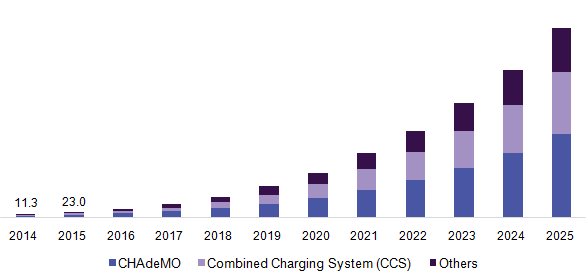
Expect the legal eagle’s fees on this one to rise faster than the current US EV charging point predictions!