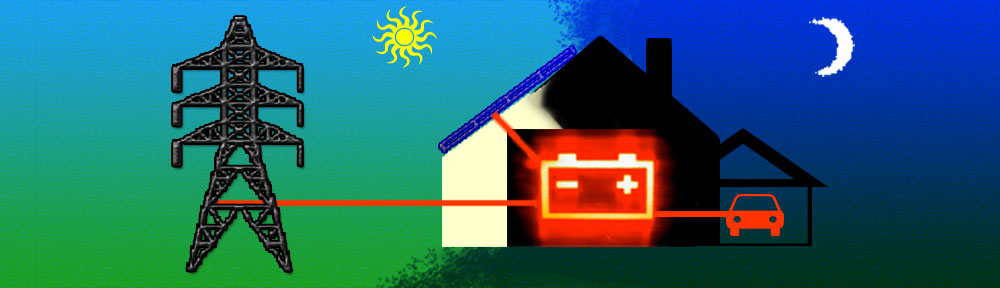
Honda Joins Delaware Vehicle to Grid Project

Earlier this year we reported that the University of Delaware were running a pilot project in which a fleet of BMW Minis were actually earning money by providing a useful service to PJM Interconnection‘s electricity grid over the pond in North America.

Now comes news that Honda are taking part in the self same project. According to their press release:

Honda has joined a demonstration project for experimental vehicle-to-grid (V2G) technology aimed at providing a potentially valuable energy storage resource to the nation’s electrical grid while providing for more cost-effective ownership of plug-in electric vehicles.

The Honda technology builds off of the research conducted by the University of Delaware and now supported by NRG Energy, Inc.  NRG and the University of Delaware, through their eV2g joint venture, came online early in 2013 with the world’s first revenue-generating vehicle-to-grid project, demonstrating the controls, regulatory requirements, and market participation rules for selling energy storage from vehicles into the PJM Interconnection Regulation Market. Honda is supplying an Accord Plug-In Hybrid with added V2G capabilities to the University’s Science, Technology and Advanced Research (STAR) Campus to jointly investigate the potential of this technology to benefit the electrical grid, vehicle owners and society.

There were of course also a number of quotes from senior managers of the companies involved. Steven Center, vice president of the Environmental Business Development Office of American Honda Motor Co., Inc said that:

This technology has the potential to support both a cleaner and more efficient power grid and a more positive ownership experience for EV customers. With V2G technology, a network of PEVs becomes essentially a distributed energy storage system. It makes for an even stronger value equation for plug-in vehicles, with benefits for both the community and the vehicle user.

Willett Kempton, professor in the College of Earth, Ocean, and Environment and Research Director of the University of Delaware’s Center for Carbon-Free Power Integration said that:

The participation of global automakers like Honda will help demonstrate and refine the technology. The University of Delaware has been developing the technology so that vehicle batteries can be used not only for mobility but also for grid services.  It is a big step toward a future with widespread availability of the technology to have Honda join our demonstration with their V2G-capable car.

Finally Denise Wilson, NRG Executive Vice President and President, New Businesses said that:

As the U.S. adds more intermittent resources to the grid, finding a lower cost energy storage technology that also benefits electric vehicle drivers is a great opportunity. We see this demonstration by Honda as an important step in the development of vehicle to grid technology.

Much the same sort of sentiments apply here in the UK as we too “add more intermittent resources to the grid”. However I could not help but notice that once again nobody mentioned international standards!

In Delaware at Least, Electric Vehicles Earn Money From the Grid

Vehicle to grid technology is making money at last, and it’s mainstream news too. In a press release earlier today NRG Energy said that:

Joined by government and industry leaders, the University of Delaware and NRG Energy are celebrating an important milestone for its eV2g project today: becoming an official resource of PJM Interconnection and proving for the first time that electric vehicle-to-grid technology can sell electricity from electric vehicles (EVs) to the power grid.

Cameras were on hand to record those celebrations, and here is the resulting video:

According to NRG’s press release, Delaware Governor Jack Markell said that:

Moving innovative ideas out of the classroom and into the marketplace is critical to growing our economy. The partnership between NRG and University of Delaware perfectly illustrates the potential for research institutions to spur economic development

whilst NRG Executive Vice President Denise Wilson said that:

This demonstrates that EVs can provide both mobility and stationary power while helping making the grid more resilient and ultimately generating revenue for electric vehicle owners.

and University of Delaware President Patrick Harker said that:

I thank all of the industry and policy leaders who have come together around a project that incorporates clean transportation, stable energy and profitable sustainability. And I thank Prof. Willett Kempton and his fellow scientists for leading the way. It might be a few more years before a grid-integrated vehicle sits in every American driveway, but I’m excited to continue the journey.

Personally I suspect it might be a few more years before a grid-integrated vehicle sits in any American driveway, let alone in any British driveway. One of the reasons I say that is covered next in the press release. NRG briefly mention the raison d’être of V2G:

For grid operators, the technology serves as an innovative new approach to energy storage. It has the potential to balance the power provided by intermittent renewable resources such as wind and solar. Energy storage, such as large-scale batteries or those in a fleet of vehicles, can take the wind’s power generated at night and store it to use when demand is higher.

Whilst that potential may well exist, here’s the rub when it comes to reality. Michael J. Kormos, who is senior vice president of operations at PJM pointed out that:

PJM changed rules for participation in the regulation service market to decrease the minimum amount of power needed to participate and we implemented new rules that recognize and compensate faster, more accurately responding resources, such as batteries. We knew that by doing so would attract innovation and would find potential for energy storage or other technologies. We’re glad to be a part of this project and hope that this inspires continued innovation among our partners and others in the industry.

How many other “grid operators” like PJM, whether in the United States or over here in Europe, are going to be willing to change their rules and lower their thresholds for entry into wholesale electricity markets to include an EV sat in a driveway overnight, or even a fleet of 15 Mini EVs as in this project? If the answer turns out to be “none”, then who’s going to do the necessary aggregation and sit in the middle between the EVs in every driveway and the PJM’s of this world?

Be all that as it may, and no doubt having read the same press release as me, the New York Times put a slightly different spin on the story. They point out that:

The scale of this project, using 15 two-passenger Mini E models, donated by BMW, is indeed minuscule compared with the task of keeping the grid system that serves two-thirds of North America in balance, making sure that supply matches demand as precisely as possible.

and quote Michehl Gent, former president of the North American Electric Reliability Corporation (or NERC for short) as saying that:

The Delaware idea is tiny but promising. If we can get our electric vehicles to do more than just be electric vehicles, it will be very well received.

It would certainly be well received by your humble author, although at this juncture in history I cannot help but wonder which of all the currently competing international standards will ultimately ensure that all the electrical, mechanical and financial components of a future smart grid, produced by a plethora of international vendors, will all happily co-exist. There are still a long list of hurdles to be jumped before the realisation of Professor Kempton’s vision of:

[Seeing] the electric car and the wind machine as complementary tools for a low-carbon energy system.

is turned into electrical, mechanical and financial reality.