Legal Eagles Target Tesla Grid Scale Storage Down Under

According to a Reuters article yesterday:

Australian Energy Regulator (AER) has filed a lawsuit against Neoen SA (NEOEN.PA), saying the French firm’s Tesla “Big Battery” in South Australia did not provide backup power during four months in 2019 for which it had received payment.

Neoen said it was disappointed with AER’s decision. It did not comment on the actual allegations.

On-demand power from storage is critical for preventing blackouts in Australia which is increasingly dependent on wind and solar farms from which energy is not always available.

Neoen’s Hornsdale Power Reserve was the world’s biggest battery when it was switched on in 2017, built after Tesla Inc (TSLA.O) Chief Executive Elon Musk said his firm could prevent blackouts in South Australia with its “Megapack” batteries….

AER said Hornsdale Power Reserve had offered to provide market services and was called on by the Australian Energy Market Operator to dispatch power in July to November 2019 during frequency disturbances – or power drops on the network – but that the energy was not supplied as needed.

“It is vital that generators do what they say they can do if we’re going to keep the lights on through the market’s transition to variable renewable generation,” said AER Chair Clare Savage.

The regulator is seeking fines and court costs for a “significant number of breaches” over the four-month period. Each breach of national electricity market rules carries a maximum penalty of A$100,000…

The AER action comes as Neoen faces potential delays with what will be its biggest battery in Australia, the 450 megawatt hour Victoria Big Battery, following a fire in one of its Tesla Megapacks.

Bad Weather Batters Global Electricity Grids

Over on the eastern side of the Pacific Ocean there has been a summer heat wave in California:


As a consequence air conditioning works hard, electricity demand goes up, and over the last few days there have been some rolling blackouts across the Golden State. According to the New York Times on August 16th:

As temperatures began to rise in California on Friday and again on Saturday, the manager of much of the state’s electric grid called on utilities to cut power to hundreds of thousands of customers.
But the rolling blackouts on those days left some of the state’s energy experts bewildered. They said that the utilities had plenty of power available and that the blackouts weren’t necessary. The grid’s capacity may be tested in coming days as temperatures are forecast to reach into the triple digits again in some places.

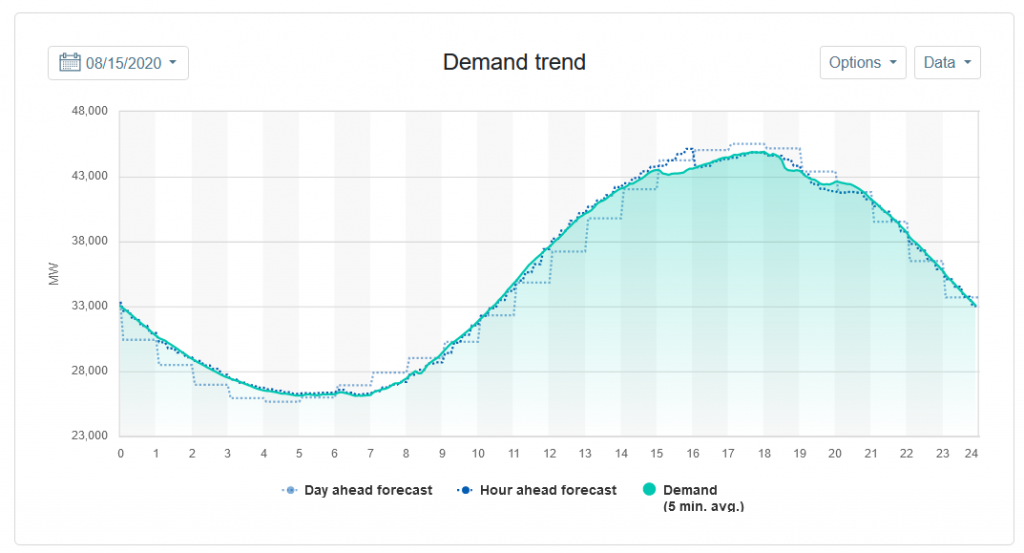
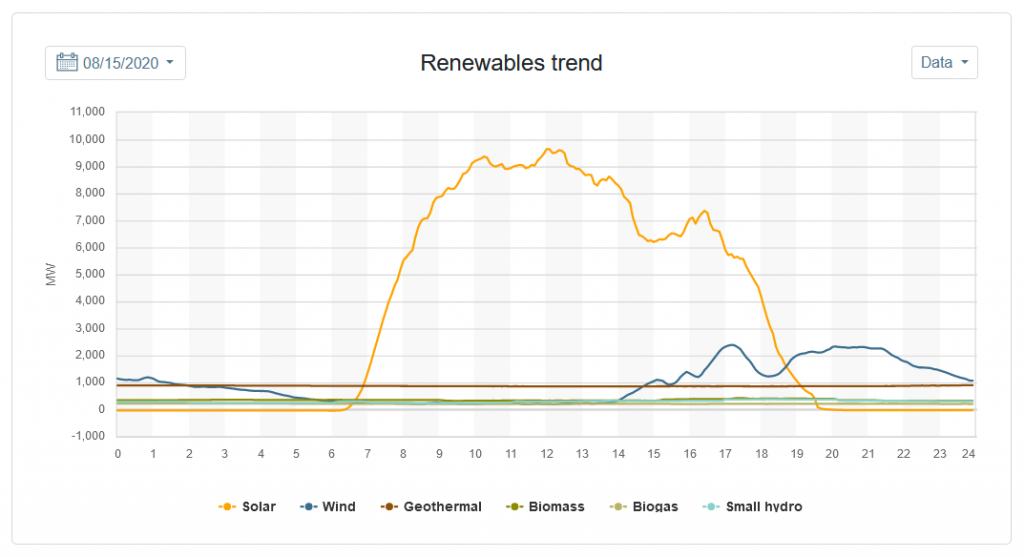
The grid’s capacity was indeed tested in the following days. It’s not clear why the California Independent System Operator (CAISO for short) didn’t issue a call for a voluntary “Flex Alert” on August 15th, but the ultimate consequence was some power cuts. Here’s CAISO’s record of electricity demand and renewable generation that day:

Continue reading →

Masdar invests in UK’s Charging Infrastructure Investment Fund

In a press release yesterday Masdar announced that:

Masdar, one of the world’s leading sustainability investors and renewable energy developers, has today joined UK government leaders in London for a specialised industry event to discuss its recent investment in the Charging Infrastructure Investment Fund (CIIF).

Hosted by the Infrastructure and Projects Authority (IPA) at the Foreign and Commonwealth Office in Whitehall, participants included Simon Clarke, Exchequer Secretary to HM Treasury, Khaled Al Qubaisi, CEO of Aerospace, Renewables & ICT for Mubadala, HE Mansoor Abulhool, UAE Ambassador to the UK, Mohamed Jameel Al Ramahi, CEO of Masdar, Matthew Vickerstaff, Deputy CEO of IPA, and Samer Salty, Managing Partner of Zouk Capital.

Masdar, a subsidiary of Mubadala Investment Company, last month became the first commercial investor in the UK government’s £400 million CIIF, which aims to more than double the country’s electric vehicle charging infrastructure with 3,000 new rapid charge points by 2024 as part of its ambition to end the sale of petrol and diesel vehicles by 2040.

To be managed by Zouk Capital, Masdar has invested £35 million in the fund, which has been matched by the UK government.

UK-CIIF-group

HM Government also published a transcript of the speech made by Simon Clarke, the Exchequer Secretary to the Treasury, at the Foreign and Commonwealth Office yesterday:

In November of last year, I was one of 50 Tory MPs who wrote to the Prime Minister and urged her to set a target of net-zero emissions by 2050.

We felt then as we do now – that that we could decarbonise through science, not economic sacrifice…

…That our method would not be hair-shirted self-denial, but innovation and investment driven by the right incentives.

Our past should give us confidence.

This country’s ingenuity has kept the UK at the forefront of science and engineering for hundreds of years.

And, provided we keep our ambitions high, we will lead the world for hundreds more.

And the goal of net zero emissions will inspire us all to great heights of achievement.

Entrepreneurs will see opportunities in new industries, and create jobs all around the UK.

And the new technologies they create will clean the air we breathe, and cut the bills in our homes.

In June this year, the government became the first major economy in the world to adopt the Net Zero 2050 target, which is fantastic news.

I was made a minister a month later and – while this is possibly slightly less momentous – I can assure you all I will do everything I can to make sure the government keeps its promise.

By way of Her Majesty’s Government keeping its Net Zero promises, Mr. Clarke went on to say that:

The Charging Infrastructure Investment Fund is in many ways emblematic of our approach to Net Zero.

Our philosophy isn’t that government can solve everything.

Of course, we have an important role to play – but we have to do it in partnership with the energy and expertise of the private sector.

Our approach is therefore to set up the right incentives and conditions, and then allow a powerful green market to flourish.

In this case, we wanted to encourage more people to buy and use electric vehicles, or EVs, which are far less polluting than traditional cars.

We set up grants for cars, taxis, vans and motorcycles.

But we realised that people looking at buying EVs were wary of getting marooned, without any battery in their car left and miles away from home or the nearest charging point.

And handouts wouldn’t cut it – we needed to unleash the power of the market.

So, with Zouk Capital, we set up the Charging Infrastructure Investment Fund as a catalyst, with government money matching any private capital that comes in to maximise impact.

And we were delighted that Masdar chose to invest £35 million in the fund – which the government topped up to £70 million – for the installation of 3,000 rapid chargers across the country.

This more than doubles the UK’s number of rapid chargers, producing a dense network of stopping points where family cars can be charged in 20 minutes flat – the time it takes for a sandwich and a coffee on the way to the seaside.

And, further, it shows Masdar’s continued participation in the UK’s clean energy commitments.

Masdar has invested more than £3 billion in the UK in the past ten years, predominantly in offshore wind.

It’s a pleasure to welcome Mohamed Al Ramahi here today for the signing ceremony and to talk more about how we can work together.

Here’s hoping that Zouk Capital, HM Government and/or Masdar also decide to invest in vehicle-to-grid capable “destination” charging points in the not too distant future. If the UK is aiming for “Net Zero” carbon emissions in the foreseeable future one way or another UK plc needs to back up offshore wind and other renewable energy generation with some form of storage of that energy for those times when the wind doesn’t blow and the sun doesn’t shine. Electric vehicle battery packs can provide a very cost effective way of achieving that end, assuming that the appropriate infrastructure is already in place.

A problem we are already working hard on solving down here in the Wild and Windy West Country!

3 MW xStorage Now Live at the Johan Cruijff ArenA

We covered the start of this story, and are now pleased to be able to report that the xStorage Buildings electricity storage system at the Johan Cruijff ArenA, home of Ajax Amsterdam, is now live. According to this morning’s press release:

Today the largest European energy storage system using second-life and new electric vehicle batteries in a commercial building was made live. Amsterdam Alderman Udo Kock, deputy mayor for Finance and Economic Affairs (Amsterdam) conducted the official opening ceremony.

This unique project is the result of collaboration between Nissan, Eaton, BAM, The Mobility House and the Johan Cruijff ArenA, supported by the Amsterdam Climate and Energy Fund (AKEF) and Interreg.

The 3 megawatt storage system provides a more reliable and efficient energy supply and usage for the stadium, its visitors, neighbors and the Dutch energy grid. Combining Eaton power conversion units and the equivalent of 148 Nissan LEAF batteries, the energy storage system not only enables a more sustainable energy system, it also creates a circular economy for electric vehicle batteries.

Europe’s largest energy storage system is now live at the the Johan Cruijff Arena

Europe’s largest energy storage system is now live at the the Johan Cruijff Arena

According to Henk van Raan, director of innovation at the Johan Cruijff ArenA:

Thanks to this energy storage system, the stadium will be able to use its own sustainable energy more intelligently and, as Amsterdam Energy ArenA BV, it can trade in the batteries’ available storage capacity.

The ArenA is assured of a considerable amount of power, even during an outage. As a result, the stadium will contribute to a stable Dutch energy grid. The Johan Cruijff ArenA is one of the most sustainable stadiums in the world and leads the way in introducing smart innovations like this unique energy storage system.

The press release continues:

The energy storage system plays an important role in balancing supply and demand of energy in the Johan Cruijff ArenA. The storage system has a total capacity of 3 megawatt, enough to power several thousand households. This capacity also means that the energy produced by the 4,200 solar panels on the roof of the ArenA can also be stored and used optimally. The energy storage system will provide back-up power, reducing the use of diesel generators, and provide relief to the energy grid by flattening the peaks that occur during concerts.

Finally, for the moment at least, here’s a video of the Ajax Amsterdam ArenA and it’s new static distributed energy storage system in action:

Energy Island and Other Ways to Store Energy with Water

The latest issue of the IEEE’s Spectrum magazine contains a most interesting article:

“4 New Ways to Store Renewable Energy With Water”

The introduction outlines the problem:

In the United States, 97 percent of utility-scale storage in 2014 was in pumped-storage hydroelectric plants, according to research by Oak Ridge National Laboratory, in Tennessee.

In traditional pumped hydro, a dam separates a lower reservoir from an upper reservoir. When a utility company needs to store energy, the system pumps water from the bottom to the top. It generates electricity when water flows back down through a turbine. In 2015, Citibank estimated that the cost of power from pumped hydroelectric was about 5 percent of the cost of grid-scale battery-stored electricity. The problem is that there are many places that consume high amounts of power but don’t have geological opportunities to build conventional pumped-storage plants.

Now here at V2G UK we’re obviously of the opinion that the Li-ion batteries of a future electrified transport fleet are going to provide a lot of distributed energy storage. Alternative forms of energy storage are going to be needed too though, and the lower the cost of such storage the better! The IEEE goes on to consider four novel storage technologies that utilise water. A commodity of which we have plentiful supplies in and around the South West peninsula!

In a variation of the concept of a tidal lagoon being proposed over the Bristol Channel in Swansea is DNV’s “Energy Island“. Instead of relying on tides to fill the lagoon,:

For now, this energy island is only in the concept stage. DNV GL, based in Norway, is running a business case analysis with partners in the Netherlands and discussing plans to build a large-scale system.

In DNV GL’s energy island concept, a dike encloses a 10- by 6-kilometer section of the North Sea off the Dutch coast. To store electricity, the system pumps interior water up and out to sea. Letting water flow through a turbine on its way back generates electricity.

Unlike with traditional pumped storage, the inner lake can be built out in the sea as long as the seafloor has a sufficiently large layer of clay to prevent the ocean from seeping back in. There would also be some trade-off between more energy storage gained from a deeper ocean and increased construction cost.

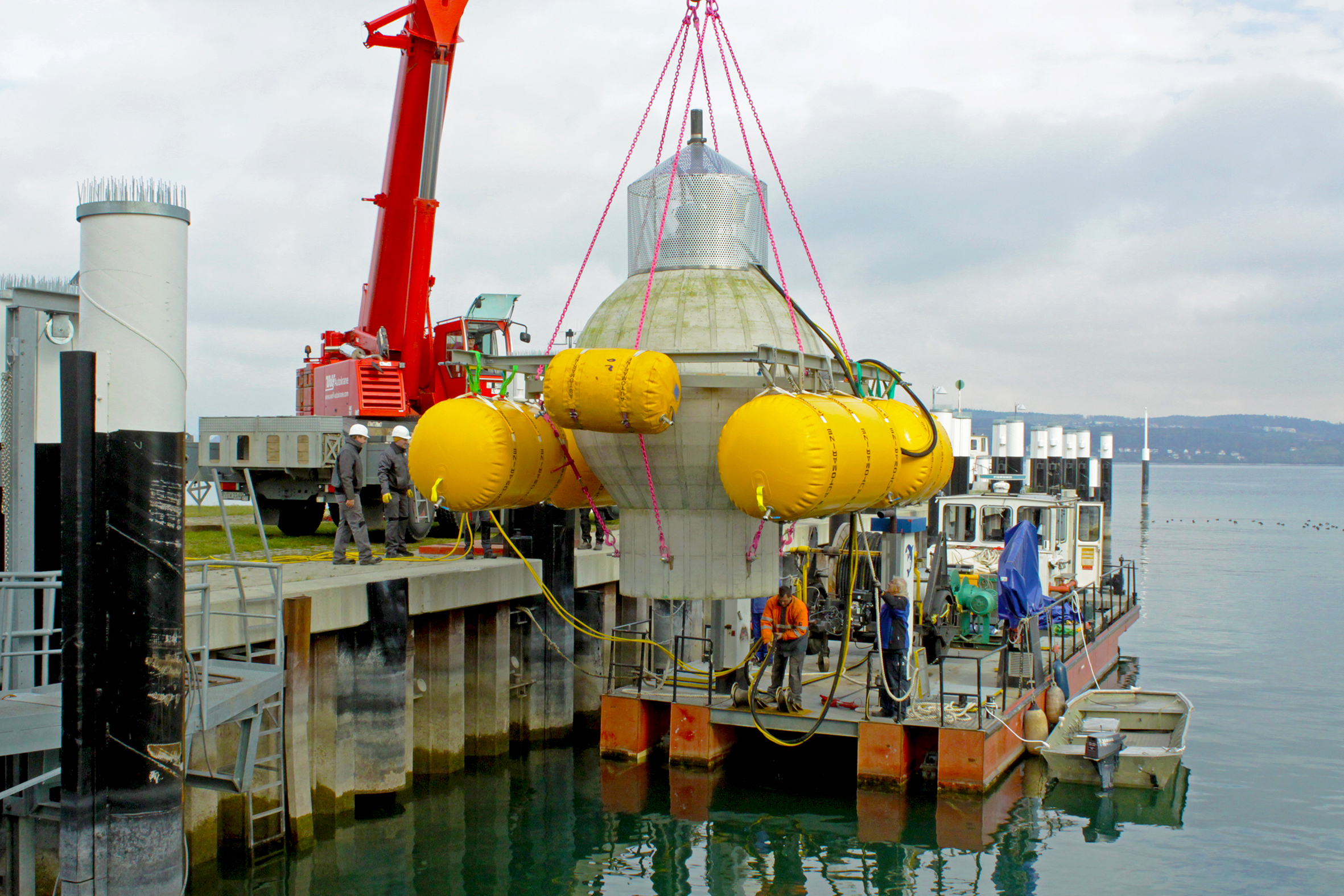
Next an energy storage system that is undergoing trials – Stored Energy in the Sea (StEnSEA for short), which:

Is a hollow concrete sphere with a built-in pump turbine. It sits on the seafloor and, in its discharged state, is filled with water. To store energy, the system uses electricity to pump water out into the sea. When discharging, the pump works in reverse, generating electricity as water refills the sphere.

In November, Fraunhofer IWES installed a 3-meter-wide pilot sphere in southern Germany’s Lake Konstanz at a depth of around 100 meters. Following a year-long feasibility study, the team is now developing the concept for a 5-megawatt, 20-megawatt-hour full-scale system.

Next up is Canadian startup Hydrostor which aims to store compressed air in bags underwater:

Hydrostor’s system consists of weighted-down balloon like bags that are placed underwater and connected to a system on the shore. To store energy, it uses electricity to compress the air and fill the underwater bags. (A heat exchanger and underwater bath capture heat lost during compression to help preserve efficiency.) When electricity is needed, the air flows back out of the bag into a machine that expands it to drive a turbine. [See “Stashing Energy in Underwater Bags,” IEEE Spectrum, August 2014.]

Hydrostor commissioned a 660-kilowatt pilot plant with undisclosed storage capacity in November 2015 at Toronto Island, and the company is currently optimizing the performance. It could be followed by a 1-MW, 6-MWh storage system in Aruba later this year.

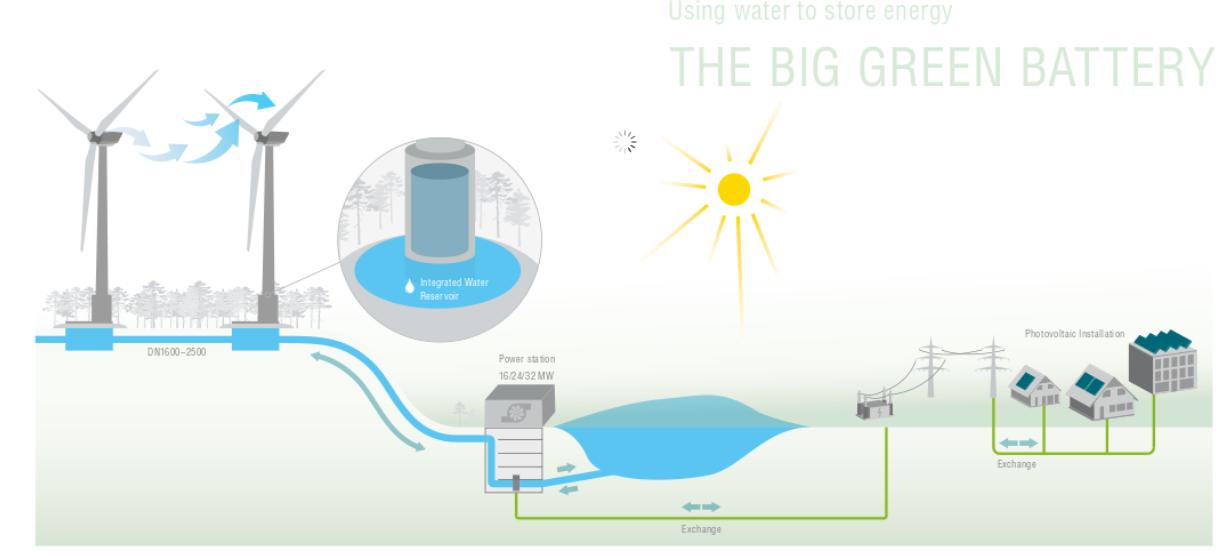
Finally there is the combination of a wind farm with built-in pumped hydro storage from Naturspeicher:

Wind turbines are built on the top of a hill with a pair of water storage reservoirs at their bases that raise them by an extra 40 meters above a typical turbine. A man-made lake sits at the bottom of the hill; energy is stored when the water is pumped up into the reservoirs, and electricity is produced when the water falls back down to the lake.

Naturspeicher plans to have a wind farm on line by the end of 2017 in the hills of the Swabian-Franconian Forest, in Germany, with pumped storage following by late 2018. It expects the system, when completed, to store 70 MWh and deliver up to 16 MW.

I wonder if any of these “low cost” energy storage systems will find their way over to South West England at some point in the not too distant future?

Nissan Unveil Solar PV Integrated Static xStorage for UK

In two separate press releases there have been two interesting announcements from Nissan on the ex EV battery storage front. In the first there’s a football connection!

Nissan, power management leader Eaton and The Mobility House today signed a ground-breaking 10-year deal with Amsterdam ArenA – home of Ajax Football Club and world-famous entertainment venue – to provide back-up power from second life Nissan LEAF batteries.

The xStorage Buildings system efficiently stores and distributes energy when it’s needed, ensuring that the lights never go out at the renowned 55,000-seater stadium, which has played host to numerous high profile concerts and sporting events over the years.

By repurposing batteries from previously used electric vehicles, the xStorage Buildings system can draw energy from the grid, providing businesses with more control, better value and a more sustainable choice for their energy consumption.

Using 280 Nissan LEAF batteries, the system designed for the Amsterdam ArenA will be the largest energy storage system powered by second-life batteries used by a commercial business in Europe and will have four Megawatts of power and four Megawatts (sic) of storage capacity.

As well as providing vital back-up power services to the ArenA, xStorage Buildings also enables the Amsterdam ArenA to power the surrounding neighbourhood when necessary and protect the grid.

We’ll excuse Nissan PR the misprint because they’ve provided this nice video accompaniment to their announcement, which doesn’t make the same mistake:

In the second announcement it is revealed that:

Nissan and power management leader Eaton are broadening their portfolio of xStorage Home residential energy storage solutions by introducing a range of six product configurations, giving consumers greater choice to meet their energy needs. This announcement comes as pre-orders of xStorage Home begin today in the United Kingdom, Norway and Germany with other European markets to follow in the coming months.

The xStorage Home system can draw energy from the sun or from the grid, making energy consumption more affordable and encouraging home-owners to make a more sustainable choice. The cutting-edge technology in the xStorage Home system is also fit for the future, and can enable customers to sell energy back to the grid – an opportunity that is expected to be offered by energy companies in the future.

The system gives consumers greater control over how and when they use energy in their own homes enabling them to avoid expensive tariff periods. The expanded range will offer consumers greater choice over power capacity and price as well as units. Consumers can opt to purchase units powered by either second life batteries or new batteries.
xStorage Home units – which provide a sustainable second life for Nissan’s electric vehicle (EV) batteries after their first life in cars is over – will be priced competitively starting at €3,500 (excluding VAT and installation costs) for a power capacity of 3.5kW rising to just €3,900 for 6kW. Units powered by new Nissan batteries will start from €5,000 rising to €5,580 for the highest capacity and will come with an extended warranty period of ten years.

Connected to a residential power supply and/or renewable energy sources such as solar panels, the unit has the potential to revolutionise the way people manage energy usage in their own home, providing added flexibility.

xStorage Home comes with solar panel inverters already integrated meaning that if a home is equipped with solar panels, the consumer can connect directly to xStorage Home, storing and then powering their homes using clean, renewable energy. It can also save customers money on their utility bills by charging up when renewable energy is available or cheaper, and releasing that stored energy when demand and costs are high.

The xStorage Home unit also has the capability to provide energy back to the grid in countries where the conditions enable customers to do so. This provides another potential revenue stream as customers will be able to sell stored energy back to the grid when demand and costs are high.

The system also provides the ultimate back-up energy solution to consumers, ideal at a time when energy grids are coming under significant strain. With smartphone connectivity, it allows consumers to switch between energy sources at the touch of a button.

I wonder if Eaton have solved all the Great British G83 issues yet, and whether they will incorporate V2H functionality into their xStorage offering? I also cannot help but wonder how many Great British Pounds that €3,500 will translate to by the time UK deliveries eventually commence?

Nissan Electric Vehicles Prove Popular at UK Universities

In a news release today Nissan UK point out that:

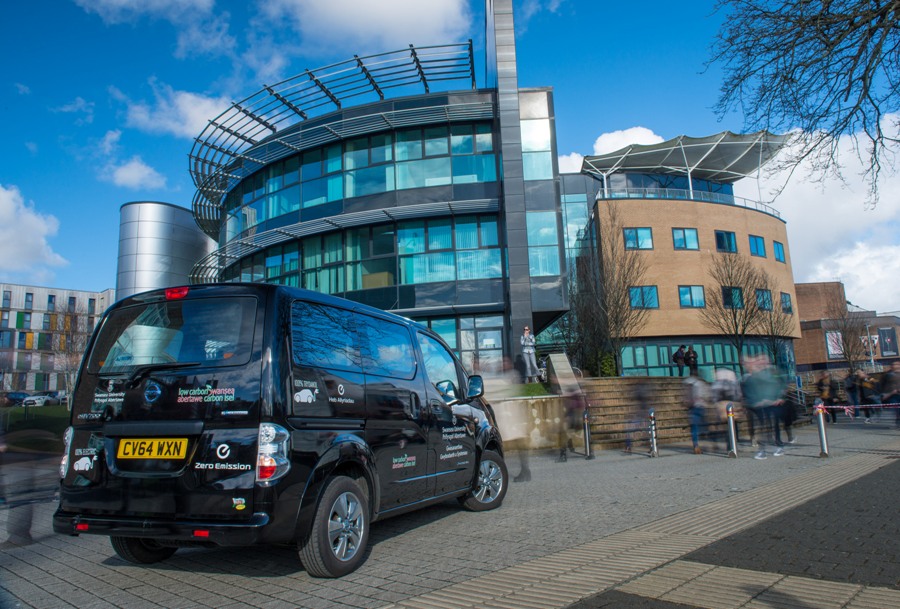
The all-electric Nissan e-NV200 van has graduated with flying colours to become one of the most popular new vehicle choices for university fleets in the UK.

The multi award-winning van, which costs from just two pence per mile to run and offers zero emissions mobility whilst driving, is now in service on the fleets at more than 20 of the nation’s leading academic institutions.

University of Birmingham was the first fleet operator in the country to take delivery of the model when it added two to its fleet in 2014.

Since then, the University has added four more and the e-NV200 has moved to the top of the of the list for universities and colleges the length and breadth of the UK.

e-NV200s are now in service at universities including Bath, Brighton, Coventry, Dundee, Edinburgh, Exeter, Leicester, Leeds, Manchester, Manchester Metropolitan, Newcastle, Oxford, Sheffield, St Andrews, Swansea, the University of Central Lancashire and the University of Wales.

In addition, a number of other universities across the UK are currently trialling the e-NV200 as they explore the environmental and financial benefits it could have for their fleets.

Many moons ago I lived in Mayals and I’ve studied at Swansea University:

Nissan point out that in Swansea:

The e-NV200 Combi has been introduced as part of a broader commitment to sustainability and is operated as a pool vehicle, available on a booking system, by the information services and systems team.

As part of a seven-strong EV fleet, which also includes four Nissan LEAFs, the e-NV200 has proved a popular choice thanks to its size, flexibility and car-like driving dynamics.

Nigel Morris from the information services and systems team at Swansea University said:
 “Our EV fleet has already been a big success, cutting our carbon emissions by 4.5 metric tons and saving around several thousand pounds in fuel so far.

“The e-NV200 has made a terrific contribution to those figures as it’s proved so popular with staff. It’s a big vehicle that’s got lots of space for cargo or people but it’s very easy to drive.”

This news is all very encouraging of course, but I cannot help but wonder about something Nissan didn’t reveal to us this morning. Which of their long list of UK universities might actively be researching the application of vehicle-to-building or even fully fledged vehicle-to grid technology?

Perhaps the answer is “none of them”, but I am able to reveal that a UK University not mentioned by Nissan is in fact already so doing. Here’s an exterior view of the European Bioenergy Research Institute (EBRI for short) at Aston University:

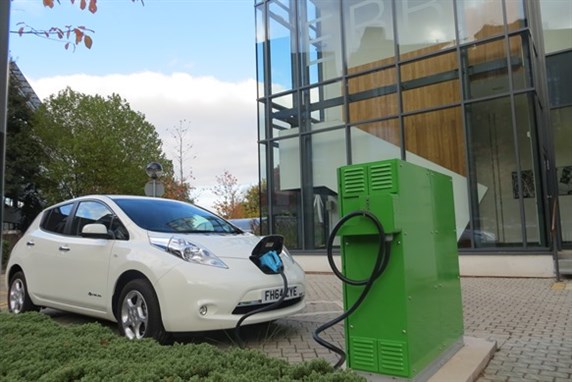
and here’s what EBRI’s press release from a month or more ago has to say about the bright green box attached to the 24 kWh battery equipped 2014 model year Nissan LEAF pictured above:

Aston University has successfully commissioned the UK’s first permanent electric vehicle to grid (V2G) charging system.

This next generation of electric vehicle charging infrastructure allows power to flow both in the traditional way (grid to vehicle) and in reverse (vehicle to grid). The technology, developed in Japan to improve electricity supply reliability in the wake of the Fukushima disaster, is being investigated in collaboration with our leading industry partners, as a new method for energy storage and grid balancing services in Europe.

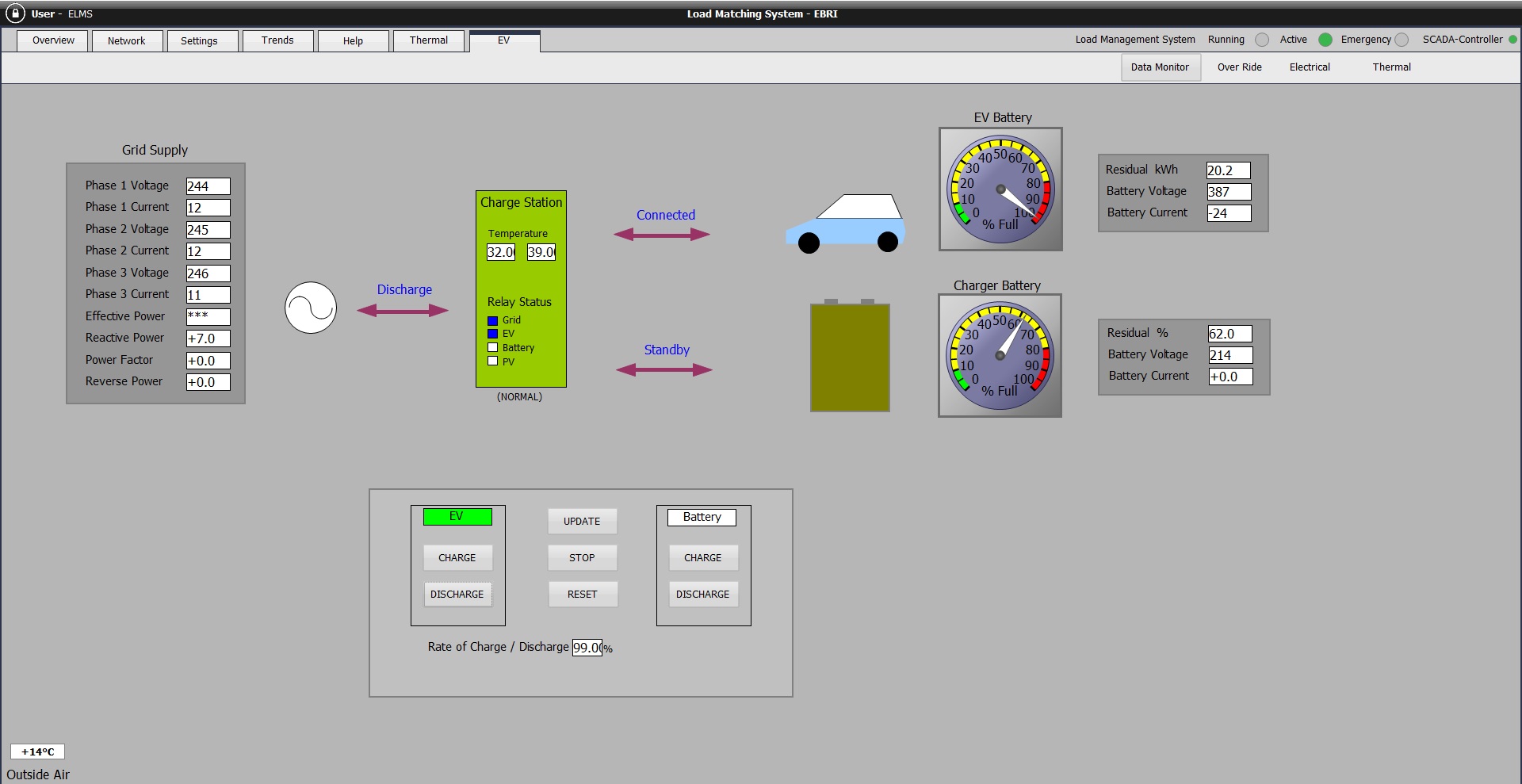
Please do read the press release in it’s entirety, and when you’ve done that also take a good look at the user interface of EBRI’s “load matching system”:

Exciting times for V2G enthusiasts here in the United Kingdom! Now that this pilot project is up and running there’s a few more urgent things to be ticked off on the to do list. How about OCPP 2.0 or even fully fledged British and international standards for “smart charging”, V2B and ultimately pukka V2G protocols for starters?

Here’s how the Open Charge Alliance explain the need for “Open Standards”:

The specification for version 2.0 of the Open Charge Point Protocol still seems to be absent from their web site however!

UK Parliament Debates Energy Storage

It’s all go on the energy storage front in the UK. Yesterday not only was V2G mentioned in the mainstream media but it was also debated by a committee in the House of Commons. The summary of the Energy Bill [Lords] 2015-16 states that it is:

A Bill to make provision about the Oil and Gas Authority and its functions; to make provision about fees in respect of activities relating to oil, gas, carbon dioxide and pipelines; to make provision about wind power; and for connected purposes.

I presume energy storage must count as a “connected purpose”, since the proposed New Clause 14 which was under discussion yesterday, reads as follows:

Electricity storage

(1) Section 4 of the electricity Act 1989 is amended as follows.

(2) After subsection (1)(c) insert—

“(d) stores electricity for the purpose of giving a supply to any premises or enabling a supply to be so given,”

(3) At end of subsection (4) insert—

““Store” means the conversion of electricity into a form of energy which can be stored, the storing of the energy which has been so converted and the reconversion of the stored energy into electrical energy in devices with an individual capacity of more than 50MW.”

(4) Section 6 of the electricity Act 1989 is amended as follows.

(5) After subsection (1)(d) insert—

“(e) a licence authorising a person to store electricity for the purpose of giving a supply to any premises or enabling a supply to be so given (‘a storage licence’);”

(6) After subsection (2) insert—

“(2ZA) In addition to holding a storage licence, the same person may be a holder of—

(a) a distribution licence,

(b) a transmission licence, or

(c) a generation licence.

(2ZB) The Secretary of State may by order determine the circumstances under which a person may hold a storage licence in addition to a distribution licence, a transmission licence or a generation licence under subsection (2ZA).

Events in The House were recorded for posterity, and the debate about NC14 can be seen in this video:

In some of the edited highlights Dr. Alan Whitehead, who is Shadow Minister for Energy and Climate Change, pointed out that:

A number of the issues we have discussed in the Committee—intermittency of wind, base-load problems and a whole range of other issues—can begin to be addressed by battery storage of electricity.

For example, if a battery storage system is attached to a solar array, the life of that solar array can be extended far beyond the period during the day when the sun shines. Clearly, the power that comes from it can go right through the night. We are already seeing that effect, to a minor extent, with solar arrays on streetlights, but on a much larger scale it could revolutionise the way in which solar is used in future.

Battery storage can also be used in relation to wind. We have heard that wind, quite self-evidently, does not always blow, and sometimes when it does blow, it blows rather a lot. Ensuring that the capturing of that variability is smoothed out into a regular supply through the attachment of battery storage to the wind turbine is clearly a positive step forward as far as wind supply is concerned.

However Andrea Leadsom, who is The Minister of State at the Department of Energy and Climate Change ultimately responded by saying:

On this last new clause, I am as keen as mustard on electricity storage; it has a vital contribution to make to dealing with intermittency and I wish we were five years ahead—it will be interesting to see how much we have managed to achieve in creating this new ability to store intermittent generation.

New clause 14 would create a new licence category for electricity storage operators and allow other licence holders, such as generators and transmission and distribution network operators, to hold an electricity storage licence. The creation of a separate electricity storage licence is an option that is being considered by my Department and one of a number of issues for storage operators to be included in a call for evidence in the spring. This will enable us to test it against other options, which may be less regulatory and burdensome, more targeted and, importantly, faster to implement. So, much as I would love to say, on this very last new clause, that we agree with the hon. Gentleman, the problem is that licensing storage now would be premature. Indeed, the Electricity Storage Network, which is a key trade body for the storage industry, has criticised this new clause on the grounds that it

“pre-empts the current work by the Department” and

“may hinder, rather than help, the progress of well thought-out strategies to support … the storage industry.”

following which Dr. Whitehead withdrew his proposed amendment.

All of which does rather beg the question of what “well thought-out strategies to support the storage industry” here in the United Kingdom will eventually look like, and whether they will accommodate “EV owners”, “Communities” and/or “Aggregators” as well as Distribution Network Operators, Transmission System Operators and electricity generators, whether distributed or centralised.

V2G and Energy Storage are in the News. In the UK!

Spring is in the air here in the United Kingdom. Several of the people I debate the future of distributed energy storage with on a regular basis have been in the news this week!

First up was Mark Thompson of Innovate UK. According to the headline in an article in Utility Week:

EVs are stable energy storage asset, says Innovate UK

The article goes on to explain that:

Innovate UK has brushed aside ongoing fears around using electric and plug-in vehicles as an energy storage facility, insisting they present a “car park of energy storage” for UK network companies after 2025.

Innovate UK’s lead technologist for energy systems Mark Thompson said at a recent storage event that fears that using EV batteries for grid support will rapidly degrade the batteries are unfounded. Innovation projects already undertaken into EV charging reveal the batteries will be accessible to the grid 95 per cent of the time.

Thompson said “a lot of anxiety” around using EVs as energy storage centres on battery recycling, but tests show that using an EV battery to provide 7kW of grid support is equivalent to driving at just 20mph.

Mark went on to point out:

That is a modest amount of power but aggregated would be very useful for a distribution network operator. The stress level on that battery of sitting there continually pushing out 7kW compared to a 35 minute journey is a no-brainer, it’s an extremely calm and un-stressful environment for that vehicle. Car manufacturer Nissan has been very vocal on the potential benefits of using EVs for grid support because there really isn’t an issue compared to the complexities and stresses that the battery goes through for a pretty normal driving scenario.

If we can be clever and come up with the right business models to engage people in moving their charging and allow network operators to have some control, if we can be savvy about that then network investment costs are virtually zero until you are well into the 2020s

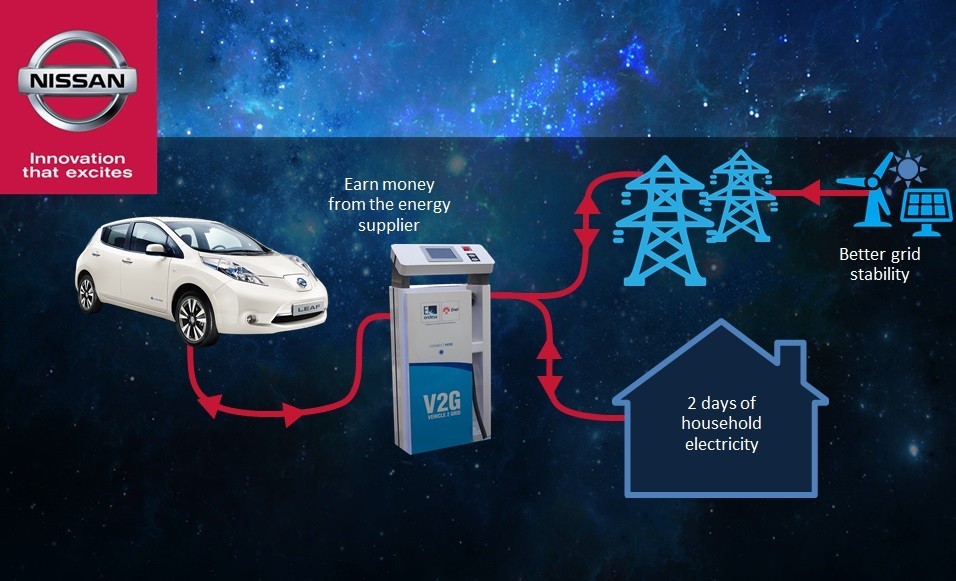
Here’s one of Nissan’s infographics showing how they see the technology working:

UK Plc “being savvy” and providing support for the “right business models” is another matter entirely however! Utility Week continued:

Projects such as My Electric Avenue have revealed that vehicles are sat stationary at either the home or workplace, both potential charging locations, 95 percent of the time making EVs a “stable storage asset”. Based on “very modest projections” there could be as many as 300,000 EV or hybrid vehicles on UK roads by 2025, presenting around 4GW of potential storage to the UK’s electricity system with very little network reinforcement required.

Having discussed the Utility Week article with Mark Thompson it seems they have misinterpreted a couple of points:

I didn’t wish to imply that cars would be 95% available, just that they are “parked for 95% of the time” but that data DNO projects such as My Electric Avenue and ETI analysis indicate that a “very healthy proportion” of plugins will be accessible over the 24 hour cycle for grid support given charging and use patterns. The 95% figure as currently illustrated is not of course realistic, but perhaps eventually grid “connected availability” may be in the region of 30-60% depending on the time of day, which in time will amount to a significant amount of grid connected resource.

Also, the 4GW figure should be 4GWh.

Here’s the original slide from Mark’s presentation, with the correct units clearly visible on the Y axis and in big letters towards the end of the headline:

Today the mainstream media picked up the story in the form of an article by Damian Carrington in The Guardian entitled “From liquid air to supercapacitors, energy storage is finally poised for a breakthrough”. Damian opens with a quote from Jill Cainey, director of the UK’s Electricity Storage Network.

It doesn’t always rain when you need water, so we have reservoirs – but we don’t have the same system for electricity.

A battery project can take 12-18 months from saying we will do it, to completion. California is aggressively pursuing a low-carbon agenda and they don’t want diesel [generator back-up] on the system. Amber Rudd is talking a lot about energy storage, but we need a clear regulatory steer. The planes are circling, but there is no runway to land on.

Next Mark Thompson is quoted once again, apparently from the Utility Week article rather than from his actual presentation:

Using electric car batteries as a smart storage network while still in the cars is a promising option in the future, according to Mark Thompson at Innovate UK, a government agency. He says there could be 4GW capacity – a nuclear power station is about 1GW – by 2025 across the 300,000 electric cars projected to be on UK roads by then. He says cars are stationary for 95% of the time and using them could save billions of pounds, removing the need for new power stations and power lines.

However the article continues:

While interest in energy storage projects in the UK is surging – a recent call from National Grid for 200MW of short-term storage was oversubscribed six times – it is starting from a low base: just 24MW has been installed compared to the 5,000MW the government’s official advisers, the Committee on Climate Change, envisages in a low-carbon nation in 2030.

In November, energy secretary Amber Rudd said: “Locally generated energy supported by storage, interconnection and demand response, offers the possibility of a radically different model… We are looking at removing regulations that are holding back smart solutions, such as demand side response and storage.”

Removing the regulations that are holding back smart solutions is one of the reasons Mark and Jill were already on my list of people to call this week. That’s because DECC’s current consultation about how to “Ensure Regulation in the Energy Sector Encourages Innovation” closes on February 11th!

Four Cities Awarded £40 million “Go Ultra Low” Funding

The United Kingdom’s Department for Transport has just announced that:

Nottingham, Bristol, Milton Keynes and London named as winners of multi-million fund to encourage drivers to go green.

Four cities have been awarded significant funds today (25 January 2016) to promote green vehicle technology after successfully bidding for a share of a multi-million pot created to support the take-up of plug-in electric cars across the United Kingdom”.

Here’s the video version of the announcement:

Transport Secretary Patrick McLoughlin said:

  • These Go Ultra Low Cities have proposed exciting, innovative ideas that will encourage drivers to choose an electric car. I want to see thousands more greener vehicles on our roads and I am proud to back this ambition with £40 million to help the UK become international pioneers of emission cutting technology.
  • The UK is a world leader in the uptake of low emission vehicles and our long-term economic plan is investing £600 million by 2020 to improve air quality, create jobs and achieve our goal of every new car and van in theUK being ultra-low emission by 2040.

Third in the list of winners is Bristol, just up the M5 motorway from us here in Exeter, who were actually bidding under the banner of the “West of England”. According to this morning’s announcement:

Bristol get £7 million to offer residents free residential parking for ULEVs, access to 3 carpool lanes in the city, over 80 rapid and fast chargers across the city and a scheme encouraging people to lease a plug-in car for up to 4 weeks to help them better understand the range of benefits that electric vehicles bring.

There’s no mention anywhere in OLEV’s announcement about vehicle-to-grid or distributed storage however. Perhaps that sort of thing is still not on UK plc’s shopping list?