At the beginning of June I attended the “Utrecht Energized” extravaganza at the Jaarbeurs Convention Centre in the heart of Utrecht in the Netherlands. According to Renault’s press release about the event:
Renault Group, MyWheels and We Drive Solar, together with the Municipality of Utrecht, announce the go-live of Europe’s first large‑scale Vehicle‑to‑Grid (V2G) car‑sharing service: Utrecht energized. The initiative supports a more sustainable, efficient energy system in a city where 35 % of rooftops are already fitted with solar panels. Thanks to the V2G technology, electric vehicles can store energy and feed it back to the local grid during peak periods, so renewable power remains available around the clock. By combining a shared‑mobility service with advanced technology, the project keeps the local grid in balance while accelerating the transition to sustainable urban transport.
Here’s Renault Nederland’s brief promotional video:
More about all that in due course, but first of all please note these paragraphs from the press release:
In response to the massive growth of renewable energy in the Netherlands, Renault Group, We Drive Solar, MyWheels and the City of Utrecht have joined forces to launch Europe’s first large-scale car-sharing service utilizing Vehicle-to-Grid (V2G) technology.
Renault Group will supply 500 Renault 5 E-Tech electric equipped with Mobilize’s V2G technology.
We Drive Solar will provide and operate bidirectional charging stations.
MyWheels, the leading car-sharing platform in the Netherlands, will operate the fleet.
Utrecht is taking a bold step towards more sustainable mobility with this groundbreaking collaboration. This initiative aims to facilitate the large-scale availability of electric shared mobility while offering an innovative way to balance the city’s electric grid through bi-directional charging technology. The Netherlands has become a world leader in the roll-out of solar and wind energy, causing challenges on the electricity grid. Utrecht is one of the most advanced European cities in using renewable energy, with already 35% of all rooftops covered with solar panels.
The press release is in Dutch, so I’m relying on Google Translate somewhat for this article! There is no explicit mention of V2x technology, but let’s read between the lines:
Hyundai and mobility provider We Drive Solar announced on April 13th a strategic partnership to provide housing projects with the energy system of the future.
I don’t know about you, but I’m getting a hint of vehicle-to-building already. Moving on:
Hyundai is well on its way to becoming a top 3 manufacturer of zero-emission vehicles worldwide, with a specific focus on 100% electric propulsion. By 2040, Hyundai aims to have its global car line-up fully electrified, aiming for a market share of 8 to 10 percent of the global EV market.
In addition to a leading role in electric driving, Hyundai also wants to accelerate the transition to sustainable mobility and optimally unburden customers with the help of innovative services, fully in line with the brand’s Progress for Humanity philosophy. In that context, Hyundai is expanding its e-mobility activities in the Netherlands significantly this year. Hyundai recently announced its partnership with Jedlix, the market leader in smart charging. Starting today, Hyundai is adding a new chapter in accelerating sustainable mobility by announcing its partnership with We Drive Solar.
Smart charging, sometimes referred to as V1G, is part of the equation but what about smart discharging? The press release continues:
Groupe Renault, the European leader in electric vehicles, is beginning the first large-scale pilot schemes in reversible electric charging. Our alternating-current technology has the particularity of placing the reversible charger inside vehicles, so it just requires a simple, inexpensive adaptation of the existing charging terminals.
A fleet of fifteen Zoe vehicles with vehicle-to-grid charging will be introduced in Europe over the course of 2019 to develop our future offerings in reversible charging and lay the groundwork for the future standards —with our partners’ help. These pilot schemes will begin today in Utrecht (the Netherlands) in an ecosystem developed by We Drive Solar and on Porto Santo Island (in the archipelago of Madeira, Portugal) with Empresa de Electricidade da Madeira, an energy supplier. Following these, more pilot schemes will be introduced in France, Germany, Switzerland, Sweden and Denmark.
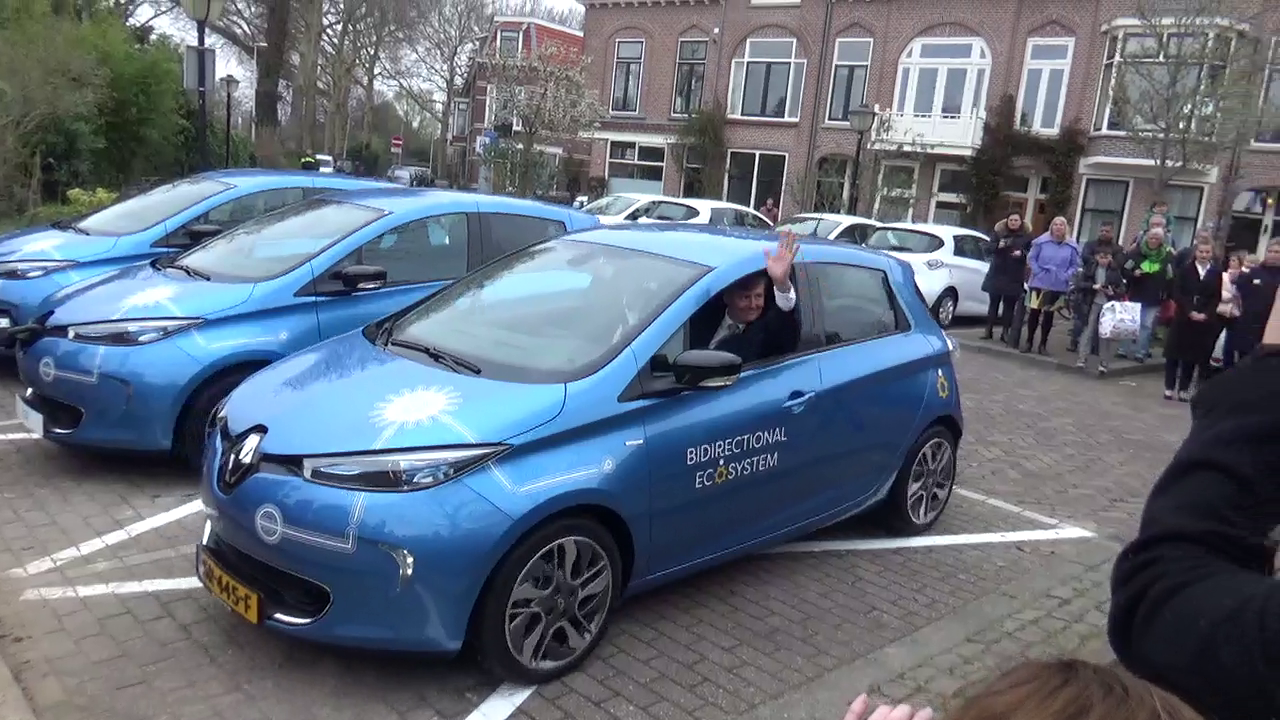
It looks like we’ll have to (metaphorically of course) twist someone’s arm at Renault to let us try one or more of their modified Zoes with AC V2G capability! I was at the launch in Utrecht today and spoke to a variety of representatives from Renault Netherlands and Renault France, who by and large seemed amenable to the idea of a suitably funded UK pilot project. Renault’s press release was of course accompanied by a variety of images. However I took lots of pictures of my own, and a fair few videos too. Here’s the three Zoes that were lined up in Utrecht today:
and here’s King Willem-Alexander of the Netherlands driving away in one of them, accompanied by Robin Berg of We Drive Solar:
Here too is a video recording of some of the excellent entertainment at the event, provided by the Hillsback Brassband:
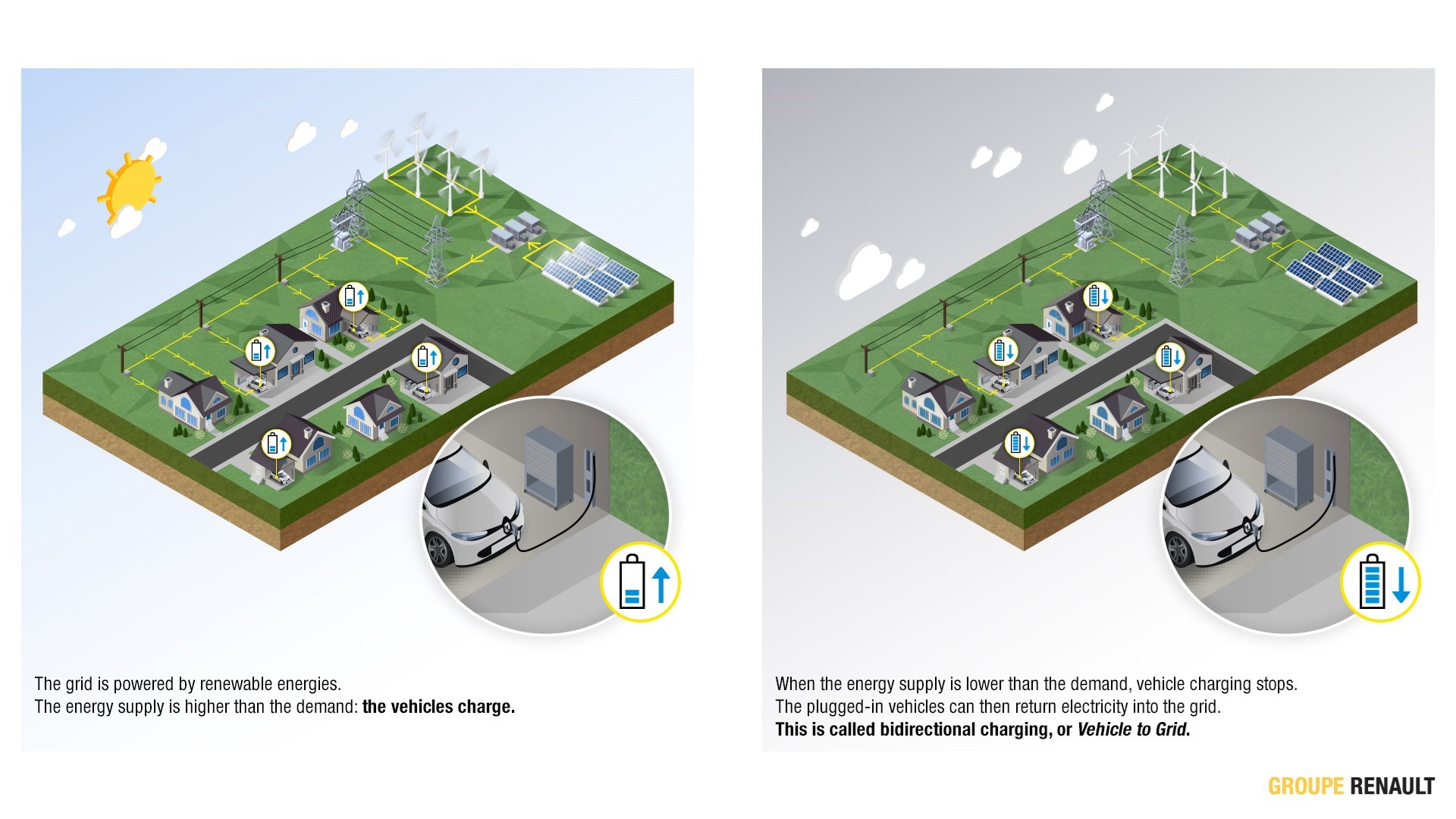
Invigorated by the brilliant brass section here’s one of the press release infographics that I couldn’t snap for myself. Renault’s visualisation of vehicle-to-grid technology in action:
2019 – Recharge bidirectionnelle
Charging during the day on the left. Discharging during the night on the right. Much like our very own V2G UK banner above! Renault’s press release continues:
Vehicle-to-grid charging — also called reversible charging — modulates the charging and discharging of electric-vehicle batteries in accordance with users’ needs and the grid’s supply of available electricity. Charging reaches its maximum level when the electricity supply exceeds demand, notably during peaks in production of renewable energy. But vehicles are also capable of injecting electricity into the grid during peaks in consumption. Electric vehicles can therefore serve units of temporary energy storage and become key drivers in the development of renewable energy. In this way, the electricity grid optimizes the supply of local renewable energy and reduces infrastructure costs. At the same time, customers enjoy greener, more economical consumption of electricity and are financially rewarded for serving the electricity grid.
Reversible charging will be piloted in several projects (electric ecosystems or mobility services) through seven countries and alongside various partners to lay the groundwork for Groupe Renault’s future offering. The aim is twofold: to measure large-scale feasibility and potential gains. In particular, these pilot schemes will help us:
Underline the technical and economic advantages of an onboard solution in electric vehicles
Demonstrate—in concrete terms—the value of services provided for the local and national electricity grid, such as encouraging consumption of solar and wind energy, checking the grid’s frequency or tension, and reducing infrastructure costs
Work on the regulatory frameworks of a mobile energy-storage scheme, detecting any pitfalls in it and offering concrete solutions
Establish common standards, the basic requirement for an industrial-scale roll-out.
I now have a few more videos of the event to go away and edit, but whilst those are being prepared here’s one that Renault provided earlier, illustrating both “Smart charging” and “Bidirectional smart charging”:
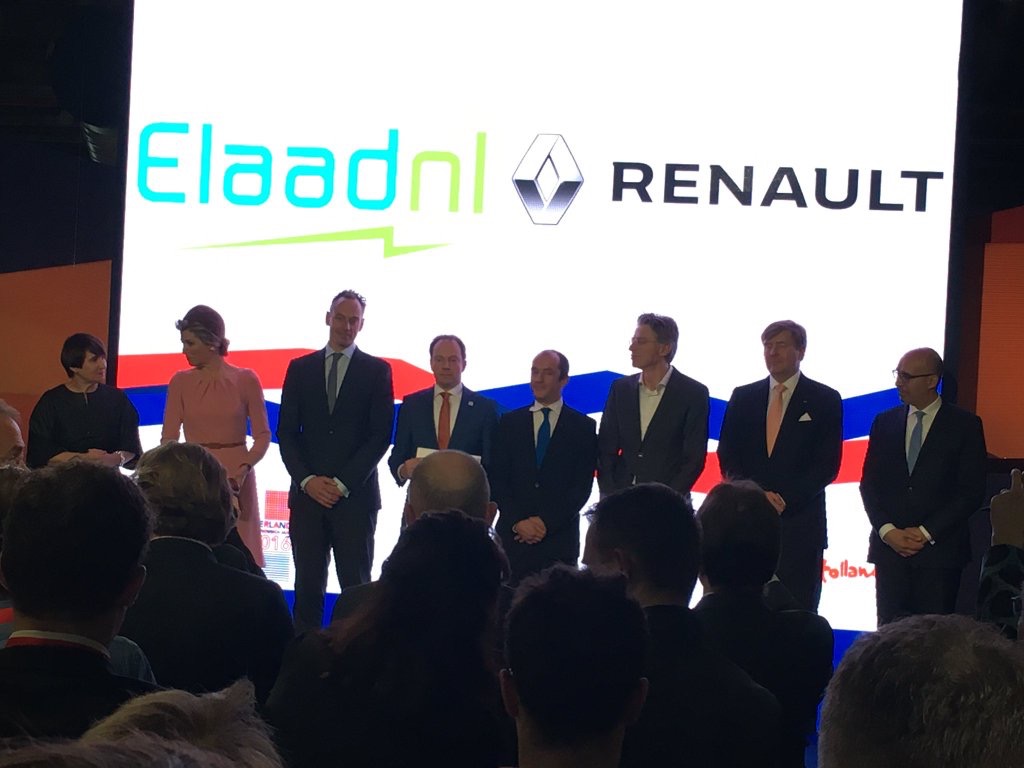
The signature took place during the state visit to Paris of King Willem-Alexander and Queen Máxima of the Netherlands.
According to the letter of intent, the city of Utrecht could be the testing ground for the solar smart-charge project. Renault, Europe’s leader in electric vehicles, would supply a fleet of 150 Renault ZOE models through 2017 to the city. ElaadNL would handle management of infrastructures and the smart-charge standard, and LomboXnet would take charge of installing the network of unique public charging terminals powered by a 44 kW grid connection. Grid operator Stedin would be involved to balance supply and demand of the grid.
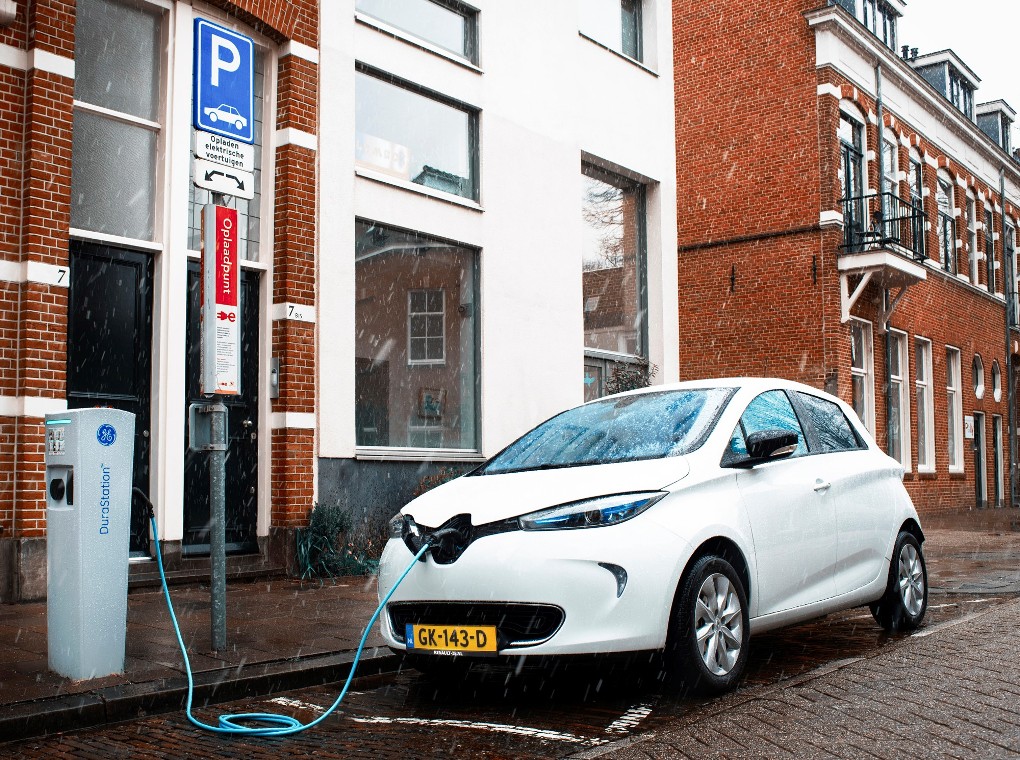
The Royal Family might have left better weather behind during their trip to Paris, but here’s a Renault ZOE charging outside the LomboXnet offices in Utrecht, in the rain:
Moving on to some more technical details of the Utrecht project:
Phase one of the project would involve setting up 1,000 smart solar-charge stations, powered by 10,000 photovoltaic panels in the Utrecht region. Infrastructure installation would run side by side with development of a car-share service of electric cars, powered by renewable energy, for Utrecht residents. The Renault ZOE R.Access connectivity and 22 kW charging make it ideal for car-share and smart charging applications.
So far so good, and then comes phase 2!
Phase two of the project would proceed with the partners developing a vehicle-to-grid ecosystem, with the network of solar chargers capable of both charging the electric cars and of feeding energy stored in the batteries of parked cars onto the grid to meet demand peaks. This could be the starting point for a new system storing renewably sourced energy.
As always at this juncture, one cannot help but wonder where and when the first “vehicle-to-grid ecosystem” will evolve here in the United Kingdom!
I had the pleasure of meeting Robin Berg in Utrecht last summer at the launch of the LomboXnet solar PV powered bi-directional vehicle to grid system. Here is a video of Robin’s recent presentation at TEDx Utrecht:
Robin says many interesting and enlightening things, but for the moment please consider this one:
Tomorrow your car will run electric. The day after it will power your house. It will be 100% renewable, it will be 100% clean, and it will be the end of coal, oil and gas.