My Electric Avenue Preliminary Results Revealed

Just in case the name is unfamiliar to you, the My Electric Avenue project has been running for a couple of years now. According to the My Electric Avenue web site:

Whilst there’s plenty of capacity to deliver power for EV charging across the UK, if the charging requirements are concentrated in small areas and during peak demand, local feeders can become overloaded. With the development of even faster charging times, this problem shows no signs of fading.

The full size and scale of the problem that EV clusters could cause will only become apparent to Distribution Network Operators (DNOs) when they are already on the network, demanding costly mitigation measures in short timescales.

EA Technology and Scottish and Southern Energy Power Distribution (SSEPD) are working together with partners under the Ofgem Low Carbon Networks (LCN) Fund to develop a ready-made low cost solution. EA Technology is developing an EV charge control system to balance out the charging cycles of EVs at times of network stress.

To test the system the trial is simulating a future EV network, and to do this, clusters of EVs have been ‘created’.

If all that information strikes you as being a bit on the dry side, here’s an episode of Robert Llewellyn’s “Fully Charged” show that explains the project in a more entertaining fashion!

I watched a webinar last week in which some preliminary results from the project were released, but EA Technology had a few internet connection problems due to high winds in the North of England, and the feed gave up the ghost halfway through! To rectify that they’ve made a video of the proceedings available to all and sundry, and here it is:

There’s also a page on the My Electric Avenue web site where you can download additional information.

The data referred to in the video is based on the initial results from an ongoing survey. It explains that the approximately 200 participants who each leased a Nissan LEAF were split into two roughly equal groups. The “technical” group used “smart” or “controlled” charging, whilst the “social” group simply had their EV charging activity monitored. There’s obviously much more detail available from the video and accompanying documentation, but in brief:

  • Only ~5% of people disagreed with the proposition that “EVs are easy to live with”, however
  • 117 out of 193 people “struggle to charge away from home”
  • Of those 117, 12% intend to buy their LEAF at the end of the trial and 43% intend to lease it
  • Overall 17% intend to buy their LEAF at the end of the trial and 41% intend to lease it
  • Even after the “controlled” charging trial 80% of people like to charge their car until it is full
  • Of the people on the “technical” trial, 16% disagreed with the proposition that “My electric vehicle charges sufficiently in the time available to charge”

The concluding section of the presentation points out that the sense of “community” was very important to the success of the project, with “local champions” recruiting friends and neighbours into their “cluster” of EVs a vital element of that.

The final report on the My Electric Avenue project is due to be released by De Montfort University towards the end of October 2015. In the meantime if you are in the EV business and you would like to take a quick survey yourself on the topic of “Industry Views on the Impact of Cycling Electric Vehicle Charging” then you can do so over at:

https://www.surveymonkey.com/s/Y5N8TTV

Is Distributed Energy Storage on Ofgem’s Roadmap?

In the first of my reports from the Regen SW “Community Energy Markets” conference in Bristol last Thursday I’ll be highlighting references in several of the presentations to what I like to call “Distributed Energy Storage“, which encompasses a whole lot more than just the battery packs in electric vehicles.

The first person to mention the subject was Jeff Hardy, who is Head of Future Consumers & Sustainability at Ofgem. His presentation was on the topic of “Non-traditional business models: Supporting transformative change in the energy market” which deserves an article all of its own in due course. However whilst discussing “rapid technological innovation” Jeff pointed out that “battery storage is the current flavour of the month”. After that Sonya Bedford, Head of Renewable Energy at Stephens Scown solicitors, also hinted at the subject in her talk about “Local supply models” in which she mentioned “Demand Side Response” and “Local Balancing Units”.

At the conclusion of the morning session Merlin Hyman, chief executive of Regen SW and our host for the day, asked if there were any questions from the floor. Nobody else seemed very keen to put their hand up, so I waved my arm in the air and was duly invited to stand up, state my name and affiliation, and then pose the panel a question. In the event I actually asked two. The first was to enquire if anybody else present was interested in international smart grid standards apart from me, since the LBUs that Sonya had mentioned seemed to me to come within the remit of the IEC 62325 standard working group which I am part of. Then I asked the panel whether the battery packs in electric vehicles were anywhere near being “flavour of next month” in the UK as yet.

Nobody responded to my first question, but Merlin framed my second question to the panel in terms of the recent “Powerwall” announcement from Tesla Energy. I was both pleased and somewhat surprised when Jeff pointed out that V2G was indeed on his radar screen, since he is “fascinated by EVs” and the “traditional battery worries have been overcome by technology”. Sonya was then good enough to mention that I had said much the same thing at the AGM of Exeter Community Energy earlier in the week.

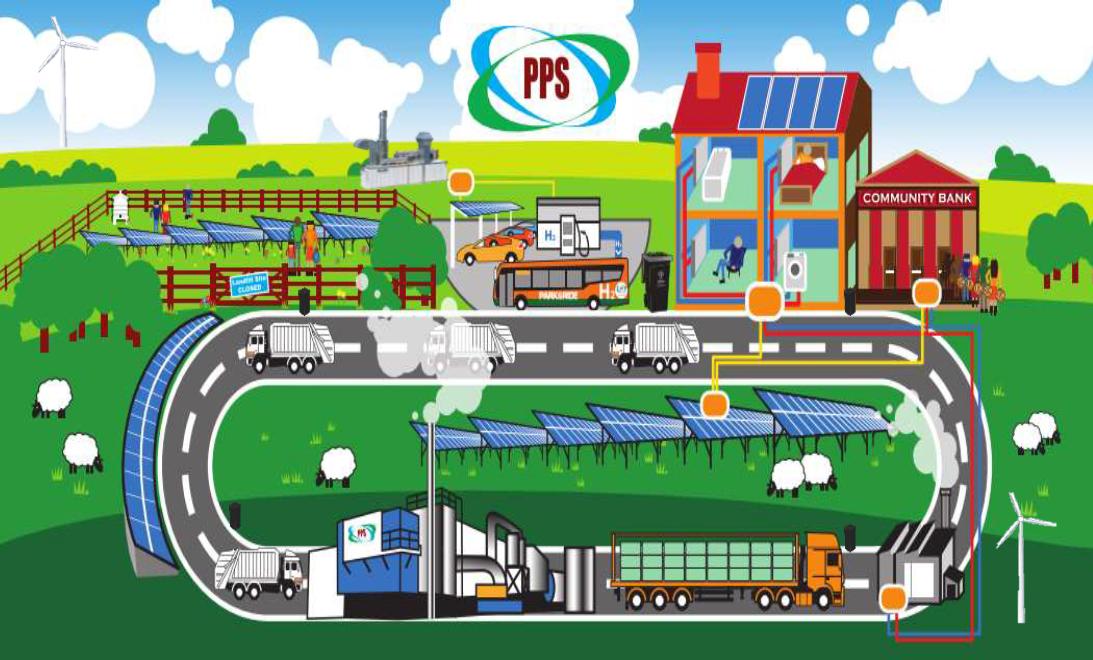
After lunch James Owen, commercial director of Public Power Solutions, started off by giving us a history lesson about local electricity generation in the UK.  Then he went on to discuss the benefits of “Local Balancing Units”, “street level storage solutions” and “a true local smart micro-grid” amongst other things, using both Swindon and the Danish island of Bornholm as examples. James freely admitted to having pinched an infographic of Bornholm, so I’ve taken the liberty of pinching one of his! Here is PPS’s template for a future Bristol, or Bornholm, or the Isle of Wight, or anywhere else in Europe for that matter.

See if you can spot the difference between this version and the one on the PPS web site. It seems those recent additions are Tesla Powerpacks, and in my own vision of a future sunny Southwest England the cars under the solar PV canopy at the park and ride would be connected to similar “black boxes” that incorporate V2G functionality.

Having finally got the preface out of the way, I’d like at long last to mention some alternative battery filled “black boxes” from suppliers other than Tesla Energy. For “grid scale” battery storage you can repurpose EV battery packs like Sumitomo, or use batteries designed for the task from the likes of Saft.

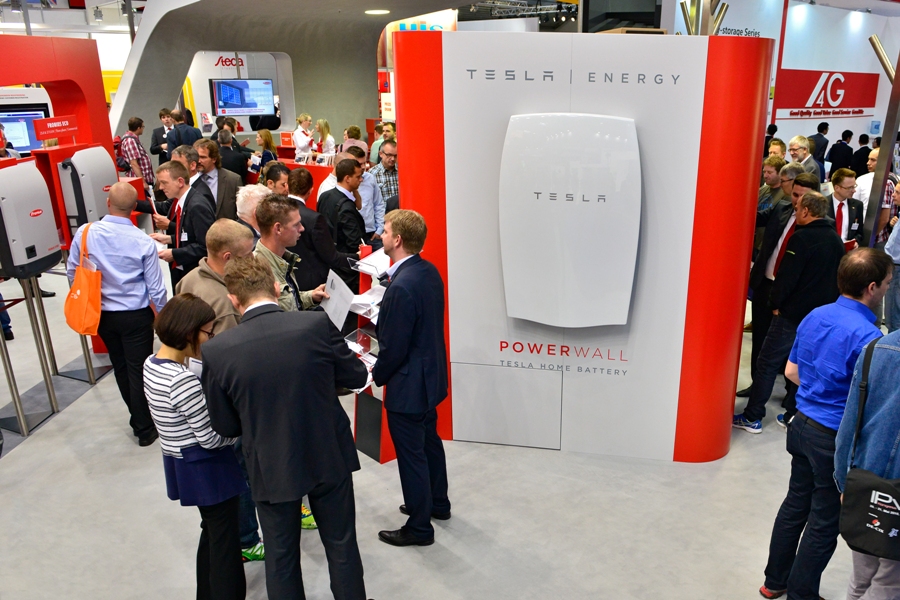
Moving down to the domestic scale I note that for some strange reason the solar PV equipped dwelling in a future Bristol/Bornholm lacks a V2x equipped garage similar to the one shown in the V2G banner at the top of this article. Moving indoors Moixa’s Maslow predates the Powerwall by a long way, and is designed to power a DC circuit for LED lighting, computers etc. Quite possibly prompted by Elon Musk‘s recent announcement, Samsung have also launched a domestic version of their modular Energy Storage System (or ESS for short). Stefan Quandt (of BMW fame) has launched the SolarWatt MyReserve, which has already won an award at the recent ees Europe exhibition over in Germany. Varta also launched their Engion Element “storage for beginners” at ees Europe. Here’s how they looked at the show:

and just in case you haven’t yet tasted the flavour of the month, here’s a Tesla Powerwall for your delectation:

As you’ve probably gathered by now I have a lot more to say about all of this and more, including covering Anthony Price of Swanbarton’s talk dedicated to “Local balancing using storage”. However for the moment at least I cannot help but wonder what Ofgem make of all this “rapid technological innovation”, not to mention the potential associated “non-traditional business models” and last but by no means least, international smart grid standards!

The First Great Dunchideock Blackout

At May’s film night in Dunchideock Village Hall it was announced that anybody interested in learning more about the recent power cut in the village could “read all about it” on this very web site. A cry was heard from the audience:

Which one is that then?

It has now been brought to my attention that the other end of the village has suffered far more from the absence of electricity this year than my own particular neck of the woods. Having engaged in further communications with some local residents and Western Power Distribution I have another long tale of woe to tell!

There was undoubtedly much wet and windy weather around the Haldon Hills earlier this year. According to the UK Met Office, handily situated just up the road in Exeter, in their summary of Winter 2013/14:

Winter 2014 was an exceptionally stormy season, with at least 12 major winter storms affecting the UK in two spells from mid-December to early January, and again from late January to mid-February. When considered overall, this was the stormiest period of weather experienced by the UK for at least 20 years. An analysis of pressure fields by the University of East Anglia suggests this winter has had more very severe gale days than any other winter season in a series from 1871.

All those storms didn’t appear to have any long lasting impact on the southern side of Dunchideock at the time, but the story is rather different slightly to the north. Here’s a map of Western Power Distribution’s high voltage electricity network in the area:
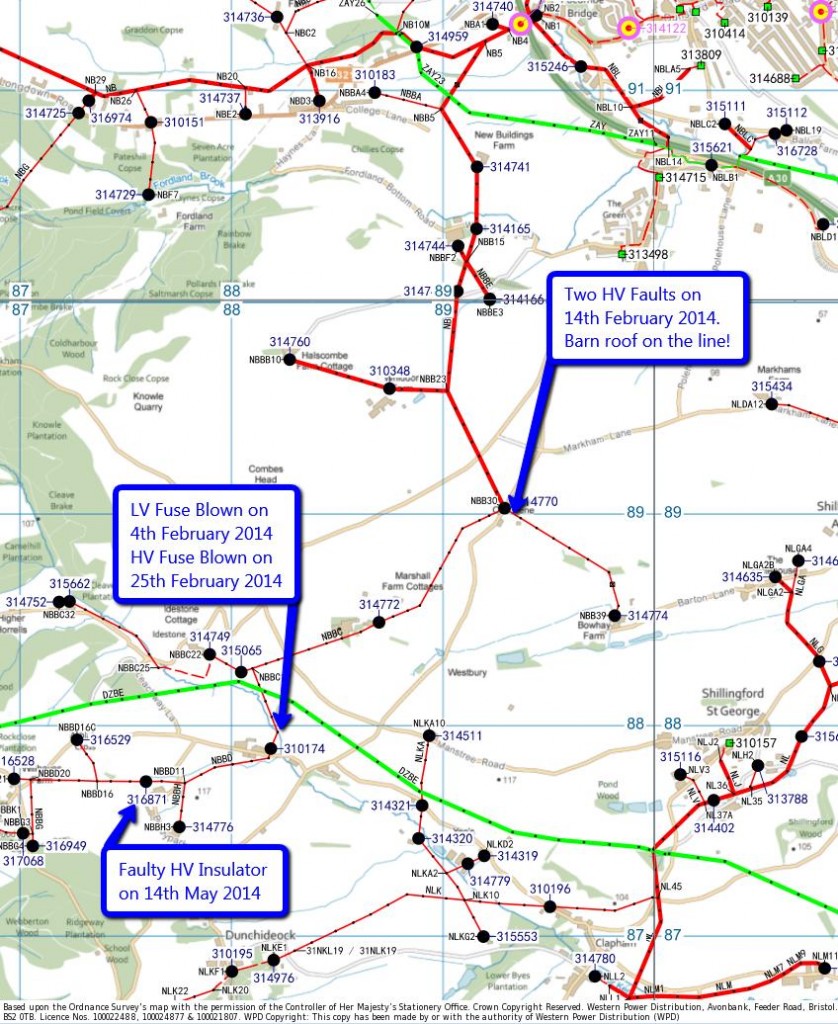
WPD map of 11 kV (red) and 33 kV (green) cables south and west of Exeter

WPD map of 11 kV (red) and 33 kV (green) cables south and west of Exeter

Hopefully it is now apparent to you that the northern part of Dunchideock is on a completely different “circuit” to the southern part. You can also see that there have been a few electricity supply issues over the past few months! Taking them in chronological order, the first outage was on Tuesday February 4th. It’s unlikely to be mere coincidence that on the same day the Met Office issued a press release saying that:

The stormy conditions are expected to bring damaging gusts of wind of up to 60 mph inland and perhaps as high as 80 mph along some southern and western coasts of Britain on Tuesday night and Wednesday. These severe gales, combined with further heavy rain may cause some disruption because of fallen trees and high waves in coastal areas.

The net result as far as northern Dunchideock was concerned was:

A power cut from 21:00 to 02:00 on the 5th. When the power went off alternate houses in the road came back on after a minute or so and stayed on.

According to Western Power Distribution the immediate cause was that:

One of two low voltage fuses blew (on a split phase transformer). Hence 50% of customers would be on supply.
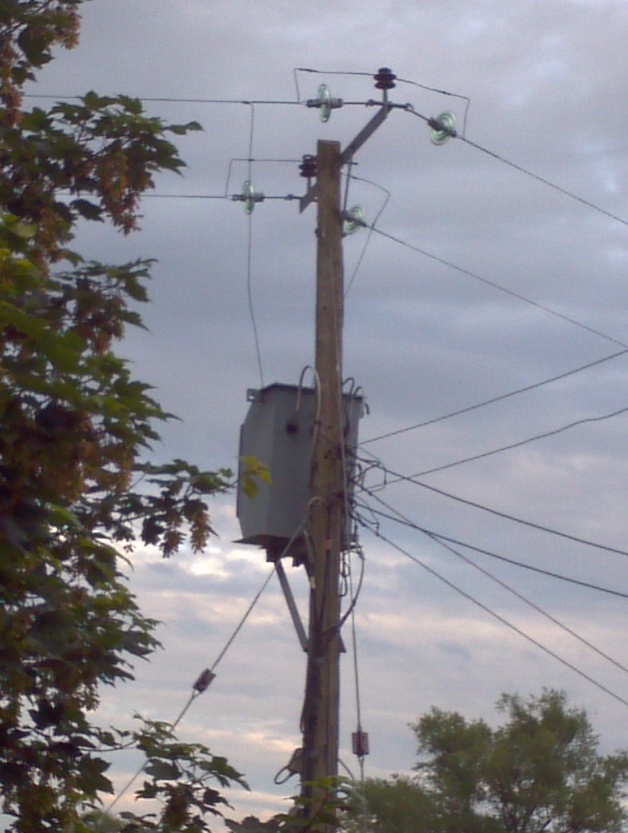
Transformer 31/0174 near Thornes Meadow, Dunchideock

Transformer 31/0174 near Thornes Meadow, Dunchideock

Ten days later the real “Great Dunchideock Blackout” occurred. According to the Met Office once again, in their forecast for Friday February 14th:

The Met Office was so concerned about the wind speeds on Wednesday a Red weather warning was issued for wind, the first red warning since January 2013. Extremely strong winds were seen in the south and northwest of England and parts of Wales.

We have another weather system crossing the UK on Friday bringing further heavy rain and very strong winds, leading to a number of weather warnings being put in place. The rain will push into the UK from the southwest during Friday morning, moving quickly north eastwards.

There are Yellow weather warnings for wind in place for the South coast and round into East Anglia with an Amber weather warning for wind along the South coast. We are expecting some gusts of around 60 miles per hour inland and perhaps 80 miles per hour in exposed areas along the coast itself. With these very strong winds large waves will push onto the coastline with dangerous conditions possible as well as some localised coastal flooding.

Here in Dunchideock, for the residents of Thornes Meadow at least, the result was a power cut lasting almost two days:

The second power cut was on 14th February at 19:30 and the electricity did not come back on until 14:00 on the 16th. Everybody in Thornes Meadow was off this time. The recorded messages of restoration times were continually put back.

As you may be able to imagine, in such circumstances Western Power Distribution had a very long list of problems to deal with. The immediate issues for Dunchideock were:

Two separate  High Voltage faults (conductors down due to trees and an entire barn roof being blown onto the line).

Due to the number of faults WPD had to bring in extra engineers from the Midlands and South Wales to help with the repairs. In normal circumstances the UK electricity market regulator Ofgem specifies a maximum 18 hour time limit on restoring electricity supplies. However in extreme circumstances this can relaxed. Ofgem themselves foresaw the potential difficulties, and issued a news release of their own on February 12th, stating that:

Severe weather is currently forecast across Great Britain. Electricity distribution companies, who own and operate the local networks, are making preparations ahead of this weather. We set rules on how quickly companies have to respond to restore power in both normal weather and severe weather conditions.

For severe weather there are different categories according to the severity of the storm. The category sets the amount of time companies have to restore power before compensation must be paid. The category is determined by the number of major faults experienced within a 24 hour period on the distribution company’s network.

The distribution company may be able to give an initial early view of what category the storm is but the data is checked and verified by us. The time you are off supply before being able to claim payments varies according to severity of storm. This is because the companies will have more work to do to fix faults.

  • Category 1: After 24 hours
  • Category 2: After 48 hours

In this case the storm was ultimately classified as category 2, and hence the unfortunate residents of Thornes Meadow are not entitled to any compensation despite being without any electricity supply for nearly two days.

Moving on to the next outage, which took place on “February 25th from 18:50 to 19:45” on which date there were no special press releases from the Met Office. Thankfully this power cut was of much shorter duration than the previous one, and was because:

A high voltage fuse operated. Restoration was via HV fuse replacement.

Finally we come to May 14th, when “a faulty high voltage insulator” led to a power cut in properties supplied by transformer 31/6871 in the vicinity of Dunchideock Church. Once again the weather wasn’t sufficiently inclement to warrant a Met Office press release.
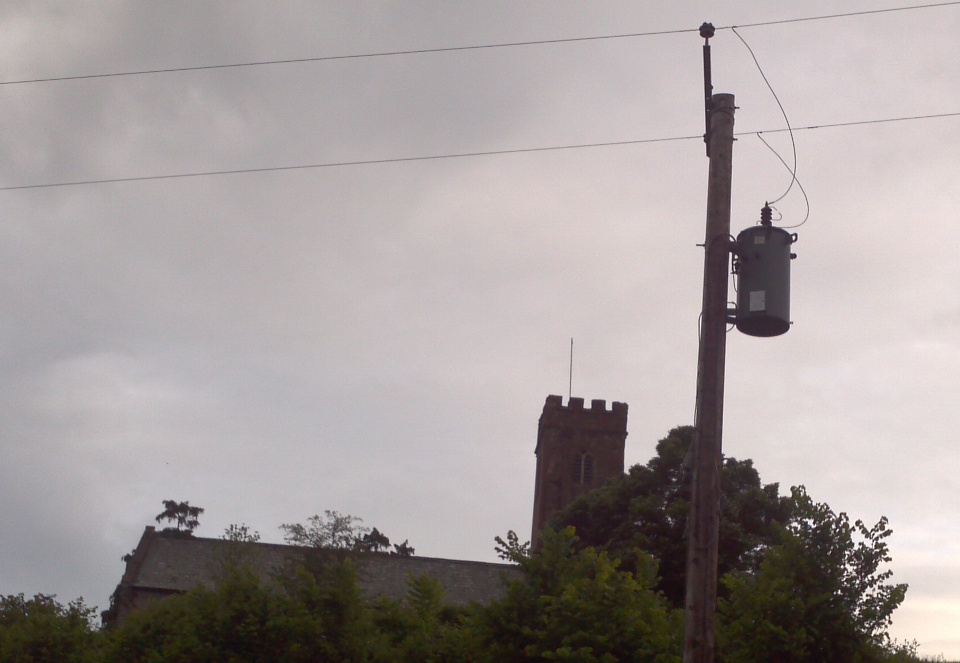
Transformer 31/6871 near Dunchideock Church

Transformer 31/6871 near Dunchideock Church

All of this additional information leads me to conjecture yet again about all those blown fuses and faulty insulators. What stresses and strains is our local electricity distribution network being subjected to these days by the combination of lots of inclement weather and renewable electricity generation, down here in not always Sunny South West England?

Rather too many for comfort would seem to be the answer, if Dunchideock’s recent experience is anything to go by.