Google Gives UK Schools Piles of Raspberry Pi Kits

Last year Google chairman Eric Schmidt warned that Britain was throwing away its “great computer heritage” by failing to teach programming in schools. Mr. Schmidt also promised some funds to teach teachers how to use the Raspberry Pi “microcomputer” to teach programming. Now Google has taken the next obvious step, and promised more money to put piles of Pis in UK classrooms. According to the BBC:

Schools around the UK are to be given 15,000 free microcomputers, with a view to creating a new generation of computer scientists. Funded by Google, the Raspberry Pi Foundation hopes the free devices will inspire children to take up coding.

Eric Schmidt put it this way:

Britain’s innovators and entrepreneurs have changed the world – the telephone, television and computers were all invented here. We have been working to encourage the next generation of computer scientists and we hope this donation… to British school pupils will help drive a new wave of innovation.

Not everybody appears to be happy with Google’s initiative however. The National Union of Teachers said that:

Schools are increasingly being used as marketing venues by companies promoting their own brands in return for teaching resources, books, sports equipment or computers. Commercial sponsorship of school resources and equipment and their involvement in training can actively undermine teachers’ efforts to educate children about the dangers of manipulation and commercial exploitation.

Somewhat surprisingly it seems that Microsoft are at least partly in agreement with Google on this issue. According to Steve Beswick, their Director of Education:

Computer science is something that we have been calling the ‘fourth science’ for some time. We believe that it is every bit as important as physics, chemistry and biology. By formally introducing children to computer science basics at primary school, we stand a far greater chance of increasing the numbers taking the subject through to degree level and ultimately the world of work.

Perhaps Microsoft will soon also be providing NUT members with free hardware around which to develop cross-curricular “fourth science/dismal science” lessons on modelling the benefits of increased knowledge of computer science to the Great British Economy?

Whether that comes to pass or not it seems that the Great British Government agrees with Google and Microsoft that such benefits will in fact occur. Education Secretary Michael Gove has just announced that computer science will be added to the English Baccalaureate syllabus. According to a Department for Education spokesperson:

We need to bring computational thinking into our schools. Having Computer Science in the EBacc will have a big impact on schools over the next decade. It will mean millions of children learning to write computer code so they are active creators and controllers of technology instead of just being passive users. It will be great for education, great for the economy, and will help restore the spirit of Alan Turing and make Britain a world leader again.

Here’s Eben Upton and Eric Schmidt explaining “Google’s secret plan” to some Great British Schoolchildren:

Long live the spirit of Alan Turing!
Fresh Raspbian Refreshes the Raspberry Pi

A few days ago I was complaining (albeit only slightly!) about sluggishness whilst scrolling through the V2G blog on my shiny new Raspberry Pi. Now however help is at hand, in the form of the official release of the “Raspbian” flavour of Debian “Wheezy” Linux. According to Eben Upton on the Raspberry Pi blog this morning:

We are pleased to announce the release of our first SD card image based on the Raspbian distribution. This is the result of an enormous amount of hard work by Alex and Dom over the past couple of months, and replaces the existing Debian squeeze image as our recommended install. Notably, it is the first official image to take full advantage of the Raspberry Pi’s floating point hardware for, amongst other things, much faster web browsing.

Users who are still using Debian squeeze will definitely want to switch to this, as it contains numerous tweaks and performance improvements to the firmware, kernel and applications.

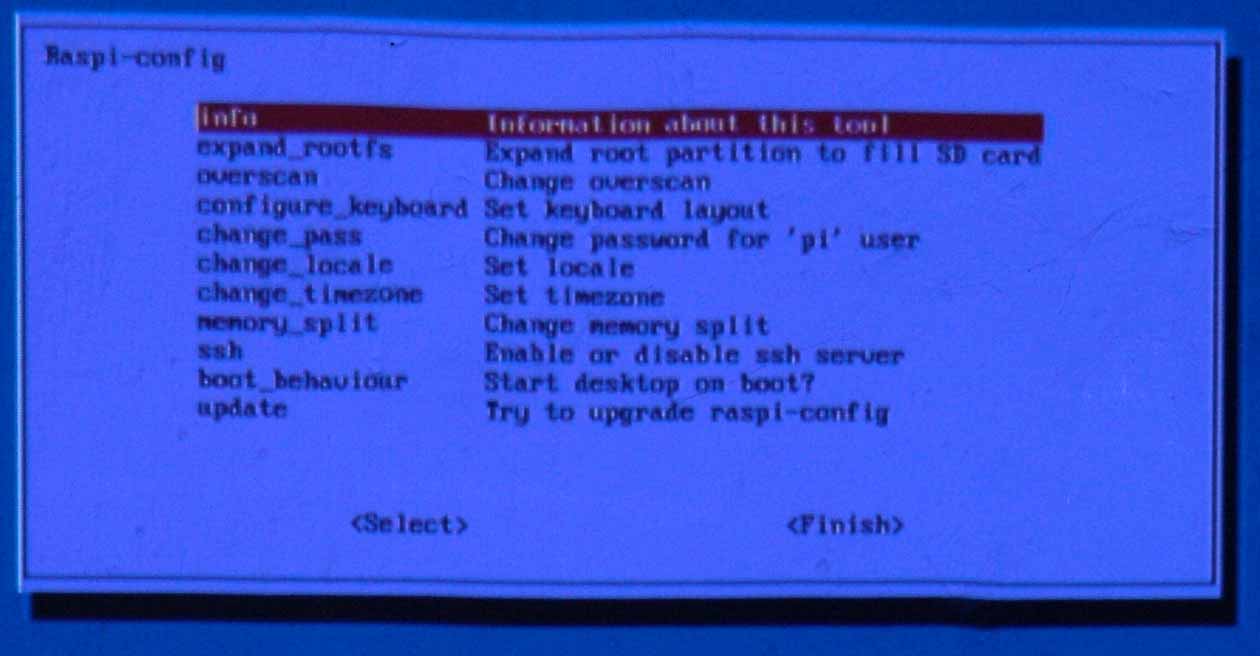
Needless to say the first thing I did when I heard the news was to download the new image  (2012-07-15-wheezy-raspbian.zip) from one of the many “alternative” Raspberry Pi mirror sites.  The first thing I noticed was that on the inital boot I was presented with the shiny new (to me at least) raspi-config utility:

The RasPiConfig utility on the V2G Office wall

The RasPiConfig utility on the V2G office wall

I duly used it to expand the root partition to use the whole of my 8Gb SD card, and also to configure my Pi to boot into a graphical desktop automatically. In case you’re wondering why that picture is a bit fuzzy and a slightly strange colour, here’s one reason.

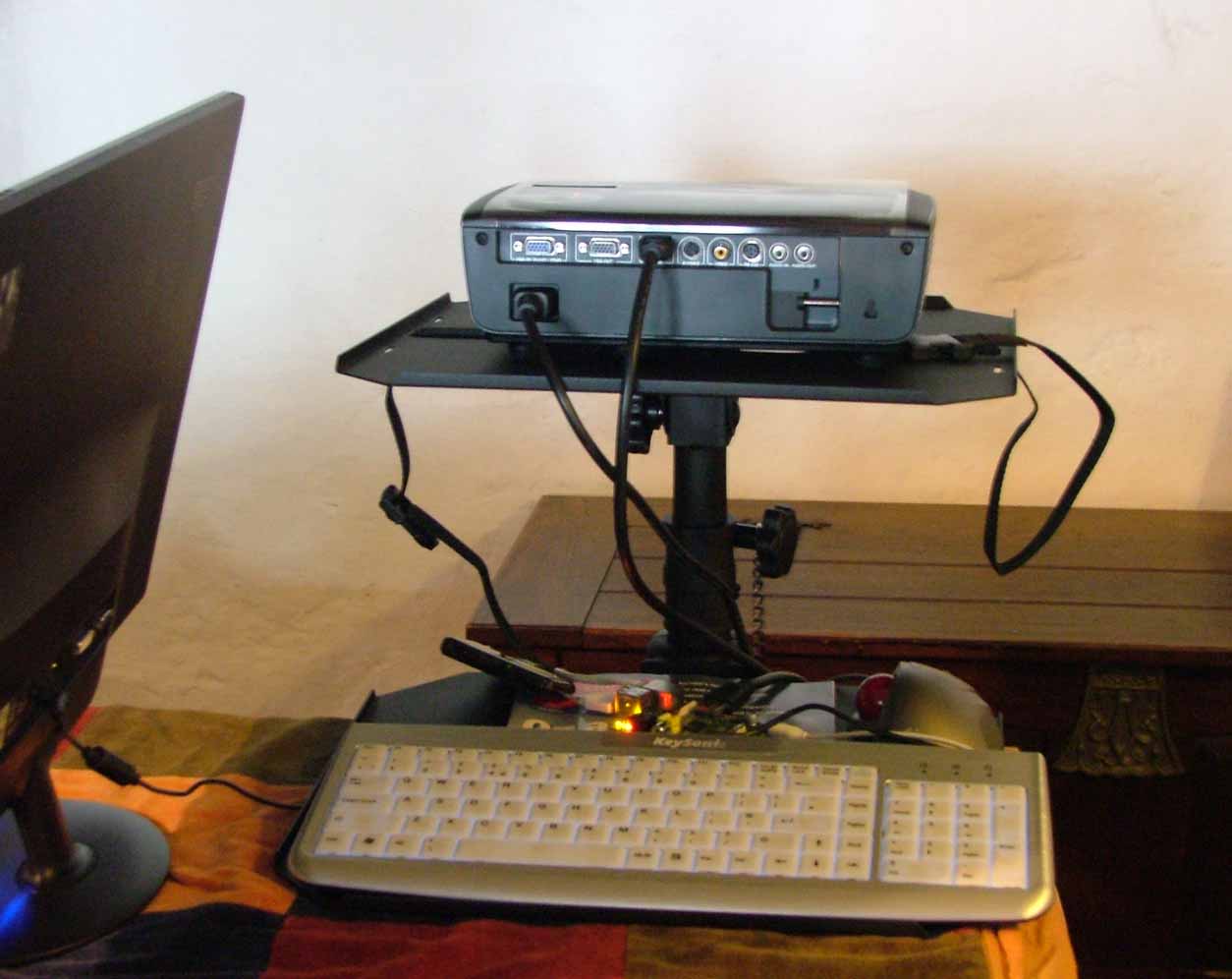
The V2G Pi Projector System

The V2G Pi Projector System

You’ll note that we have a shiny new display device to go with our shiny new operating system.  The first picture is of the V2G office wall, now powered by a shiny new Optoma HD600-X LV projection display driven by a Raspbian equipped Raspberry Pi model B.

After a reboot I then tried out the Midori web browser in anger once more, I’m happy to confirm that reading the V2G blog on a RasPi no longer feels “remarkably similar to wading through treacle”:.

No Gnome Means No Screenshots

No Gnome means no screenshots

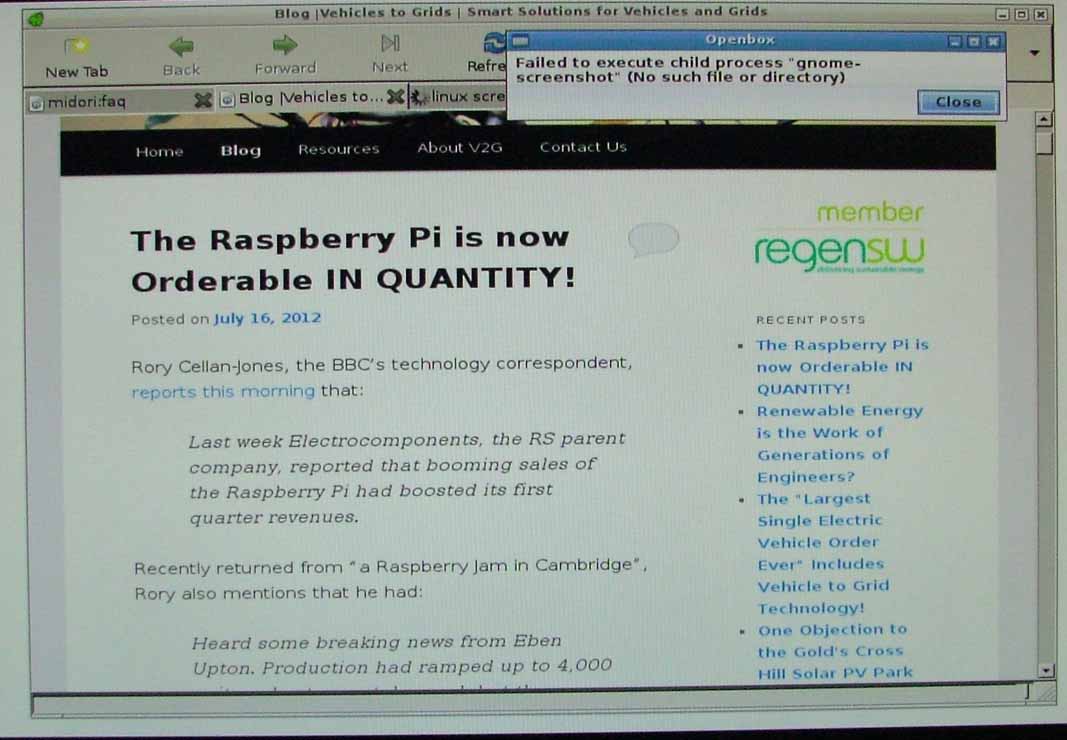
The raw Raspbian distribution seems to be cut right down to the bare essentials, and after a brief hunt I couldn’t find my familiar Gnome desktop, or even some sort of “Paint” utility. Hence I’ve resorted to taking pictures of screens, not to mention walls! Finally, for today at least, swiftly scrolling through the V2G blog did reveal one remaining “feature” to me:

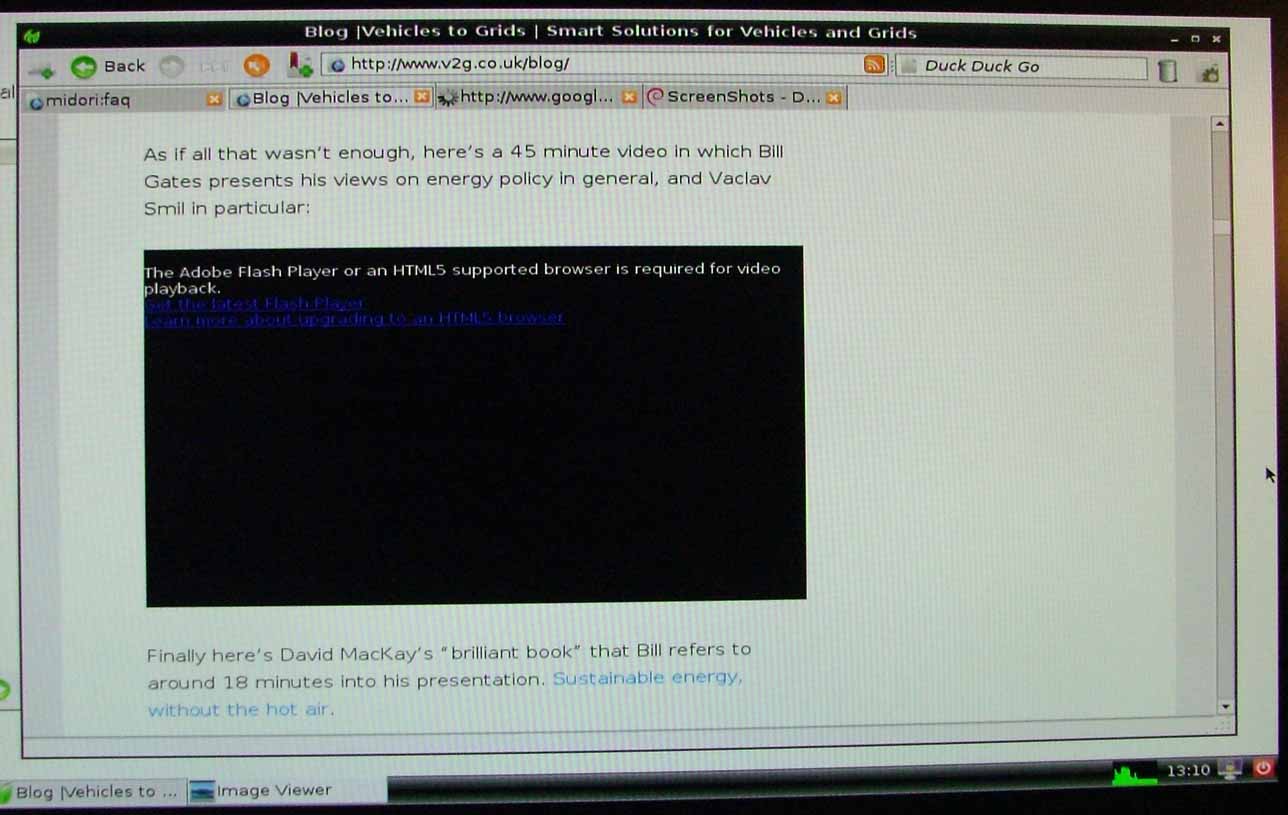
"An HTML5 supported browser is required for video playback"

"An HTML5 supported browser is required for video playback"

It seems to be a trifle tricky to watch web videos with Raspbian Midori at the moment!


The Raspberry Pi is now Orderable IN QUANTITY!

Rory Cellan-Jones, the BBC’s technology correspondent, reports this morning that:

Last week Electrocomponents, the RS parent company, reported that booming sales of the Raspberry Pi had boosted its first quarter revenues.

Recently returned from “a Raspberry Jam in Cambridge”, Rory also mentions that he had:

Heard some breaking news from Eben Upton. Production had ramped up to 4,000 units a day to meet demand, but there was still a backlog of orders.


But what really excited the crowd was the announcement that a camera module for the device was coming very soon, priced at $20-$25 and offering 5MP photos and good quality video.

According to Rory, Eben also said:

It’s been completely crazy. At Christmas last year we thought we might sell 10,000 of these devices, so to be sitting here with 200,000 out in the wild and plans to get to a million by the end of the year is just incredible.

In other Raspberry Pi flavoured news this morning, Liz Upton reports on the Raspberry Pi blog that:

Up until now, we’ve had to restrict purchases of the Raspberry Pi to one per customer  because the demand has been (and continues to be) so high. Both of our manufacturing partners have been working at building capacity so you we can lift that limit – right now, 4000 Raspberry Pis are being made every day. As of this morning, you’ll be able to buy as many Raspberry Pis as you want.

Unfortunately delivery won’t be next day, because according to Jo from RS:

We’re currently forecasting that these orders will start reaching customers by the end of September.

Nonetheless this would seem to be a step in the right direction if you’re currently planning on having a classroom full of RasPis ready in time for the start of the next academic year, with or without 5 megapixel cameras attached.


Liz Upton reports on the Raspberry Pi blog this morning that:

Up until now, we’ve had to restrict purchases of the Raspberry Pi to one per customer  because the demand has been (and continues to be) so high. Both of our manufacturing partners have been working at building capacity so you we can lift that limit – right now, 4000 Raspberry Pis are being made every day. As of this morning, you’ll be able to buy as many Raspberry Pis as you want.

Delivery won’t be next day however, because according to Jo from RS Components:

We’re currently forecasting that these orders will start reaching customers by the end of September.

Nonetheless this would seem to be a step in the right direction if you’re currently planning on having a classroom full of RasPis ready in time for the start of the next school year.