
George Osborne Invests in Energy Storage

George Osborne, the United Kingdom’s Chancellor of the Exchequer, gave a speech at The Royal Society yesterday, extolling the benefits of scientific research for the British nation.  He said that:

I want to begin a debate about eight future technologies where we believe we can be the best – where we already have an edge, but we could be world-leading.

Number 5 on Mr. Osborne’s technology shopping list he described as:

Energy Storage for the Nation: Stockpiling Electricity

More specifically he mentioned three particular areas of British expertise:

First there are the batteries in all our personal electronic devices. These use lithium ion batteries working on a chemical reaction developed at Oxford in the early 1980s. Thirty years on that basic technology is still central.

Second there is the development of battery-powered vehicles. One reason Nissan decided to produce their new all electric LEAF car here in the UK in Sunderland was the continuing support for research on innovative batteries for cars.

Third there is the challenge of storing more electricity for the Grid.

Mr. Osborne then expanded on the why and the how of the UK Government’s support for grid scale storage research and development:

Electricity demand peaks at around 60 GW, whilst we have a grid capacity of around 80 GW – but storage capacity of around just 3 GW. Greater capability to store electricity is crucial for these power sources to be viable. It promises savings on UK energy spend of up to £10 billion a year by 2050 as extra capacity for peak load is less necessary.

The Research Councils’ energy programme is investing over £500 million over this Spending Review period in energy research, including energy storage. However, urgent action is needed to accelerate translation of research into new technologies and products so that global market opportunities are realised by UK companies – and ensure the UK is established as an international focus for energy storage research and innovation.

Research projects are delivering but the UK currently lacks the test-bed demonstrator capacity and dedicated R&D facilities to take the next step in developing and testing new grid-scale energy storage technologies. We need to create them. We are funding the Energy Technologies Institute jointly with industry partners – including BP, Caterpillar, EDF Energy, E.ON, Rolls Royce and Shell – to accelerate new technologies for producing clean, reliable and affordable energy. And we are now investing £800 million with industry to maximise the funding of low carbon energy technology innovation.

Mr. Osborne ultimately concluded his speech by saying that:

It is right that, even at times of fiscal restraint, we find the resources to enable new scientific breakthroughs, to bridge the gap between discovery and commercialisation and to spread the economic and social benefits of scientific research. The prize is not just our future wealth but our health and quality of life, and our commitment to intellectual enquiry.

No one can know what the future holds. But we can discern those areas where we have particular strengths and which scientists themselves believe have the most potential. Let us identify what Britain is best at – and back it.

We have great science in Britain. We are backing it. And we will do more.

Let’s hope so! Mr. Osborne may not know what the future holds, but personally I predict a rather grim one if the UK (and indeed other nations) doesn’t get its energy R&D and broader energy policy sorted out in a hurry. Do you suppose the forthcoming Energy Bill will achieve that? Whilst we wait with bated breath to find out here’s a video in which David Clarke, Chief Executive of ETI, explains his views on “the real issue of avoiding the cost of having to upgrade our distribution network for electricity” in general, and Isentropic’s “pumped heat” thermal storage in particular:
Liquid Nitrogen Storage As Well As Electric Cars?

The Economist published an article on their web site last week entitled “End of the Electric Car?”. According to the Economist’s columnist “Babbage”:

A breakthrough in engine design has made liquid nitrogen an even more attractive alternative than the lithium-ion batteries used in electric cars. An invention made by an independent British engineer called Peter Dearman dispenses with the costly heat exchanger that is needed to vaporise the liquid nitrogen quickly.


The Institution of Mechanical Engineers in London, the leading standards-setting and registration body for the profession, was so impressed with the Dearman Engine Company’s developments that it has now established a working group comprising engineers, academics, government officials and industry leaders, to explore ways of exploiting liquid-nitrogen technology.

An aspect of the story that the Economist unaccountably failed to mention can instead be found on the web site of the Liquid Air Energy Group, where Tim Fox, Head of Energy and Environment at the Institution of Mechanical Engineers is quoted as saying:

We’re coming out of the cave blinking on this one and we’re only just getting an inkling of how great the energy benefits of liquid air could be.

which the Liquid Air home page follows up with:

Cryogenic liquids are widely used in industry already, but their adoption as an energy vector is only just beginning. A number of British organisations, research teams and Universities are already developing ways to use liquefied air (or liquid nitrogen, its major constituent) as a zero emission energy storage medium and transport fuel.

Note the emphasis on energy storage rather than transport fuel?  The Economist story has thus far attracted 422 comments, only one of which mentioned energy storage. That was one I made myself! I did get one recommendation for it, so perhaps at least one other Economist reader understands what I was on about?  Heading back to the Liquid Air Energy Group home page, they share the following video:

The first minute or so is spent on the Dearman Engine, but the video then goes on to point out that:

Liquid air could also have helped to keep the lights on

and then takes a look at a:

Liquid air pilot plant near Slough [that] uses up excess electricity from power stations and wind farms when consumer demand is low. It’s cheap energy storage that could reduce the need for so many power stations.

As I pointed out to the Economist, I’m afraid that cheap energy storage that’s already connected to the UK National Grid is a concept that gets me a lot more excited than speculation about liquid nitrogen pumps at motorway service stations.

ACCIONA Energy Announce Grid Connected Solar PV Storage

Spanish renewable energy company ACCIONA Energy have just announced (in a slightly strange translation into English) that they have:

Materialized the first European experience of real operation of a grid-connected photovoltaic plant on an industrial scale with energy storage in batteries.

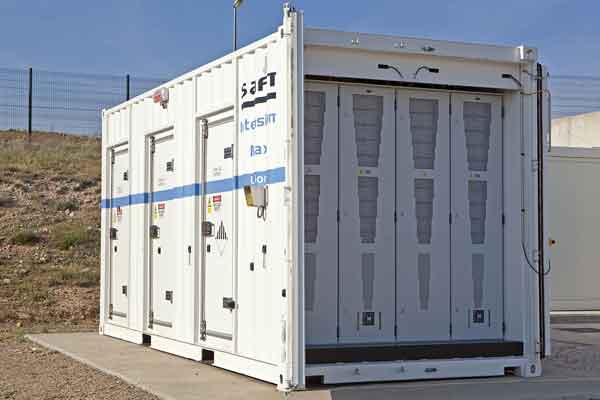
In somewhat plainer English, ACCIONA have installed a 1.1 MW / 560 kWh modular lithium-ion battery system supplied by French battery manufacturer Saft at their existing 1.18 MWp solar photovoltaic site at Tudela in the Navarre region of northern Spain. Please note that Navarre currently obtains most of its electricity from renewable sources, unlike the rest of Europe!

Saft 560 kWh modular lithium-ion battery system

Saft 560 kWh modular lithium-ion battery system

Continue reading →

Isentropic and Western Power to Test Pumped Heat Electricity Storage

I missed the announcement at the time, but what with one thing and another I’ve recently been doing my due diligence on innovative methods of storing energy in and around 33 kV substations.  I’ve just discovered that last week Isentropic Ltd.revealed that:

The Energy Technologies Institute (ETI) has provided project funding and an equity investment, together totalling £14m ($22m). The funding is to build a full scale demonstrator of its revolutionary, low cost energy storage device – called Pumped Heat Electricity Storage (PHES).

All that money is going to be put to some practical use, since:

Isentropic will use the funds to develop and deploy a 1.5MW/6MWh electricity storage unit on a UK primary substation owned by Western Power Distribution in the Midlands region.

This news was obviously of great interest to me, so I called Isentropic and spoke with their Chief Technology Officer Jonathan Howes earlier today. Unfortunately in all the circumstances, Jonathan told me that whilst a scaled validation system will be up and running in the not too distant future, a utility scale machine capable of delivering 1.5 MW of power and 6 MWh of storage in the field at an overall efficiency of 75% is still several years from fruition.

As UK Business Secretary Vince Cable puts it:

As our energy supplies change, finding innovative ways to store energy will become an increasingly important factor in the transition to a green economy.

and as Western Power Distribution Project Engineer Philip Bale puts it:

We believe that distribution scale energy storage could be used to improve the future operation of the distribution network

Hear, hear!