
Nissan Provide Power to the People! In the UK?

In what sounds a lot like a relaunch of the V2G hardware unveiled at the Geneva Motor Show back in March, a Nissan press release yesterday announced under the headline “Power to the People: Nissan and ENEL launch first smart grid trials” that:

  • Electric car to become home ‘energy hub’, allowing renewable energy to be harnessed and stored by the car
  • Nissan will commence Smart Grid trials in partnership with energy supplier, ENEL
  • More than Nissan 200,000 LEAF sold worldwide

At the 21st UN Conference on Climate Change (COP21) in Paris this week, Nissan has announced the development of an innovative Vehicle to Grid system which will allow drivers to operate as individual ‘energy hubs’ with the ability to store, use or return electricity to the grid.

Nissan will commence Smart Grid trials in partnership with multinational energy manufacturer and distributor, ENEL.

As part of the landmark partnership, Nissan and ENEL have committed to working together, to explore:

Introducing this revolutionary technology to the European market;
The extended use of ‘second life’ electric vehicles batteries for static applications;
Designing and evaluating potential affordable energy and mobility pack offers

Vehicle-to-Grid allows customers to take control of the type of energy they consume – avoiding peak tariffs and generating additional household income during peak times.

Here’s how the facelifted hardware looks, with an “Enel” badge instead of the original “Endesa” one:

Nissan and Enel also helpfully provide a couple of infographics to help explain how their “revolutionary technology” will work. Here’s the simple version:
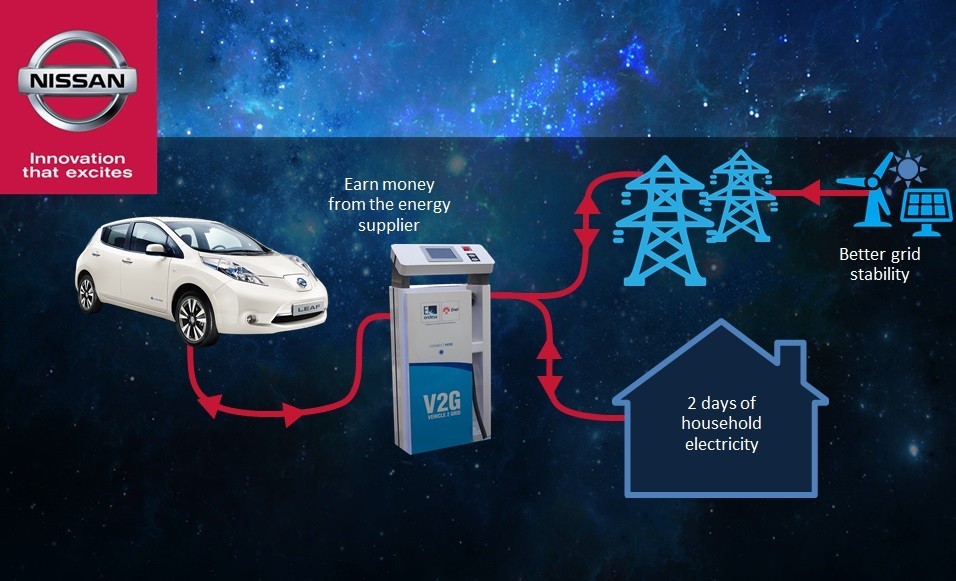
which looks a lot like a less colourful version of the V2G banner at the top of this page! Nissan go on to say that:

Using a special two-way charger and energy management system developed by Nissan in partnership with ENEL, LEAF owners can connect to charge at low-demand, cheap tariff periods, with an option to then use the electricity stored in the vehicle’s battery at home when costs are higher, or even feed back to the grid to generate additional household income.

“Our customers are no strangers to great value, with the Nissan LEAF offering unbeatable value motoring from three cents per kilometre. Now, with the introduction of Smart Grid technologies, we can empower motorists to take control of their energy mix – stimulating greater use of renewable power, and offering significant financial rewards for those who make the switch to electric.

“The personal benefits of innovations like this are clear, but moreover, we believe that this technology could help guarantee a cleaner energy infrastructure for generations to come.”

Nissan – the world leader in EV sales with 200,000 Nissan LEAF sold worldwide – is turning a page in zero emission mobility by unlocking the full potential of its electric vehicle batteries with the ENEL two-way charging technology.

Here’s the other infographic, which shows in more detail how V2G technology might “unlock the full potential of [a Nissan LEAF’s] batteries”. Click on the image to view a larger version:
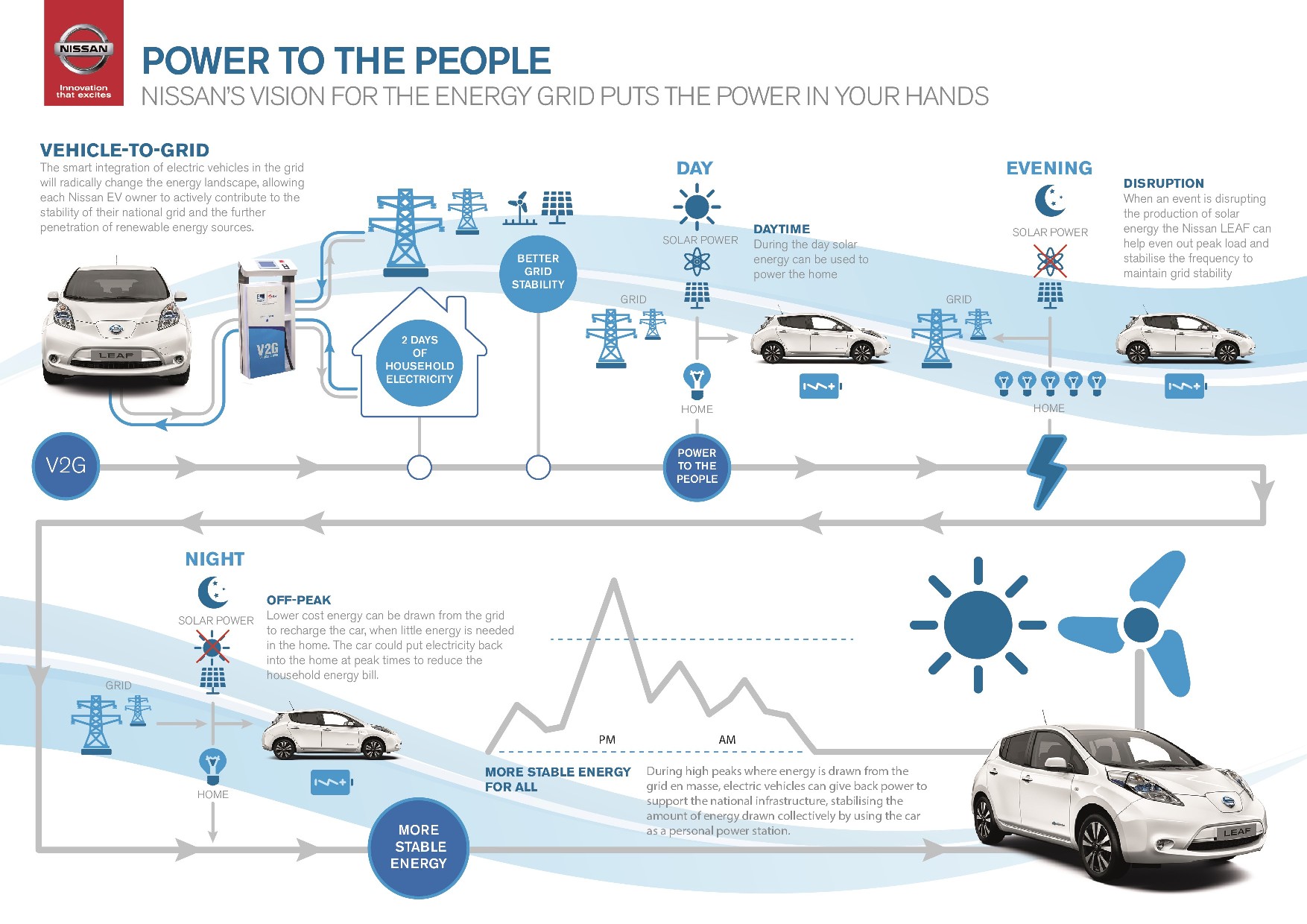
Another Nissan press release mentions where those “Smart Grid trials” will take place:

The agreement with the ENEL Group will bring the first Grid Integrated Vehicles to countries where regulation allows sufficient value generation. Denmark will host the first set of trials with Germany, Netherlands and other northern European regions following suit. This endeavour is part of Enel’s and Nissan’s commitment to support the entire electric vehicle ecosystem, going way beyond the car itself and delivering new services to the power industry.

I wonder if they could be persuaded to run one here in the United Kingdom? We are a “northern European region” after all! Here at V2G UK we’re rather keen to try out the techniques hinted at by the small print in the bottom right hand corner of the picture, which reads as follows:

During high peaks where energy is drawn from the grid en masse, electric vehicles can give back power to support the national infrastructure, stabilising the energy drawn collectively by using the car as a personal power station.
UK Smart Grid Vision Lukewarm on V2G

Last week the United Kingdom’s Department of Energy & Climate Change published their new “Smart Grid Vision and Routemap“. According to DECC’s introduction to the document it:

Sets out the wide ranging benefits that smart grids will bring, for example: minimising consumer bills; allowing consumers to play a more active role in managing the energy system; increasing energy security; helping to facilitate the integration of low carbon technologies; and supporting economic growth.


Great Britain is already recognised as a European leader with respect to the investment in smart grid research and demonstration projects and has begun the nationwide rollout of smart meters, which will help improve network management and facilitate demand response. The Smart Grid Vision and Routemap outlines what action is now needed to build on this initial success to ensure the benefits are realised as soon as possible.

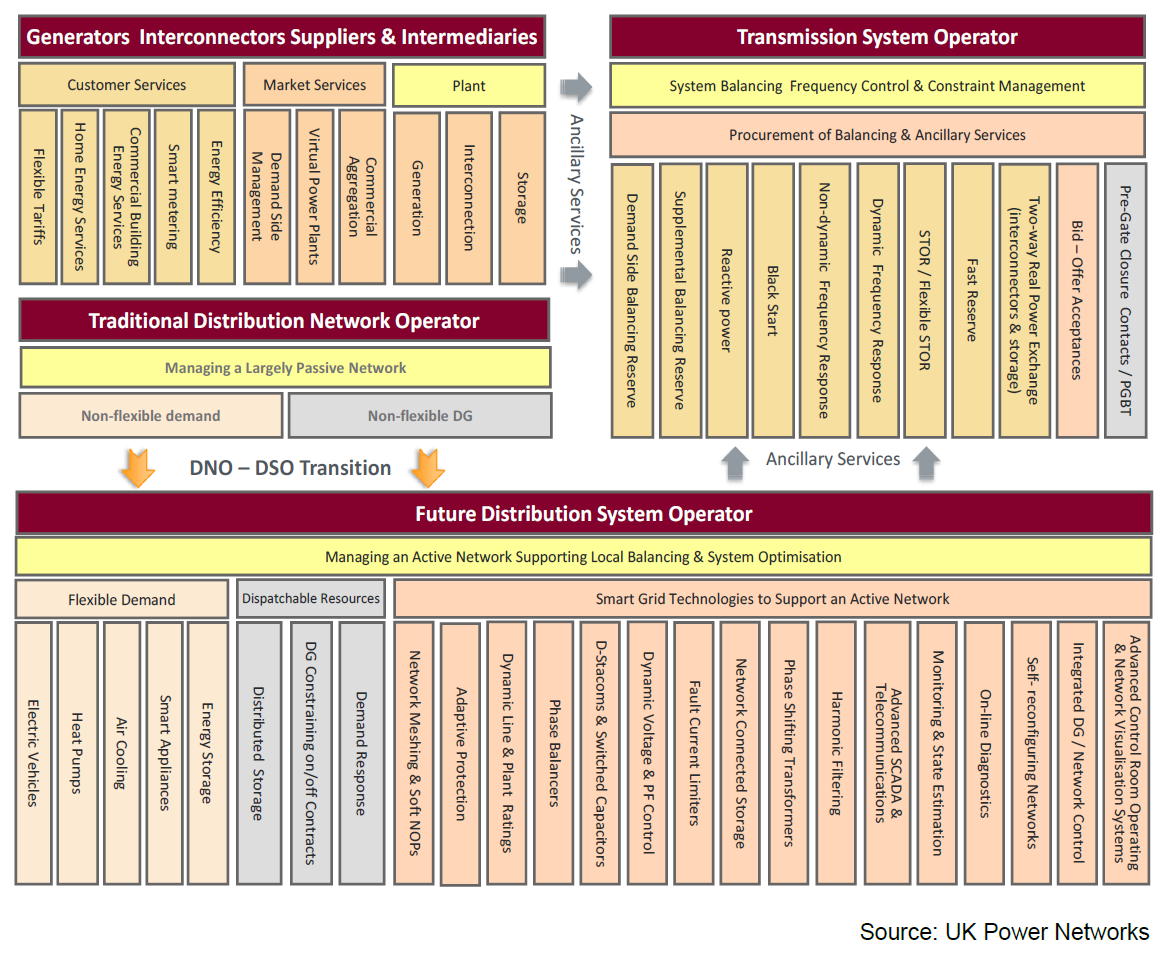
Delving into the routemap itself, I searched for any substantive reference to electric vehicles in general, or vehicle to grid technology in particular. Here’s what I managed to dig up. Firstly a diagram illustrating where EVs fit into the grand design of the future Great British Smart Grid:

February 2014 UK "Smart Grid Vision and Routemap" graphic

February 2014 UK "Smart Grid Vision and Routemap" graphic

Click on the image to see a larger version, where you will note it is anticipated that the “Traditional Distribution Network Operator, managing a largely passive network” will be transformed into a “Future Distribution System Operator, managing an active network supporting local balancing & system optimisation”. Electric vehicles are down in the extreme bottom left hand corner, under the heading of “Flexible Demand”, apparently totally separate from either “Energy Storage” or even “Distributed Storage”.

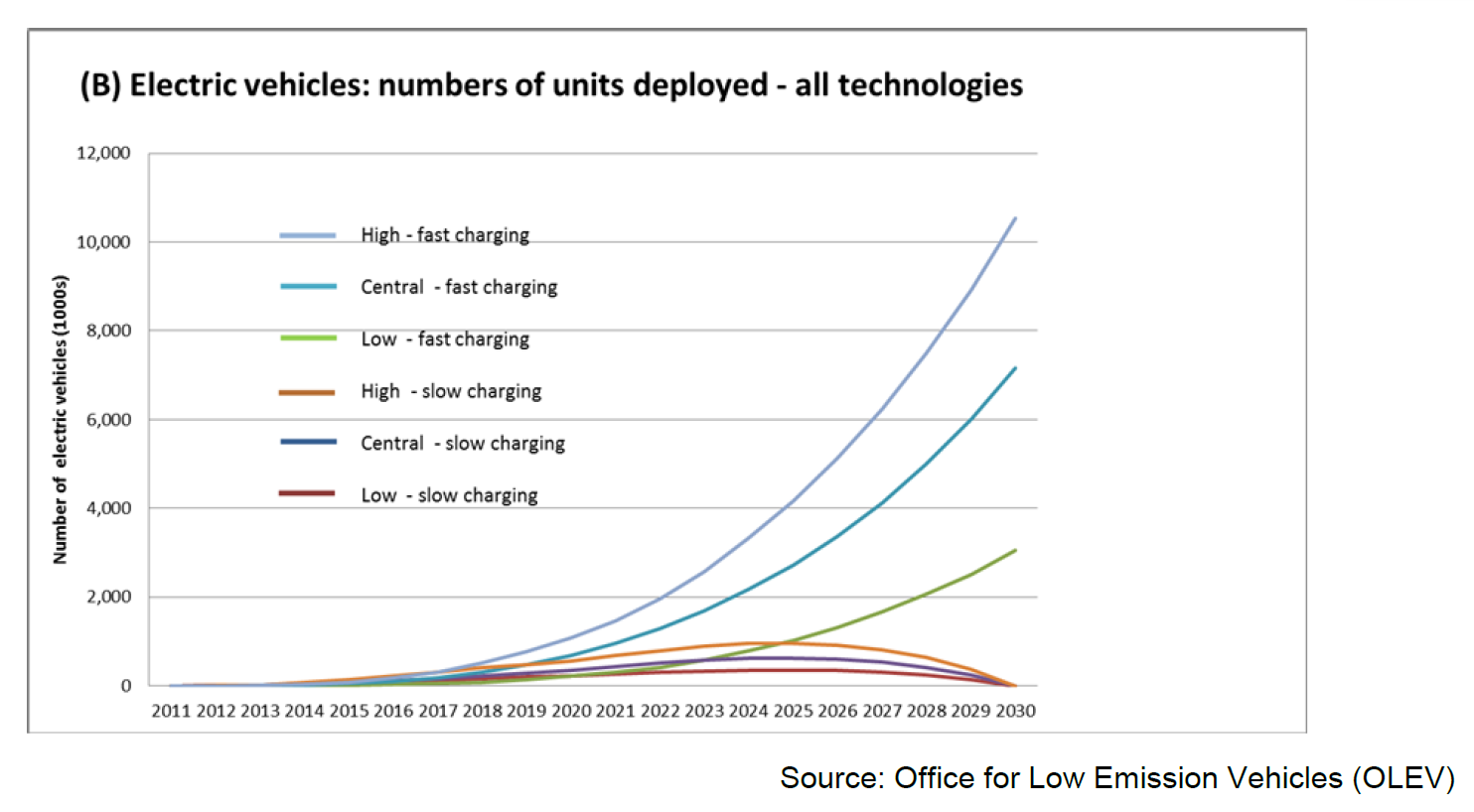
Secondly there is a forecast for the future growth in the number of EVs humming along the UK’s highways and byways, which looks like this:

February 2014 OLEV projection for number of electric vehicles deployed in the UK

February 2014 OLEV projection for number of electric vehicles deployed in the UK

The significant bullet points in the document that mention electric vehicles seem to think that an EV is much like a heat pump. A future British smart grid will:

  • Minimise consumer bills – more efficient use of network assets helps reduce the need to invest in costly infrastructure and ultimately reduces the costs passed through to consumer bills. It is estimated that by 2050, smart grids will reduce the cost of additional distribution reinforcement needed to accommodate the connection of low carbon technologies such as heat pumps, solar PV and electric vehicles by between £2.5bn and £12bn (a 20 to 30 per cent reduction)
  • Enable new low carbon technology to be deployed – heat pumps and electric vehicles will deliver significant carbon reductions, but will increase demand on the electricity network. Using smart grid technology to phase operating times, these devices can be incorporated into the network in conjunction with distributed generation to balance supply and demand, reducing the need for costly network reinforcement.

Finally there is a reference to another document, “Driving the future today – a strategy for ultra-low emission vehicles in the UK” from the Office for Low Emission Vehicles, which contains a few more bullet points about electric vehicles combined with smart grids:

  • The mass adoption of ULEVs will have significant implications for the energy sector at both a local and a national level. As the number of plug-in vehicles on our roads increases, so will the demand for electricity, placing additional pressures on the electricity system.
  • However, ULEVs can also help to balance the demand for electricity at peak periods and support the efficient use of energy by consumers. This will be facilitated by the introduction of intelligent power supply networks (smart grids) and the roll out of electricity smart meters across all domestic properties in the UK by 2020.
  • The majority of plug-in vehicle owners will charge their vehicles at home, at night time, during the off-peak period. This is not only most convenient for drivers, but also maximises the environmental and economic benefits of plug-in vehicles by using cheaper, lower carbon night-time electricity generation.
  • To help people charge at home as easily as possible, the Government is ensuring that smart metering in Great Britain includes the functionality to support charging of plug-in vehicles. This will allow recharging to happen when it is cheapest for consumers and the energy system (subject to appropriate technology in the chargepoint or plug-in vehicle).
  • Plug-in vehicles could also act as distributed energy storage during periods when renewable (or nuclear) electricity generation exceeds demand. This could happen during the life of the vehicle or as a potential end-of-life use for batteries. There may even be the potential for these vehicles to be used as an energy store, to power the house or feed electricity back to the grid at peak periods.

At long last a reference to something resembling V2G, or at the very least V2H! Moving on to page 71 of “Driving the future today” I finally found what I was searching for, an explicit (if somewhat grudging) reference to V2G technology. I reproduce it here in full:

Vehicle to home and vehicle to grid

As the smart grid and battery technologies develop, there may be the potential for plug-in vehicles to act as backup energy sources for homes and supplement the grid during peak demand periods. Nissan already offers a ‘power control system’ to its customers in Japan which allows their LEAF car to power a house for up to two days from its battery pack. Development of this technology was brought forward following the Fukushima nuclear reactor disaster.


There remain issues about the potential impact of taking charge from vehicles on battery life and the investment necessary to facilitate this on a large scale. However, Government will continue to talk to industry and researchers in this area and monitor developments.

Storage has the technical ability to provide a number of benefits to the electricity system – for example, smoothing supply profiles from variable generation and potentially reducing constraint costs by allowing generation to run during periods of low demand. It can also potentially save or defer network upgrade costs that may be required in the future to meet peak demand. Sixteen organisations have recently been awarded a share of £2 million by Government to help develop innovative storage solutions for energy. This funding is helping to drive forward innovation and encourage private sector investment.

The only trouble then is that none of those sixteen projects mention V2G or V2H, although both the the EVEREST project and Aston University’s Hybrid Batteries to Grid project refer to “‘Second Life’ EV batteries” but unfortunately not to EV batteries in situ. It rather sounds as though “Storage to Grid” (or S2G for short) is a more likely prospect here in the United Kingdom than fully fledged V2G.

Andrew Neil Tilts at “Windmills”

In my capacity as a member of the FIX Protocol Limited working group on electrical energy pricing (now inactive) I attended the FPL EMEA Trading Conference at Old Billingsgate in London on Thursday. The keynote speaker at the event was Andrew Neil. Publisher, writer and broadcaster according to the delegate guide. As you might expect Andrew had many insightful and/or amusing things to say about the current state of the global economy in general, and the no longer AAA British economy in particular. It’s probably not much consolation to most of my readers when I say that he was far more optimistic about prospects for the United States than for the United Kingdom and Europe.  I’ve been waiting for someone to post a comprehensive overview of Andrew’s musings, but nobody seems to have done so as yet, so it looks as though I will have to pick up the baton. It’s a tough job, but someone’s got to do it!

Neil Ainger over at bobsguide has briefly covered the first part of Andrew Neil’s speech, but for some reason neglects to mention the considerable amount of time he spent offering his different prognoses regarding the future energy security of us over here in Europe compared to our cousins over in the United States.  According to Neil:

In his opening speech, Neil [the other one] outlined the UK and European economic and political situation for the audience of traders, investors, technologists and financial market participants, warning that loose monetary policy in the UK has the potential to incubate a low wage, high inflation economy. In recent years, wage rises have not kept pace with the cost of living in the UK, depressing demand and creating a downward economic cycle in the country.

You get the idea! Please feel free to read the rest of Neil’s article should you feel the need to experience a pain in all the diodes down your left side. My ears really pricked up however, when Andrew start talking about what he described as an imminent “major geopolitical change” based upon the much improved outlook for United States energy security. He thought that the exploitation of large deposits of shale oil in North Dakota will, almost literally, change the world overnight:

When Mr. Obama was re-elected for a second term in November 2012 only 10% of US oil was imported from the Middle East.  When he leaves office not a single drop of oil will come from the Middle East.

Mr. Neil predicted that in the comparatively near future the US will actually become a net exporter of both Liquified Natural Gas and oil. Consequently Mr. Obama would become “the first Pacific President”, and the United States’ strategic interests and military muscle would move away from Europe, the Middle East and Africa (EMEA for short) towards a “Pan Pacific Pact“. As Mr. Neil put it:

Once that has happened who will keep the Strait of Hormuz open if not the Americans. Even the Chinese cannot do it. They don’t have enough planes.

With that sobering thought still ringing in our ears, Andrew offered to take a few questions from the floor. I waved my arm hopefully in the air, and was the second lucky recipient of the precious microphone. After announcing my name and affiliation I continued as follows:

You’ve already answered most of the questions I had about energy policy, but I do have a couple of supplementary questions. Tar sands, Keystone XL, renewables in the US and renewables in Europe?

Mr. Neil seemed convinced that both gas and oil would be flowing towards the Gulf of Mexico for export in significant quantities. However he didn’t seem optimistic that “windmills” as he called them would save our bacon over on this side of the Atlantic Ocean. I still had hold of the mic at that point, and took the opportunity to gently point out that the correct terminology is “wind turbines”. According to Mr.Neil renewable energy in general, and wind in particular, is far too variable to ever be more than a peripheral supplier of electrical energy, either in Europe or the United States.

By this time I had already handed the microphone back, so I had to bite my tongue while Andrew answered another question or two. After a well deserved round of applause he sat down.  At this point I stood up, jumped onto the podium, handed him my business card and suggested he get in touch at a more convenient time.

Here’s the thing. If Andrew knows anything about what the FPL EEP working group got up to, or what the rest of the United States smart grid working groups and committees are endeavouring to achieve, he gave a very good impersonation of someone who hasn’t got a clue.

Mr. Neil seemed to be similarly unaware that no less an authority than George Osborne recently suggested that low cost energy storage is vital to the UK’s future economic well being. As George succinctly put it last year:

Electricity demand peaks at around 60 GW, whilst we have a grid capacity of around 80 GW – but storage capacity of around just 3 GW. Greater capability to store electricity is crucial for [renewable] power sources to be viable. It promises savings on UK energy spend of up to £10 billion a year by 2050 as extra capacity for peak load is less necessary.


Today Is Smart Grid Day

According to the IEEE Power and Energy Society at least, today is “Smart Grid Day“. The IEEE PES are currently holding their annual Transmission and Distribution conference in Orlando Florida, and they are devoting today’s proceedings to:

A complete smart grid program…. to highlight lessons and identify opportunities as experts reflect upon the most recent smart grid developments.

The schedule for the day doesn’t explicitly mention electric vehicles or vehicle to grid technology, but it does include “Smart Grid Standards: Developments and Gaps” and “The Future of Smart Grid – Technology, Policy, Standards and Consumer Behavior”.

Surely V2G will be mentioned at some point in both those discussions?