BP Buys Chargemaster

We have previously reported on Shell’s plans to add “ultra rapid” charging points for electric vehicles on their filling station forecourts here in the UK. Now BP are following suit, according to today’s press release:

BP today announced that it has entered into an agreement to purchase Chargemaster, the UK’s largest electric vehicle (EV) charging company. Chargemaster operates the UK’s largest public network of EV charging points, with over 6,500 across the country. It also designs, builds, sells and maintains EV charging units for a wide range of locations, including for home charging.

According to BP Downstream’s chief executive, Tufan Erginbilgic:

Bringing together the UK’s leading fuel retailer and its largest charging company, BP Chargemaster will deliver a truly differentiated offer for the country’s growing number of electric vehicle owners.

At BP we believe that fast and convenient charging is critical to support the successful adoption of electric vehicles. Combining BP’s and Chargemaster’s complementary expertise, experience and assets is an important step towards offering fast and ultra-fast charging at BP sites across the UK and to BP becoming the leading provider of energy to low carbon vehicles, on the road or at home.

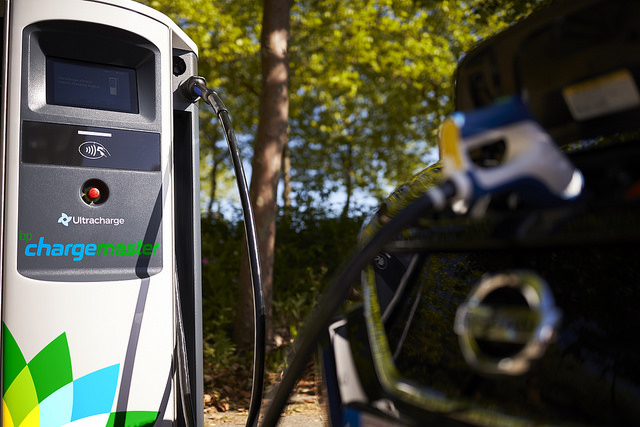
Here’s an artist’s impression of a BP Chargemaster branded “electric pump”:

BP-Chargemaster-1

BP’s press release continues:

The number of EVs on the road is anticipated to increase rapidly in coming decades. By 2040 BP estimates that there will be 12 million EVs on UK roads, up from around 135,000 in 2017.

The development of convenient and innovative EV charging technologies and networks is a key part of BP’s strategy to advance the energy transition. BP is committed to developing new offers to meet changing customer demand and growing new businesses and supporting opportunities for customers to reduce their emissions.

BP believes that to accelerate the adoption of EVs, customers will require convenient access to fast and ultra-fast charging. BP’s UK retail network is well positioned to provide this access with over 1,200 service stations across the country. A key priority for BP Chargemaster will be the rollout of ultra-fast charging infrastructure, including 150kW rapid chargers capable of delivering 100 miles of range in just 10 minutes. BP customers in the UK can expect to access BP Chargemaster chargers on forecourts over the next 12 months.

Chargemaster’s Chief Executive David Martell added:

The acquisition of Chargemaster by BP marks a true milestone in the move towards low carbon motoring in the UK. I am truly excited to lead the Chargemaster team into a new era backed by the strength and scale of BP, which will help us maintain our market-leading position and grow the national POLAR charging network to support the large range of exciting new electric vehicles that are coming to market in the next couple of years.

As we idly wondered after Shell’s announcement, “when will BP’s plans extend as far as South West England though, if ever?”

Nissan’s Future Promises “Free” EV Charging

The 3rd “Nissan Futures” event entitled “The Car and Beyond” took place in Oslo today. Apart from the European launch of the 2018 Nissan LEAF our suspicions about a 40 kWh battery for the e-NV200 were confirmed:

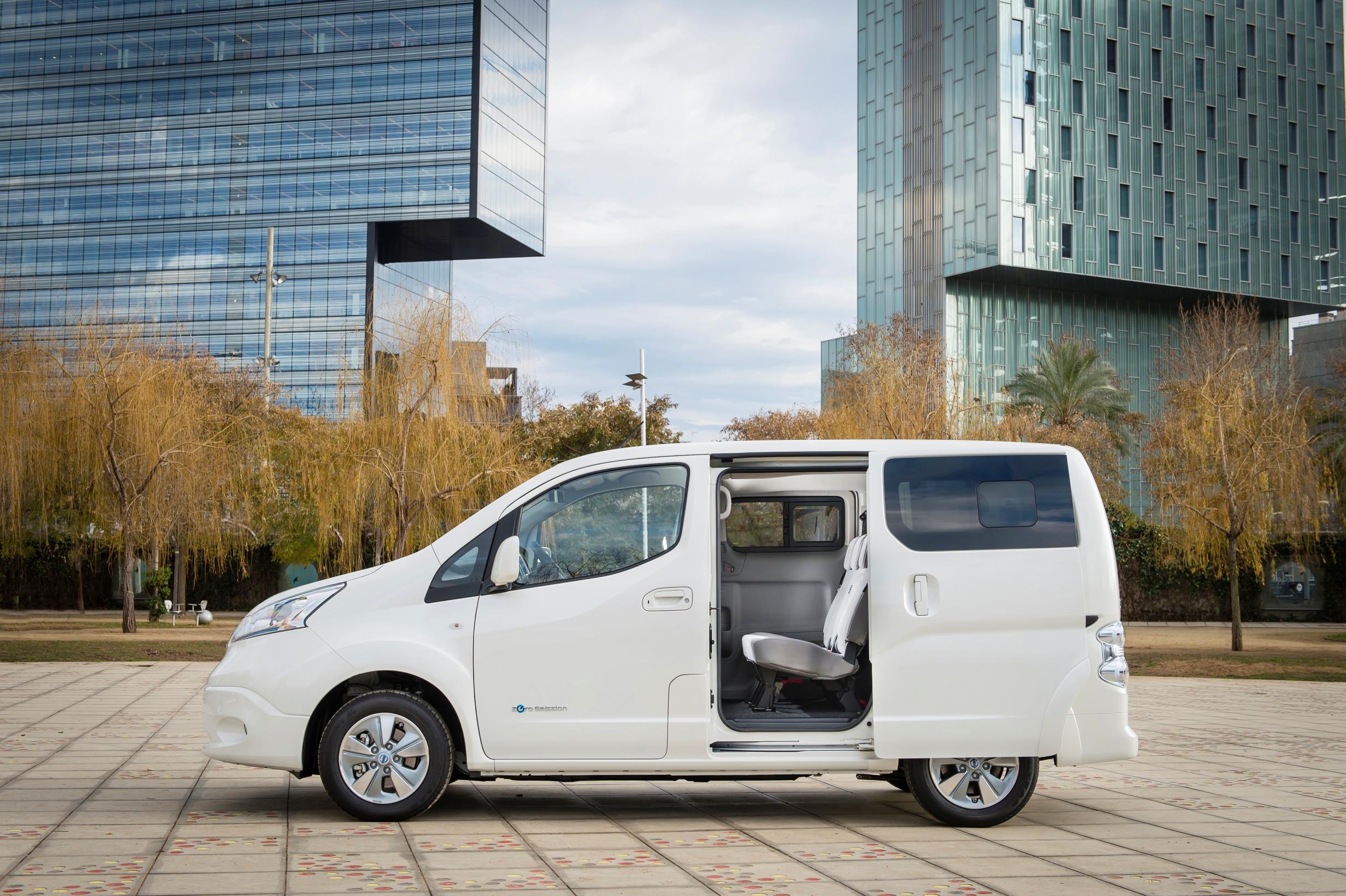
The new 40kWh battery for the 100% electric e-NV200 offers a 60% extended range of up to 280km NEDC. And, with no increase in size of the battery itself, customers will face no compromise in either load space or payload. Crucially, it can help make 100% electric last miles delivery achievable for businesses and professional drivers everywhere, with customers now able to drive more than 100 km further on a single charge.
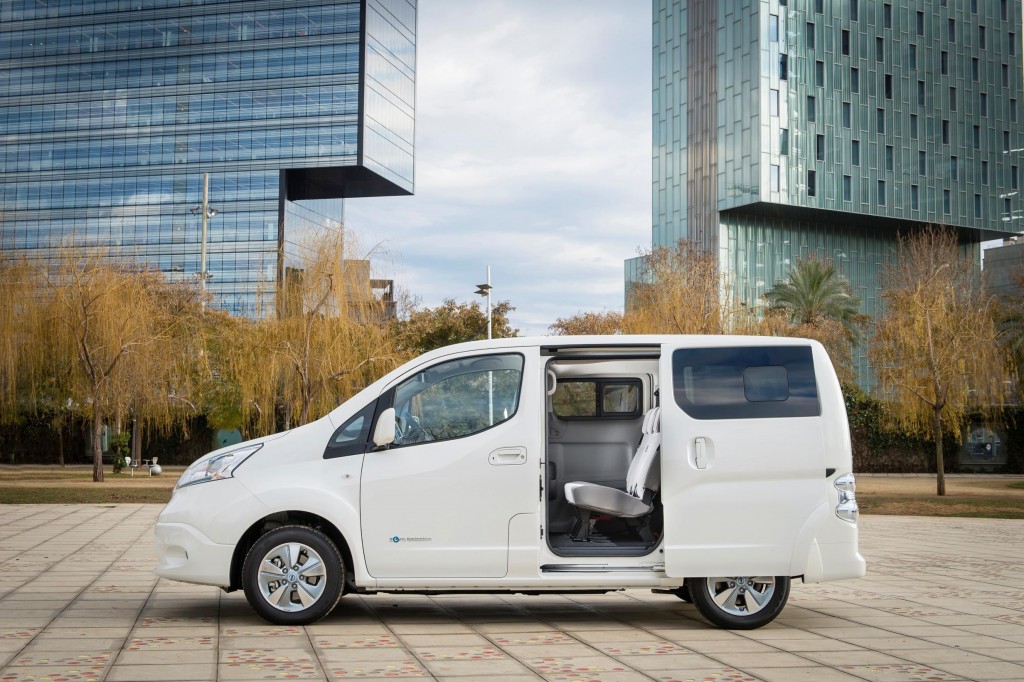
1450933_426205630_Nissan_world_premiere_of_new_longer_range_e_NV200_van
As well as helping business customers enhance their green credentials, the van represents a key pillar in Nissan’s wider commitment to cutting the level of CO2 emissions in city centres caused by professional drivers making deliveries and/or collections.

Nissan announced a few other things as well, including a so called “Revolutionary ‘free power for EVs’ breakthrough”:

Over the past year in Denmark, Nissan has been testing this revolutionary new way of driving and today, this has become an offer open to all fleet customers throughout the country. Using Nissan bi-directional charging, customers can draw energy from the grid to power their car or van and then ‘sell’ back to the grid for others to use. This means, once a nominal charge has been paid by the business for the installation of a V2G charger there are no fuel or energy costs; just free power for your EV.

And Denmark is just the start. Nissan also announced a UK collaboration with OVO allowing customers to purchase an xStorage home energy unit at a discounted price enabling them to ‘sell’ back energy to the grid. This helps contribute to grid stability in a world where demand for energy is increasing due to a growing, urbanising population. It can result in an additional expected income for users averaging £350 / €400 per year.

OVO Energy have also issued a press release about their collaboration with Nissan today:

The new offering is the first of its kind in the UK and will combine VNet – OVO’s groundbreaking intelligent energy technology – with the capabilities of the innovative Nissan xStorage Home system.

Building from this collaboration, OVO plans to launch OVO SolarStore (beta), the company’s first battery storage offering for qualifying customers. OVO customers with solar households will soon be able to purchase an xStorage Home system direct from OVO for £4,800 (excluding installation, subject to terms and conditions), and benefit from a £350 annual credit and estimated average £240 savings on their energy bill.

According to OVO CEO Stephen Fitzpatrick:

Electric vehicles are fast becoming a mainstream option for drivers and solve many of the challenges facing our cities. We believe that they have an integral part to play in the twenty-first century power grid and accelerating decarbonisation and mobility.

We’re delighted that we can now offer such a compelling incentive to customers who are generating their own clean power, providing a truly sustainable alternative to the traditional energy model.

The press release also waxes lyrical about vehicle-to-grid technology!

Customer vehicle-to-grid (V2G) service planned from January 2018…

V2G technology allows electric vehicles to be fully integrated into the electricity grid and will likely help the grid maximise the use of renewables in the energy system.

The V2G offering will work by allowing Nissan EV owners to connect to the grid to charge at low-demand, cheap tariff periods. They can then use the electricity stored in the vehicle’s battery at home and at work when costs are higher, or even feed electricity back to the grid which could generate revenue for the EV owner. OVO plans to create special tariffs to reward customers for this interaction with the grid.

Currently if all 20,000 Nissan electric vehicles in the UK were connected to the energy network, we estimate that they would generate the equivalent output of a 200 MW power plant with a 10kW charger.

In a future where all vehicles on UK roads are electric, V2G technology could generate a virtual power plant of up to 200 GW. This energy capacity is more than double the peak requirement on the UK grid.

The new Nissan LEAF will be compatible with OVO’s VNet intelligent energy technology. Further details of the offer and the first installations will happen at the same time of the deliveries of the new Nissan LEAF, in January 2018.

If you want to register your interest in OVO’s forthcoming V2G offer they have a page on their web site where you can do so.

Yet another, albeit slightly older, OVO press release reveals more about VNet that arrived with their recent acquisition of VCharge:

In a move towards building a complete “grid smart” charging solution for electric vehicles, OVO Energy will begin to introduce its proprietary VNet technology across the network, unlocking smart charging capabilities on a national scale, ultimately enabling OVO Energy customers’ electric vehicles to function as mobile batteries at home and on-the-go, balancing renewable energy on the grid and allowing drivers to sell back unused energy.

To accelerate this transition to smart charging, OVO has also acquired electric vehicle charge point specialists, ChargedEV and Indra Renewable Technologies, an electric vehicle components and services supplier, and is harnessing their technical expertise combined with Chargemaster’s, to develop a game-changing smart charger, due to be launched to market later in 2017.

OVO also now have a shiny new section on their web site devoted to the “OVO SolarStore (Beta)“:

Built to harness the potential of your solar set-up, OVO SolarStore (Beta) combines a home battery with state-of-the-art software.

Not only could it lower your bills, but by joining the beta you’ll be helping to create a greener, more-efficient energy system for the UK.

  • Reduce your bills by storing surplus solar power in your battery to use later.
  • Your battery will support renewable generation in the energy grid by storing electricity when it’s abundant, and discharging electricity when national demands spike.
  • Receive a fixed monthly credit for using your battery and helping to balance the grid.
  • Optimised and managed by our advanced technology, so you won’t need to do a thing.

The OVO SolarStore page also includes comprehensive facts and figures:

  • Nissan xStorage – Power: 4.6kW, Capacity: 4.2kWh, Up to 5 year warranty, subject to Nissan’s terms and conditions.
  • Export Credit & Increased Solar-self consumption: £240 saving a year
  • Annual value of Battery Credit: £350 saving a year
  • Battery installation survey: £50
  • Battery cost: £4,800
  • Battery installation indicative cost: £500

Getting back to the Nissan press release for a moment, it also points out that:

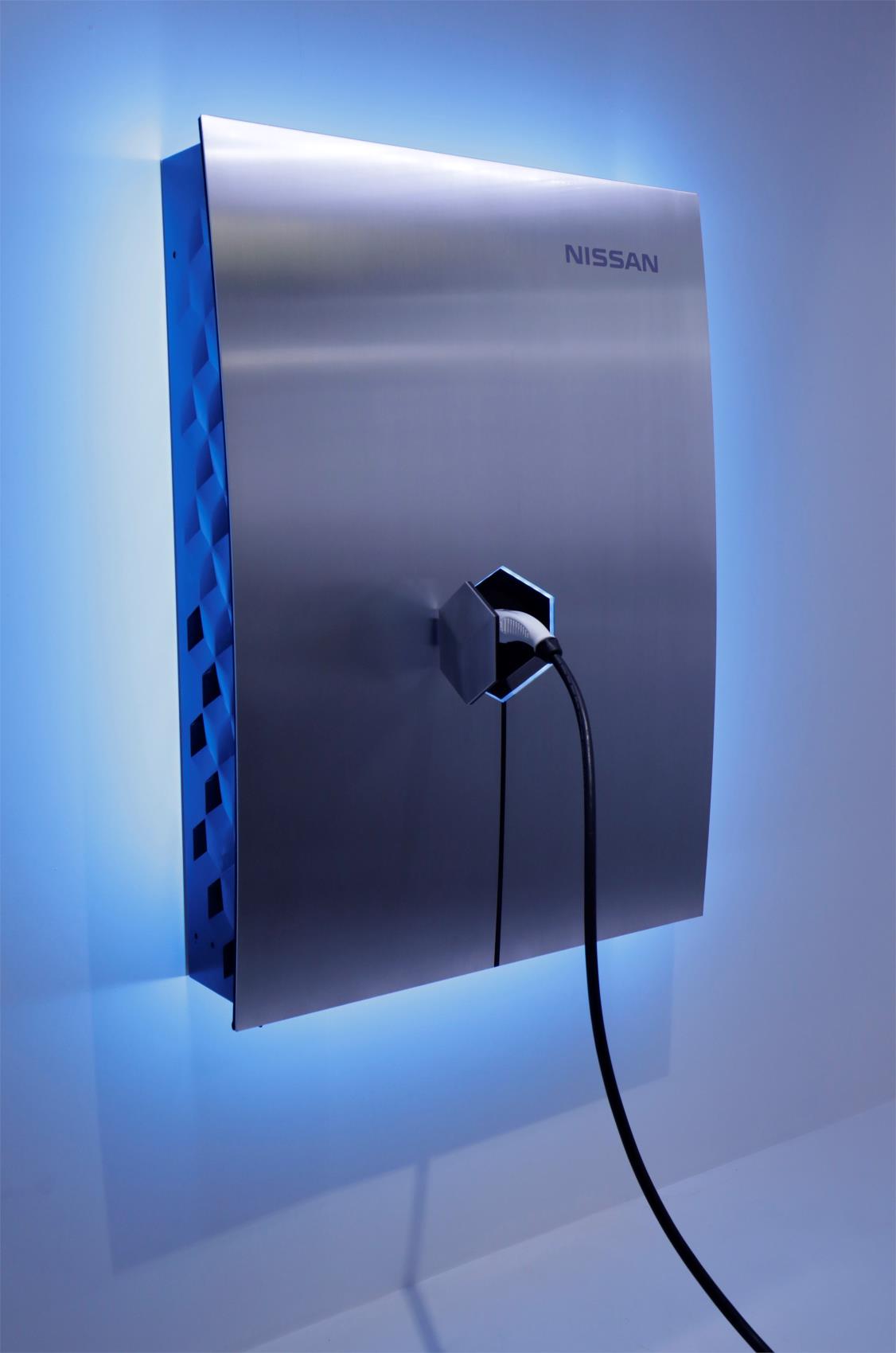
Nissan also showcased its new home energy storage system, which follows on from the success of xStorage. Created especially for EV owners, customers can plug their electric vehicle directly into the wall box to charge. It comes with its own built in energy storage system, giving customers the ability to better manage their energy costs and even generate their own electricity from solar panels, delivering 100% renewable and zero emission power for their car.
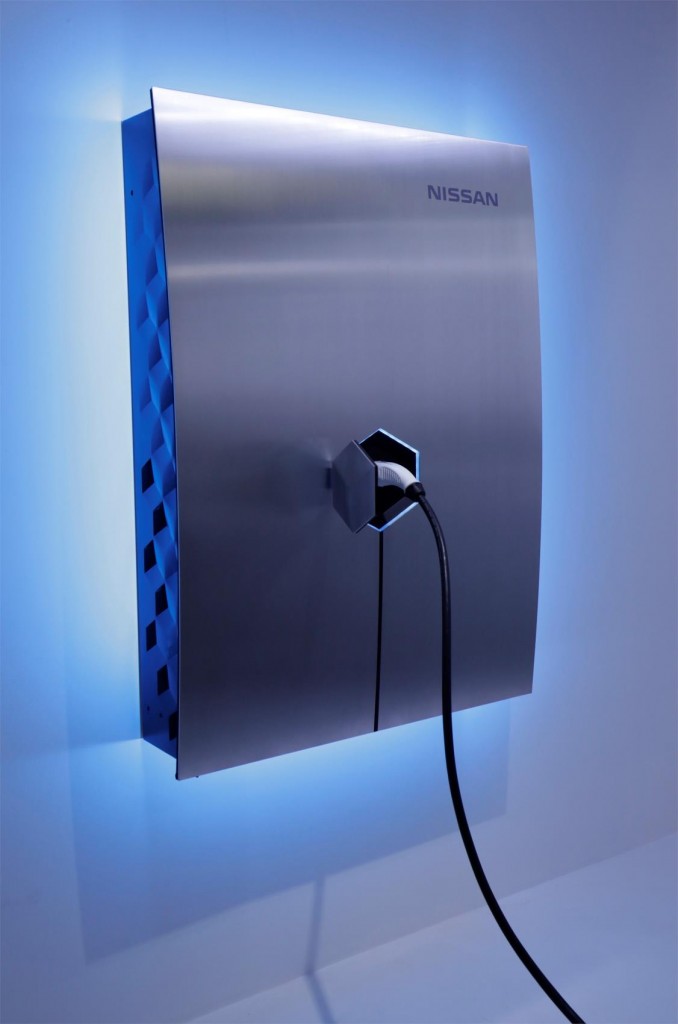
1450927_426205642_Home_Energy_System_xStorage

I wonder if OVO will ever get around to offering a game-changing bidirectional smart charger version of Nissan’s new combined home energy storage system? That would seem to be the perfect answer to the conundrum posed in our banner way back at the top of this article!

Renault ZOE – An Offer You Can’t Refuse? Day 1!

A few days ago I received an unsolicited telephone call asking me if I would like to test drive any Renault car. I said yes, as long as it was possible to test the Renault ZOE in and around Exeter. I was told “Certainly sir, which free gift would you like?”. I gather this offer is by invitation only, but you can nonetheless read all about it here, where it explains that one can:

Test drive and experience any model from the Renault range before 30 September 2015 and you can choose one of three complimentary gifts. Choose from a night away for two in a choice of hotels, afternoon tea for two or a spa treatment.

That definitely seemed like too good an offer to refuse, so I didn’t! The first thing I do at times like this is to take a look at Robert Llewellyn’s always entertaining reviews of electric vehicles on his Fully Charged show. Here’s the one for the Renault ZOE, recorded in 2013:

and here are a few of Robert’s bullet points concerning the ZOE:

  • It’s a small car. It has a really big boot, which is a surprise.
  • It’s got enough oomph to “get you out of trouble”.
  • A range of between 80 and 120 miles.
  • It’s much lighter than the Nissan LEAF.
  • It’s got a really clever heating system, that uses a heat exchanger, and it can also do the other way round. It’s 3 times more energy efficient than conventional heaters and air conditioning systems.
  • It has a 22 kWh battery.
  • It really holds the road well.
  • It’s got very good visibility.
  • When you buy this car it’s much, much cheaper than any other electric car that’s been on the market.
  • When you buy this car you don’t buy the batteries. The batteries belong to Renault, and they rent you the batteries.
  • It is a really nice car to drive. It’s a really simple car to drive.
  • It comes with a special car rental deal. If you buy this car and then you want to “Go to Scotland” or “Go to the South of France”, then you ring up and you book a car and it gets delivered to your house and you’ve got a rental internal combustion engine (ICE) car and you go on holiday [in that instead].

So far so good then, and a couple of days later we had a short drive around the Marsh Barton trading estate in Exeter. We both took our turn at driving the ZOE, and Kasia liked it a lot. Daniel Mann, the Renault Sales Manager at Bristol Street Motors in Exeter, explained that their most attractive offer at the moment is a two year PCP deal for £79 down and then £79/month, which doesn’t include the battery. The small print explains that “Battery hire is £55 per month for 750 miles per quarter“. That also sounds very much like an offer one cannot refuse, but it was at that point that I had to explain our particular circumstances to Dan. The ZOE seems to us like an excellent way of driving a few tens of miles to work and back, but V2G’s home, office and laboratory are all in the same building. We don’t do a daily commute, but we do occasionally drive to Bristol Airport, we do occasionally go on business trips to the far side of London, and we do from time to time go surfing on the north coast of both Devon and Cornwall. Our short test drive hadn’t given us much of a feel for how the ZOE would be able to cope in those situations. As Robert explains in the video above we could always hire a more conventional car as and when required, but then we’d hardly ever use the ZOE!

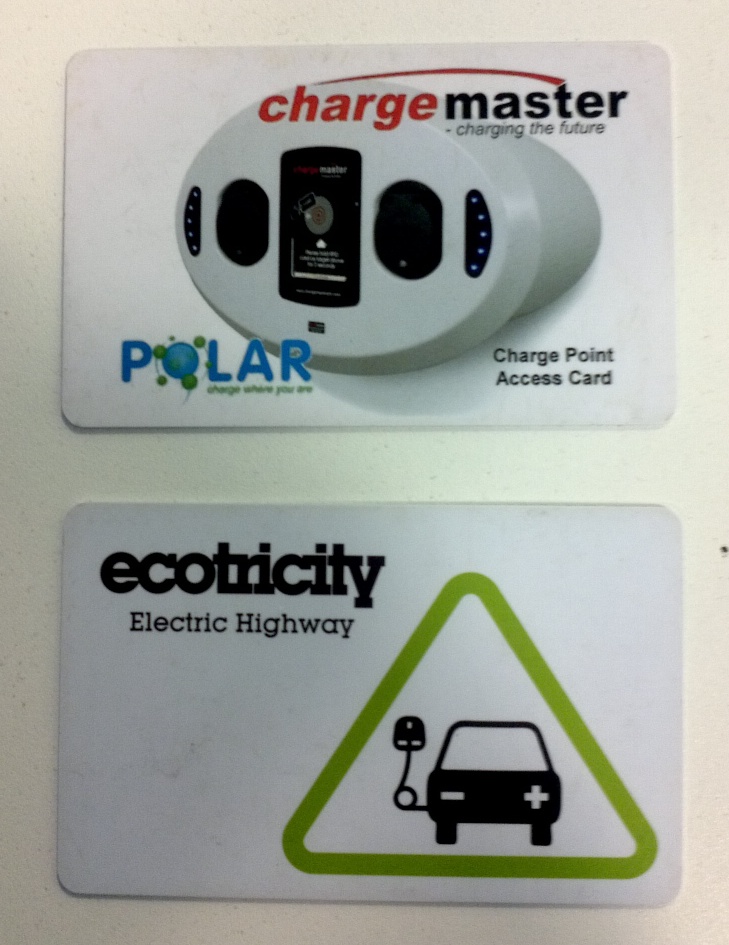
We had a chat to Marc Seabridge, Bristol Street Motors EV specialist (pictured below), and explained that I’d be dropping Kasia off at Bristol Airport the following weekend and then returning to Exeter. I wondered whether we could borrow the ZOE to do that trip, in an endeavour to discover if it was fit for our particular purposes. Marc said yes! When we picked the car up at 11:00 on Friday he lent us a couple of RFID cards so that we could charge the ZOE en route, one for ChargeMaster’s Polar network and one for Ecotricity’s Electric Highway:

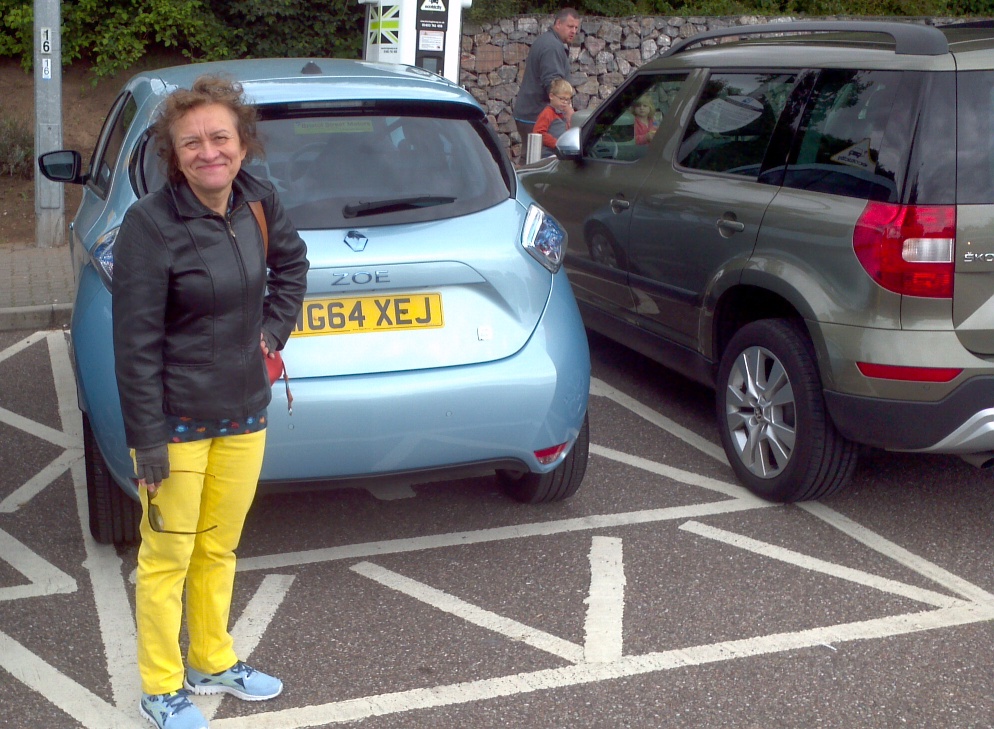
The ZOE’s lithium ion battery was about 70% full when we picked it up, so we thought we’d get the hang of charging an EV at a public fast charger by heading straight to Exeter Services, just off the M5 motorway. That’s where our troubles began!

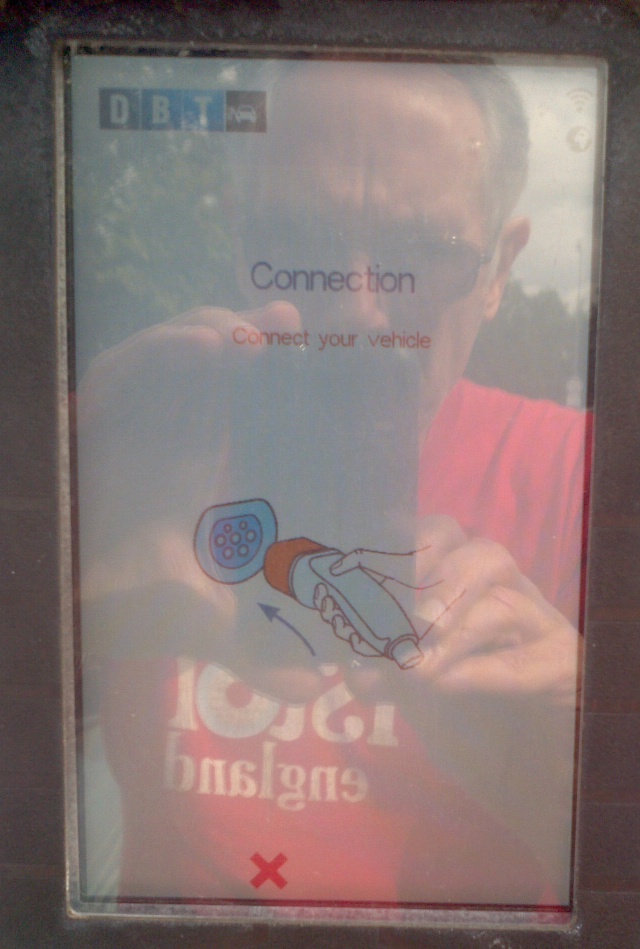
Try as we might, and even with lots of telephone assistance from James Cocks, the Service Manager at Bristol Street Motors, we couldn’t persuade the ZOE to successfully connect to the Electric Highway type 2 fast charger. Here’s what the problem looked like:

Whatever we tried, there was no way we could persuade a little green tick to show itself. Chastened, we headed back to Marsh Barton to top up the ZOE at one of BSM’s own charging points:

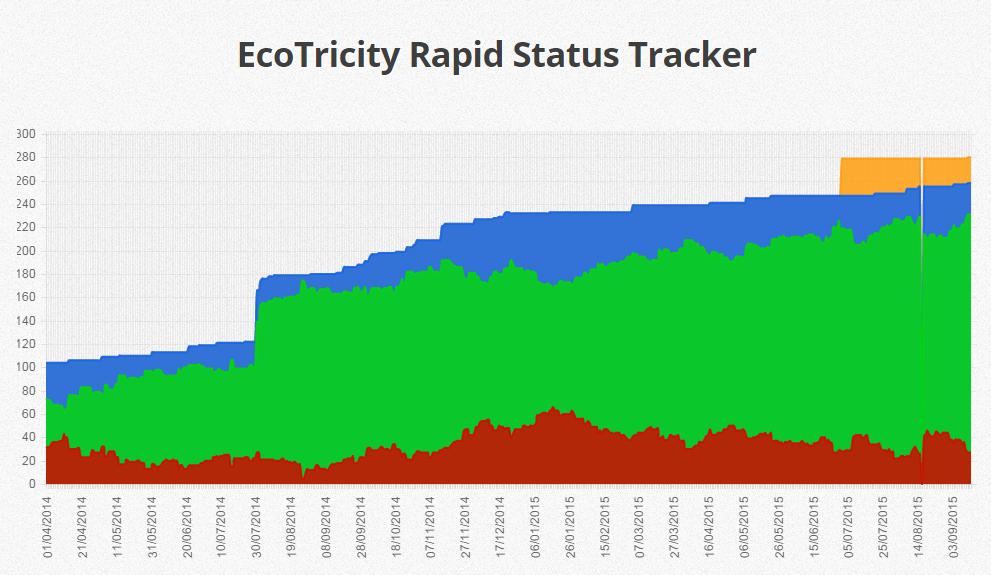
Whilst we waited I telephoned the Electric Highway helpline and explained what we’d discovered. I was told that Ecotricity were already aware of the problem, but they couldn’t tell me when it might be fixed. It seems they have quite a few non functional chargers, and not many engineers available to repair those that cannot be restored to full health via a remote connection from Ecotricity’s offices. Here’s a graphical demonstration of the problem:

To be continued……..