Is Apple Developing an Electric Vehicle?

According to Bloomberg the answer to the question posed in our title is a most definite yes! In a February 19th article Tim Higgins says that:

Apple Inc., which has been working secretly on a car, is pushing its team to begin production of an electric vehicle as early as 2020, people with knowledge of the matter said.

The timeframe — automakers typically spend five to seven years developing a car — underscores the project’s aggressive goals and could set the stage for a battle for customers with Tesla Motors Inc. and General Motors Co., both of which are targeting a 2017 release of an electric vehicle that can go more than 200 miles on a single charge and cost less than $40,000.

then adds that:

Apple representatives declined to comment for this story.

According to Bloomberg, however:

Apple began around June an “aggressive campaign to poach” employees from A123 Systems LLC, the Waltham, Massachusetts-based battery maker said in a lawsuit against Apple filed this month.

Apple hired five people from A123 and has tried to hire battery experts from LG Chem Ltd, Samsung Electronics Co., Panasonic Corp., Toshiba Corp. and Johnson Controls Inc., according to the lawsuit.

Bloomberg also talked to Tesla CEO Elon Musk, who told them:

That Apple was seeking to hire away his workers, offering $250,000 signing bonuses and 60 percent salary increases.

It seems as though when it comes to EVs, there’s never any smoke without fire?

[Edit – Saturday February 21st 2015]

This morning’s edition of The Economist includes an article on the Apple EV rumours:

APPLE’S ability to make desirable iGadgets designed for easy portability is beyond question. Reports emerged this week that it is planning to make a mobile device that will instead carry its users—an electric car. Apple’s plans are unclear and unconfirmed. By some accounts it has put a few hundred people to work developing cars to match Tesla, another Silicon Valley firm that makes fast and luxurious battery-powered saloons. Others reckon that it is working on a self-driving car.

Plenty of other tech firms are turning their attention to cars. In February Uber, a firm that provides taxis through a smartphone app, said it would set up a laboratory in Pittsburgh to develop self-driving taxis. Sony recently put money into ZMP, a self-driving car startup; Google has been working for years on driverless cars.

The Economist doesn’t sound optimistic about the future for the alleged Apple EV:

The likes of Apple may not know much about pistons and gearboxes, but the big challenge for electric cars is batteries. Battery-powered cars have many advantages: refuelling at home, cheap running costs and no tailpipe emissions. But the market for pure electric vehicles is tiny:

Expensive batteries make for costly cars, and limited range and a lack of recharging infrastructure have put off most drivers. Nissan’s Leaf, the world’s best-selling electric car, attracted only 40,000 buyers last year compared with the 250,000 the company once hoped to shift. Tesla aspires to enter the mass market but so far it has dealt with the battery problem by putting lots of them in a big, expensive car, thereby limiting it to a luxury niche. The plunging oil price dents the prospects for electrification still further.
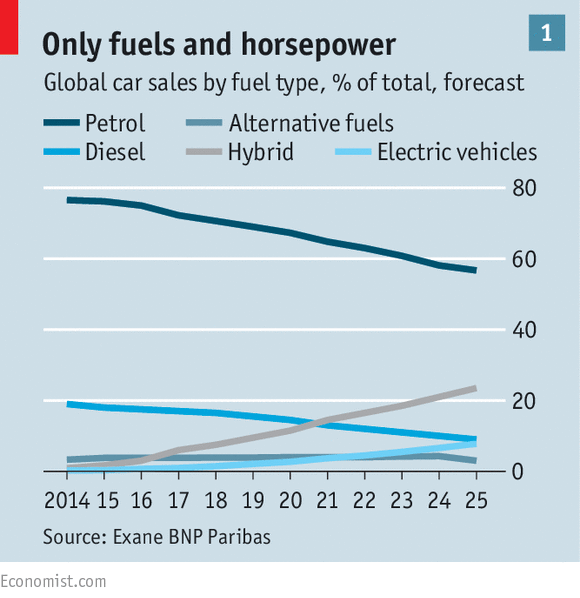
and concludes:

Tech firms may be better off working with carmakers, to develop the software that will provide the brains of the self-driving car, and to improve the range and battery costs of the electric car. In the motor industry, supplying the key parts is generally more profitable than putting the cars together, even if you do not get your company’s badge on the bonnet. In the future cars will be different but the brands will probably be much the same.
 

Used Nissan EV Batteries Now Provide Grid Scale Storage

Nissan have recently announced that:

The manmade island of Yumeshima in western Japan’s Osaka is now home to the world’s first large-scale energy storage system, a project that also highlights the potential to reuse electric vehicle batteries.

Hikari-no-Mori – or Forest of Light – is a mega-solar project of 36,000 solar panels built on top of a landfill and managed by Sumitomo Corporation.

The first paragraph is not strictly accurate, since as we reported a couple of years ago, such things have been in use in Spain for a while now. Sumitomo’s press release about the project was nearer the mark stating instead that:

Sumitomo Corporation has developed and installed the world’s first large-scale power storage system which utilizes used batteries collected from electric vehicles.

Nissan did however also release the following video, so we can see for ourselves what the partnership has in fact developed:

According to Sumitomo once more:

Over the next three years, the system will measure the smoothing effect of energy output fluctuation from the nearby “Hikari-no-mori,” solar farm, and will aim to establish a large-scale power storage technology by safely and effectively utilizing the huge quantities of discarded used EV batteries which will become available in the future. This project has been selected as a model project for “Verification of the battery storage control to promote renewable energy” for the fiscal year 2013 by the Ministry of the Environment of Japan.

Sumitomo Corporation created the joint venture company, “4R Energy Corporation”, in collaboration with Nissan Motor Co., Ltd. in September 2010, to address the secondary use of EV lithium-ion batteries. The used EV batteries that will be recycled into this large-scale storage system have been recovered and have gone through thorough inspection and maintenance at 4R, to confirm safety and performance. This prototype system (600kW/400kWh) consists of sixteen used EV batteries.

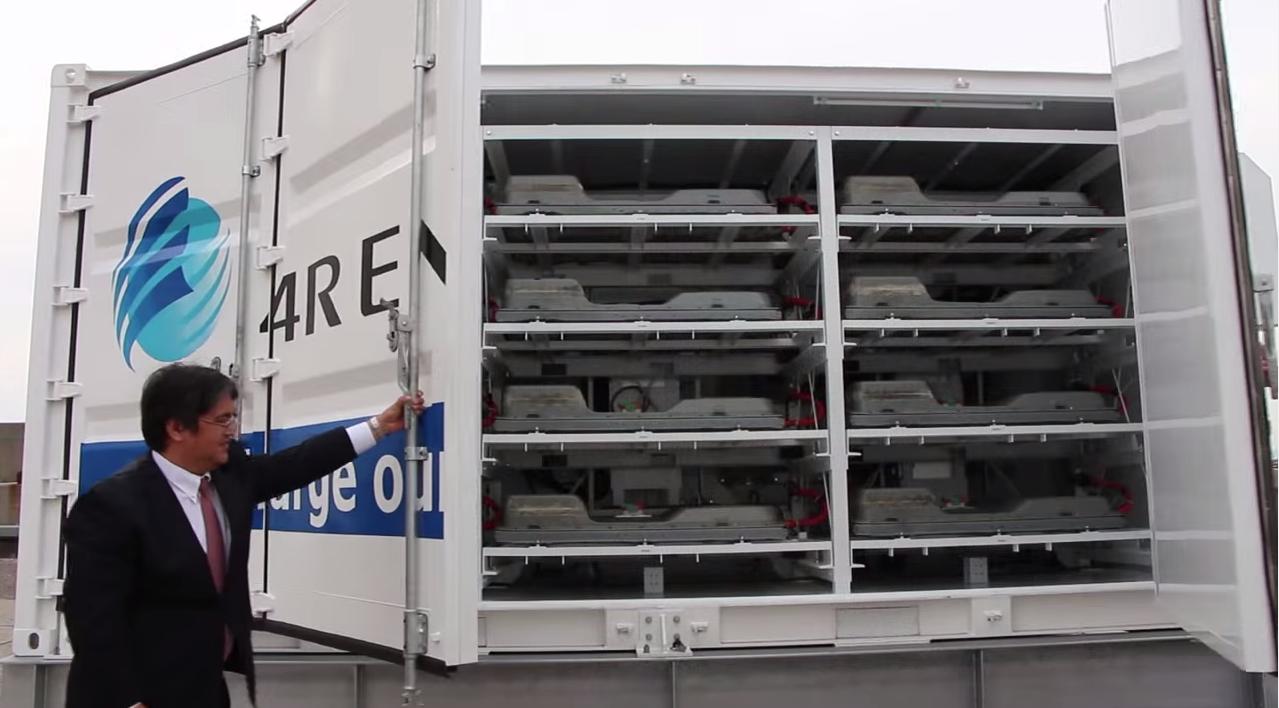
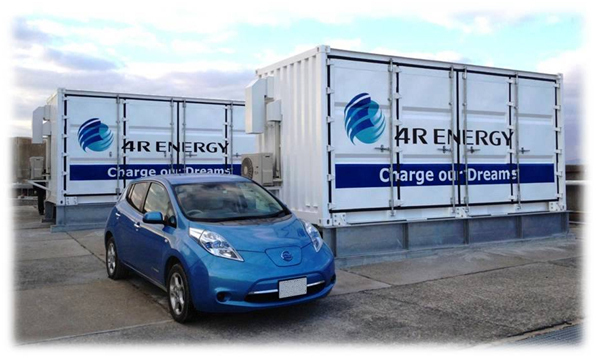
The 600kW/400kWh rating of the Japanese energy storage system compares unfavourably with the 1.1MW/560kWh of the lithium-ion battery Saft system installed in Spain, so it can’t even claim to be the largest such system in the world, but the French system uses new batteries rather than ones that are no longer up to the job of powering an electric vehicle. Here’s what the 4R system looks like:

A glimpse inside a 4R Energy used EV battery storage system

A glimpse inside a 4R Energy used EV battery storage system

It seems to have 12 battery packs per container, although Nissan claim that:

A joint venture between Sumitomo and Nissan called 4R Energy – Reuse, Resell, Refabricate and Recycle – uses 16 lithium-ion batteries from EVs to help monitor energy fluctuations and store the solar farm’s energy output.

Judging by both Nissan’s video and Sumitomo’s picture there looks to be two of those on the man-made island, so maybe the actual number is in fact 24?

Continuing with some further (hopefully accurate!) quotes from Nissan’s press release:

Natural energy sources, such as solar and wind, vary in strength and frequency, and the innovative battery management system developed by 4R is the first of its kind, says the firm’s President Eiji Makino.

“Depending on use, a battery’s degree and rate of deterioration and the battery’s condition vary by vehicle,” says Makino. “So 4R has created a technology that allows us to have optimal control in regulating those conditions.”

The project is part of a three-year test under Japan’s Environment Ministry to expand renewable energy resources and power grid management. In Japan, electricity liberalization will be realized after 2016.

The batteries have up to 70% of capacity remaining – the average left after 100,000 kilometers or five years of driving.

Sumitomo General Manager Norihiko Nonaka said his company, in cooperation with 4R, expects to make the results of the project commercially viable in 5 years or so.

“The electricity-value-chain is divided into 3 sections: electricity generation, transmission and distribution. We would like to focus on electricity generation and transmission. If we rely on renewables to obtain energy – like solar and wind – they don’t always generate the necessary amount of energy and that may cause an issue with supply-and-demand,” said Nonaka.

“On the other hand, if the cost of batteries is too high and is economically inefficient, 4R will have to continue to work and investigate the situation and market in the long term, about 5 years or maybe after 2020.

In conclusion I fear I may have to disagree slightly with Sumitomo for a change. Why should “the electricity-value-chain” not also include community renewable energy projects such as the South Brent Community Energy Society’s 250 kW wind turbine, which is located a few miles down the A38 from the V2G offices, and of which I am a proud (albeit modest) shareholder?

The Nissan LEAF – Now Built In Britain

The very first British built LEAF electric vehicle has recently rolled off the production line at Nissan’s plant in Sunderland. British Prime Minister David Cameron was there to celebrate the event, as were some cameras. Here’s what one of them recorded:

Commenting on Nissan’s £420 million investment Mr. Cameron said that:

This plant, all of the people who work here, the cars being produced behind me, are the best possible rebuke to those who say “In Britain we can’t design things any more, we can’t make things any more or we can’t export things any more. You’ve shown here at Nissan in Sunderland that we can, and we can do it brilliantly.

As the reporter points out:

The new LEAF boasts over 100 improvements and uses an advanced lithium-ion battery, which is also manufactured at the Sunderland plant. Updates include an increased driving range of 123 miles or 199 km, and the ability to recharge in half the time of the first generation LEAF.


More than 54,000 LEAFs have been sold worldwide. Nissan says the new LEAF is the first in a number of pure electric vehicles that it plans to launch over the next few years.

Unfortunately no mention was made of the “vehicle to home” technology that Nissan have been trialling back home in Japan, let alone fully fledged V2G. Maybe Mr. Cameron will announce some significant Great British investments in the design of such esoteric devices in the near future?

George Osborne Invests in Energy Storage

George Osborne, the United Kingdom’s Chancellor of the Exchequer, gave a speech at The Royal Society yesterday, extolling the benefits of scientific research for the British nation.  He said that:

I want to begin a debate about eight future technologies where we believe we can be the best – where we already have an edge, but we could be world-leading.

Number 5 on Mr. Osborne’s technology shopping list he described as:

Energy Storage for the Nation: Stockpiling Electricity

More specifically he mentioned three particular areas of British expertise:

First there are the batteries in all our personal electronic devices. These use lithium ion batteries working on a chemical reaction developed at Oxford in the early 1980s. Thirty years on that basic technology is still central.

Second there is the development of battery-powered vehicles. One reason Nissan decided to produce their new all electric LEAF car here in the UK in Sunderland was the continuing support for research on innovative batteries for cars.

Third there is the challenge of storing more electricity for the Grid.

Mr. Osborne then expanded on the why and the how of the UK Government’s support for grid scale storage research and development:

Electricity demand peaks at around 60 GW, whilst we have a grid capacity of around 80 GW – but storage capacity of around just 3 GW. Greater capability to store electricity is crucial for these power sources to be viable. It promises savings on UK energy spend of up to £10 billion a year by 2050 as extra capacity for peak load is less necessary.

The Research Councils’ energy programme is investing over £500 million over this Spending Review period in energy research, including energy storage. However, urgent action is needed to accelerate translation of research into new technologies and products so that global market opportunities are realised by UK companies – and ensure the UK is established as an international focus for energy storage research and innovation.

Research projects are delivering but the UK currently lacks the test-bed demonstrator capacity and dedicated R&D facilities to take the next step in developing and testing new grid-scale energy storage technologies. We need to create them. We are funding the Energy Technologies Institute jointly with industry partners – including BP, Caterpillar, EDF Energy, E.ON, Rolls Royce and Shell – to accelerate new technologies for producing clean, reliable and affordable energy. And we are now investing £800 million with industry to maximise the funding of low carbon energy technology innovation.

Mr. Osborne ultimately concluded his speech by saying that:

It is right that, even at times of fiscal restraint, we find the resources to enable new scientific breakthroughs, to bridge the gap between discovery and commercialisation and to spread the economic and social benefits of scientific research. The prize is not just our future wealth but our health and quality of life, and our commitment to intellectual enquiry.

No one can know what the future holds. But we can discern those areas where we have particular strengths and which scientists themselves believe have the most potential. Let us identify what Britain is best at – and back it.

We have great science in Britain. We are backing it. And we will do more.

Let’s hope so! Mr. Osborne may not know what the future holds, but personally I predict a rather grim one if the UK (and indeed other nations) doesn’t get its energy R&D and broader energy policy sorted out in a hurry. Do you suppose the forthcoming Energy Bill will achieve that? Whilst we wait with bated breath to find out here’s a video in which David Clarke, Chief Executive of ETI, explains his views on “the real issue of avoiding the cost of having to upgrade our distribution network for electricity” in general, and Isentropic’s “pumped heat” thermal storage in particular:

Nissan Announce “LEAF to Home” Power Supply System

Nissan announced last week that from the middle of this month its Japanese dealerships will be showcasing:

An industry first backup power supply system that can transmit the electricity stored in the large-capacity batteries of Nissan LEAFs to a residential home.

Here’s a video in which Nissan corporate vice president Hideaki Watanabe explains the benefits of such a system:

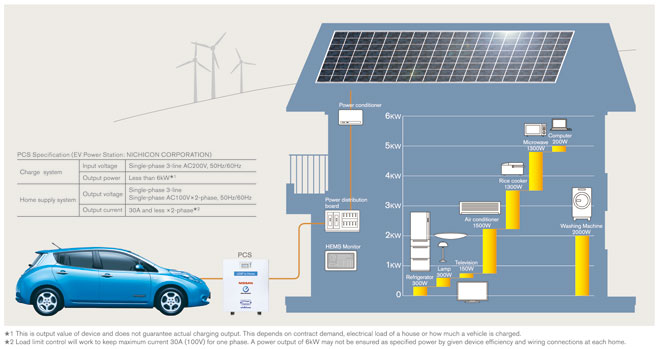
The technology is actually supplied by Nichicon as part of their “EV Power Station” fast charging units. According to Nissan:

The LEAF to Home system will help encourage Nissan LEAF owners to charge their cars with electricity generated during the night, when demand is low, or sourced from solar panels. This assist in balancing energy needs by supplying electricity to the grid during daytime, when demand is highest. It can also be used as back-up power source in case of power outages and/or shortages.

The [LEAF’s] lithium-ion batteries can store up to 24kWh of electricity, which is sufficient to supply an average Japanese household for about two days. This system underscores an additional attribute of EVs: vehicles which can be used as a storage battery whether they are moving or stationary.

Nissan say that “all current Nissan LEAF owners in Japan will be able to use the system, depending on their home’s installation requirements” as long as they have 330,000 yen to spare (after Japanese government subsidies). Nissan are forecasting sales of 10,000 “LEAF to Home” systems in the first year.

Mr. Watanabe says in Nissan’s video that:

We are starting from Japan, but if there is interest from other parts of the world we are willing to partner up with any other partners. This time we are partnering up with Nichicon, so we can go out to other countries and partner up with other global suppliers.

Nissan’s press release concludes by saying:

Nissan and Nichicon will continue to work together to create new value in EVs as part of the way forward toward the realization of a zero-emission society.

although they don’t forecast when such a society will be realized!

P.S. The video mentioned above seems to have disappeared, so here’s an infographic of Nissan’s V2H technology instead:

Nissan-LEAF-to-home-system