The Labour Party Likes V2G!

The United Kingdom’s Labour Party has issued two related press releases recently. According to the first one from September 21st:

Speaking on the Today programme, Shadow Chancellor John McDonnell announced that Labour will introduce 2.5 million interest free loans for the purchase of electric cars.

The loans of up to £33,000 will allow low to income households, those living in rural areas and independent contractors and SMEs middle to save on new electric cars. The government will cover the £1,500 cost of interest on a loan, with individuals saving up to £5,000 over time.

The scheme will ensure that access to the Electric Car Revolution is broadened beyond elites, as part of Labour’s vision of clean transport for everyone.

The interest-free loans will require participation in a mass trial of Vehicle-2-Grid technology which will allow the UK to transition to renewable energy.

This new technology will allow electric cars to store excess energy from the national grid, smoothing energy supply from renewable sources.

The scheme will boost the British automobile industry and support the UK’s transition away from petrol and diesel cars.

Then two days later the second one announced that:

In order to jumpstart the transition to electric cars and tackle the climate emergency Labour will invest £3.6 billion into a mammoth expansion of the UK’s electric vehicle (EV) charging networks.

Labour’s rapid roll out of charging stations will eliminate concerns over driving range and lack of electric car charging infrastructure by providing enough electric charge points for 21.5 million electric cars – 65% of the UK’s fleet – by 2030. This would double the number of electric cars that the Conservatives are planning for by 2030.

The networks will be made up of ‘en-route’ Ultra-Fast charge stations along motorways, and a mixture of ‘about town’ Rapid and Ultra-Fast charge stations in more urban environments.

Electricity will be generated from renewable sources and distributed by Labour’s publicly owned grid and newly created National and Regional Energy Agencies. These bodies will also oversee the roll out of the EV charging networks and create up to 3,000 new jobs for electricians and network engineers.

These plans will create the infrastructure necessary to transition the UK away from fossil fuel driven cars to low-carbon electric cars – tackling climate change and boosting the UK’s automobile industry.

On the expansion of the UK’s EV charging networks charging Shadow Secretary for BEIS, Rebecca Long Bailey said:

“The Tories have sat on their hands as air pollution poisons our children and the climate emergency intensifies. Their inaction on electric charging infrastructure has held back the transition to cleaner vehicles and put our industry behind the curve.

“Labour is ready to jumpstart an Electric Car Revolution. We will roll out electric vehicle charging infrastructure to every city, town and village, and along our motorways.

“Under Labour, nobody buying an electric car needs to worry about running out of fuel.”

All of which is of course sweet music to our ears. Now all we need is for the Labour Party to win the forthcoming election! Failing that presumably a coalition with the Lib Dems and/or the Green Party would also approve of similar plans? Here’s our local Lib Dem candidate, Danny Chambers, inspecting the AC V2G charging post currently installed in our North Cornwall car park:

20190920_164833

I wonder who the local Labour candidate is?

Triodos’ New Car Park with Solar Powered AC V2G

Today we are finally able to bring you exciting news of a large vehicle-to-grid installation in the Netherlands, with some unusual twists apart from the sheer number of charging stations.

In a thankfully English language article in PlaceTech it was reported earlier this week that:

Edge has delivered an office building for Triodos Bank in the Netherlands engineered to be sustainable inside and out with the latest circular construction principles designed throughout. The 135,000 sq ft office in Driebergen-Zeist, Netherlands was built with the intention to harmonise with the surrounding fauna and flora, on a construction level and beyond.

Edge-triodos-12

Please bear in mind that the article is referring to EDGE Technologies which is part of Dutch developer OVG Real Estate, and not the U2 guitarist!

After further description of the office building itself the article eventually gets to the part of the project of most interest to us. The solar PV covered car park:

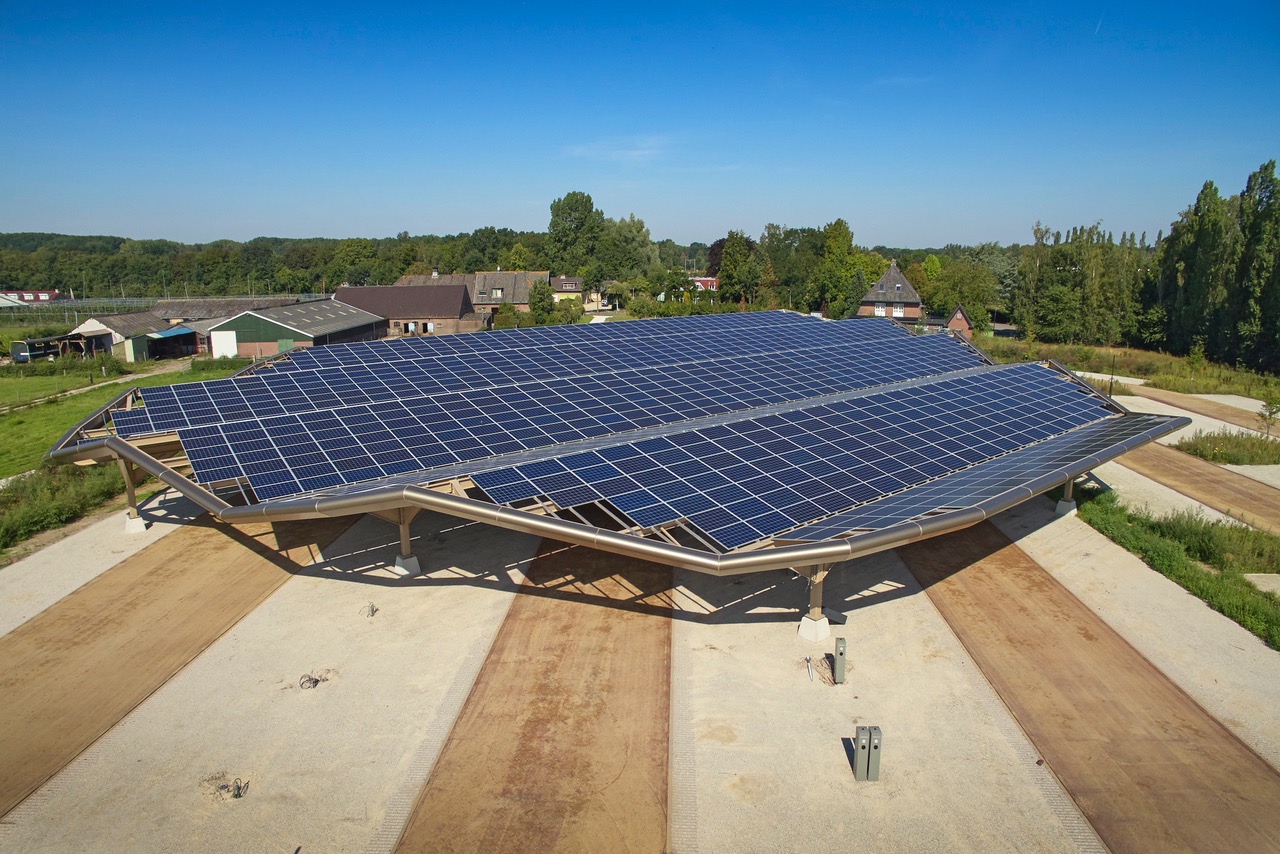
The extensive use of renewable energy, reflected in over 3,000 m² of solar panels, as well as heat and cold storage, contributes to the energy neutrality of the building. The project encompasses ‘smart charging’ electric cars from solar energy and ‘Vehicle2grid’ technology. Vehicle2grid means that the cars cannot only be charged with solar energy but also discharged, which is called bi-directional charging. The cars become an active part of a ‘smart net’, which includes such benefits as being able to store solar energy.

Drone triodos

The PlaceTech article doesn’t go into any more detail than that but we certainly intend to, not least because the aerial view of the solar PV canopy reveals a number of electric vehicle charging stations that look identical to the one we have installed in our “wall to wall” V2G “living lab”:

DSC_0464

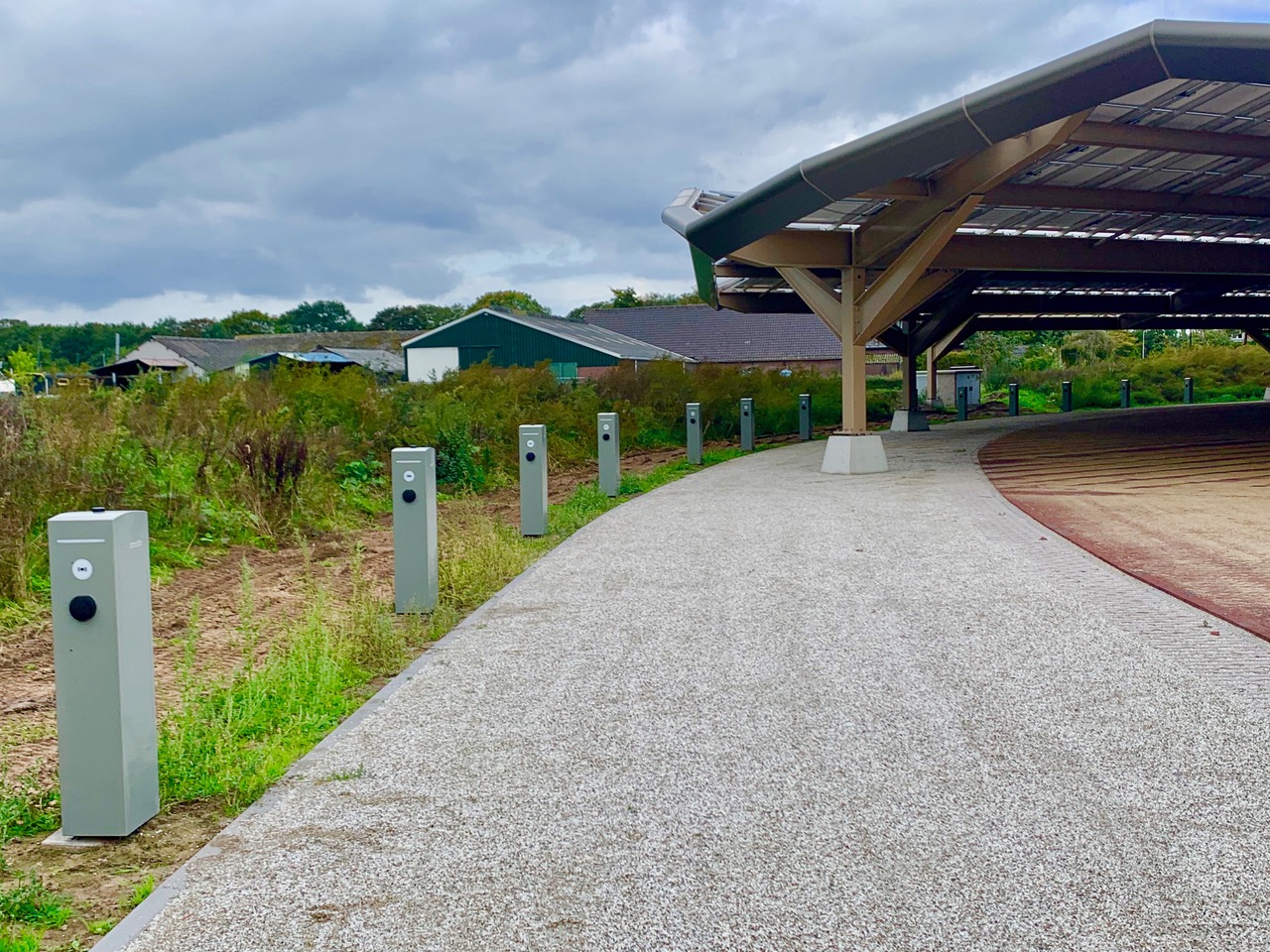
Taking a look at the new Triodos car park from ground level it becomes apparent that a large array of AC V2G capable charging stations are currently being installed, both under and around the solar PV canopy:
SolarStations

To find out more about what’s going on we’ve had to resort to Google Translate. According to a Dutch language article on the Triodos Bank web site from earlier this year:

The largest bidirectional charging plaza in the world is under construction at the new office building of Triodos Bank next to Driebergen-Zeist station. From this Autumn, 120 smart chargers will be able to store solar energy in the batteries of shared electric cars.

Triodos Bank have realised the project in close collaboration with developer EDGE Technologies and We Drive Solar. The bidirectional chargers are directly connected to 3,253 m² of solar panels and have a triple function. Electric cars can charge here. Cars whose battery is full enough can also supply power, so that the energy can be used in the office building or be fed back into the electricity grid.

Part of the plan is that Triodos Bank will replace its pool cars with 100% electric cars, so that they become part of the bidirectional charging ecosystem. Triodos Bank will investigate how, in addition to Triodos Bank employees, the residents of Zeist and the surrounding area can also use its shared electric cars. According to Triodos Bank director Matthijs Bierman “The plan fits in with our new ambitions in the field of sustainable mobility. We want to make car sharing as sustainable and attractive as possible. Not only for our employees, but also for the local community.”

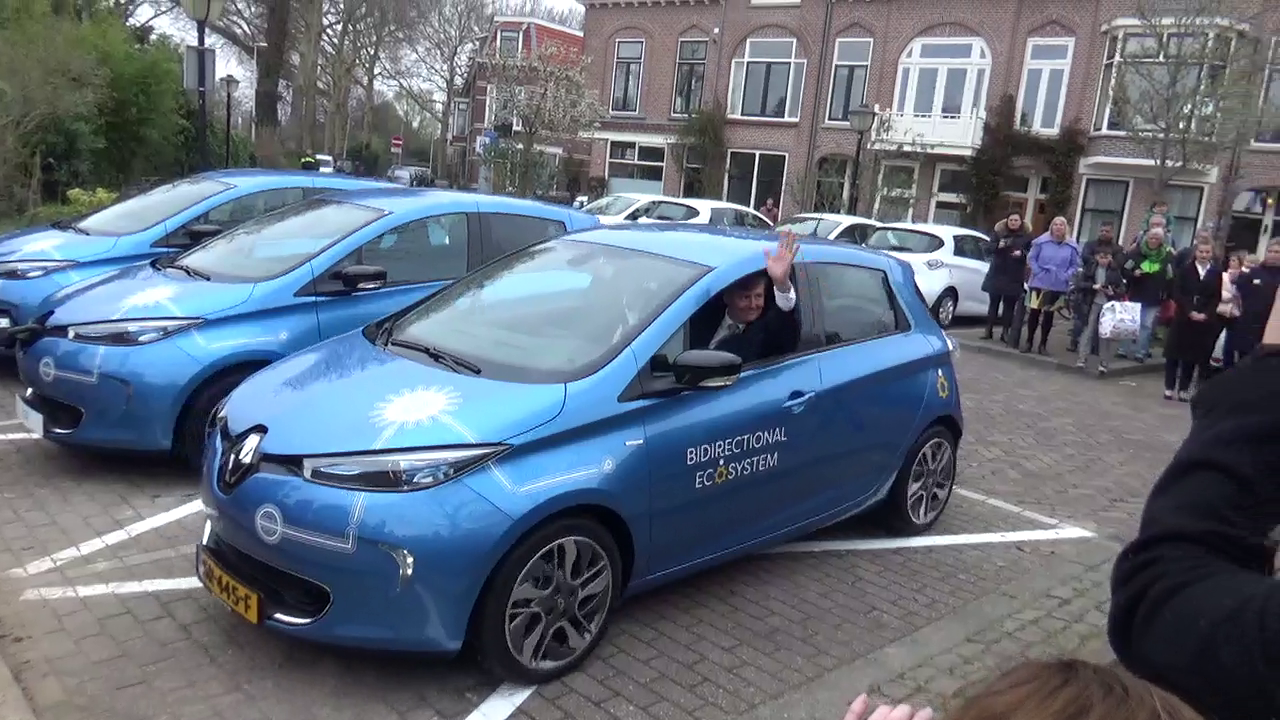
Now 120 AC V2G charging stations sounds amazing, but where are 120 or more AC V2G capable electric cars going to come from? I can help answer that question, since I attended the launch of the We Drive Solar bi-directional ecosystem in Utrecht earlier this year. According to Renault:

A fleet of fifteen Zoe vehicles with vehicle-to-grid charging will be introduced in Europe over the course of 2019 to develop our future offerings in reversible charging and lay the groundwork for the future standards —with our partners’ help. These pilot schemes will begin today in Utrecht (the Netherlands) in an ecosystem developed by We Drive Solar and on Porto Santo Island (in the archipelago of Madeira, Portugal) with Empresa de Electricidade da Madeira, an energy supplier. Following these, more pilot schemes will be introduced in France, Germany, Switzerland, Sweden and Denmark.

vlcsnap-2019-03-21-18h30m55s189

So that explains 15 prototype AC V2G capable Renault ZOE’s across Europe in 2019, but that’s a lot less than 120 in the Triodos car park! As far as I am aware Renault have not announced when V2G enabled ZOEs will go into production, but when ultimately they do Triodos Bank will be ready! In the meantime I’m sure that plenty of “smart charging” will be going on in Driebergen-Zeist and across the Netherlands

All in all the project sounds a lot like a combination of our “Camelford Electric Car Club” and “Static and Mobile Distributed Energy Storage” projects, albeit on a much grander scale! That probably explains this remark by Robin Berg of We Drive Solar to Bobby Llewellyn at the recent Fully Charged LIVE event at Silverstone in the summer?

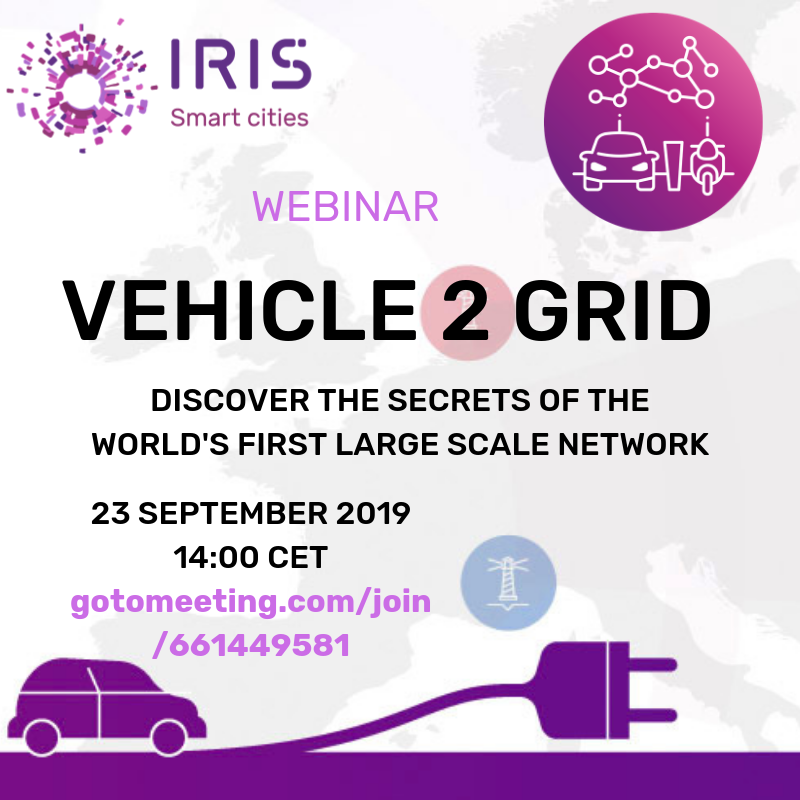
If you want to discover more about the We Drive Solar bi-directional ecosystem then please feel free to attend this webinar on September 23rd at 13:00 British Summer Time:

Webinar-2019-09-23

Terna and Fiat Chrysler Announce 700 Vehicle V2G Project

Italian utility Terna announced in a press release yesterday that:

Today in Turin, the CEO and General Manager of Terna, Luigi Ferraris, and the Chief Operating Officer of Fiat Chrysler Automobiles in EMEA, Pietro Gorlier, signed a Memorandum of Understanding for the joint trialling of sustainability mobility services and technologies, such as Vehicle-to-Grid (V2G), which enables electric vehicles to interact with the grid via ‘smart’ charging infrastructure.

The partnership between the companies will involve the realisation at the Terna location in Turin of the E-mobility Lab, an innovative technology laboratory which will allow trials on the performances and capacities of electric cars for the provision of services to support the flexibility and stabilisation of the electricity grid, and their one-way and two-way interaction with the grid via a dedicated charging infrastructure. Feasibility studies will also be launched for an experimental demonstration fleet of electric cars connected to the grid via a V2G infrastructure, to be built in an area inside the FCA Mirafiori industrial complex.

According to a Reuters report Pietro Gorlier said:

“We’ll start with the electric Cinquecento. The project will kick off in the coming months, we plan to reach 600-700 test vehicles by 2020-21”.

FCA will start producing a full electric version of its Cinquecento mini car in Mirafiori by the second quarter of next year.

Nissan and EDF collaborate on UK V2G

In a press release earlier today Nissan announced that:

Nissan and EDF Group have signed a cooperation agreement to accelerate the delivery of electric mobility together – particularly through the smart charging of electric vehicles. This agreement applies to the United Kingdom, France, Belgium and Italy.

The cooperation agreement focuses mainly on developing smart charging solutions (vehicle to grid, or V2G) by bringing together technologies developed and mastered by both companies. Smart charging refers to technologies that optimise the charging or discharging of an electric vehicle in an efficient and cost-effective manner.

As part of the cooperation agreement, Nissan is responsible for the sale of V2G compatible electric vehicles, and EDF Group in charge of V2G charging solutions and related services.

If EDF have “developed and mastered… V2G charging solutions” I cannot help but think they must be buying in the necessary hardware technology from elsewhere rather than having developed and mastered it themselves. However the news release is rather vague about that side of things! It continues:

Fundamental to Nissan’s Intelligent Mobility vision is the integration of electric vehicles into society, with V2G technology offering significant benefits to electricity grids and providing new financial opportunities to businesses. As increasing numbers of drivers and businesses make the switch to 100% electric vehicles, Nissan achieved record sales for both the Nissan LEAF and e-NV200 van in Europe last year.

EDF Group is committed to promote clean mobility for everyone, in particular by developping “smart charging” solutions with tangible benefits to customers. These fully integrated solutions include the management of the battery’s charge and discharge as well as flexibility services to the grid available through storage. They are carried by Izivia, a wholly-owned subsidiary of the EDF Group specialising in charging infrastructure, and Dreev, the newly launched EDF-NUVVE joint venture, specialising in V2G commercial solutions.

Perhaps EDF’s V2G hardware arrives via Dreev then. However Nuvve have told me numerous times that they are “not in the hardware business”. Who is then?!

The coda to the interesting bit of the release states:

Today’s agreement follows a previous partnership in the UK between EDF Energy and Nissan. Signed last year, the two organisations agreed to collaborate around the development of shared offerings in the areas of electric mobility, smart charging, second-life battery use, energy storage and renewable energy sources.

That doesn’t reveal what Dreev are up to either, so let’s dig a little deeper shall we? According to the Dreev web site:

Dreev solution relies on Nuvve technology that has already been deployed and validated on 5 continents.

followed by:

Nuvve Corporation is a San Diego-based green energy technology company, world leader in V2G technology, whose mission is to lower the cost of electric vehicle ownership while supporting the integration of renewable energy sources, including solar and wind.

which links to the Nuvve web site which tells us:

As part of our complete vehicle-to-grid (V2G) solution, we offer bidirectional chargers which are preconfigured to work with NUVVE’s Grid Integrated Platform (GIVe™).

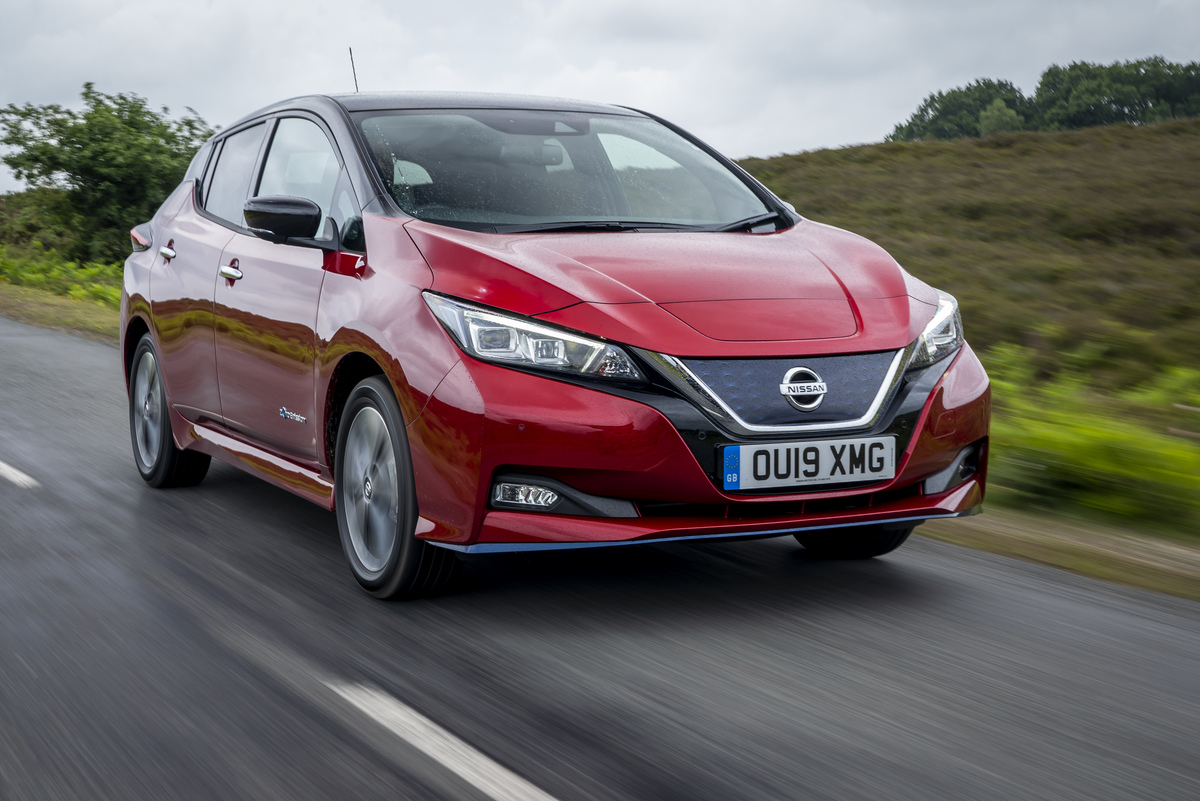
Nissan’s press release included a picture of a shiny red right hand drive 2019 model year Nissan LEAF e+:

Nissan LEAF e plus-small

A packet of peanuts will be our astonishingly generous reward for anybody able to send us a verifiable image of the Nuvve/Dreev “developed and mastered” DC V2G hardware technology. Note that the image on the Nuvve “V2G Chargers” page shows hardware technology developed by a 3rd (or should that be 4th) party.