Arrival today announced that Simon Edel, Alan Hudson and Sam Woodward of EY-Parthenon’s Turnaround and Restructuring Strategy team were appointed as joint administrators (the “Administrators”) of Arrival UK Ltd and Arrival Automotive UK Limited (the “Companies”), both subsidiaries of Arrival. All of Arrival’s other subsidiaries will continue their activities as usual outside of the administration process. The Administrators are now exploring options for the sale of the business and assets of the Companies, including the electric vehicle platform, software, intellectual property and R&D assets, for the benefit of creditors.
Arrival’s mission is to master a radically more efficient New Method to design, produce, sell and service purpose-built electric vehicles, to support a world where cities are free from fossil fuel vehicles. Arrival’s in-house technologies enable a unique approach to producing vehicles using rapidly-scalable, local Microfactories. Arrival is a joint stock company governed by Luxembourg law.
So much for the long promised, allegedly revolutionary, vehicle-to-grid capable Arrival electric van:
In a press release this morning the Department for Transport of His Majesty’s Government announced that:
New measures to support electric vehicle drivers from the government’s Plan for Drivers have launched today, including grants for schools, cash for councils and new proposals to boost chargepoint numbers.
Technology and Decarbonisation Minister, Anthony Browne, will launch support for greener schools in Nottinghamshire today, with a new grant providing up to 75% of the cost to buy and install chargepoints, up to £2,500 per socket, up from the previous £350.
Paid for by the Department for Transport, the grant forms part of the Workplace Charging Scheme and is available for state-funded schools, colleges, nurseries and academies to boost the chargepoint facilities for staff and visitors. This could also help schools to generate revenue by making their chargepoints available to the public.
Sainsbury’s has today launched Smart Charge, a brand-new, dedicated EV charging business that will give drivers access to ultra-rapid EV charging points across its stores. This bold move illustrates the retailer’s commitment to the EV industry while providing an exciting new service for drivers.
In new research commissioned by Sainsbury’s, 80% of EV users admitted to avoiding long journeys because of not wanting to charge at public EV charging stations, describing the main frustrations as chargers being broken (40%), not enough charging bays (36%) and speed of service (33%). Designed to mitigate these frustrations, Smart Charge will initially feature over 750 cutting-edge ultra-rapid charging bays rolled out across more than 100 stores by the end of 2024, putting Sainsbury’s in the top five providers of ultra-rapid charging in the UK.
It seems as though Sainsbury’s have been doing a lot of market research. The release continues:
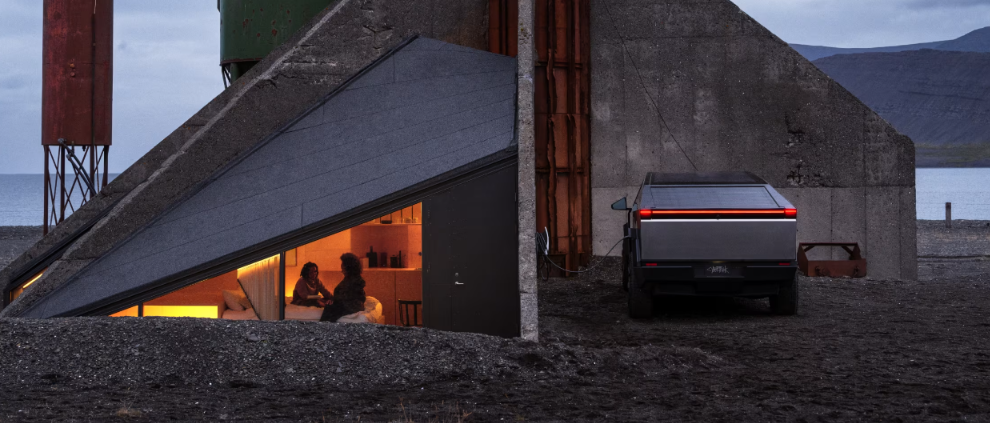
After maintaining an anti V2x stance for many years Tesla have finally accepted the inevitable! On the new Powershare page on the Tesla web site they say that:
Tesla vehicles* equipped with Powershare technology have onboard electronics that unlock your battery’s ability to provide power whenever you need it, wherever you are. Whether you need to power a construction site, pre-game tailgate, another electric vehicle or even your home during an outage, your Tesla vehicle with Powershare has you covered.
That sounds awfully exciting, but following the asterisk to the small print at the bottom of the page reveals that:
Tesla Powershare is currently available for Cybertruck only.
Without actually mentioning vehicle-to-load or vehicle-to-home Tesla suggest some use cases for the newly unlocked power:
This morning the Met Office in Exeter issued a warning of high winds due to the imminent arrival of Storm Betty, the second named storm of this tempestuous summer!
Met Éireann have named Storm Betty as a low-pressure system which is also triggering Met Office warnings…
A Met Office yellow warning for wind covers coastal areas of western Wales, eastern Northern Ireland and parts of northwest England and southwest Scotland. Rain warnings have also been issued from late Friday and into Saturday for Northern Ireland and parts of Scotland.
According to the yellow warning for wind:
Power cuts may occur, with the potential to affect other services, such as mobile phone coverage
In such circumstances I have a penchant for recording “baseline” images of the UK’s distribution network operators’ power cut maps. I was rather surprised to discover that Northern Powergrid’s looked like this earlier today:
Zooming in on the map, it seems many of those alleged power outages have been “scheduled” in advance, some of which remain on the map despite having already been cancelled for today.
It remains to be seen how many “unscheduled” additions Storm Betty leaves in her wake.
[Update – August 18th 20:30]
The predicted “unscheduled” power cuts due to the passage of #StormBetty across the British Isles have begun.
Here are the current power outage maps of ESB Networks in Eire:
Storm force winds associated with Storm Betty caused damage to the electricity network overnight affecting just over 70,000 homes, farms and businesses at the peak. As at 11.30am, just under 50,000 electricity customers remain without power with the damage mainly attributable to lightning and fallen trees on overhead lines as a result of the high winds.
Areas most impacted include counties in the South-East along with North Dublin, Dundalk, Portlaoise and Kilkenny.
All available resources are being deployed to respond to all electricity outages where safe to do so. ESB Networks crews have been working since first light and will work through this afternoon into this evening to restore power to as many customers as possible. A significant number of impacted customers will have their power restored by this evening. However, due to the scale of the damage to the electricity network, some customers in localised areas may remain without supply overnight.
GM will expand vehicle-to-home (V2H) bidirectional charging technology across its retail portfolio of Ultium-based electric vehicles by model year 2026. The first vehicles to receive the technology include the previously announced 2024 Chevrolet Silverado EV RST, followed by the 2024 GMC Sierra EV Denali Edition 1, 2024 Chevrolet Blazer EV, 2024 Chevrolet Equinox EV, 2024 Cadillac LYRIQ and the upcoming Cadillac ESCALADE IQ, which will be revealed on Aug. 9.
Building on the company’s plan to deliver a growing suite of energy management products and services through GM Energy, V2H unlocks additional value for EV drivers, who will be able to transfer energy from their vehicles to a properly equipped home when desired. The technology allows consumers to store and transfer energy to help offset electricity needs during peak demand days and mitigate the impact of power outages, making the transition to an all-electric future even more compelling.
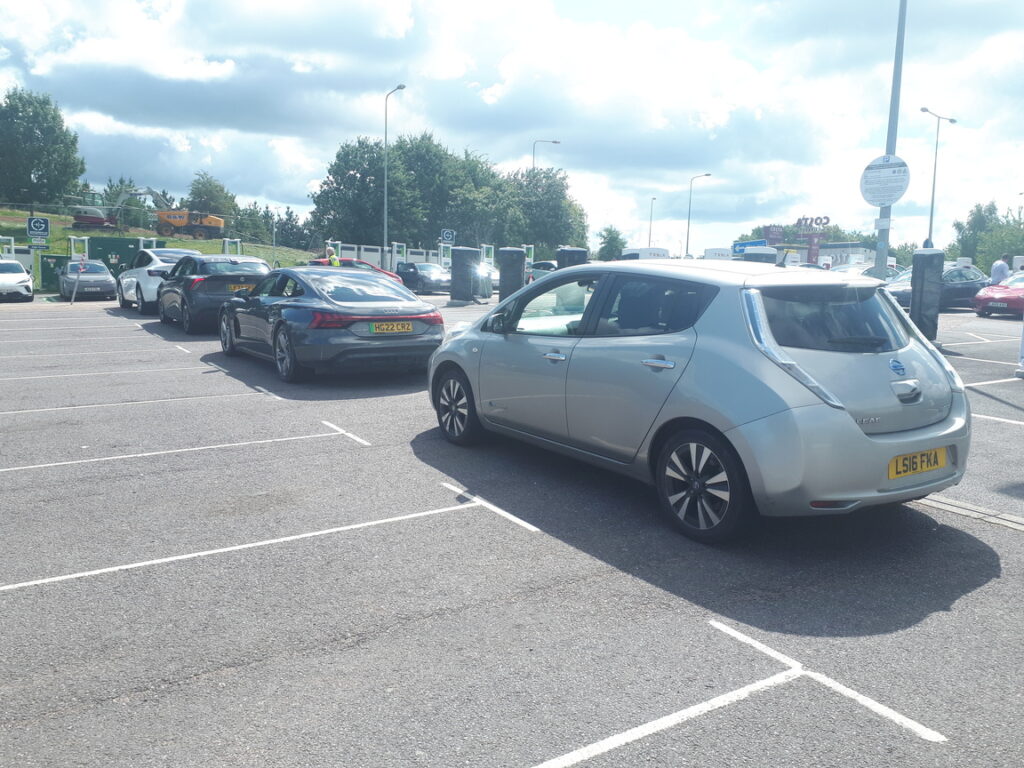
Lisa, our ageing experimental Nissan LEAF, was conveying us towards a visit to the seaside in Exmouth when she popped into Exeter Services for a quick “splash and dash” charging session. Sadly it was not to be:
There’s nothing quick or dashing about waiting in the queue for a vacant Gridserve CHAdeMO charging connector. Especially when there’s a Tesla at the head of that queue, and there seems to be a vacancy in the adjacent serried ranks of Tesla superchargers:
Eleanor Warburton, Interim Director of Energy Systems Management and Security at Ofgem, has written an open letter to:
The CEOs of the Energy Networks Assocation, the Distribution Network Operators and National Grid ESO
Here are the first few paragraphs:
I am writing to you to emphasise the importance of the Open Networks Project and the flexibility-enabling activities it is driving forward, which remain a priority for Ofgem.
Flexibility at scale is essential for achieving net zero. We recognise there has been progress made in recent years in developing flexibility markets, but we are clear that further significant changes are needed to unlock the full value of flexibility.
In recent publications we proposed reforms to help unlock this value. We set out the need for fair and transparent rules and processes for procuring flexibility services, which are standardised to minimise friction. Flexibility service providers must be able to stack revenue and participate easily in open, transparent and coordinated markets.
There is strong support for the case for change and for our proposed direction of travel, however respondents raised concerns about a risk of hiatus in the growth of local flexibility markets.
We wish to emphasise that we see no reason for there to be any deceleration in progress and we strongly expect the Energy Networks Association (ENA) and Distribution Network Operators (DNOs) to continue to progress key flexibility enabling activities through the Open Networks Project. We are confident from our recent engagements that you, the ENA and DNOs, share this view too.
The importance of growing local flexibility markets and standardising rules and processes for procuring flexibility services is reflected in RIIO-ED2 arrangements and the Distribution System Operation (DSO) incentive. Any loss of momentum could impact DSO incentive performance, through both the stakeholder survey and the performance panel assessment.
The Open Networks Project has been pivotal to the growth of local flexibility markets in the UK and building on that to drive further, faster success is very much a priority for Ofgem. We look forward to seeing the progress it makes over the coming year.
We are not seeing the scale of distributed flexibility that we need due to market access and coordination issues. This is especially true for Consumer Energy Resources (CER) like electric vehicles and heat pumps. We need a flex-centric system which facilitates distributed flexibility, but it is not clear that this will emerge organically.
We got very excited here at V2G UK way back in February 2022 when Volkswagen announced in a press release that Markus Arand, head of brand and product communications at VW Commercial Vehicles, had said:
When you have solar panels on your home, for example, this car will be able to have a thing called bi-directional charging. You can give the energy from the ID. Buzz back to your home.
From now on, many models in the ID. Family now offer bidirectional charging with the “Vehicle to Home” function. With a home power station and the integrated Home Energy Management System (HEMS) from Volkswagen partner HagerEnergy GmbH, customers can cover as much of their household consumption as possible with their photovoltaic system. Both companies have launched a pilot project in Sweden in which an entire housing estate is being supplied with vehicles and the corresponding charging infrastructure.
Another pertinent piece of information is that:
Bidirectional charging is possible in all new models with the 77 kWh battery (net) and from ID. Software 3.5 or higher.
Note that the “small print” outlines a few constraints:
The discharging and bidirectional charging functions are no longer available once the intended operating time or energy quantity has been reached: Max energy quantities: Up to 10,000 kWh Discharging; Max operating hours: Up to 4,000 hours Discharging
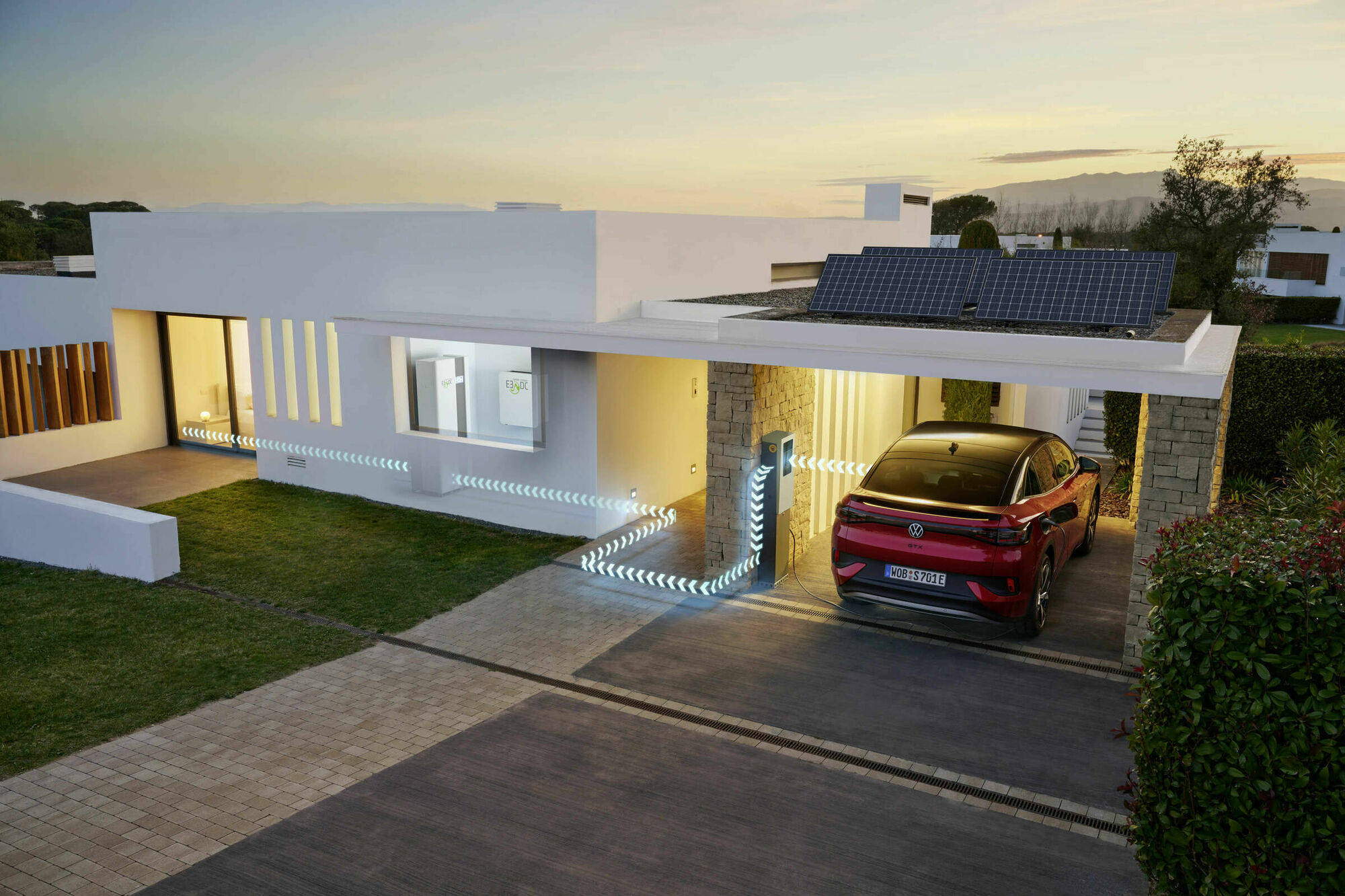
Here’s an image from the press release showing an “artist’s impression” of a VW ID.5 discharging electricity generated from a rooftop solar PV installation back into a home as dusk falls:
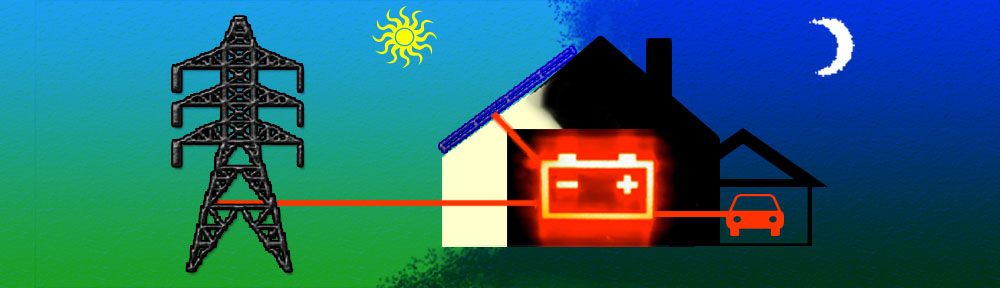
Compare and contrast the image with our own artist’s impression in the banner at the top of this article. It is now over 10 years old.
I cannot help but wonder when the first trial of Volkswagen’s exciting new V2H technology will ultimately start in a similarly equipped home here the United Kingdom, and when the current “constraints” might be raised or removed entirely?
Renault have released more details about the forthcoming Renault 5, and it’s excellent news to our ears:
The future electric Renault 5 will be Renault’s first car to come with a bidirectional on-board charger.
Over the years we have covered at some length Renault’s experiments with ZOEs modified to include bi-directional capabilities, and we are pleased to hear that AC V2G will finally be going into production in the shape of the new Renault 5.
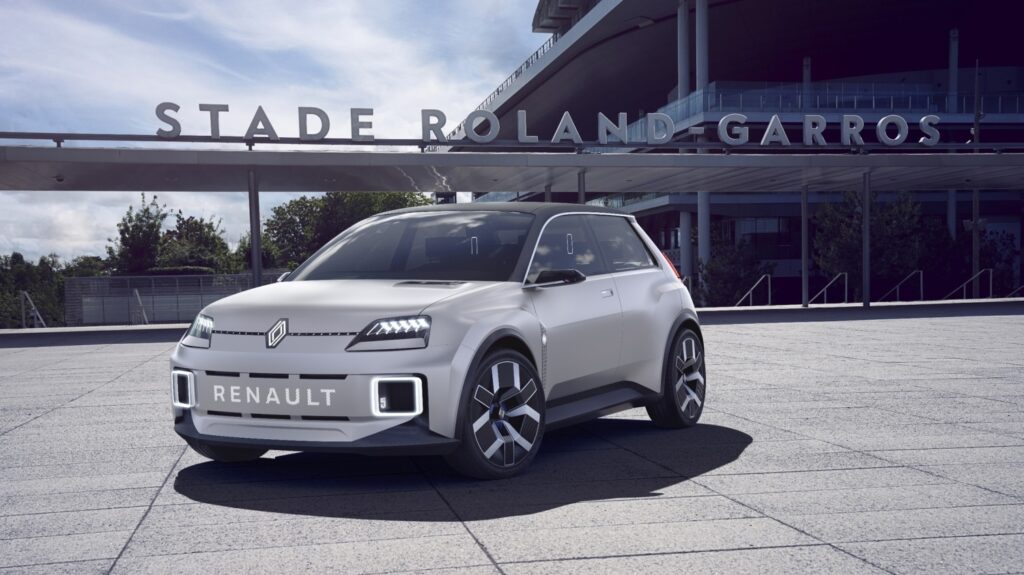
A previous press release revealed the external shape of the new R5 outside Stade Roland Garros:
Now we get to see the internals too! According to Renault: