Last week there was a significant “Energy Technology” announcement in Manchester. This article was supposed to be written/published last weekend, but Storm Darragh and our subsequent 20 hour power cut proved more than capable of disrupting the carefully laid plans of both mice and men!
Hastily returning to a rather damp Manchester on December 5th, here is a recording of the meat of the initial presentation by Devrim Celal, Chief Marketing and Flexibility Officer of KrakenFlex Limited, speaking at the launch of the “Mercury Consortium” at the “UK’s first energy tech superhub”:
Devrim’s presentation was followed by a panel session with representatives of four “manufacturers”, which we will cover at a future date. After a “networking break” there was another panel session with speakers from four “utilities”, introduced by Arshad Mansoor who is President and CEO of the Electric Power Research Institute. Here’s what Arshad had to say:
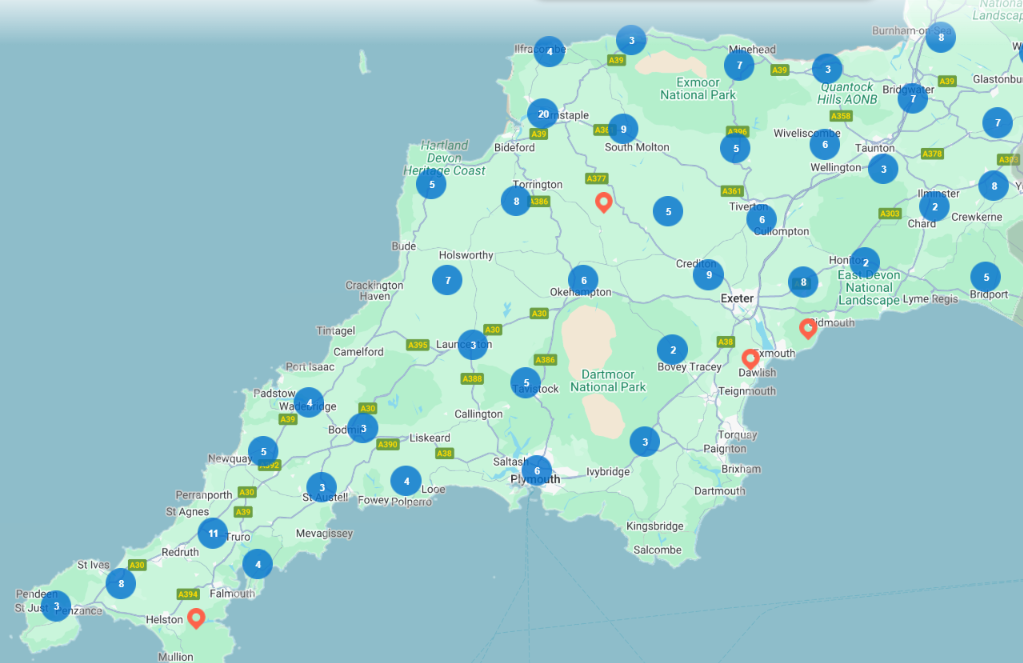
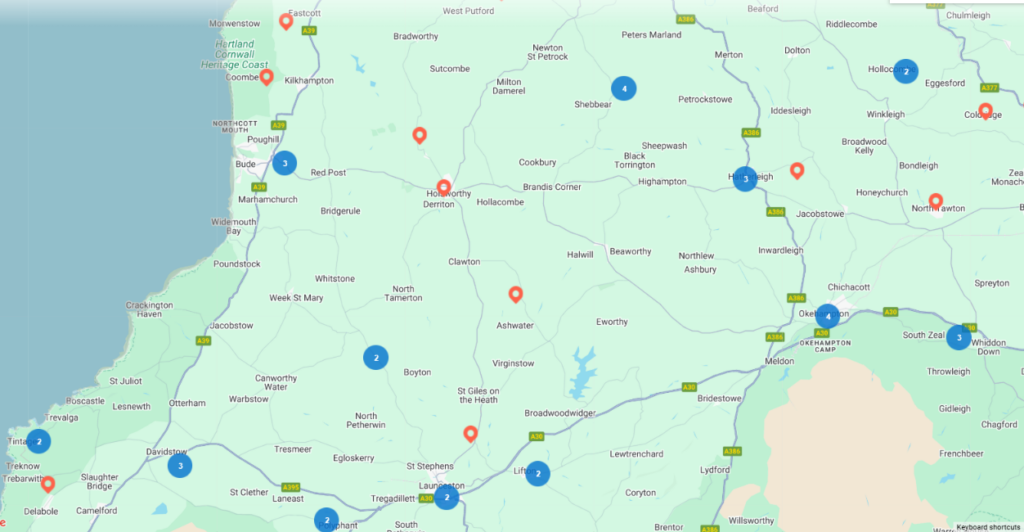
Storm Darragh arrived in the West Country yesterday. causing carnage far and wide. Here is how the Devon and Cornwall section of National Grid Electricity Distribution’s power cut map looked at 4 PM:
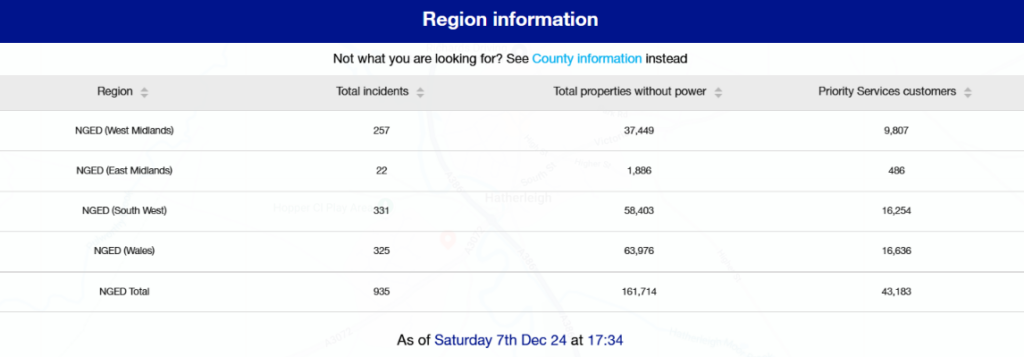
Somewhat later, here’s how NGED’s table of regional power outages looked:
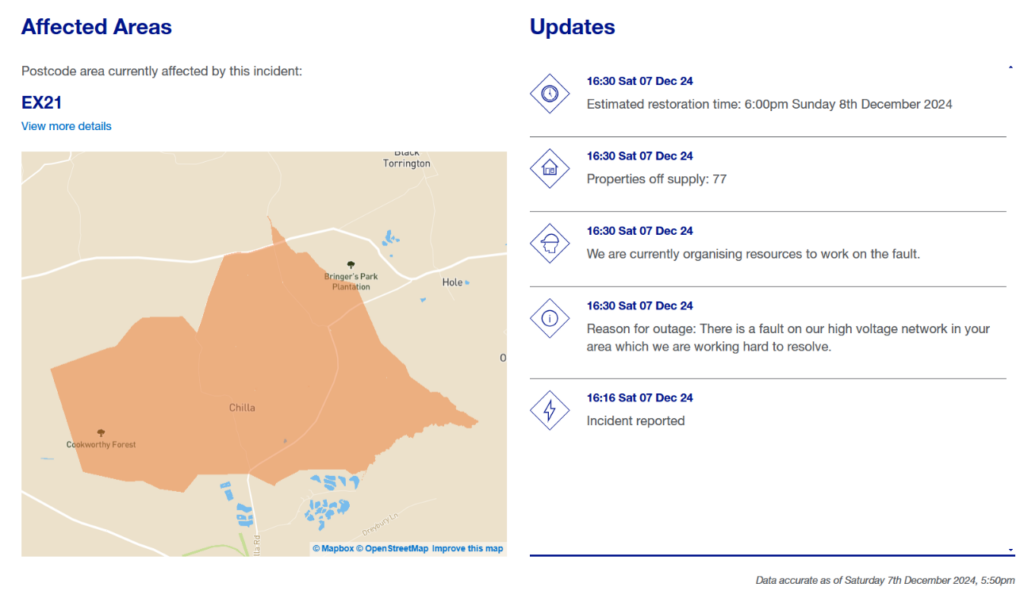
77 of the 58,423 properties in the South West without an electricity supply were just up the road from us near Chilla:
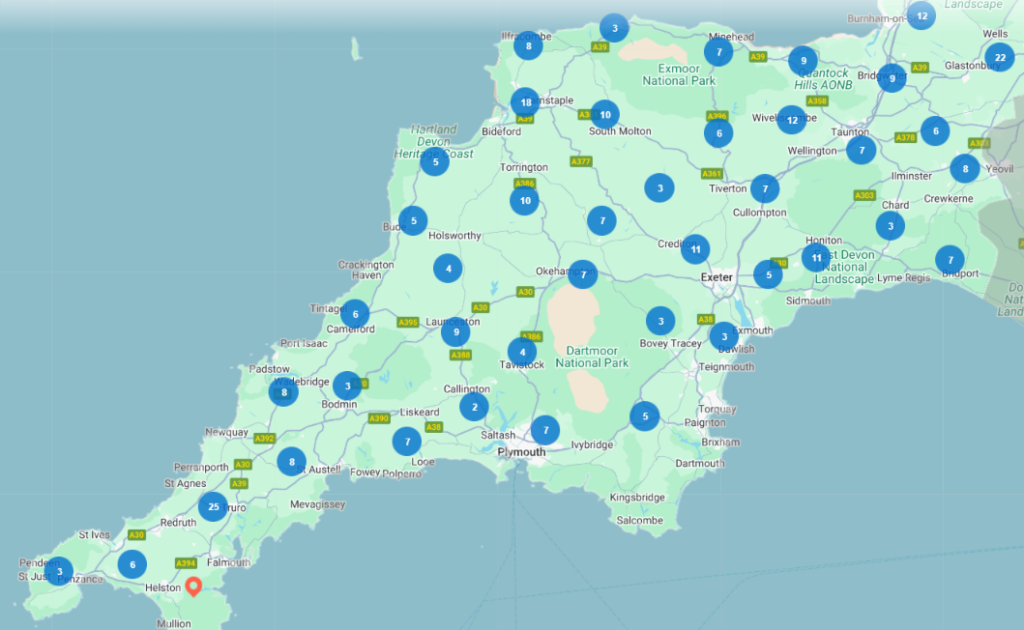
By 8:30 PM the NGED power cut map was awash with outages:
while our local area looked like this:
The power cut in Chilla was rather confusingly located in Hatherleigh according to the map!
How do you catch a cloud and pin it down? How do you find a word that means Flexibility?
We’ll get back to answering that question in due course. First some exciting news.
On November 22nd I attended the kick off meeting of a new International Electrotechnical Commission “smart grid” committee. This one is catchily entitled the “System Committee Smart Energy ad hoc Group 11 on Energy flexibility and residential DSR: common ground”, or “SyC SE ahG 11” for short.
If you follow the link just above you will discover that ahG 11’s mission is:
To consider the implementation of international residential flexibility system standards, their compatibility with national requirements, and propose best practice:
* To ensure the compatibility of end-to-end system solutions at international level,
* To identify emerging challenges related to the uptake of residential DSR,
* To consider terminology alignment, and
* To develop an accelerated report containing requirements for residential flexibility. This would give recommendations for alignment of existing national publications and flexibility projects under development with international standards. It would also identify, if relevant, the need for further standardization
Amongst other questions discussed at the kick off meeting was “How do you define the term ‘flexibility'”. Your mileage may vary of course, but since I spent 5 years of my life meeting 2 or 3 times per week on the committee developing the IEC 63110-1 document I will quote from the Committee Draft for Vote (CDV for short) of that international standard:
General concept of elasticity of resource use, (demand, storage, generation) modification of consumption and/or generation of energy/power, on an individual or aggregated level, in 371 reaction to an external signal (price signal or request) in order to provide a service within the energy system
Elasticity of resource use (demand, storage, generation), modification of consumption and/or generation of energy/power, on an individual or aggregated level, in reaction to an external signal (price signal or request) in order to provide a service within the energy system.
If you have strong objections to that definition please do not hesitate to join ahG 11, or failing that to send your preferred term of words to me so that I can bring it to the committee’s attention.
My other main action item before the next meeting in the New Year is to generate a list of existing standards, regulations etc. relevant to my particular area of expertise, which is bi-directional power transfer during electric vehicle (dis)charging (BPT for short). More commonly referred to as V2x. Since ahG 11’s term of reference includes the word “residential” this suggests an emphasis on vehicle-to-home technology (V2H for short) . However, homes are of course connected to the local electricity distribution grid, and are not forbidden from feeding electrical energy back into the grid as long as all the associated rules and regulations are adhered to.
Please let me or any other member of the committee know of any “standards” within your own area of expertise that may be relevant to “residential demand side response” (using the UK’s non standard nomenclature!), whether they be international, national, “industry de facto” or even the learnings from relevant “pilot projects”.
Please feel free to suggest candidates for “standards” for communicating across any of the arrowed lines in the diagram, and alternative diagrams for that matter!
In response to the massive growth of renewable energy in the Netherlands, Renault Group, We Drive Solar, MyWheels and the City of Utrecht have joined forces to launch Europe’s first large-scale car-sharing service utilizing Vehicle-to-Grid (V2G) technology.
Renault Group will supply 500 Renault 5 E-Tech electric equipped with Mobilize’s V2G technology.
We Drive Solar will provide and operate bidirectional charging stations.
MyWheels, the leading car-sharing platform in the Netherlands, will operate the fleet.
Utrecht is taking a bold step towards more sustainable mobility with this groundbreaking collaboration. This initiative aims to facilitate the large-scale availability of electric shared mobility while offering an innovative way to balance the city’s electric grid through bi-directional charging technology. The Netherlands has become a world leader in the roll-out of solar and wind energy, causing challenges on the electricity grid. Utrecht is one of the most advanced European cities in using renewable energy, with already 35% of all rooftops covered with solar panels.
The 361 Energy Fair is back in Barnstaple on September 29th. The 2024 event starts at 10 AM in the Pannier Market with an introduction by Ian Roome, the newly elected Liberal Democrat MP for North Devon.
To give you a better idea of what to expect, here’s a video with extracts from previous 361 energy fairs:
For the first time this year’s fair includes a series of talks on a variety of topics. Our very own Jim Hunt will be giving a presentation on the topic of “An introduction to V2x, making greater use of EV batteries”, and the emphasis will be on vehicle-to-home and vehicle-to-building rather than fully fledged vehicle-to-grid.
I had high hopes for what I dubbed the “South West Powerhouse” back in 2015, when I attended the launch of Molly Scott Cato’s “The Power to Transform the South West” report in Glastonbury. Here’s Molly, the then Green Party MEP for South West England, describing that vision from the podium:
After the presentations were over I bumped into a researcher from the University of Exeter, who didn’t look very well. I enquired after his health, and he explained that it wasn’t a physical problem. It had just been announced that the then Conservative / Lib Dem coalition Government had published its so called “Productivity Plan“, which claimed to be:
Creating a more prosperous nation.
The plan included the following weasel words:
The government does not intend to proceed with the zero carbon Allowable Solutions carbon offsetting scheme, or the proposed 2016 increase in on-site energy efficiency standards.
An unfortunate side effect of the cunning Conservative plan was that the vehicle-to-grid pilot project at South West Exeter that I’d just been discussing with Molly was instantly consigned to the recycle bin of history. Hence I wrote the first of several subsequent “open letters” to Mel Stride, recent candidate for leadership of the Conservative Party and my then Member of Parliament:
Much more recently I found myself on stage at the Everything Electric North event in Harrogate, where I exhorted to audience to “get out and vote!”, a message echoed by presenter Robert Llewellyn:
I was fortunate enough to find myself on stage for two different panel sessions at the Everything Electric NORTH show in Harrogate last weekend. We recorded those two sessions in full for posterity, but there were plenty of other interesting topics apart from V2x. Some extracts from those can also be found below.
My first panel on Saturday was on the topic of “Vehicle to Everything? What’s the true potential?”, held in the EEN “Giga Theatre”. The tagline for the session was “We believe that V2X could be the biggest benefit of all in a world with battery electric vehicles, but how do we go ‘bidirectional’?”:
As you can see from the video below, I found myself sat next to Robert Llewellyn of Fully Charged fame as a last minute replacement for host Dan Caesar:
Mark Potter from 3ti explained the full suite of V2x three letter acronyms (TLAs for short).
In a press release this morning the United Kingdom Government’s Department for Transport announced that:
Charging electric vehicles is set to get even easier thanks to hundreds of millions of funding made available for local authorities, homeowners and renters today.
The government continues to deliver its £381 million Local Electric Vehicle (LEVI) fund to councils, which can choose where is best to install chargepoints in their local area. Following the approval of the first five local authority applications in February, payments to 44 additional councils from Torbay to Tees Valley, worth over £185 million, have now been approved to help residents charge their vehicles.
The funding will support the delivery of thousands of chargepoints across England, helping more drivers get from A to B easily and supporting families in making the switch. Additionally, the local authorities that have already been allocated to the second round of LEVI funding will be able to apply to the fund from 2 April 2024, following those who have received funding in the first round and in a further boost to the chargepoint rollout.
This morning a new section was visible on the “Smart Tariffs” section of Octopus Energy’s web site. The new tariff is introduced by Constantine the friendly octopus as follows:
Octopus Power Pack: the UK’s first Vehicle-to-Grid tariff
Get free EV charging with our groundbreaking vehicle-to-grid (V2G) tariff
Add Octopus Power Pack to your regular tariff. We’ll set up your V2G charger to automatically manage your charging and discharging in the greenest way possible, so you can fill up for free.
A typical V2G driver could save £880 per year compared to Flexible Octopus, and £180 compared to Intelligent Octopus Go.
Power Pack represents the latest stage in our V2G rollout, following our wildly successful Powerloop V2G trial. It’s currently a beta tariff.
I cannot help but wonder if Constantine the intelligent octopus has been peeking at our decade old “artistic impression” of V2G technology in the domestic environment? See the banner above.