Last week there was a significant “Energy Technology” announcement in Manchester. This article was supposed to be written/published last weekend, but Storm Darragh and our subsequent 20 hour power cut proved more than capable of disrupting the carefully laid plans of both mice and men!
Hastily returning to a rather damp Manchester on December 5th, here is a recording of the meat of the initial presentation by Devrim Celal, Chief Marketing and Flexibility Officer of KrakenFlex Limited, speaking at the launch of the “Mercury Consortium” at the “UK’s first energy tech superhub”:
Devrim’s presentation was followed by a panel session with representatives of four “manufacturers”, which we will cover at a future date. After a “networking break” there was another panel session with speakers from four “utilities”, introduced by Arshad Mansoor who is President and CEO of the Electric Power Research Institute. Here’s what Arshad had to say:
Eleanor Warburton, Interim Director of Energy Systems Management and Security at Ofgem, has written an open letter to:
The CEOs of the Energy Networks Assocation, the Distribution Network Operators and National Grid ESO
Here are the first few paragraphs:
I am writing to you to emphasise the importance of the Open Networks Project and the flexibility-enabling activities it is driving forward, which remain a priority for Ofgem.
Flexibility at scale is essential for achieving net zero. We recognise there has been progress made in recent years in developing flexibility markets, but we are clear that further significant changes are needed to unlock the full value of flexibility.
In recent publications we proposed reforms to help unlock this value. We set out the need for fair and transparent rules and processes for procuring flexibility services, which are standardised to minimise friction. Flexibility service providers must be able to stack revenue and participate easily in open, transparent and coordinated markets.
There is strong support for the case for change and for our proposed direction of travel, however respondents raised concerns about a risk of hiatus in the growth of local flexibility markets.
We wish to emphasise that we see no reason for there to be any deceleration in progress and we strongly expect the Energy Networks Association (ENA) and Distribution Network Operators (DNOs) to continue to progress key flexibility enabling activities through the Open Networks Project. We are confident from our recent engagements that you, the ENA and DNOs, share this view too.
The importance of growing local flexibility markets and standardising rules and processes for procuring flexibility services is reflected in RIIO-ED2 arrangements and the Distribution System Operation (DSO) incentive. Any loss of momentum could impact DSO incentive performance, through both the stakeholder survey and the performance panel assessment.
The Open Networks Project has been pivotal to the growth of local flexibility markets in the UK and building on that to drive further, faster success is very much a priority for Ofgem. We look forward to seeing the progress it makes over the coming year.
We are not seeing the scale of distributed flexibility that we need due to market access and coordination issues. This is especially true for Consumer Energy Resources (CER) like electric vehicles and heat pumps. We need a flex-centric system which facilitates distributed flexibility, but it is not clear that this will emerge organically.
Cornwall Councillors met at the Full Council on the 22 January 2019, where Councillors debated a significant motion on tackling climate change and voted to support the declaration of a climate change emergency.
This was an amendment tabled by Councillor Jayne Kirkham to the motion put forward by Councillor Dominic Fairman calling for ‘Urgency on Climate Change’. The amended motion was agreed by the Council and a climate emergency was declared.
The declaration requires the Council to prepare a report outlining how it can sufficiently reduce carbon emissions through energy and other Council Strategies, plans and contracts to ensure Cornwall works towards carbon neutrality by 2030.
Section CC/381 of the minutes concerning “Urgency on Climate Change” reveals that:
A key element of the planning system was reduced car dependency and a move towards electrification was now government policy to help improve air quality. Other issues included highly energy efficient homes to tackle fuel poverty and well insulated homes also added protection for the vulnerable during heatwaves. Members were reminded that Cornwall was the sweet spot of the UK for renewable energy having the best resource in Western Europe and the best solar and geothermal resource in the UK.
A few days ago there was a lively debate on the topic in the Council chamber. Now as part of the process of drawing up that action plan the Council held an energy strategy workshop at the Penryn campus of the University of Exeter yesterday. Here is my brief report on what went on behind the closed doors of the Green seminar room:
Here too is one of our own suggestions for “reducing car dependency and moving towards electrification of transport” whilst improving air quality in Camelford:
Apart from improving air quality an electric vehicle club in Camelford would also reduce the number of cars sitting unused in garages and car parks for much of the time. One car club vehicle can result in 10-20 private cars being taken off the road. If you don’t possess a car you’re more likely to indulge in healthier alternatives such as walking or cycling for short journeys. In rural areas with poor public transport car clubs allow people who could never afford a car of their own to make occasional longer trips they would otherwise be unable to, except perhaps by taxi.
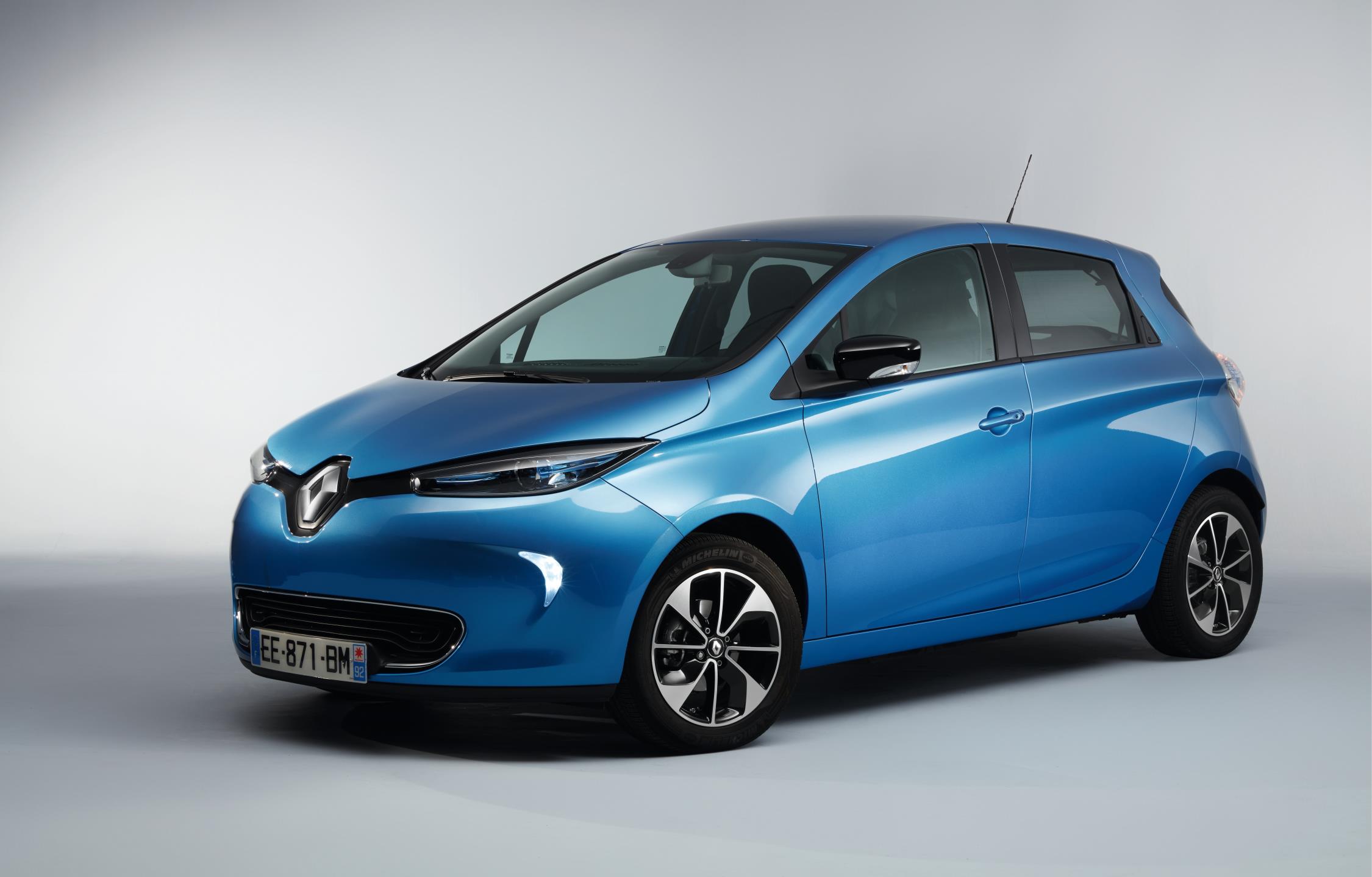
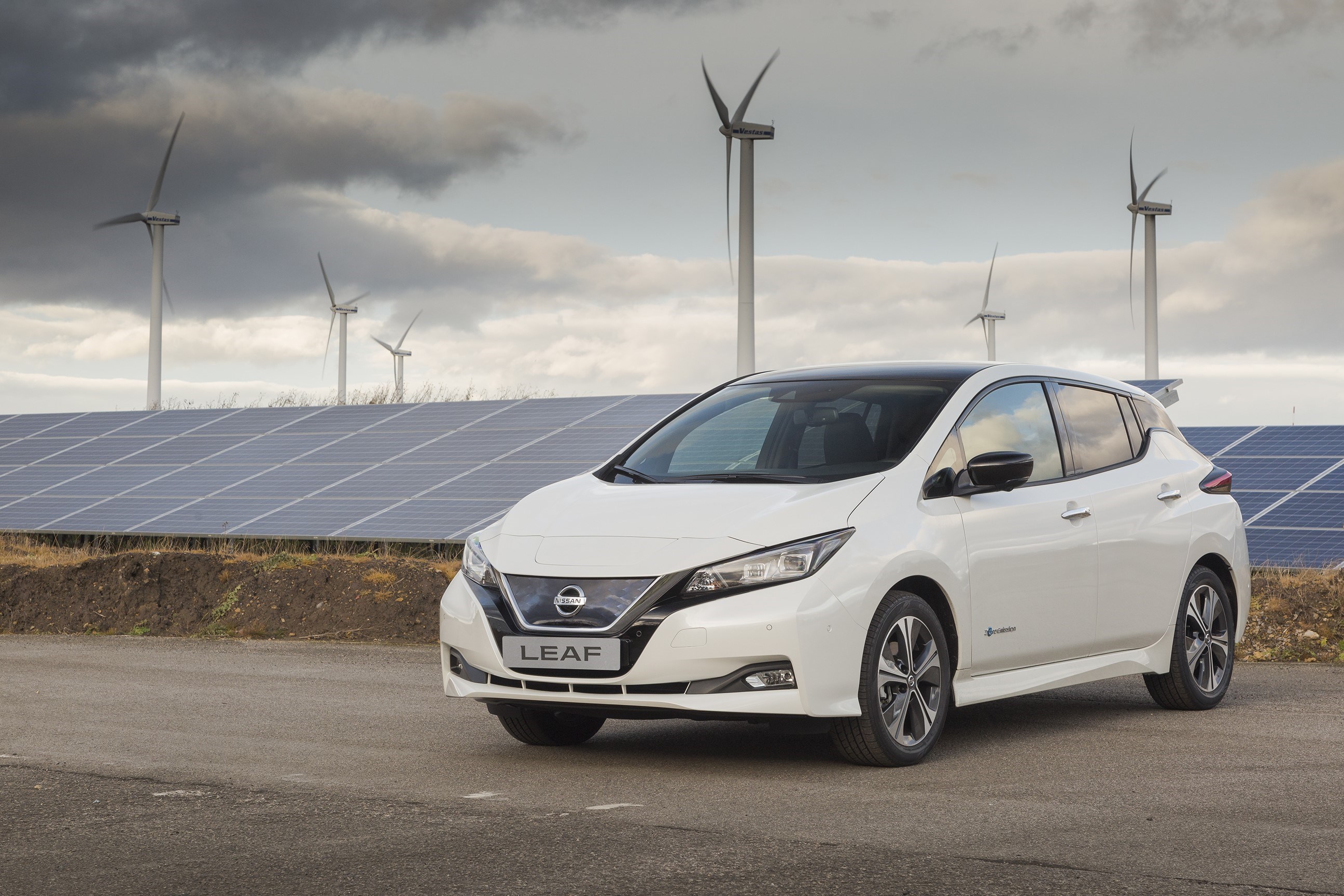
Here are a couple of popular potential car club vehicles:
Renault ZOE
Production begins of the new Nissan LEAF in Europe
This morning the United Kingdom’s House of Commons Energy and Climate Change Select Committee published its latest report, entitled “Fuelling the debate: Committee successes and future challenges”. The introduction to the report states that:
The Energy and Climate Change Committee plays a central role in scrutinising and improving the Government’s policy and legislation.
We look in detail at three case studies – electricity market reform, competition in the energy market and shale gas – each of which highlights the key role we have played in holding the Government to account and improving policy and legislation. Finally, we set out our future vision for the UK energy system, based on the views and evidence provided by the wide range of stakeholders that we work with. We also explore the challenges which will need to be overcome in the next Parliament if the UK is to achieve its ambitious long-term climate and energy goals.
The committee has also just released a video summary of their activities over the last 5 years. Here it is:
In the video Tim Yeo, who is chair of the committee, says amongst other things that:
The cheapest form of energy is the energy we don’t use in the first place. Yet despite the fact that energy efficiency is one of the cheapest ways to cut greenhouse gas emissions and improve energy security and end fuel poverty, they were neglected in the Government’s original proposals. So the committee recommended that demand reduction and energy efficiency be placed at the very heart of Electricity Market Reform.
Unfortunately today the Government is still putting too much emphasis on building new electrical generating capacity, instead of promoting demand-side measures that would improve security of supply and also reduce consumer bills.
Here at V2G we cannot help but agree with those sentiments. We also cannot help but agree with Catherine Mitchell, Professor of Energy Policy at Exeter University, who according to a “Tweet” by the ECC select committee itself at least, pointed out this morning that:
Catherine Mitchell: We need a transparent and liquid market. Must put demand side at top of the list. #UKenergyfuture — ECC select committee (@CommonsECC) March 12, 2015
In a highly unusual move the Prime Minister, Deputy Prime Minister and the Leader of the Opposition have agreed to work together across party lines to tackle climate change.
The agreement follows the launch of The Climate Coalition’s SHOW THE LOVE campaign which has reached millions across the UK, thousands of whom are wearing green hearts and telling the world what they love that could be lost to climate change.
The Green Alliance kindly provide video evidence that the signing of the agreement is not in actual fact merely a cruel hoax:
The agreement itself states that:
Climate change is one of the most serious threats facing the world today. It is not just a threat to the environment, but also to our national and global security, to poverty eradication and economic prosperity.
Acting on climate change is also an opportunity for the UK to grow a stronger economy, which is more efficient and more resilient to the risks ahead. It is in our national interest to act and ensure others act with us.
2015 offers a unique opportunity to accelerate that opportunity, with countries pledging their contributions to action before the world comes together at Paris at the end of the year to reach an agreement on tackling climate change. It is vital that this agreement is a success, and the UK will play its part in ensuring an ambitious outcome.
That is why we pledge:
To seek a fair, strong, legally binding, global climate deal which limits temperature rises to below 2°C.
To work together, across party lines, to agree [UK] carbon budgets”, which are required by law but which caused serious cabinet clashes in 2011.
To accelerate the transition to a competitive, energy-efficient low-carbon economy and to end the use of unabated coal for power generation.
Whilst that is of course all fine and dandy, the $64 gazillion question is in fact:
What will it actually take to limit temperature rises to below 2°C in practice in the real world?
The press release is accompanied by statements from a long list of the great and the good such as Al Gore, ex Vice-President of the United States of America, who gushes:
This agreement represents inspiring leadership and true statesmanship by all three men. The political courage it represents on all sides is exactly what our world most needs in order to solve the climate crisis. Thank you! Thank you! And thank you!
which doesn’t answer that question. Then there’s Lord Nicholas Stern, Co-Chair of the Global Commission on the Economy and Climate, Chair of the Grantham Research Institute on Climate Change and the Environment at London School of Economics and Political Science, and President of the British Academy, who points out that:
I am glad to see the leaders of the three main Westminster parties giving their support to strong international and domestic action on climate change. The next UK Government will need to ensure a step change in the pace of the transition to a low-carbon economy in order to meet the statutory carbon budgets and to decarbonise the power sector by 2030.
A key part will be to end emissions from coal, which are twice those from natural gas per unit of electricity generated. The Coalition Government has already introduced regulations to prevent the construction of any new coal-fired power stations unless they are equipped with carbon capture and storage technology. We now need to bring a speedy end to coal-burning by existing power stations which release carbon dioxide and other pollutants into the atmosphere.
The transition to a low-carbon economy and investment in our cities and transport to make them more efficient, less congested and cleaner has great potential to drive a dynamic, more attractive and sustainable growth story for the UK, and indeed help the UK with design and technology it can take to the world. I hope that the leaders will embody their commitment to a low-carbon economy in overseas aid to help poor countries to overcome poverty and make their transition to low-carbon growth and to become more resilient to those impacts of climate change that cannot now be avoided.
That’s a bit closer to the mark, but no mention is made of Lord Stern’s previous statement that:
Climate change is the greatest market failure the world has ever seen.
However the most surprising thing, to your humble scribe at least, is that nowhere in amongst the gigatonnes of publicity have I been able to spot the name of Kevin Anderson, who is professor of energy and climate change in the School of Mechanical, Aeronautical and Civil Engineering at the University of Manchester. Last October he wrote an “Open Letter to the Prime Minister and Secretary of State at the Department of Energy & Climate Change“. Kevin’s letter includes lots of references and starts by saying:
The letter summarises why the IPCC’s carbon budgets for a “likely” chance of not exceeding the international community’s 2°C commitment, requires the EU to reduce the emissions from its energy system by 80% by 2030, with complete decarbonisation just a few years later.
and concludes that:
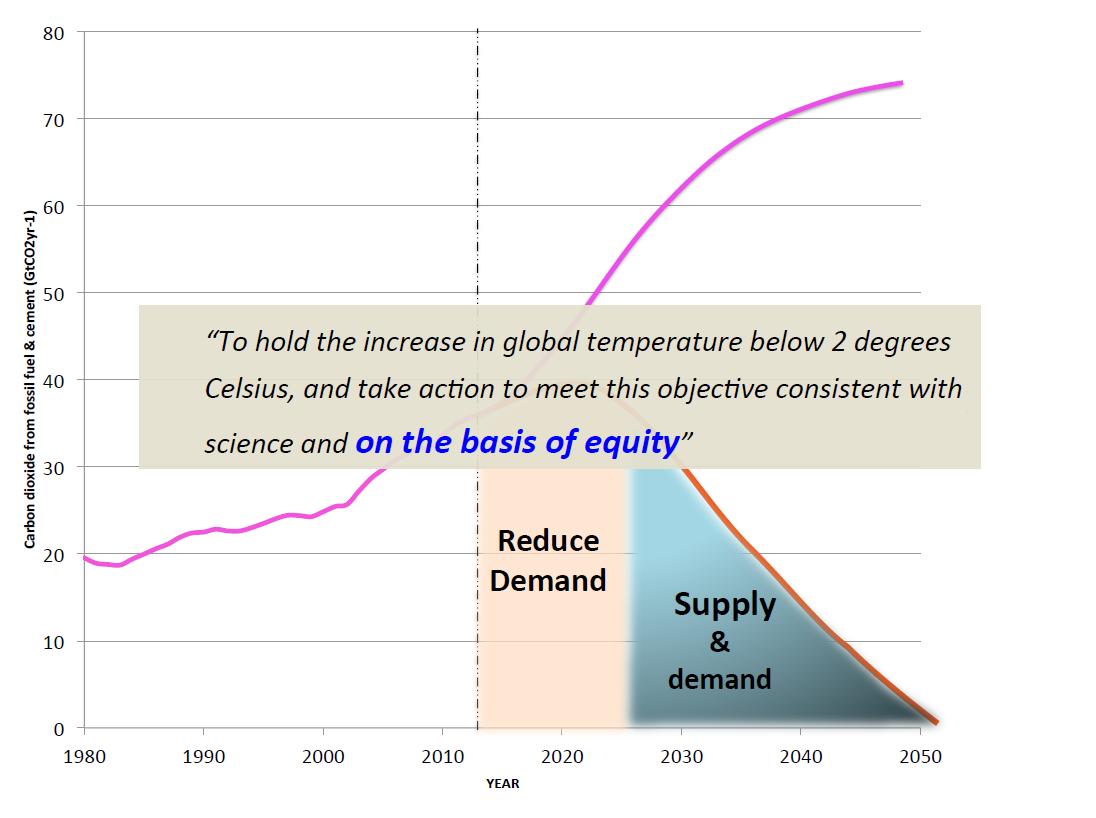
I understand the enormous political difficulties for European heads of state in developing a transparent and evidence-based mitigation agenda. However, the reasons for today’s climate dilemma reside in our prolonged abject failure to set in train an effective programme of mitigation. A quarter of a century on from the IPCC’s first report, the carbon intensity of a typical EU citizen’s lifestyle remains unchanged. I urge you to resist the vested interests calling for continued inaction and instead drive for an ambitious policy framework “consistent with science” and developed on “the basis of equity”. Ultimately, this will be the legacy we bequeath to future generations.
Now as luck would have it I attended a seminar given by Prof. Anderson to a group of climate scientists (plus your current correspondent) at Exeter University just two days ago. As further luck would have it I discovered on entering the room that my trusty surf camera was nestled at the bottom of my backpack, and Kevin kindly gave me permission to turn it on. Here is a small portion of what it managed to record for posterity:
You will note that amongst many other things Kevin asks rhetorically at 1:10:
What about 2°C?
and summarises his “recipe for success” with this graphic graphic:
He goes on to say that:
We can’t do [2°C] with low carbon supply. We can’t make the changes quick enough. You have to do something with our demand for energy, and that is very, very unpopular amongst all of us, all of our colleagues, all the policy makers, so basically the whole world, all the high emitting parts of the world, which is only a small proportion, none of us like this at all, and that’s why we don’t really like the science.
Which is one of the reasons I feel compelled to ask myself at this juncture, and not for the first time:
Why is there no mention of Professor Anderson’s letter in any of the recent hullabaloo, and how on Earth do David, Nick, Ed M. and Ed D. propose to actually hit their so lovingly enunciated target, particularly given the UK’s currently sadly “constipated” energy policy?
A copy of Professor Anderson’s slides from his presentation can be downloaded from the seminar archive web page.
On Tuesday I attended a meeting organised by Exeter Community Energy. The theme for the evening was “UK Energy Policy and the role of community energy”, and the main speaker was Catherine Mitchell who is Professor of Energy Policy at Exeter University, and was a lead author in the Inter-Governmental Panel on Climate Change Working Group 3’s recent fifth assessment report. To summarise briefly, Catherine had many more good words to say about community energy than she did about Great British Energy Policy!
It quickly became apparent that Catherine felt that the change “from ‘dirty’ energy to sustainable energy” is happening much faster elsewhere in Europe, and further afield, than it is here in the UK. After taking a while to consider a suitable epithet she settled on “constipated” as the best descriptor of UK energy policy!
Energy is always political, and has become much more political under the coalition government. Rational evidence based decision making has stopped. The current focus is on nuclear power, with only lip service being paid to renewable generation, demand management, demand reduction and community energy generation.
What positive changes that are taking place are “moving in from Europe”. Catherine moved on to give an overview of the current state of play of electricity generation across Europe. Broadly demand in the 21st century has been constant, with a slight dip due to the recession in 2009. The renewables’ share of total generation has been increasing throughout that period, and the most recent figures show much more renewable capacity being constructed than fossil fuels or nuclear.
In the UK wholesale prices are the 3rd highest in Europe, and interconnections with other countries, which are “very helpful for renewables”, are lacking. Great Britain and Poland “are trying to water down” the EU 2030 framework for climate and energy policies. Conventional utilities are however “under threat” due to the low marginal costs of renewable energy sources, which undermines their business model. However in the UK “self reinforcing governance” makes it hard for new entrants to challenge the “Big 6”, who currently have 91% of the UK electricity market, and even more for energy overall. However “despite this, there are some changes”.
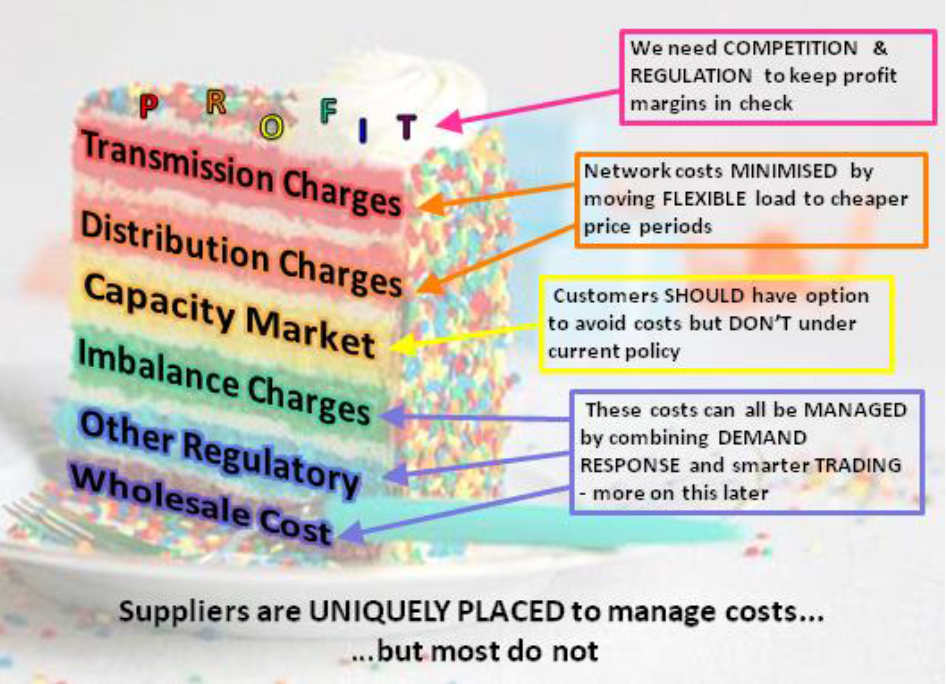
Community energy policy is “very inconsistent”, but there are new demand side entrants such as Tempus Energy, and new financial models from the likes of OVO Energy. Combined heat & power “is starting to come together”, but “the Big 6 don’t want to change. People need to start to do things differently”. Here’s how the UK energy cookie currently crumbles according to Tempus:
and here’s a video in which they explain how matters might be improved by using “a smarter approach for everybody”:
At that point the questions from the audience began. The one that most interested me concerned energy storage, and the possibility of getting paid for providing that useful service. According to Catherine “Norway is doing wonderful stuff, Germany has started, but there are no plans in Great Britain”. A member of the audience pointed out that the Renewable Energy Association had recently launched “UK Energy Storage” to lobby government, apparently:
The trade body for all storage technologies across the UK
I waved my hand in an endeavour to point out that the Electricity Storage Network has in fact been around for quite some time now, and say they are:
The industry association for the promotion of electrical energy storage.
However my turn to ask a question didn’t come around until right at the end of the evening. It seemed apparent that Catherine wasn’t very impressed by current UK energy markets, and I wondered:
Whether any future market based on “Anglo Saxon Capitalism” would be up to the job of solving the “energy/climate conundrum”?
Catherine assured me that she didn’t see capitalism going away for the foreseeable future. The slides from her presentation can be downloaded from the IGov web site.
Last year, in her role as an IPCC lead author, Catherine Mitchell also gave a presentation about UK energy policy at the Transformational Climate Science conference at Exeter University. Here it is:
Catherine also published an article on the IGov web site after that conference. For additional background information please also read:
We as individuals and communities in civil society have to do all we can to get our politicians, neighbours, businesses, energy suppliers and so on to take climate change seriously. Climate and energy policy must take note of the IPCC warning and act now.