Robin Berg’s TEDx talk on “A new local energy and transport system”

I had the pleasure of meeting Robin Berg in Utrecht last summer at the launch of the LomboXnet solar PV powered bi-directional vehicle to grid system. Here is a video of Robin’s recent presentation at TEDx Utrecht:

Robin says many interesting and enlightening things, but for the moment please consider this one:

Tomorrow your car will run electric. The day after it will power your house. It will be 100% renewable, it will be 100% clean, and it will be the end of coal, oil and gas.

Renault and Eneco Announce Smart Charging App at COP21

As we reported yesterday, the Nissan half of the Renault-Nissan Alliance made an interesting V2G announcement at the COP21 meeting in Paris. Now it’s Renault’s turn, although this one concerns “smart charging” rather than fully fledged vehicle-to-grid technology. In a December 7th press release they said that:

Renault & Eneco collaborate on smart charging solution for electric vehicles.

  • Agreement signed between electric vehicle leader Renault and energy supplier Eneco on December 7, 2015 at COP21 Paris conference
  • Eneco will develop smart charging app for ZOE, Renault’s 100% electric compact car
  • Renault ZOE users will be able to charge their car at lower costs using renewable energy

Eneco subsidiary Jedlix will develop a version of its existing smart charging app, to adapt it to Renault ZOE. This app makes it possible to charge electric cars using renewable energy at times when the market prices are most favourable. Like at night, when the production of sustainable wind energy exceeds demand in most European countries.

As far as “lower costs” go, here’s a glimpse of V2G UK filling up a Renault ZOE 100% electric compact car 100% free of charge using renewable energy in a UK motorway service station, courtesy of Nissan & Ecotricity:

Heading back to Paris, Eneco Executive Board member Marc van der Linden said :

It is expected that there will be three million electric vehicles in the whole of Europe by 2020. To reduce CO2 emissions, it is essential that this vehicle fleet will use green power. It is also important to prevent power grid overloads as a result of peaks in demand if all the cars would be charged at the same time. Our app forms a direct link between the electric vehicle and the supply of sustainably generated energy. Consequently, the energy used for charging is more sustainable, energy supply and demand is balanced and the costs of driving an electric vehicle are reduced because users charge their cars at lower rates.

Eric Feunteun, who is Electric Vehicle Program Director at Renault, added:

Renault electric cars support the energy transition in the automotive industry as they contribute to the replacement of fossil fuels by renewable energies. With smart charging systems like the one developed by Eneco, Renault electric vehicles make a big contribution to power systems’ stability and reliability: EVs turn into an asset for the grid rather than create overload. They can store and use electricity when it is less carbon-dependent and cheapest for their owners. Our partnership with Eneco is a move towards making driving a Renault ZOE more interesting and affordable and will contribute to an electric vehicles’ scale up.

Renault’s press release continues:

A pilot test carried out by Eneco in the Netherlands demonstrates that users can save up to 15% on their electricity costs by using the app. To achieve this, all they have to do is indicate by what time the car must be fully charged and the system will automatically determine the lowest price within this time frame. The app will first be available for ZOE users in the Netherlands and soon be available in other countries where Eneco operates.

Eneco do have a UK office, but quite how Renault ZOE drivers across the UK might be able to make use of “a flexible [electricity] price negotiated electronically by computers” to save a few quid on their fuel bills whilst “prevent[ing] power grid overloads” is a mystery to me at the moment, despite the fact that I sit on committees tasked with designing international standards for such things! However, here’s Eneco’s vision of “Everyone as an Energy Supplier in 2030”:

Make sure that, if nothing else, you watch the bit at 1 minute 20 seconds which mentions that “The car plays a pivotal role as an energy storage buffer”.

Hydrogen Mobility Europe Launched with €32 Million Funding

In a press release earlier today ITM Power announced that:

The most ambitious hydrogen mobility initiatives in Europe have joined forces to support the introduction of hydrogen-fuelled transport

A large coalition of European partners has launched the Hydrogen Mobility Europe project (H2ME). H2ME is co-funded with €32 million from the Fuel Cells and Hydrogen Joint Undertaking (FCH JU). The project will support the deployment of Fuel Cell Electric Vehicles (FCEVs) and Hydrogen Refuelling Stations (HRS) across Europe.

ITM’s headline summed things up so perfectly that we’ve unashamedly plagiarised it! The Hydrogen Mobility Europe project web site still says “Full website launching soon” at the top, but does state that:

The project brings together Europe’s four most ambitious national initiatives on hydrogen mobility (in Germany, France, Scandinavia and the UK) and will:

  • Place 200 fuel cell cars (from Daimler and Hyundai) and 125 fuel cell range-extended vans (Symbio FCell collaborating with Renault) in customer hands
  • Deploy 29 state-of-the art-hydrogen stations
  • Carry out a long-term evaluation campaign to demonstrate the readiness of the technology for a mass market
  • Develop insights into the customer experience and practical challenges of rolling out the technology at a large scale, which can be used in optimising the technology during its commercial roll-out

It also includes a link to their own press release, which adds that:

H2ME is the largest European project of this nature and is based around an alliance of the four most ambitious hydrogen mobility initiatives in Europe: H2 MOBILITY Deutschland, Mobilité Hydrogène France, Scandinavian Hydrogen Highway Partnership and UK H2 Mobility.

These initiatives originally brought together the key stakeholders in the hydrogen sector (vehicle manufacturers, hydrogen refuelling station providers and Government representatives), to study and develop strategies to make hydrogen-fuelled transport a reality in the respective regions. These initiatives will now be working together to make hydrogen-fuelled transport a reality in Europe.

Under H2ME they will deploy 200 FCEVs, 125 fuel cell range-extended electric (FC RE-EVs) commercial vans and 29 new HRSs in 10 countries (Austria, Belgium, Denmark, France, Germany, Iceland, Netherlands, Norway, Sweden and the UK) by 2019. This plan ties in with existing national level initiatives for the roll-out of a large scale hydrogen refuelling infrastructure, aimed at enabling Europe wide emission-free driving. The consortium, led by Element Energy, includes global leaders in the hydrogen and fuel cell sector, from fuel cells and car manufacturers (Daimler, SymbioFCell, Hyundai, Honda, Intelligent Energy, Nissan) and infrastructure providers (Air Liquide, BOC, H2Logic, ITM Power, Linde, McPhy Energy, OMV, AREVA, EIFER, H2 MOBILITY Deutschland, HYOP, Icelandic New Energy, Communauté d’Agglomération Sarreguemines Confluences) to data monitoring and dissemination organisations (Cenex, WaterstofNet).

The original agreements for the project were signed in July this year and the project has already delivered the first vehicles to customers in France and Germany (Daimler, SymbioFCell).

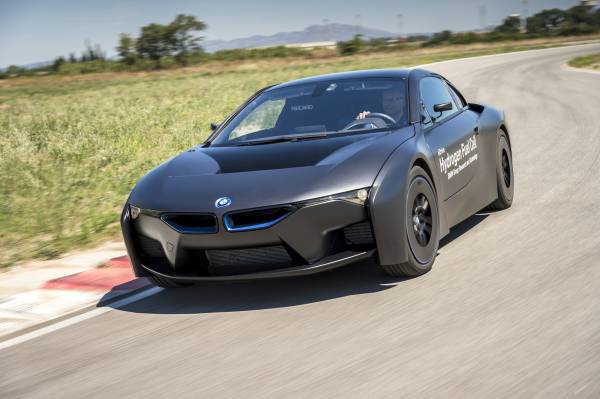
We have previously reported on BMW’s FCEV technology, developed in conjuction with Toyota, whose names are strangely absent from the above press releases. Perhaps that’s something to do with BMW’s use of “cryogenic pressure vessel technology”? Here’s BMW’s “CCH2 FCEV i8” prototype:

We wondered back in July about the:

Wait to discover how, where and when the hydrogen infrastructure BMW refer to materialises in Europe.

The H2ME project seems to be at least a partial answer to that question. In similar vein see also our report on the UK’s Riversimple open source hydrogen fuel cell vehicle. A much less extravagent beast than either BMW’s prototype FCEV i8, or the production Tesla Model S for that matter!

Renault ZOE – An Offer You Can’t Refuse? Day 1!

A few days ago I received an unsolicited telephone call asking me if I would like to test drive any Renault car. I said yes, as long as it was possible to test the Renault ZOE in and around Exeter. I was told “Certainly sir, which free gift would you like?”. I gather this offer is by invitation only, but you can nonetheless read all about it here, where it explains that one can:

Test drive and experience any model from the Renault range before 30 September 2015 and you can choose one of three complimentary gifts. Choose from a night away for two in a choice of hotels, afternoon tea for two or a spa treatment.

That definitely seemed like too good an offer to refuse, so I didn’t! The first thing I do at times like this is to take a look at Robert Llewellyn’s always entertaining reviews of electric vehicles on his Fully Charged show. Here’s the one for the Renault ZOE, recorded in 2013:

and here are a few of Robert’s bullet points concerning the ZOE:

  • It’s a small car. It has a really big boot, which is a surprise.
  • It’s got enough oomph to “get you out of trouble”.
  • A range of between 80 and 120 miles.
  • It’s much lighter than the Nissan LEAF.
  • It’s got a really clever heating system, that uses a heat exchanger, and it can also do the other way round. It’s 3 times more energy efficient than conventional heaters and air conditioning systems.
  • It has a 22 kWh battery.
  • It really holds the road well.
  • It’s got very good visibility.
  • When you buy this car it’s much, much cheaper than any other electric car that’s been on the market.
  • When you buy this car you don’t buy the batteries. The batteries belong to Renault, and they rent you the batteries.
  • It is a really nice car to drive. It’s a really simple car to drive.
  • It comes with a special car rental deal. If you buy this car and then you want to “Go to Scotland” or “Go to the South of France”, then you ring up and you book a car and it gets delivered to your house and you’ve got a rental internal combustion engine (ICE) car and you go on holiday [in that instead].

So far so good then, and a couple of days later we had a short drive around the Marsh Barton trading estate in Exeter. We both took our turn at driving the ZOE, and Kasia liked it a lot. Daniel Mann, the Renault Sales Manager at Bristol Street Motors in Exeter, explained that their most attractive offer at the moment is a two year PCP deal for £79 down and then £79/month, which doesn’t include the battery. The small print explains that “Battery hire is £55 per month for 750 miles per quarter“. That also sounds very much like an offer one cannot refuse, but it was at that point that I had to explain our particular circumstances to Dan. The ZOE seems to us like an excellent way of driving a few tens of miles to work and back, but V2G’s home, office and laboratory are all in the same building. We don’t do a daily commute, but we do occasionally drive to Bristol Airport, we do occasionally go on business trips to the far side of London, and we do from time to time go surfing on the north coast of both Devon and Cornwall. Our short test drive hadn’t given us much of a feel for how the ZOE would be able to cope in those situations. As Robert explains in the video above we could always hire a more conventional car as and when required, but then we’d hardly ever use the ZOE!

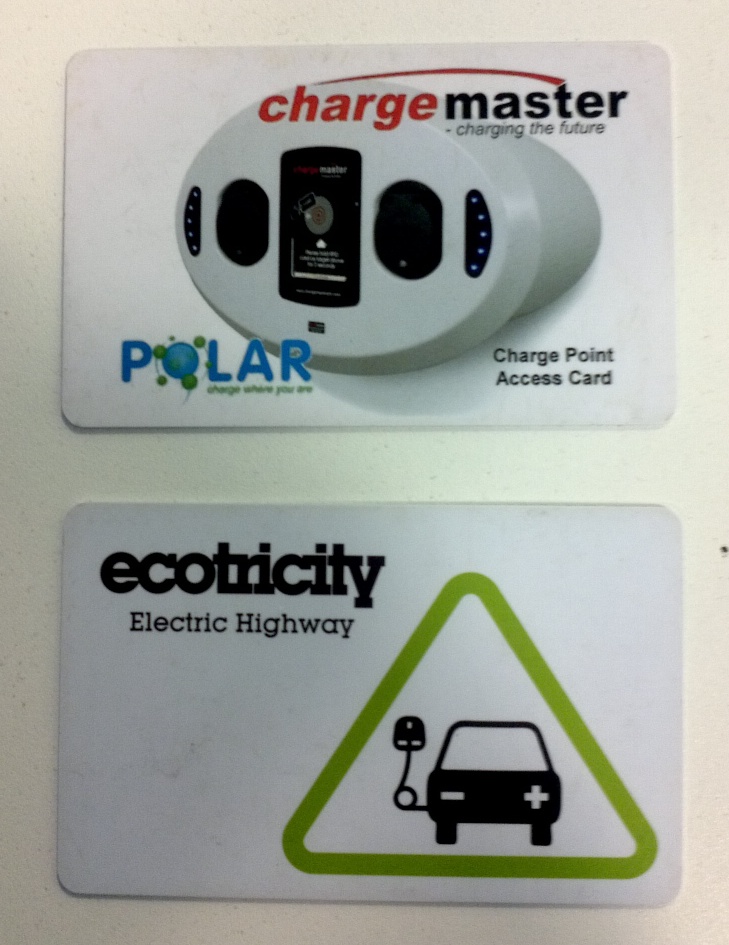
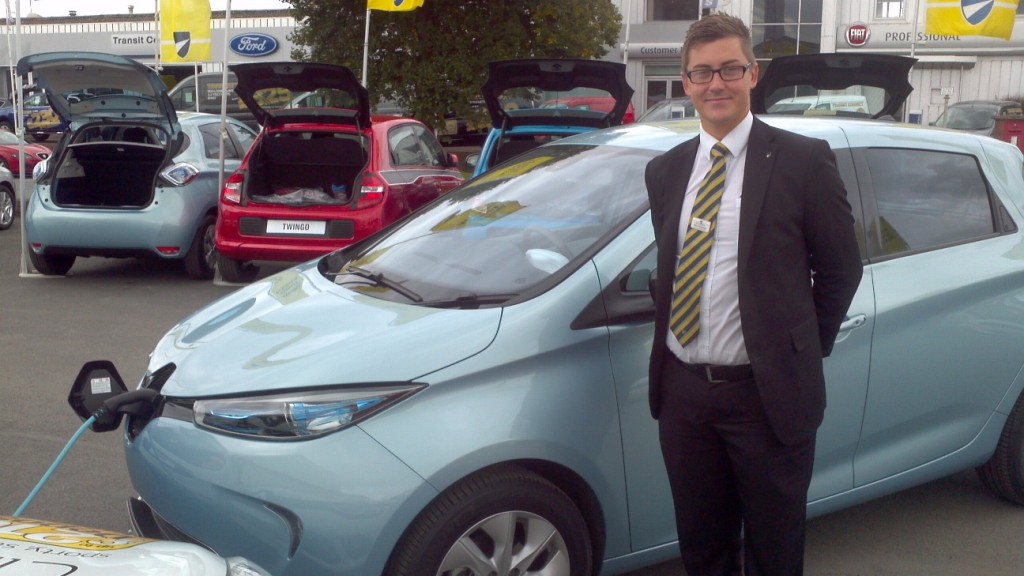
We had a chat to Marc Seabridge, Bristol Street Motors EV specialist (pictured below), and explained that I’d be dropping Kasia off at Bristol Airport the following weekend and then returning to Exeter. I wondered whether we could borrow the ZOE to do that trip, in an endeavour to discover if it was fit for our particular purposes. Marc said yes! When we picked the car up at 11:00 on Friday he lent us a couple of RFID cards so that we could charge the ZOE en route, one for ChargeMaster’s Polar network and one for Ecotricity’s Electric Highway:
The ZOE’s lithium ion battery was about 70% full when we picked it up, so we thought we’d get the hang of charging an EV at a public fast charger by heading straight to Exeter Services, just off the M5 motorway. That’s where our troubles began!
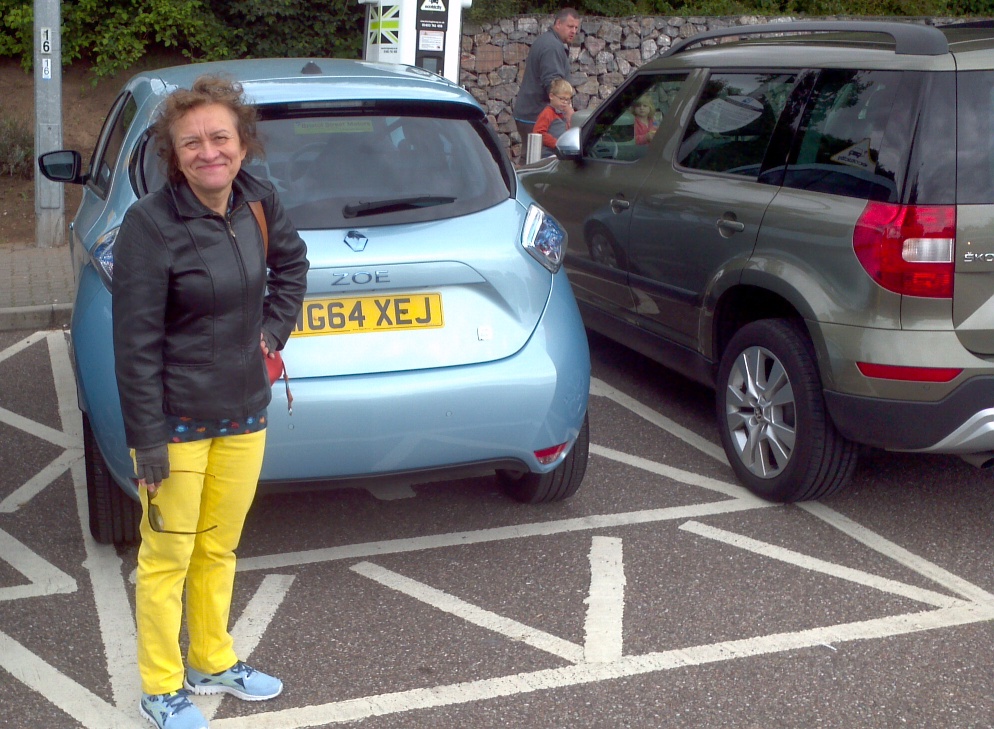
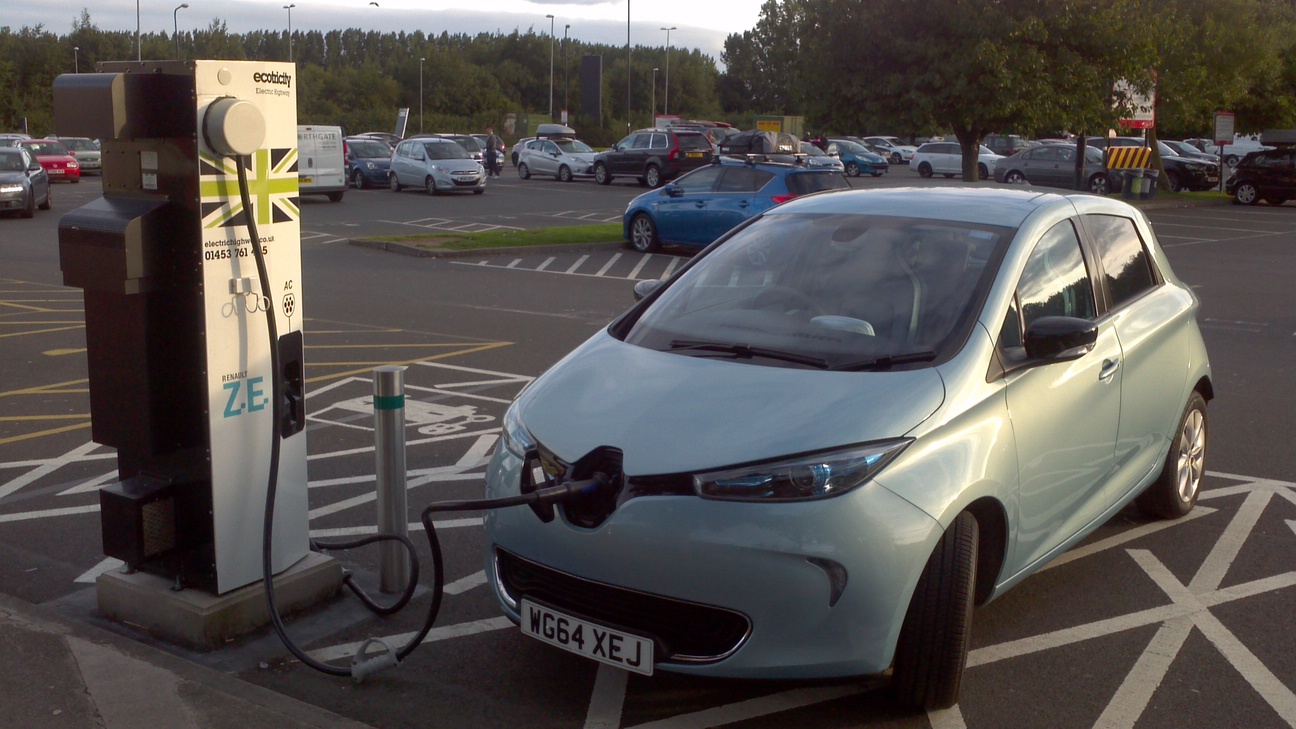
Try as we might, and even with lots of telephone assistance from James Cocks, the Service Manager at Bristol Street Motors, we couldn’t persuade the ZOE to successfully connect to the Electric Highway type 2 fast charger. Here’s what the problem looked like:
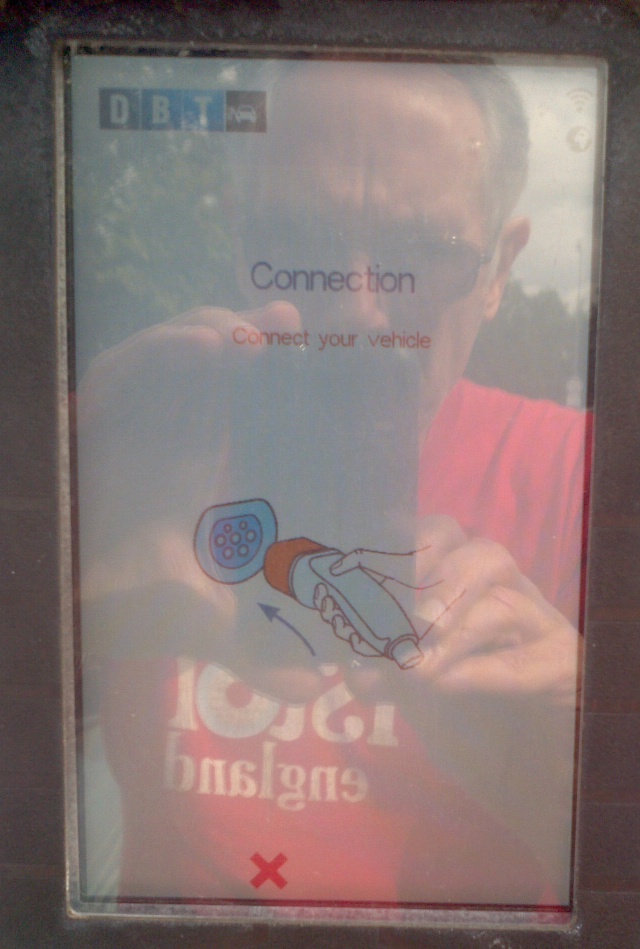
Whatever we tried, there was no way we could persuade a little green tick to show itself. Chastened, we headed back to Marsh Barton to top up the ZOE at one of BSM’s own charging points:
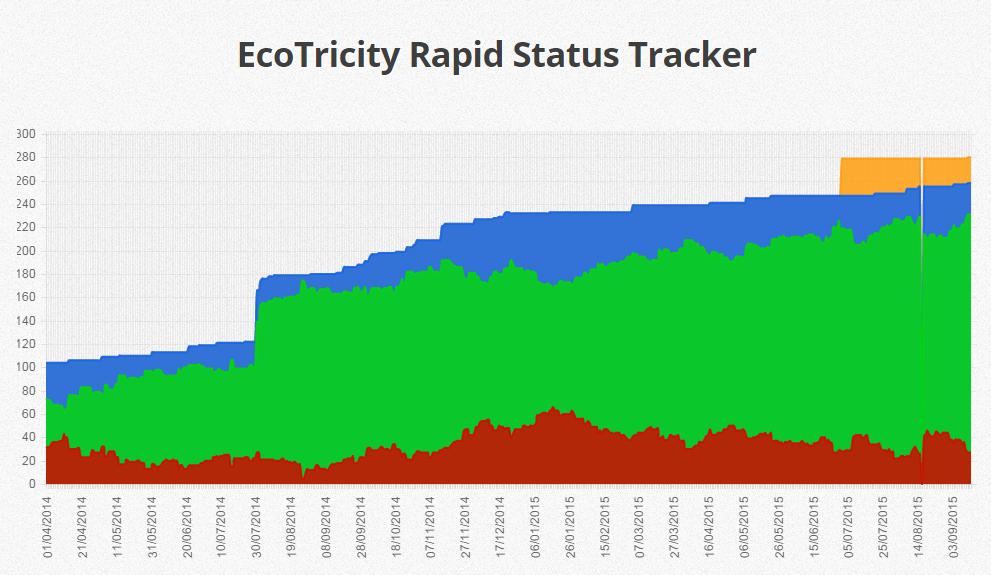
Whilst we waited I telephoned the Electric Highway helpline and explained what we’d discovered. I was told that Ecotricity were already aware of the problem, but they couldn’t tell me when it might be fixed. It seems they have quite a few non functional chargers, and not many engineers available to repair those that cannot be restored to full health via a remote connection from Ecotricity’s offices. Here’s a graphical demonstration of the problem:
To be continued……..

Renault-Nissan to Provide 200 Electric Vehicles for UN COP21 Paris Climate Conference

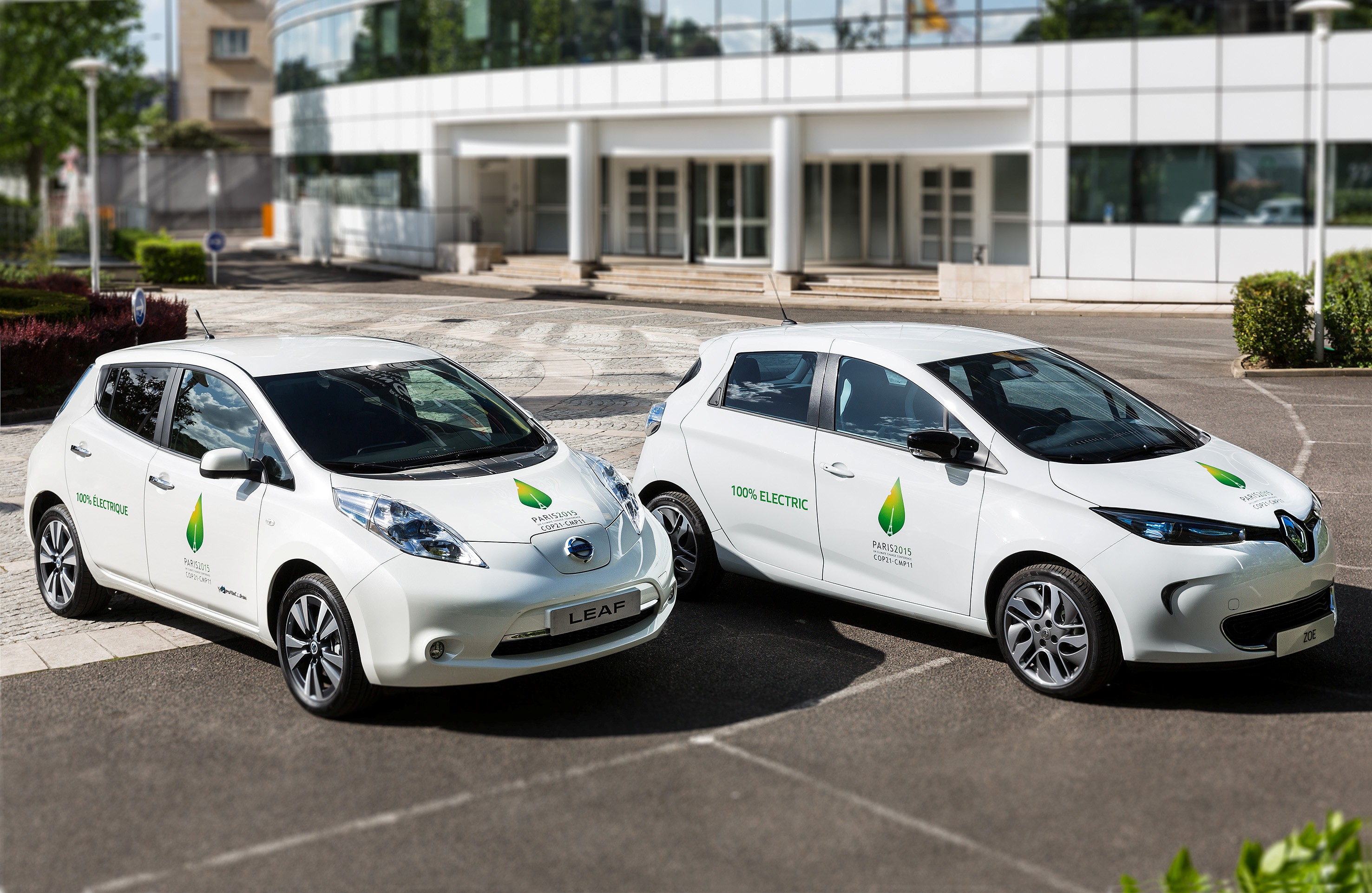
The Renault-Nissan Alliance announced today that they will provide a fleet of 200 all-electric vehicles as the official passenger-car provider for the United Nation’s COP21 climate conference in Paris later this year. The fleet of vehicles will include Renault’s ZOE and Kangoo Z.E. and Nissan’s LEAF and e-NV200. Here’s what a small part of it looks like:


According to the Alliance press release:

The partnership agreement was signed today between the Renault-Nissan Alliance and the General Secretary in charge of the preparation and organization of the 21st annual Conference of Parties (better known as COP21). The fully electric car fleet will shuttle delegates during the event from Nov. 30 to Dec. 11.

More than 20,000 U.N. participants from 195 countries are expected to attend the annual climate summit. It will be the first time the U.N. will use a zero-emission fleet for its entire passenger car shuttle at a COP event.

Laurent Fabius, the French Minister of Foreign Affairs and International Development and President of COP21, said that:

We are delighted to announce that the Renault-Nissan Alliance is an official partner of COP21 in Paris. Thanks to the Alliance’s fleet of 100% electric vehicles, it will contribute to our goal of achieving a carbon neutral event. The technology of electric vehicles helps reduce greenhouse gases in the transportation sector efficiently.

whilst Carlos Ghosn, Chairman and CEO of the Renault-Nissan Alliance, said that:

Electric vehicle technology is an efficient solution for a practical and affordable mode of transportation. This solution has a positive impact on the climate and air quality in our cities. It’s time to accelerate the shift to zero-emission mobility by working together with all parties concerned.

At this point in time I cannot help but wonder what Amber Rudd and her new team at DECC will make of being ferried around Paris in 100% electric vehicles later this year? Maybe they’ll be so impressed that they will follow the lead of Paris and:

Set up network[s] of more than 50 quick and standard charging stations powered by 100% renewable energy in strategic locations. The quick charging stations will be able to charge the EVs from 0 to 80% capacity in about 30 minutes.