Shell Joins the IONITY High Power Charging Network

Our “High power charging” prayers have been answered! Three weeks ago we bemoaned the apparent lack of any plans to roll out the freshly announced IONITY network of CCS charging stations here in the UK. However IONITY have just announced that:

IONITY, which was founded only a few weeks ago, is taking off quickly. The joint venture of BMW, Daimler, Ford and Volkswagen with Audi and Porsche has formed initial strategic partnerships for the realization of its “High-Power-Charging” (HPC) network for electric vehicles in Europe. By teaming up with Shell, OMV, Tank & Rast and Circle K, IONITY has secured the coverage of more than half of the approximately 400 sites planned between now and the year 2020. Other partnerships are planned.

By joining forces with Shell, IONITY will be able to install its fast charging infrastructure at sites throughout ten European countries: Belgium, France, Great Britain, the Netherlands, Austria, Poland, Slovakia, Slovenia, the Czech Republic and Hungary. This collaboration will reinforce the business strategy pursued by both companies to offer more and more drivers of electric vehicles a fast, reliable charging service at attractive sites.

It was announced back in October that:

Shell, one of the world’s largest energy providers, has signed an agreement to buy NewMotion in a deal that will enable both companies to accelerate the transition to low-carbon transport.

Under the terms of the deal, NewMotion will remain focused on accelerating its mission in Europe by delivering more innovative smart-charging solutions to homes, businesses and public parking spaces. The acquisition will help NewMotion enhance its electric vehicle (EV) charging services turning more parking spaces into charging stations as well as improving users charging experience across Europe.

One way and another it looks as though Shell have some big plans for electric vehicles! When will those plans extend as far as South West England though, if ever?

Last Call for IEC 63110 Use Case Submissions

Our regular reader(s) will be aware that quite some time ago I suggested that:

There’s a few more urgent things to be ticked off on the to do list. How about OCPP 2.0 or even fully fledged British and international standards for “smart charging”, V2B and ultimately pukka V2G protocols for starters?

I am happy to now be able to report that my wish has come true! An international standard is now being developed for electric vehicle supply equipment (EVSE for short) communications with the “back office”, including vehicle to grid (V2G for short) functionality. For my sins I now sit on IEC technical committee 69 joint working group 11 (TC69/JWG11 for short). According to the Wikipedia article on the subject, which I wrote:

IEC 63110 is an international standard defining a protocol for the management of electric vehicles charging and discharging infrastructures, which is currently under development. IEC 63110 is one of the International Electrotechnical Commission’s group of standards for electric road vehicles and electric industrial trucks.

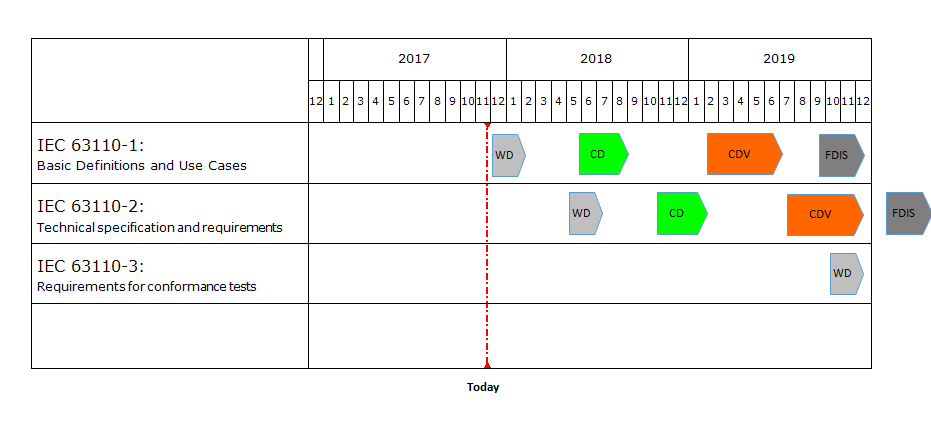
You will no doubt be delighted to discover that proceedings are still at a fairly early stage. Here’s the current IEC 63110 roadmap:

IEC-63110-2017-11-24

The top line indicates to the initiated that I am still able to point out that IEC TC69/JWG11 is currently seeking submissions for potential use cases to add to our initial list. The current deadline is December 6th. It is probably safe for you to assume that all the obvious stuff from the Open Charge Alliance’s Open Charge Point Protocol and ISO/IEC’s 15118 protocol is already included on our list.

However if you have a use case that isn’t in amongst the obvious stuff then please do not hesitate to get in touch!

Are you ready?

Static and Mobile Distributed Energy Storage Launched At Long Last

Our roadmap didn’t call for this announcement just yet, but on Autumn 2017 budget day Philip Hammond, the Great British Chancellor of the Exchequer, had this to say:

The next day Nissan’s Francisco Carranza made an interesting announcement on Twitter:

In a bit more detail, Nissan announced:

Nissan Motor Parts Center in Europe is the first company in the Netherlands to make its roof available to others for the production of sustainable energy on a large scale. The electricity generated is sufficient for the power consumption of 900 households. The first section becomes operational at the end of February. The project will be fully completed in May.

With the installation of this immense solar roof, Nissan is taking a further step toward its strategy focusing on Intelligent Mobility, with sustainable energy as one of its cornerstones.

“This project is perfectly suited to Nissan’s endeavors to make mobility smarter and more sustainable,” said Koen Maes, managing director Nissan Benelux (Belgium, Netherlands and Luxembourg). “That’s why we are working on sustainable energy production and on projects such as energy storage in used batteries – vehicles which return energy to the network and car sharing. The solar roof is one of the cornerstones.”

That’s pretty much the way we see things too, and after a couple of false starts over the years the team here at V2G UK decided to accelerate our plans:

Here are some other things that have been happening on Twitter over recent days:

In case it’s not yet obvious to you, our Static and Mobile Distributed Energy Storage project roadmap includes rolling out just the right sort of V2G capable electric vehicle charging station for our purposes. My personal Twitter profile reads as follows:

I’ve been programming computers since the late 60s. We had to build our own! Now what can I program next? Will I have to build it first?

It looks as though the answer to that question is YES!

Meanwhile the V2G UK Twitter profile concludes:

A friendly local neighbourhood energy market would also be nice!

Are we going to have to build that too?

V2G Explained by the Mainstream Media

V2G is now a hot topic in the UK mainstream media! A few days ago The Times newspaper published an article on vehicle-to-grid technology. According to Edward Lucas:

The hunt is on for cheaper and better storage, which is where electric cars come in. For its owners, the car battery is an unused asset most of the time, just as the engine is for those of us with old-style vehicles. Yet for grid managers dealing with the spikes and troughs in demand, a terawatt hour stored in spare batteries is exactly what is needed. Instead of subsidising standby generators, we can pay car owners to sip power from their vehicles’ batteries.

But making this work on a larger scale requires change. Our existing energy set-up is centralised: big power plants transmit large amounts of electricity over long distances to passive consumers. This arrangement copes with the 115,000 electric cars we have now. But it will not be fit for 2040, when the government intends to ban the sale of new diesel and petrol cars. By then we are predicted to have more than 25 million electric vehicles.

Done wrong, that will resemble something like a vast network of electric kettles. Charging them all at once at home would crash the grid. Consumers will curse, costs will soar and benefits will shrivel. To avoid that, the electricity system of the future will have to look like the internet: decentralised and interactive. Consumers will also be producers — perhaps from rooftop solar panels or by supplying power from their car batteries back into the grid when needed. Demand will be smarter: appliances will adjust their consumption according to price. Electric car owners, for example, will not mind exactly when their vehicle is charged, so long as it is ready when they need it. They will take advantage of cheap electricity just as consumers do already with night storage heaters.

The prospect is both exciting and daunting. Dieter Helm, the energy economist who recently reviewed energy costs for the government, says that the combination of electric vehicles, battery technology and digitisation presents challenges of a scale and magnitude not witnessed since the reconstruction of our electricity system after 1945.

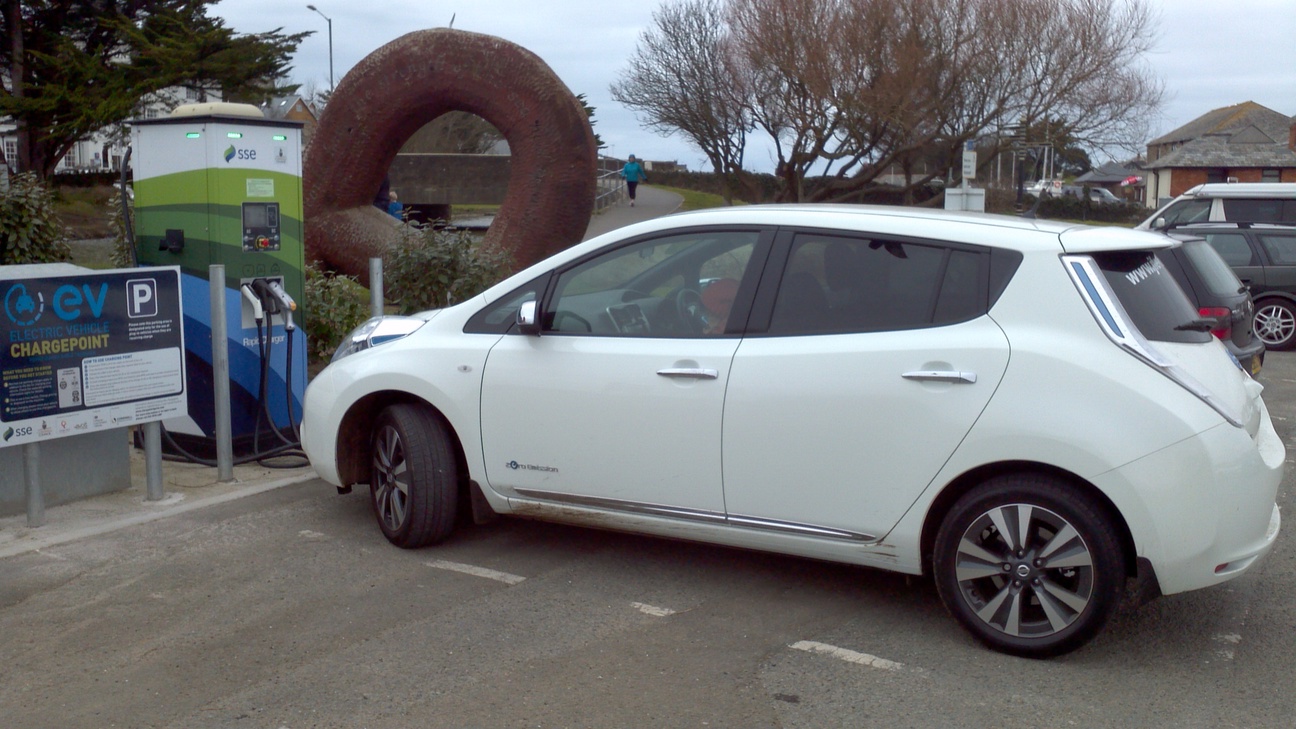
Today the BBC have followed the Times’ lead by publishing an article by Theo Leggett with a slightly different perspective. Unfortunately they included at the top a stock photo of what looks a lot like a Renault ZOE instead of a Nissan LEAF. Here’s one of our stock photos of a 2016 LEAF, which is V2G capable:
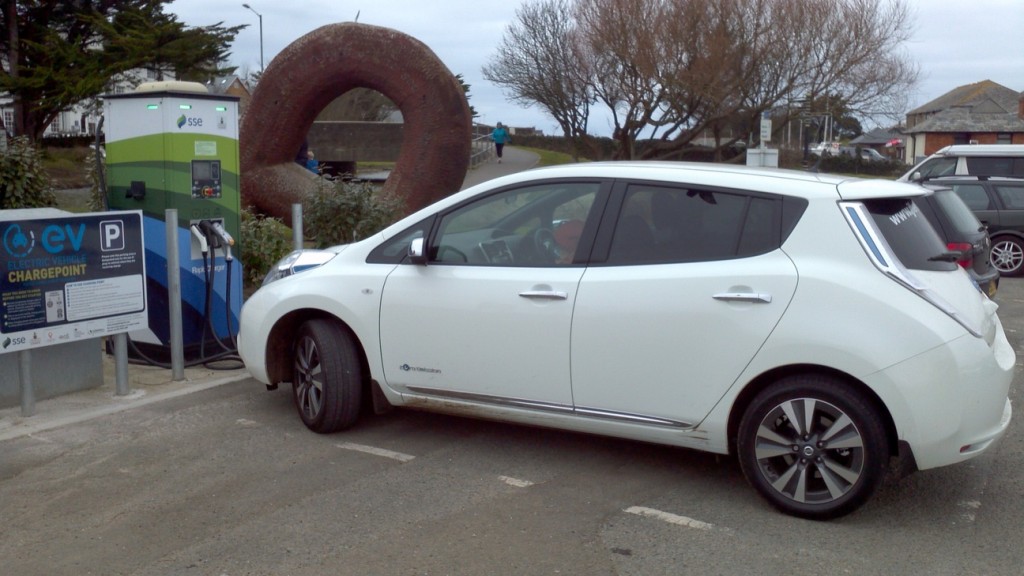
2016-03-19_12-56-18_200

However currently the ZOE is not. Here’s what one of those looks like:
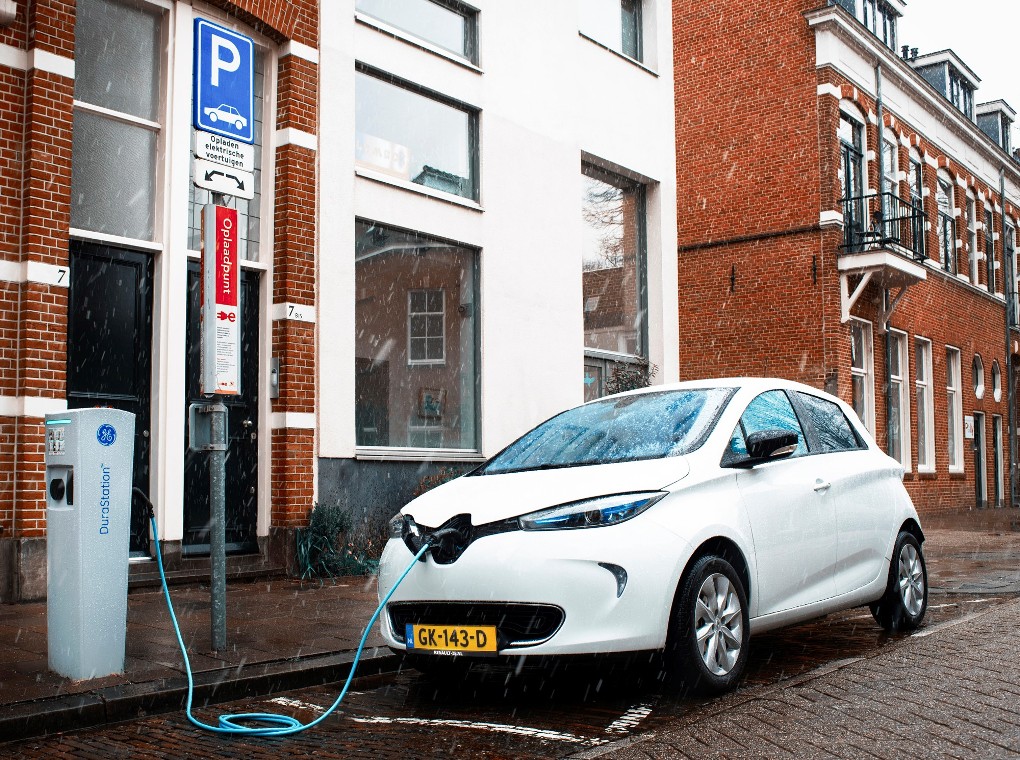
ZOE-LomboXnet-1024

Theo points out that:

At the Nissan Technology Centre in Cranfield, Bedfordshire, a number of the company’s electric Leaf models are lined up alongside a bank of chargers. But these cars aren’t just drawing energy from the grid; they’re also putting it back.

The system is called Vehicle to Grid, or V2G. The Japanese company is developing it in partnership with the Italian power firm Enel and is already operating a small trial hub in Denmark.

Electric cars are, in effect, energy storage devices, and because they spend much of their time parked up not doing anything they can help smooth out the peaks and troughs in energy demand.

“Basically, we can consider the car as a battery with wheels,” says Maria Laura Corallini, the engineer in charge of the V2G project.

“You can use the energy storage capability in the battery to provide specific services back to the grid.”

The system uses software to regulate the charging level of multiple vehicles.

When the grid needs extra power, it can draw very small amounts from each individual vehicle. When energy is abundant, it can top them up again. Users will get paid for the electricity they provide.

If thousands of cars are connected together, then the amount of energy given back to the grid can be substantial, and it can be varied on a second-by-second basis.

Initially the plan is to sell it to businesses that operate large fleets, although the company says it will also introduce a residential version. Other organisations are also experimenting with the technology.

I suppose V2G UK must count as one of those “other organisations” in this context! Theo continues by referring to an oft mentioned tale of V2G woe:

Not everyone agrees that V2G makes commercial sense, however. The chief technical officer of Tesla, JB Straubel, for example, has suggested in the past that he doesn’t see it becoming a viable solution, largely due to its cost and complexity.

I am forced to agree with JB that here in the UK V2G currently doesn’t “make commercial sense”, which further forces me to reveal once again this image of a Tesla Model S connected to a V2G capable bi-directional charging station in the Netherlands:
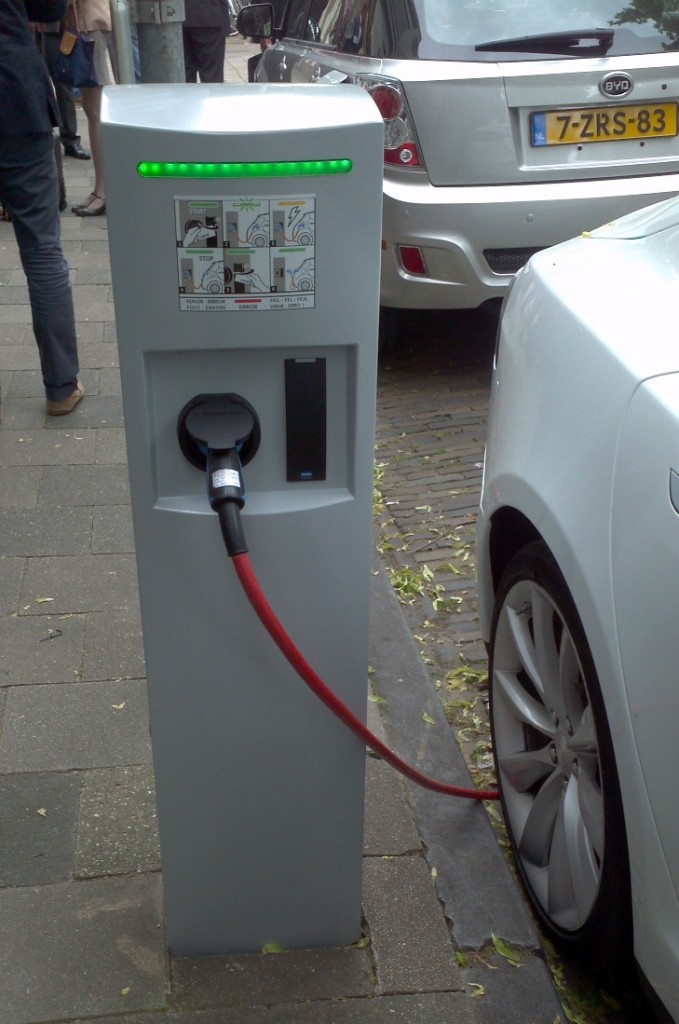
Unfortunately in all the circumstances that particular Tesla was only capable of charging from the kerbside bi-directional charging station. The BYD e6 parked next to it could however also discharge, ultimately to the local distribution grid. Do you suppose that if and when the “cost and complexity” reduces and V2G does “make commercial sense” in Tesla’s view, power will suddenly start flowing in the opposite direction down that stout red cable?
redT Flow Machine Connects to Centrica Local Energy Market

In a press release last week redT Energy announced that it:

Is pleased to announce that in partnership with Centrica, its flagship UK 1MWh energy storage project is now fully operational and connected to the UK grid

This is exciting news because the project is located in North Cornwall just like us!

redT’s machines located at The Olde House, a 600 Acre working farm and holiday retreat, situated in North Cornwall, will be used as a ‘flexible platform’ enabling the customer to generate strong commercial returns and utilise significantly more of its renewable solar onsite generation. redT expects this type of project to achieve an IRR % in the mid-teens. The energy storage machine has a 25+ year asset life, thus proving the strong investment case for redT’s patented vanadium redox flow machines.

This is the largest operating containerised vanadium redox flow machine system in the UK and the first commercial energy storage system to sign up to Centrica’s Local Energy Market trial. The LEM is a £19m project designed to demonstrate the role that flexible generation and storage can play in relieving pressure on the grid and driving down energy prices in the UK.

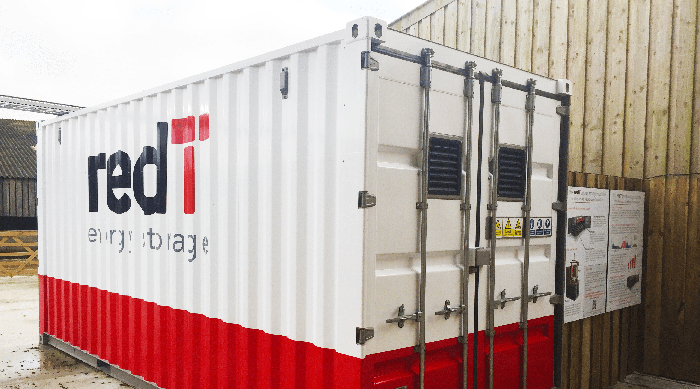
Here’s what the containerised flow machine (not battery!) looks like:

RedT_Vanadium_Redox_Flow_System_Olde_House_Cornwall

Somewhat unusually the redT press release has an accompanying sound track. It’s an interview with redT CEO Scott McGregor, which you can listen to here. Note in particular the section at 1 minute 40 where Scott says:

The Cornwall grid is probably one of the weakest grids in the UK and has a GW of renewables on it, but it’s stuck. You can’t put any more on.

This is of course a big problem! Going back to the redT press release we are informed that:

The potential addressable market for behind the meter industrial and commercial (I&C) energy storage in the UK is in the range of 3,000 GWh total (calculated using 2016 Digest of UK Energy Statistics (DUKES) data). Making a conservative assumption of 20% take up across all I&C sites in the UK, this equates to 8 million redT tank units.

Here at V2G UK we cannot help but wonder if all the energy that could be stored in the battery packs of millions of future electric vehicles might not come in handy too?

IONITY – A New Pan-European High-Power Charging Network

In a press release a couple of days ago it was announced that:

BMW Group, Daimler AG, Ford Motor Company and the Volkswagen Group with Audi and Porsche today announced joint venture IONITY that will develop and implement a High-Power Charging (HPC) network for electric vehicles across Europe. Launching approximately 400 HPC stations by 2020, IONITY will make long-distance journeys easier and marks an important step for electric vehicles.

Based in Munich, Germany, the joint venture is led by Chief Executive Officer Michael Hajesch and Chief Operating Officer Marcus Groll, with a growing team, set to number 50 by the start of 2018.

A total of 20 stations will be opened to the public this year, located on major roads in Germany, Norway and Austria, at intervals of 120 km, through partnerships with “Tank & Rast”, “CircleK” and “OMV. Through 2018, the network will expand to more than 100 stations, each one enabling multiple customers, driving different manufacturer cars, to charge their vehicles simultaneously.

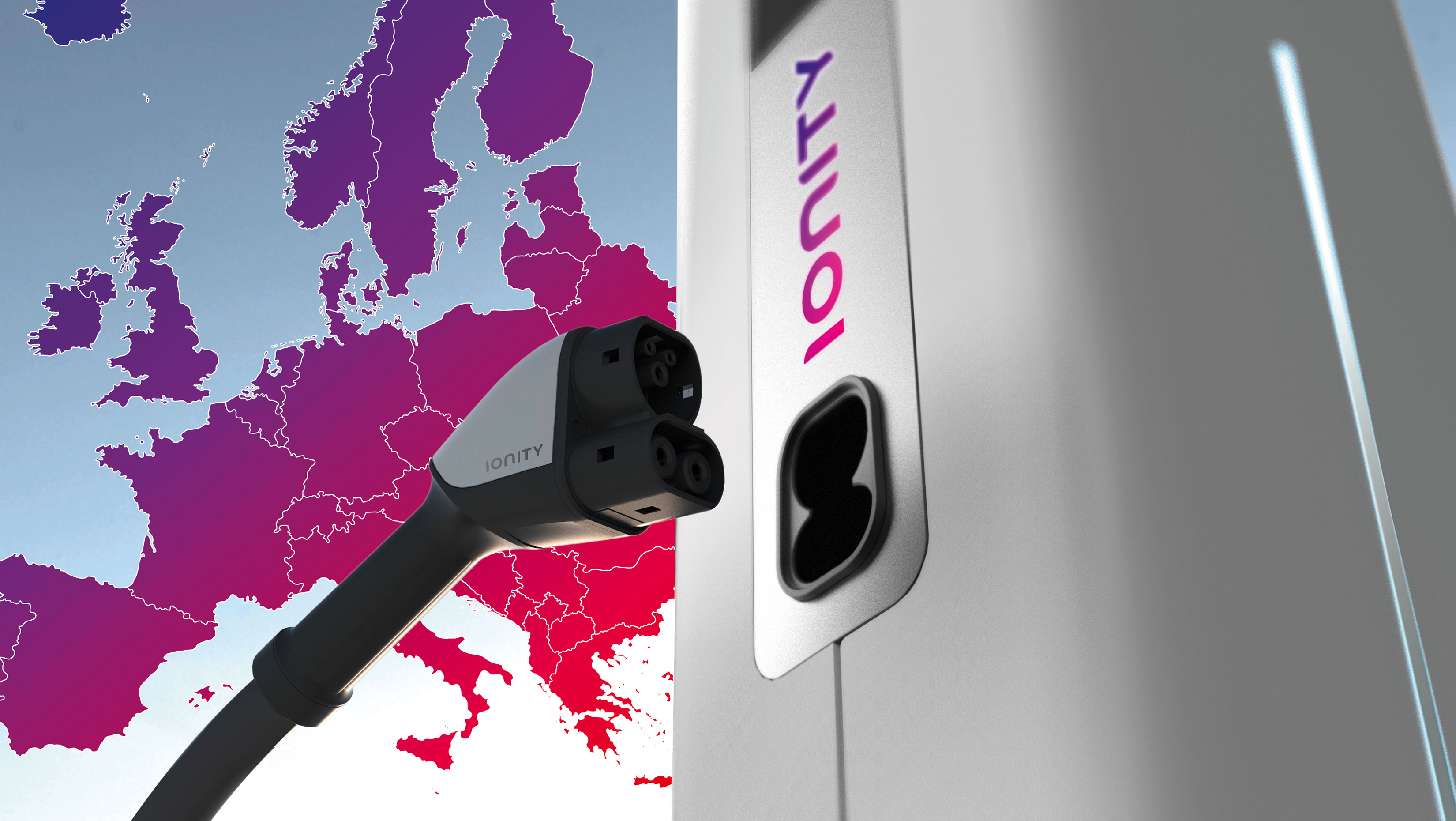
588961_ionity_2017_porsche_ag

As that image implies:

With a capacity of up to 350 kW per charging point, the network will use the European charging standard Combined Charging System to significantly reduce charging times compared to existing systems. The brand-agnostic approach and Europe-wide distribution is expected to help make electrified vehicles more appealing.

Unfortunately, from our perspective at least, it seems as though “Europe-wide” doesn’t currently include the United Kingdom. What’s more the new joint venture isn’t worldwide “brand-agnostic” either. It seems unlikely that any Japanese EV OEMs will be joining the group any time soon. When it comes to rapid charging they currently prefer the CHAdeMO connector!