Nissan Announces 62kWh LEAF e+ N-TEC. With Free V2G Charger!

A Nissan press release has just landed in my in box, and I’m now so excited I’m going to reproduce it in reverse order! The final bullet point reads as follows:

Earlier in the release the following points are also mentioned:

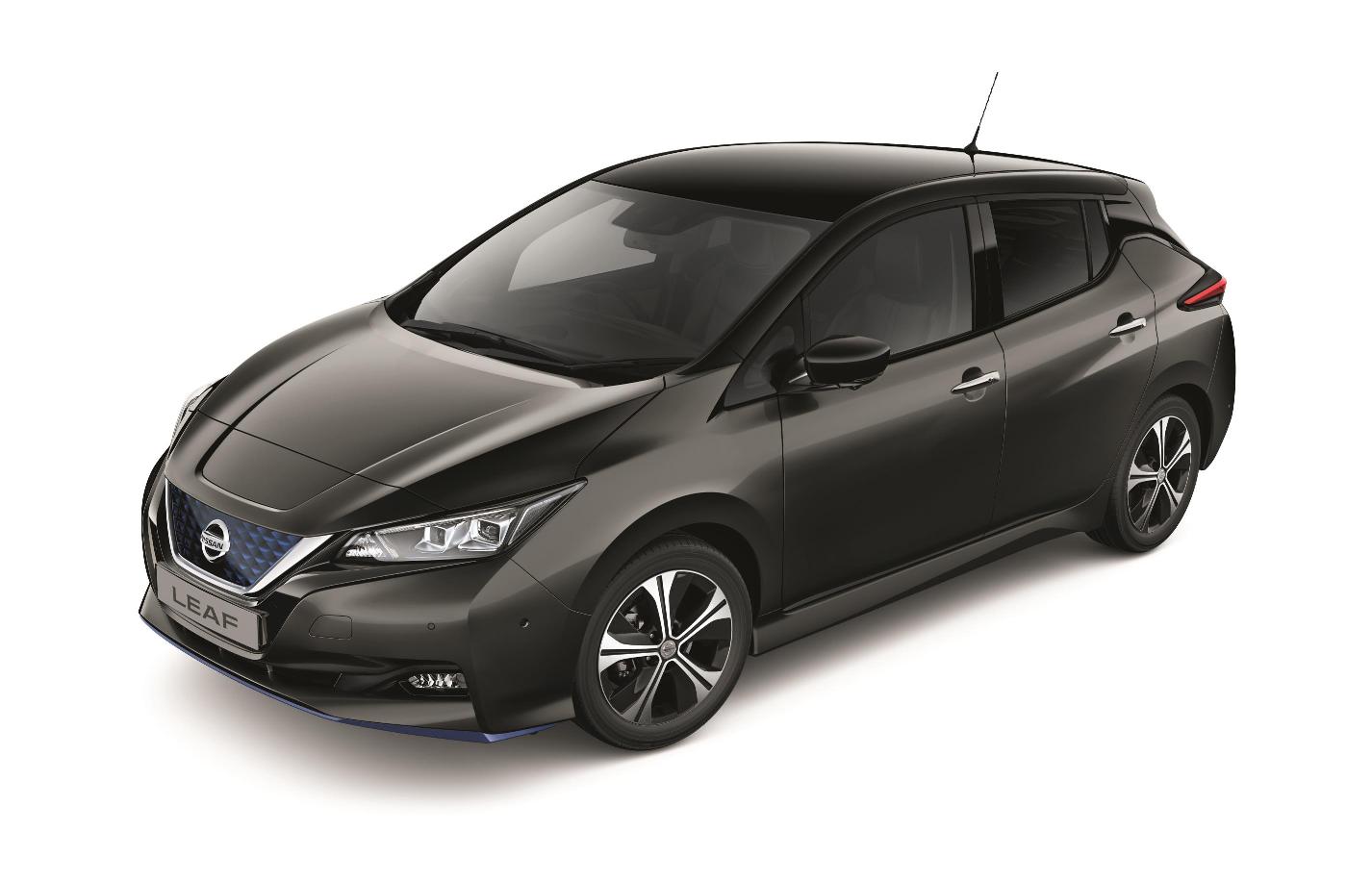
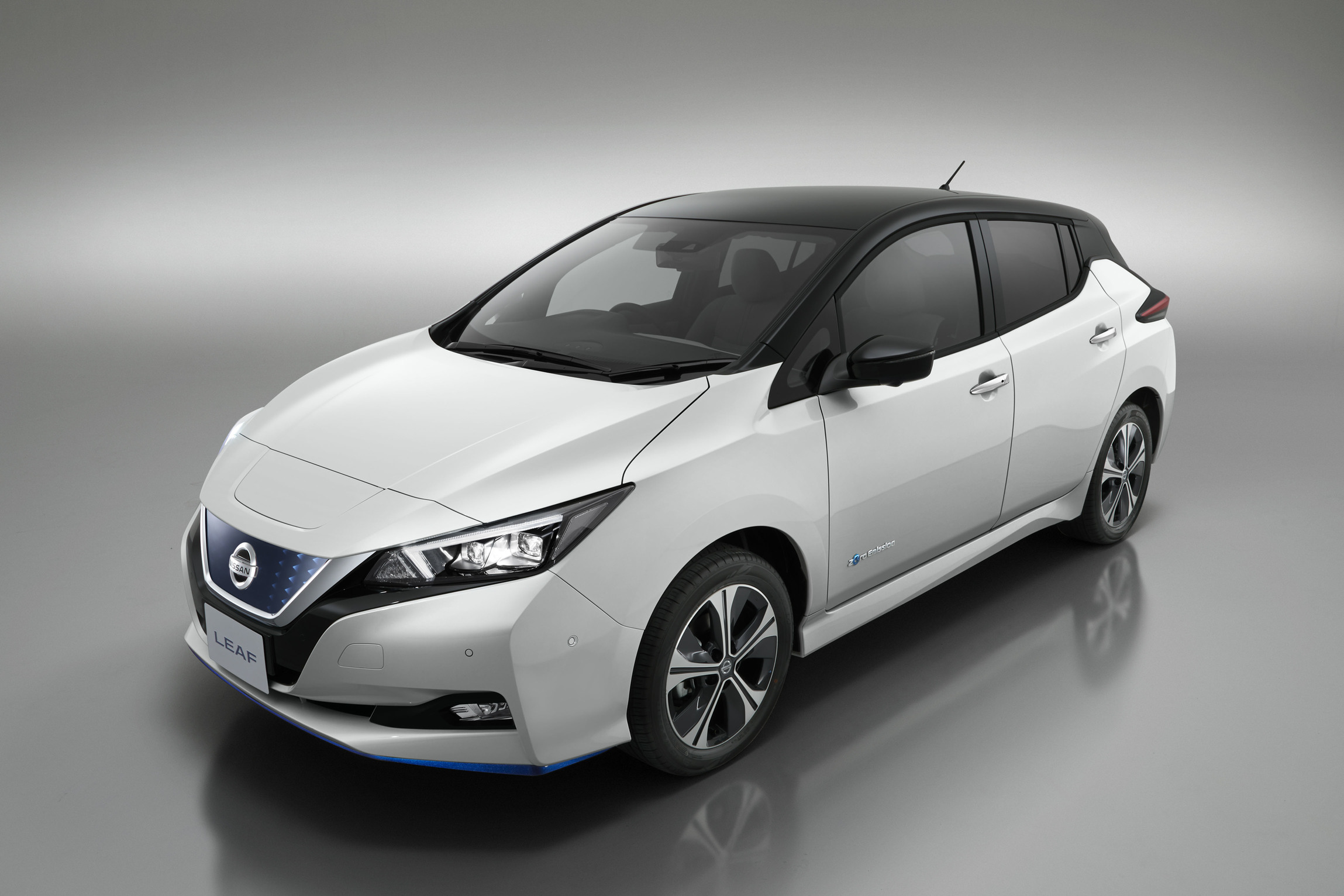
Nissan has confirmed the all-electric LEAF range will benefit from a new N-TEC limited edition, joining the cross car line N-TEC versions of Micra, Qashqai and X-Trail, which were launched in January.LEAF e+ N-TEC 2020

Priced at £32,795 OTR (including the £3,500 Government Grant) the LEAF e+ N-TEC creates a new accessible price point for the higher 62kWh capacity battery drivetrain. Launched in summer 2019, the e+ version of LEAF delivers 217PS of power, 340Nm of torque and up to 239 miles of range (WLTP combined) on a single charge.

The LEAF e+ was previously available as a range-topping Tekna version. The new N-TEC edition, limited to just 1,000 examples, is based on the N-Connecta grade of the 40kWh line-up, but with added technology and styling, complementing the higher capacity 62kWh battery.

The N-TEC specification adds:

  • LED Pack and LED fog lights with cornering function (usually £495 option)
  • ProPILOT with Lane Keep Assist & Traffic Jam Pilot (usually £595 option)
  • Electronic Parking Brake
  • Metallic Blue Front Splitter
  • Revised e+ suspension set-up

It seems as though the “free” OVO vehicle-to-grid wallbox comes as part of Nissan’s finance campaign, available until 31st March 2020 as part of Nissan’s Red Tag Event.

I have endeavoured to contact both Nissan UK and OVO for comment, but they have yet to get back to me.

P.S. Nissan UK have been in touch. They assure me that the 62 kWh LEAF N-TEC is already in production, and if the 1000 special edition vehicles haven’t all been sold by March 31st a new finance offer will be made available. Based on that conversation it sounds as though the “free” V2G wallbox is available as part of OVO Energy’s continuing V2G trial, and is not dependent on Nissan’s finance. Full details can be seen at:

https://www.ovoenergy.com/electric-cars/vehicle-to-grid-charger

Our V2G Charger stores electricity in your Nissan electric vehicle battery when it’s cheaper and more likely to have been produced by renewable sources, then sells energy back to the grid when it’s in demand.

Sign up to OVO Energy, join the trial and you’ll get a groundbreaking charger for free. You will also get a £75 credit on your OVO Energy bill and a payment of up to 30p per kWh of energy exported back to the grid.

Watch this space for more news as and when we receive it.
Autonomous Nissan LEAF Drives 230 Miles

A press release from Cranfield University reveals that:

A car developed with advanced vehicle engineering research and testing facilities at Cranfield University has successfully completed the UK’s longest and most complex self-navigated journey. Travelling 230 miles on UK roads from the Nissan European Technical Centre in Cranfield up to its factory in Sunderland, the autonomous car journey was alongside regular road users and marks a significant milestone in the development of autonomous cars.

Here’s a video of the autonomous Nissan LEAF’s “Grand Drive” road trip:

The Cranfield press release continues:

The HumanDrive project – jointly funded by the UK Government through the Centre for Connected and Autonomous Vehicles (CCAV) and Innovate UK, and nine other consortium partners – includes:

  • Nissan – Lead partner and leading the autonomous vehicle (AV) development
  • Hitachi – Artificial Intelligence (AI) to provide human-like control and perception
  • University of Leeds – Understanding humanistic driving and its application to AVs whilst also developing a driver risk model
  • Connected Places Catapult (CPC) – Project management, communications and marketing activity, dissemination and safety case elements of the project
  • HORIBA MIRA – Provider of test facilities, supported safety aspects of the project
  • SBD Automotive – Cyber security support and AV Human machine Interface (HMI) studies
  • Atkins Ltd – Provision of a Cyber Security Framework
  • Aimsun Ltd – Studying the impact of AVs on the transport system
  • Highways England – Understanding the infrastructure needs for AV deployment

The Grand Drive journey was successfully completed on 28 November 2019, with two engineers on board and monitoring the vehicle’s actions at all times. Both were fully trained to conduct autonomous vehicle testing, with one behind the wheel and ready to take control if required, and the second supervising the car’s control and monitoring systems.

Honda and Moixa Announce V2G Pilot Project

According to a Honda press release yesterday:

Honda is installing five bi-directional electric vehicle charging points at Islington Town Hall in London, in partnership with smart charging specialists, Moixa. The initiative will help Islington Council electrify its entire vehicle fleet; part of its efforts to achieve net-zero emissions by 2030.

This is the first project resulting from the collaboration between Honda and Moixa, which was announced at Geneva Motor Show in 2019. The strategic partnership forms a significant part of Honda’s Electric Vision strategy to deliver industry-leading innovation through a portfolio of energy management products and services in Europe.

The bi-directional vehicle-to-grid (V2G) chargers incorporate Moixa’s GridShare smart software, which optimises EV battery charging when grid power is cheapest and cleanest. The software can also aggregate groups of plugged-in EVs to provide battery power to the grid when it is most expensive and carbon intensive. When EVs are plugged in to all the chargers, the smart technology can provide enough energy to power the base load of Islington Town Hall.

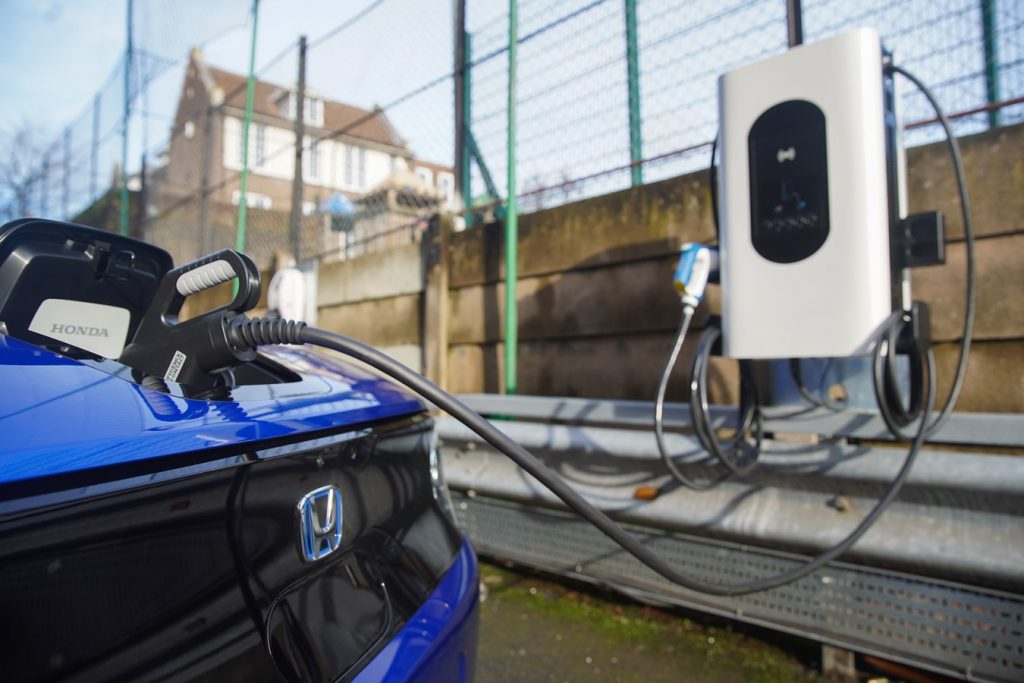
The press release was accompanied by an image showing a CCS connector plugged into the front of an anonymous vehicle with a Honda badge:

However a Moixa press release about the Islington project had a somewhat different emphasis:

At Moixa, we’ve hit the ground running in 2020, unveiling a new smart EV charging project to optimise Islington Council’s fleet at the town hall. This is an exciting first step in our partnership with Honda, to deploy smart EV charging and management solutions across Europe.

We’re working with Honda to support Islington Council achieve its ultra-low emissions zone (ULEZ) standard across its fleet of 500+ vehicles. The council’s goal is to electrify its entire fleet, cutting 1,400 tonnes of dangerous carbon dioxide (CO2) emissions every year. This project will reduce harmful air pollution, save money for essential services and help Islington achieve its 2030 net-zero carbon emissions target.

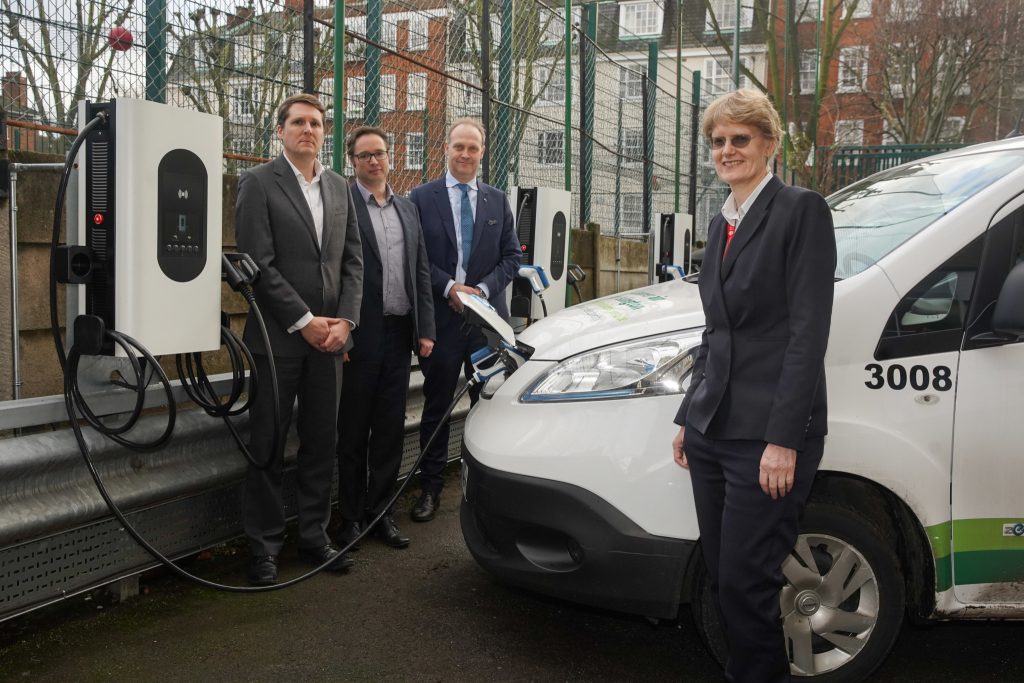
and a rather different image:

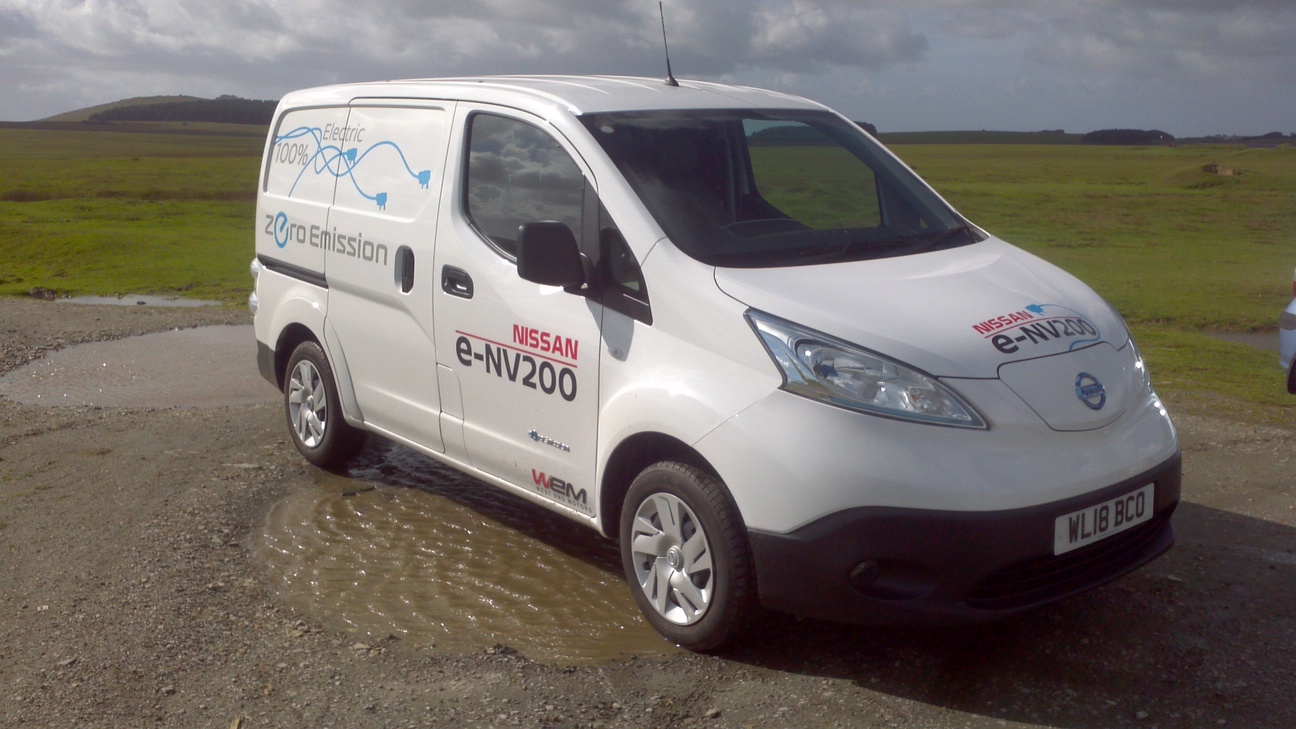
That looks suspiciously like a CHAdeMO connector plugged into the front of a Nissan e-NV200 van, with Simon Daniel and Chris Wright from Moixa looking on in the background!

According to Chris, who is Moixa’s Chief Technology Officer:

The EV revolution will put millions of ‘batteries on wheels’ on our roads in the next decade. By using AI-driven charging technology, we can intelligently manage these fleets of batteries, securing lowest-cost charging and highest-impact carbon savings. Our project with Honda and Islington shows what is possible and provides a blueprint for all large organisations to follow.

Whilst according to Honda Motor Europe’s Project Leader of Energy Management,
Jørgen Pluym:

As the shift towards electrification accelerates, we must continue to innovate with projects like these – helping to drive awareness and uptake of charging solutions and advanced vehicle-to-grid technologies. Honda is committed to promoting sustainable future energy management in Europe, and this project in Islington represents an important part of our vision for future energy solutions.

It looks to me as if Islington Council already possesses one or more Nissan e-NV200’s, but I suspect they will have to wait quite a while for a V2G enabled Honda, especially if it’s vans that they’re after!

Nissan and EDF collaborate on UK V2G

In a press release earlier today Nissan announced that:

Nissan and EDF Group have signed a cooperation agreement to accelerate the delivery of electric mobility together – particularly through the smart charging of electric vehicles. This agreement applies to the United Kingdom, France, Belgium and Italy.

The cooperation agreement focuses mainly on developing smart charging solutions (vehicle to grid, or V2G) by bringing together technologies developed and mastered by both companies. Smart charging refers to technologies that optimise the charging or discharging of an electric vehicle in an efficient and cost-effective manner.

As part of the cooperation agreement, Nissan is responsible for the sale of V2G compatible electric vehicles, and EDF Group in charge of V2G charging solutions and related services.

If EDF have “developed and mastered… V2G charging solutions” I cannot help but think they must be buying in the necessary hardware technology from elsewhere rather than having developed and mastered it themselves. However the news release is rather vague about that side of things! It continues:

Fundamental to Nissan’s Intelligent Mobility vision is the integration of electric vehicles into society, with V2G technology offering significant benefits to electricity grids and providing new financial opportunities to businesses. As increasing numbers of drivers and businesses make the switch to 100% electric vehicles, Nissan achieved record sales for both the Nissan LEAF and e-NV200 van in Europe last year.

EDF Group is committed to promote clean mobility for everyone, in particular by developping “smart charging” solutions with tangible benefits to customers. These fully integrated solutions include the management of the battery’s charge and discharge as well as flexibility services to the grid available through storage. They are carried by Izivia, a wholly-owned subsidiary of the EDF Group specialising in charging infrastructure, and Dreev, the newly launched EDF-NUVVE joint venture, specialising in V2G commercial solutions.

Perhaps EDF’s V2G hardware arrives via Dreev then. However Nuvve have told me numerous times that they are “not in the hardware business”. Who is then?!

The coda to the interesting bit of the release states:

Today’s agreement follows a previous partnership in the UK between EDF Energy and Nissan. Signed last year, the two organisations agreed to collaborate around the development of shared offerings in the areas of electric mobility, smart charging, second-life battery use, energy storage and renewable energy sources.

That doesn’t reveal what Dreev are up to either, so let’s dig a little deeper shall we? According to the Dreev web site:

Dreev solution relies on Nuvve technology that has already been deployed and validated on 5 continents.

followed by:

Nuvve Corporation is a San Diego-based green energy technology company, world leader in V2G technology, whose mission is to lower the cost of electric vehicle ownership while supporting the integration of renewable energy sources, including solar and wind.

which links to the Nuvve web site which tells us:

As part of our complete vehicle-to-grid (V2G) solution, we offer bidirectional chargers which are preconfigured to work with NUVVE’s Grid Integrated Platform (GIVe™).

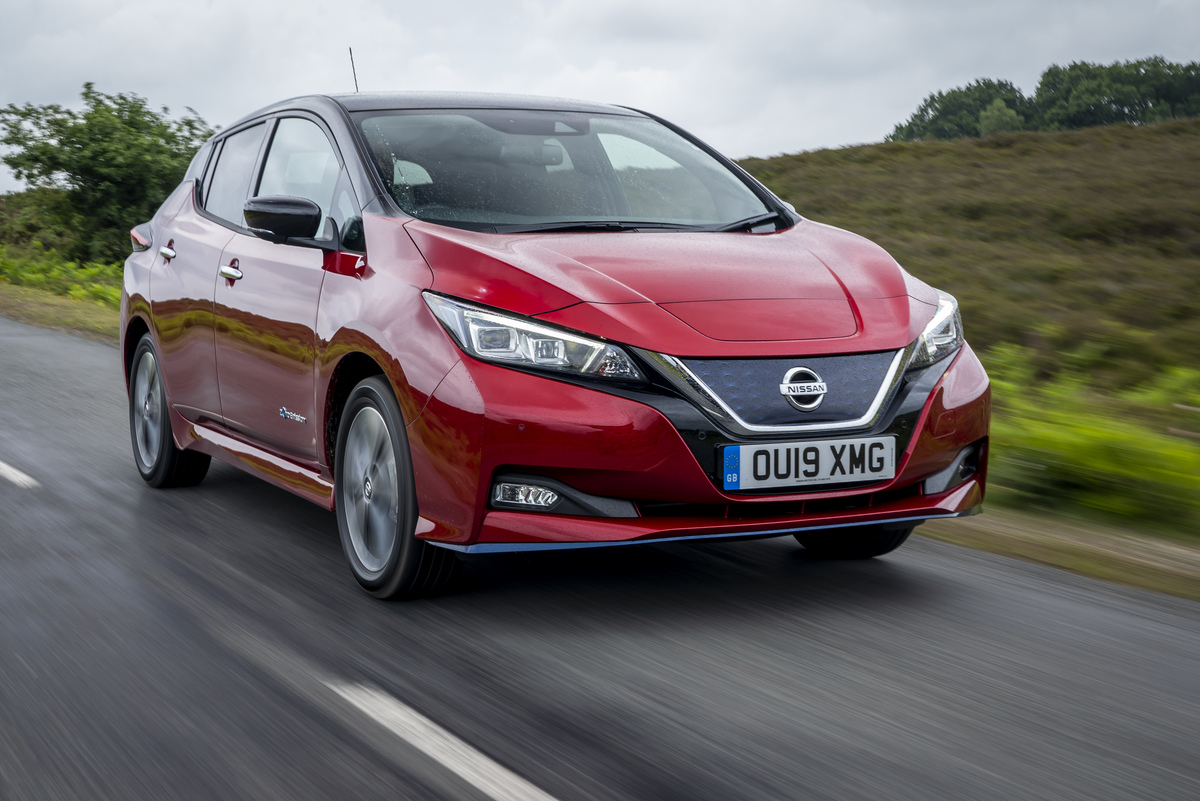
Nissan’s press release included a picture of a shiny red right hand drive 2019 model year Nissan LEAF e+:

Nissan LEAF e plus-small

A packet of peanuts will be our astonishingly generous reward for anybody able to send us a verifiable image of the Nuvve/Dreev “developed and mastered” DC V2G hardware technology. Note that the image on the Nuvve “V2G Chargers” page shows hardware technology developed by a 3rd (or should that be 4th) party.

Volkswagen’s New eMobility Roadmap

On the first day of V2G UK’s trip to The Netherlands I attended EVBox’s rEVolution 2019 event in Amsterdam. Here’s EVBox’s own brief overview of the event:

and here’s yours truly during a quiet interlude at the entrance to the Gashouder Westergasfabriek:

DSC_0138

In the first of several reports from Amsterdam, here’s what Martin Römheld of Volkswagen revealed in the final keynote speech:

Here are a few of the key points from Martin’s presentation:

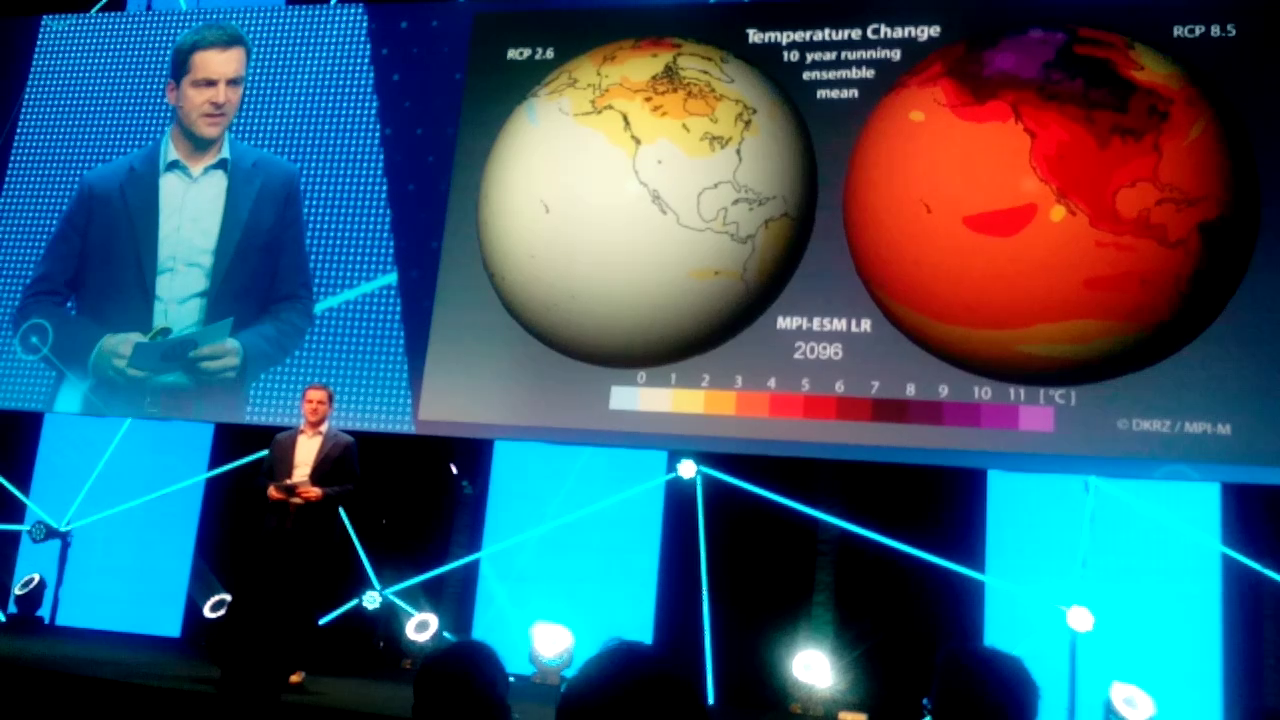
My smallest daughter, she’s 3 years now, so by 2090 she’s probably going to be 74. So that means this is not a far distant scenario. I know people now who are spilling their breakfast all over them who will have to live on that planet by 2090:

vlcsnap-2019-03-24-11h17m36s195

Martin was referring to his animation of two alternative Representative Concentration Pathways (RCPs for short). RCP 2.6 on the left “assumes that global annual greenhouse gas emissions peak between 2010–2020, with emissions declining substantially thereafter”, whereas RCP 8.5 on the right “assumes that global GHG emissions continue to rise throughout the 21st century”.

For VW I can tell you, and I think you can read that from the papers and the news currently they’re really doing a paradigm shift. The top management is really turning around the company big time. The “dieselgate” that Roger mentioned was definitely a facilitator in that. Something had to happen, and it’s really happening now. It caused a lot of fear. It caused a lot of movement, but it’s absolutely necessary.

vlcsnap-2019-03-24-12h18m46s641

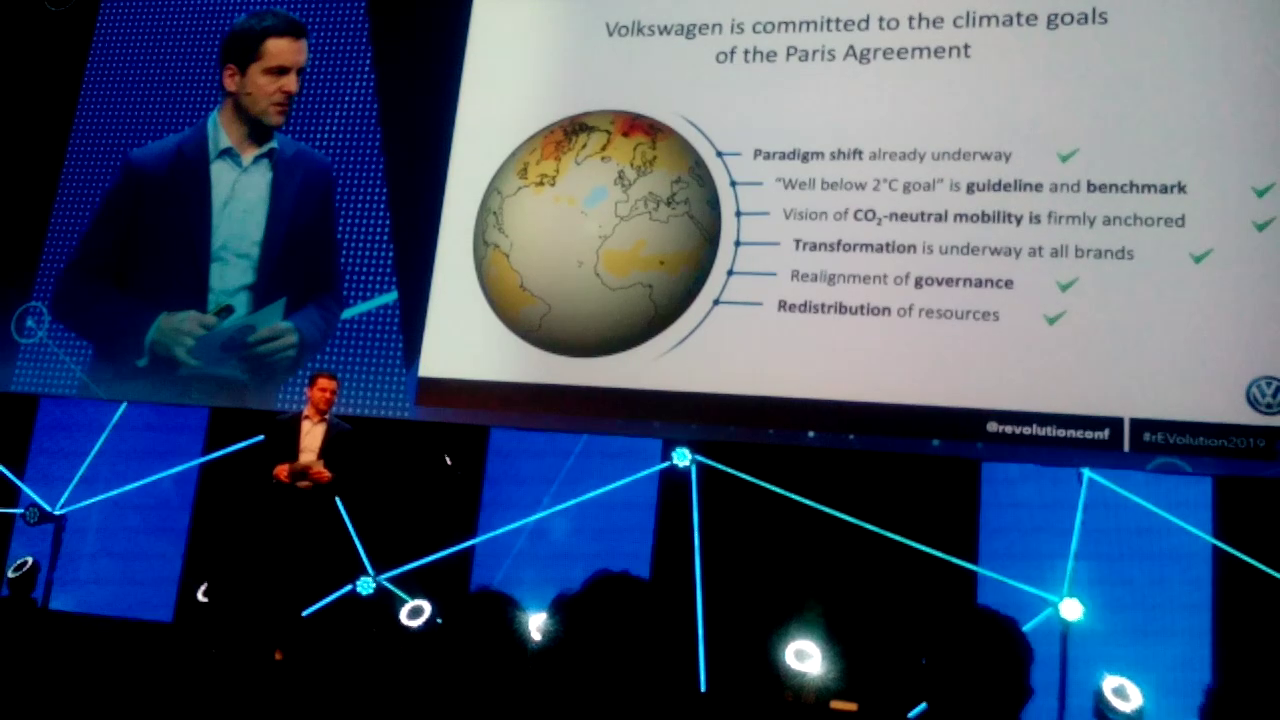
Volkswagen’s “new paradigm” includes a “commitment to the climate goals of the Paris Agreement“.

vlcsnap-2019-03-25-11h46m26s152

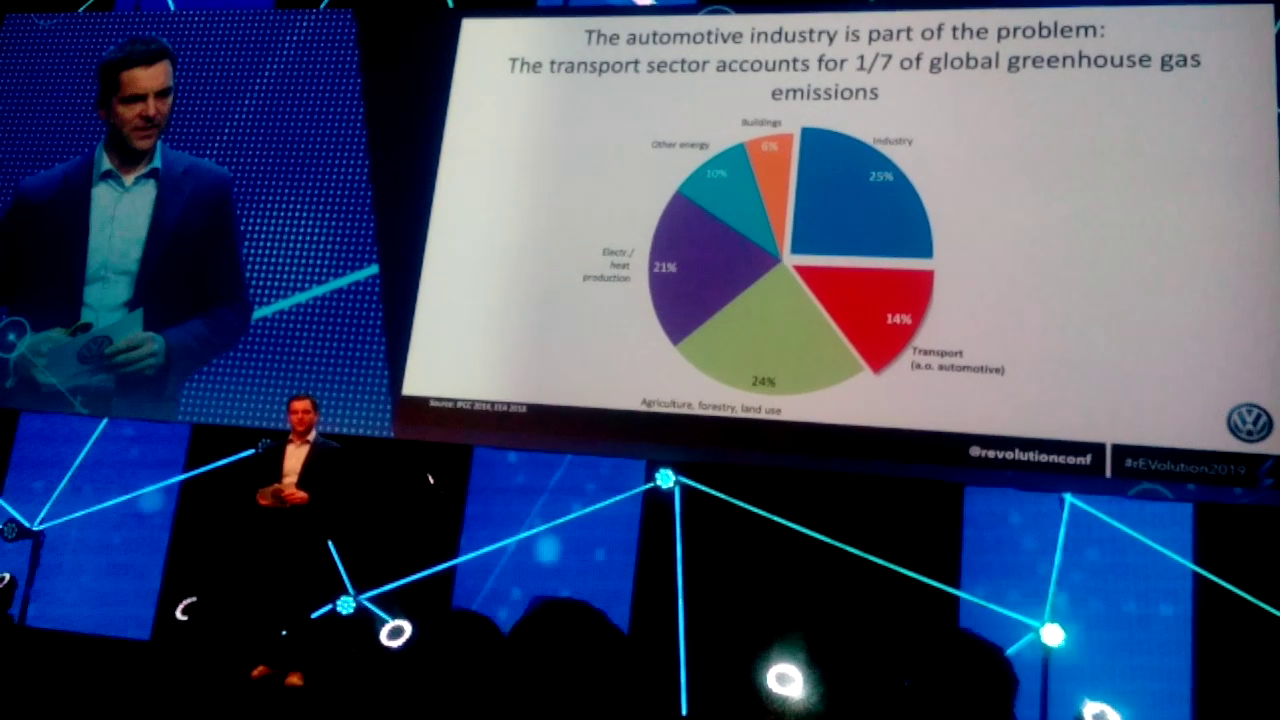
Here you can see the greenhouse gas emissions by different sectors. I’ve singled out the two that we have an influence on. We are part of the industry, so within the value chain and the production of the vehicle we have a big influence on that section, and of course with our products and the services we provide to our customers we have a big impact on the other 14%, the emissions while the vehicle are being used.

Moving on from VW’s aspirations to some engineering, Martin pointed out that:

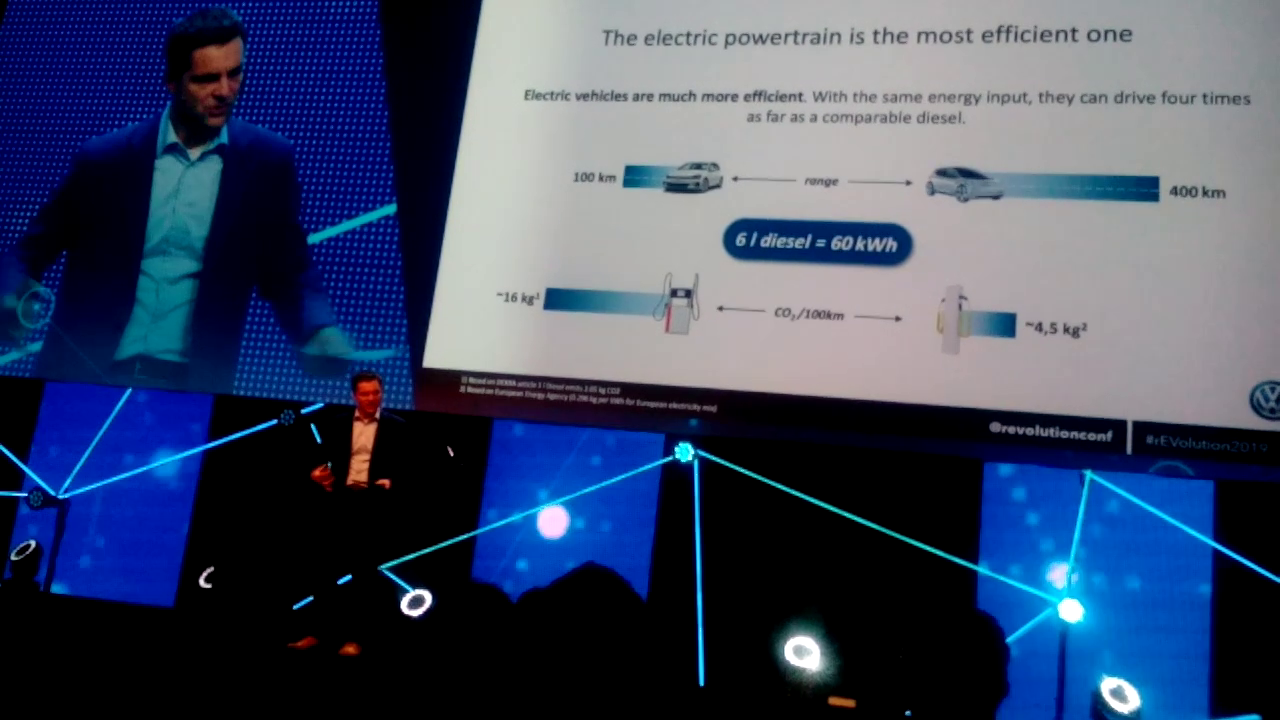
The question is “How much energy is contained in one litre of diesel?”. Very few people know that. It’s about 10 kWh, so 6 litres of diesel are the equivalent of 60 kWh of energy. So how far will that takes us? With a diesel car, if you have a moderate driving style, it will take you about 100 km… With an EV you go four times that far. And that’s the discussion we have to take. It’s not a question about how much more electricity do we consume, it’s a question about how much less energy do we consume.

vlcsnap-2019-03-25-10h59m17s091

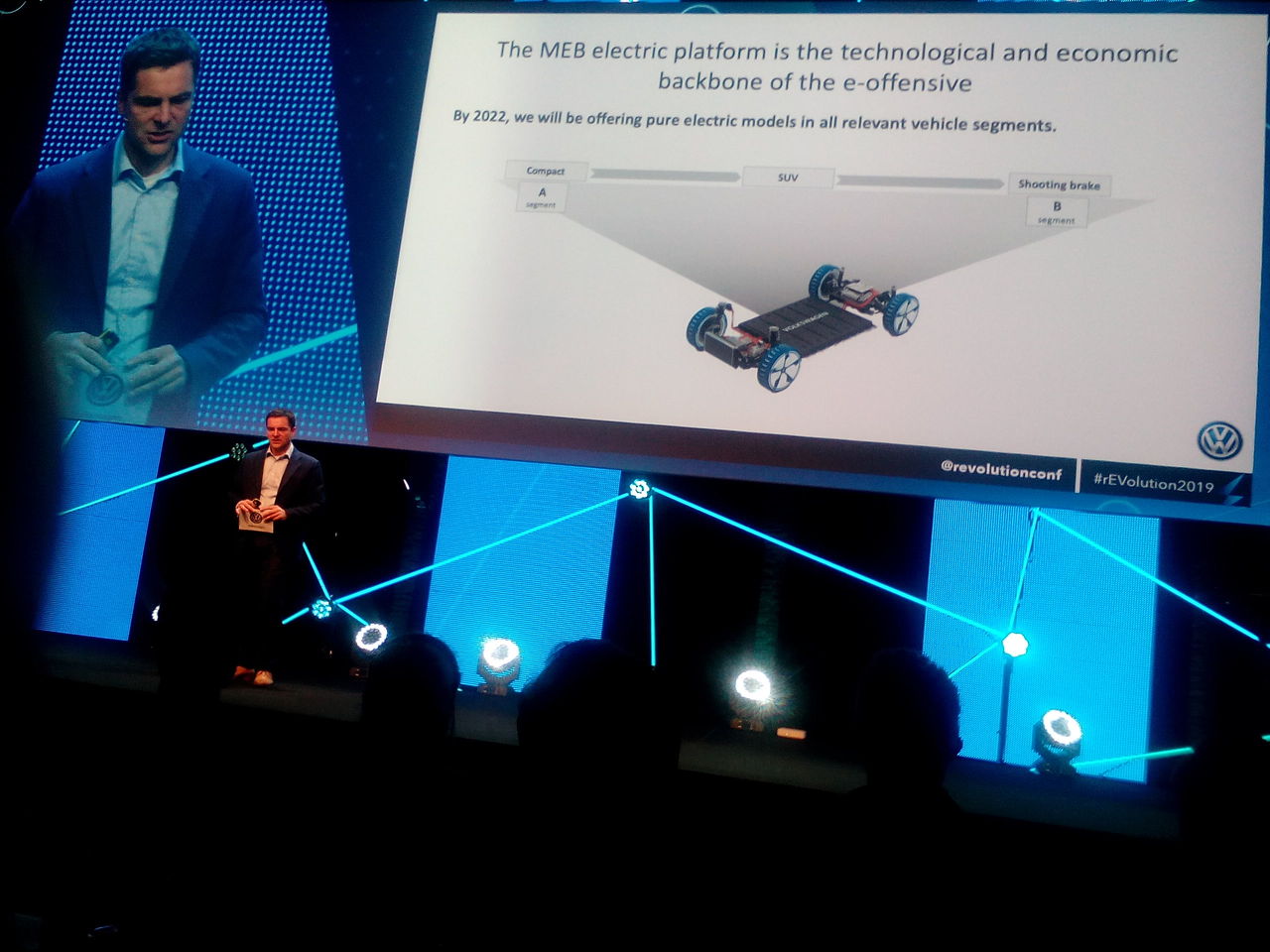
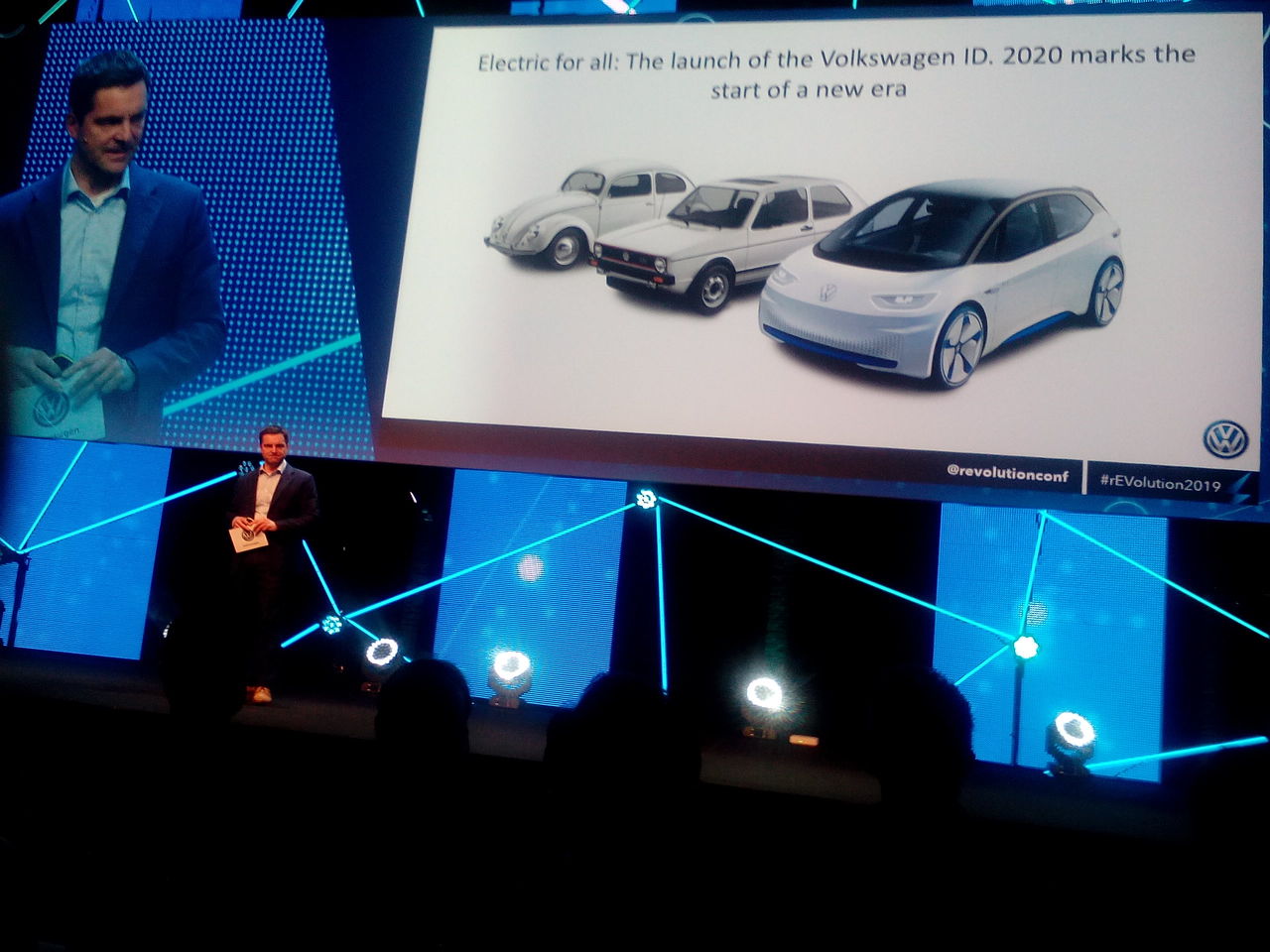
When it comes to reducing the energy consumption of “personal mobility” by a factor of four, here are Volkswagen Group’s plans. Firstly an overview of their “Modularer E-Antriebs-Baukasten” (MEB) Platform:

IMG_20190319_164855

which will form the basis for their forthcoming I.D. series of electric vehicles:

IMG_20190319_164911

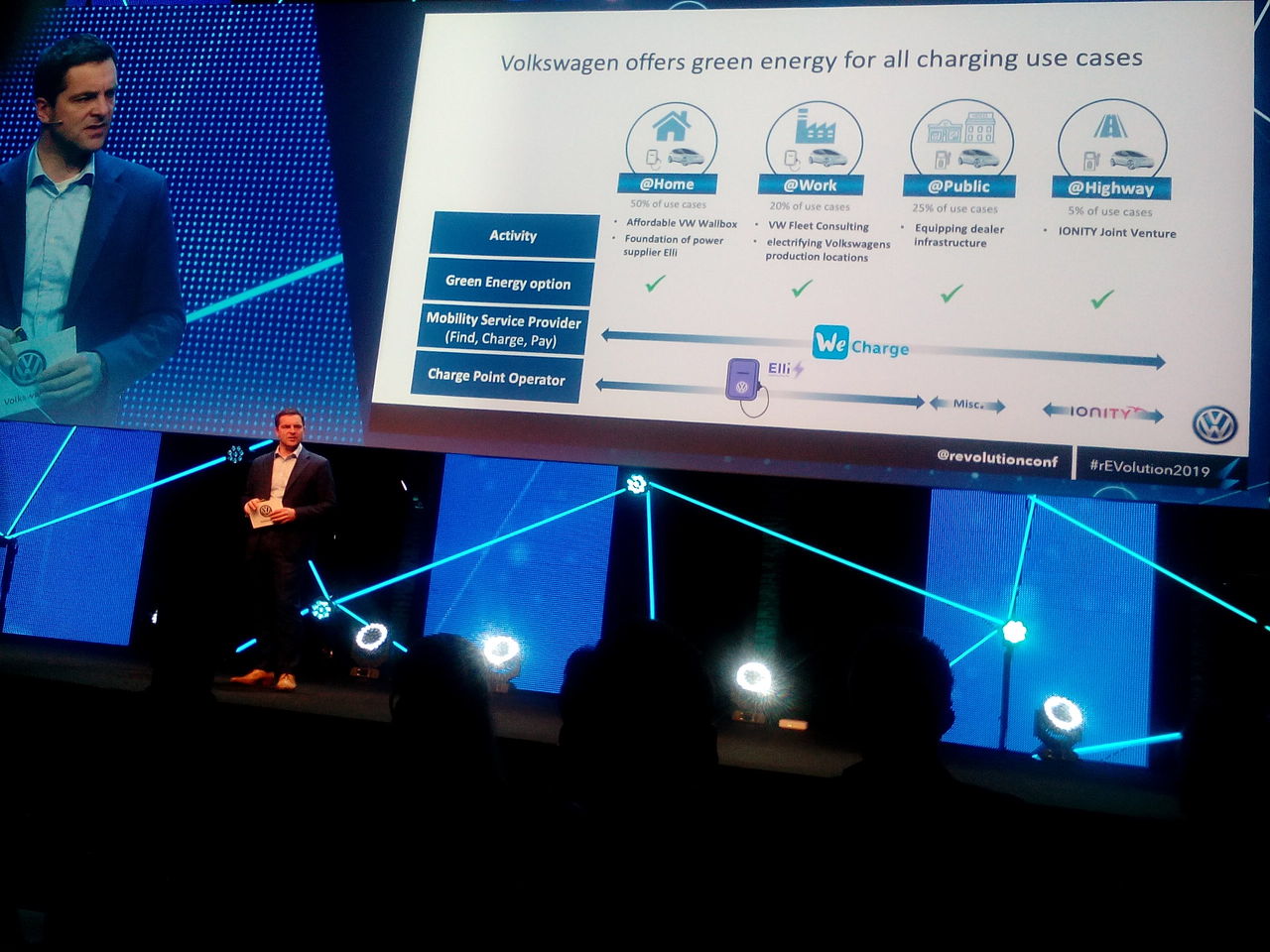
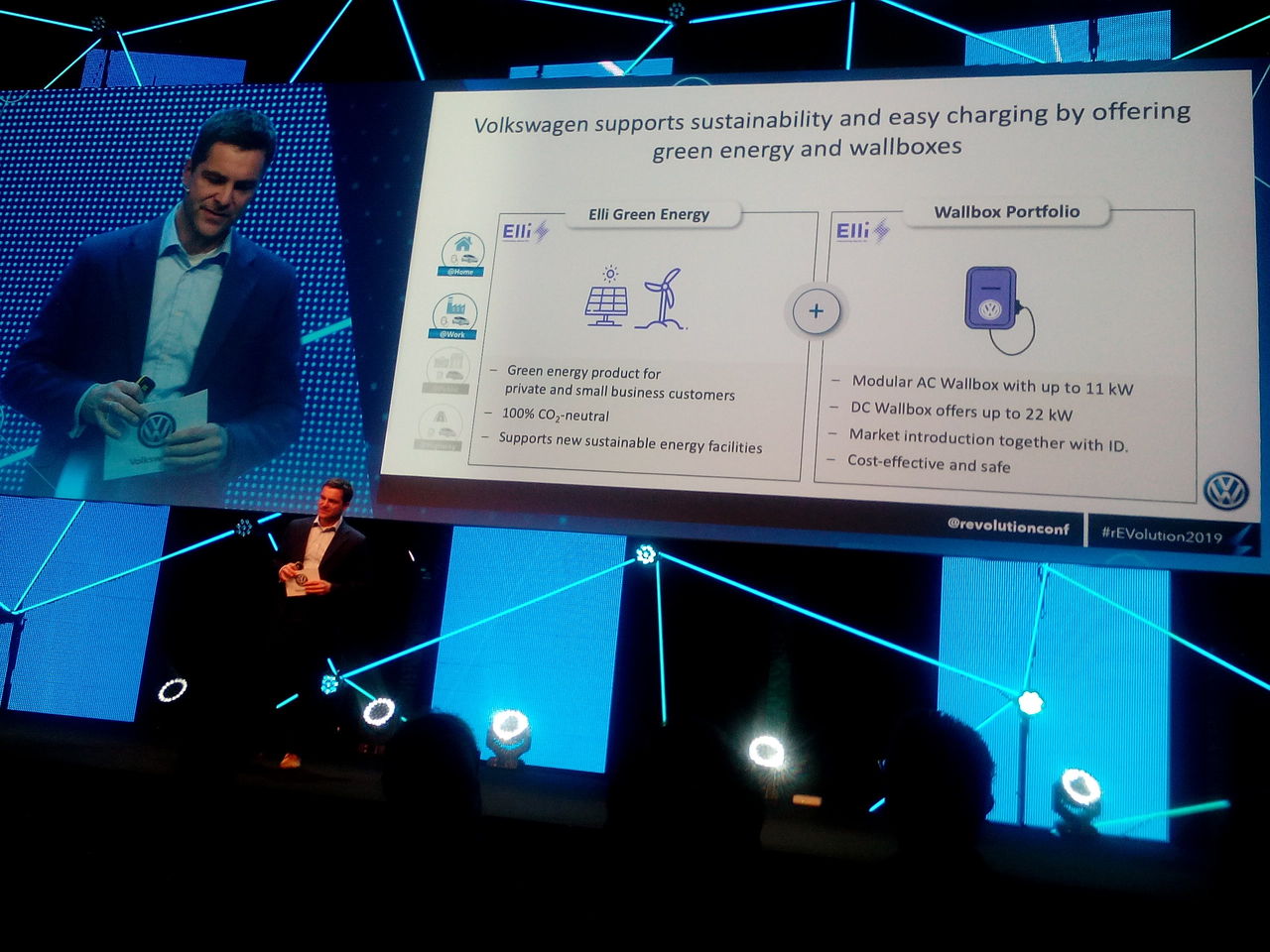
Much like Nissan and Renault, VW also plan to go into the energy business with the Elli brand:

IMG_20190319_165013

They even intend to supply their own wallboxes to charge their forthcoming range of electric vehicles:

IMG_20190319_165220

Do you suppose that Elon Musk is losing any sleep over the nascent competition to Tesla emanating from the Old World?

Nissan Announces the LEAF 3.ZERO

In a press release earlier this morning Nissan announced that:

Nissan has confirmed the evolution of the highly successful LEAF electric vehicle (EV) by launching two versions of the LEAF 3.ZERO. This new offer will broaden the appeal of EVs to more customers, and both models are ready to order from January 9, 2019.

Following a record-breaking year for Nissan electric vehicles, LEAF 3.ZERO brings to Europe’s best-selling electric vehicle a new 8-inch infotainment screen enabling additional connectivity services such as door-to-door navigation. An all-new and improved NissanConnect EV app will also be available when the LEAF 3.ZERO goes on sale in Europe.

The LEAF 3.ZERO – priced from £31,095 including the £3,500 UK Government Plug-in Car Grant – features the 40 kWh battery. New body colours and two-tone colour combinations will complete the choices. Customers can place their orders for LEAF 3.ZERO from now.

As you can see, other than the new colours the LEAF 3.0 looks a lot like the 2.0 flavour:

Exterior_03

The Nissan LEAF 3.ZERO e+ Limited Edition, priced from £36,795 including Government Grant, is also available to order from January 9. This limited edition – of which only 5,000 units will be produced for Europe – features a higher output capable of delivering 160 kW (217 PS) of power; 340Nm of torque; and a longer driving range expected to be up to 239 miles* from a single charge of the 62 kWh capacity battery.

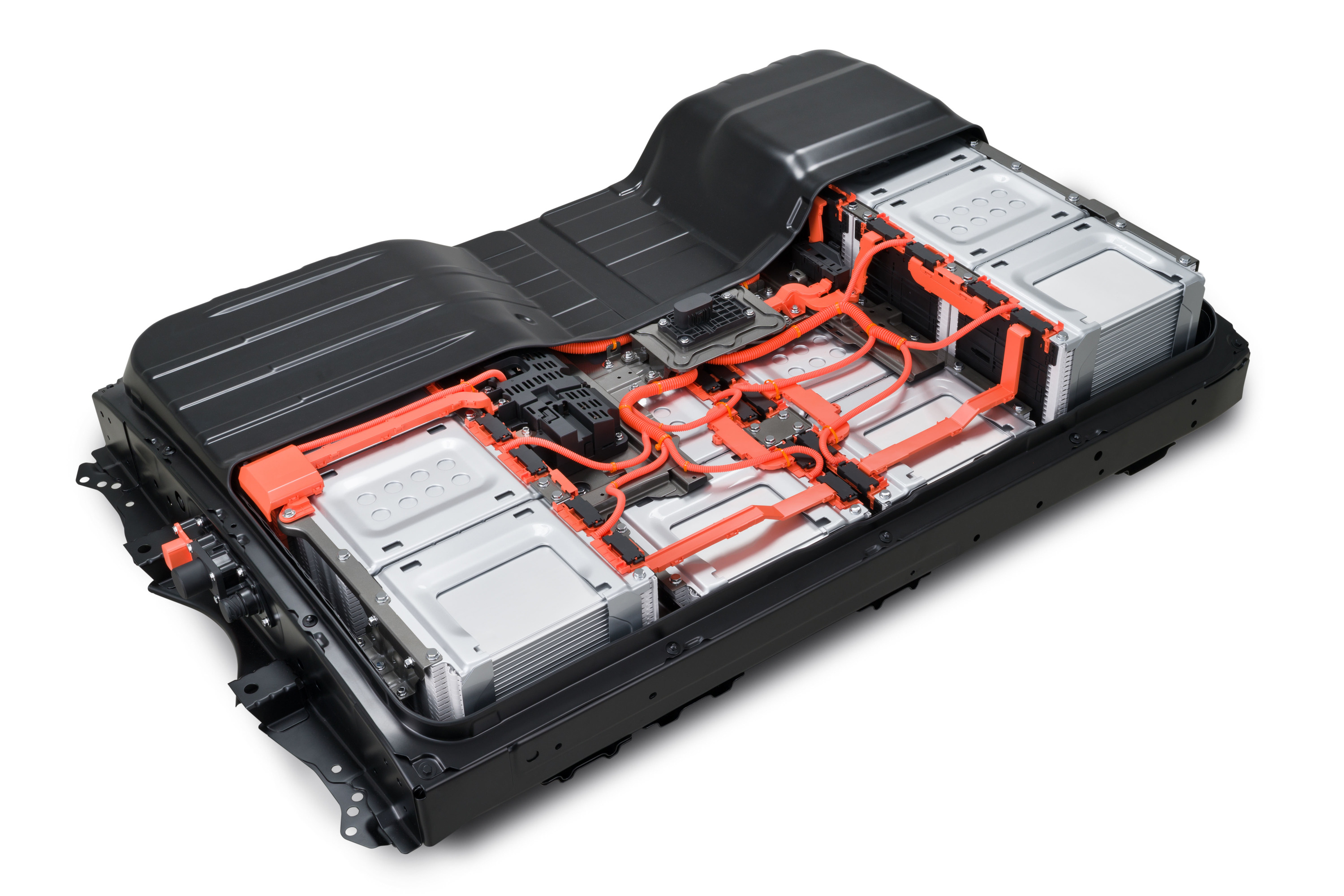
Here’s a picture of the obviously highly desirable 62 kWh battery pack!

62kWh_Battery_181107_02

Nissan’s press release continues:

Both 3.ZERO launch versions are flagship models for the 2019 Nissan LEAF, sitting at the top of their respective ranges.

At the centre of the LEAF 3.ZERO e+ Limited Edition is an Intelligent Power-enhanced high-capacity battery and more powerful motor.

On the road, the LEAF 3.ZERO e+ Limited Edition will deliver a 40% range increase over the LEAF 3.ZERO which is equipped with a 40 kWh battery. This represents more than 62 miles additional range for a comparable usage, a clear evolution of the LEAF.

Now as you might expect there’s already a #RapidGate style kerfuffle about the LEAF 3.0 on social media. See for example:

I phoned Nissan and a spokesperson informed me that the 2019 LEAF does not possess an active battery cooling system. That’s because:

In the UK the average Nissan LEAF is driven 35-40 miles per day.

I was assured that if you should live near John O’Groats and fancy a trip to visit V2G Towers down here in North Cornwall your friendly local neighbourhood Nissan dealer will still lend you a Nissan Qashqai for up to 2 weeks per year. Enough said? I expect not!

I was also assured that the “5,000 units for Europe” refers to the 3.ZERO e+ Limited Edition, and that more 2019 LEAFs with 62 kWh battery packs will become available in due course.

OVO Energy Install UK’s First V2G Home EV Chargepoint?

OVO Energy sent me a very nice birthday present yesterday via Twitter:

In an associated press release OVO announced:

Following the unveiling of the world’s first widely available, domestic vehicle-to-grid charger, at the Energy Technology Product Showcase in April, OVO can confirm it has successfully installed the first charger in a customer’s home.

Tom Pakenham, Director of Electric Vehicles, said: “We’re excited to install a vehicle-to-grid charger in a customer’s home. By developing vehicle-to-grid technology we’re enabling drivers to store renewable energy in their cars, use that to power their homes and to sell energy back to the grid at peak times, allowing our customers to earn rewards from smart charging their electric vehicle.”

By way of additional background information OVO added that:

The 6kW OVO Vehicle-to-Grid (V2G) Charger is the world’s first domestic bi-directional charger. It offers drivers of certain electric vehicles the opportunity to discharge excess electricity from their cars back to the electric grid to help supply energy at times of peak demand. It is the first such product to be produced and made commercially available at volume in the world.

Available to Nissan LEAF drivers with a 30 or 40kWh battery, the OVO Vehicle-to-Grid Charger could enable Nissan drivers to have free power for their electric vehicles by selling energy back to the grid. This is an important step for both companies to deliver their mission to offer customers free power for their electric vehicles.

This is part of the Innovate UK Vehicle-to-Grid competition, funded by the Office for Low Emission Vehicles (OLEV) and the department for Business Energy and Industrial Strategy (BEIS), in partnership with Nissan, CENEX, Indra and OVO.

Nissan, Kyushu Electric and ELEX Announce V2B Pilot Project

The following is based on Google’s translation of a Nissan press release currently only available in the original Japanese. Please forgive any inadvertent errors or omissions on my part!

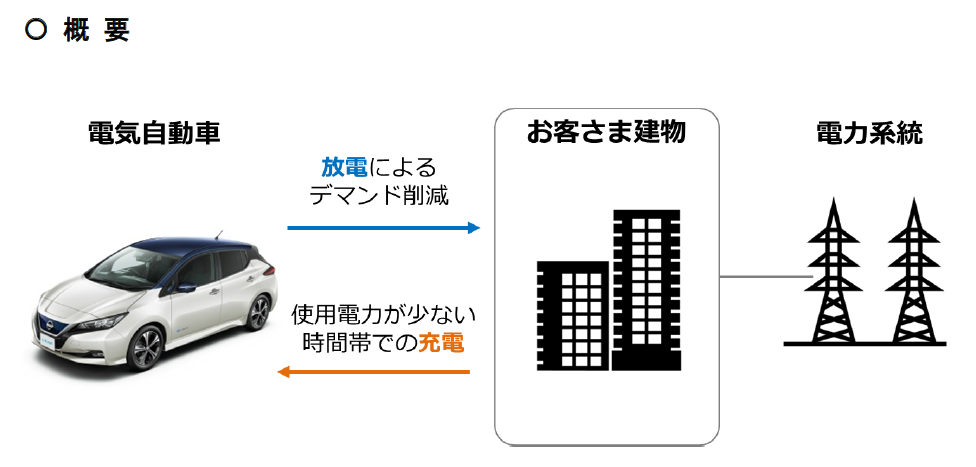
Kyushu Electric Power Company Ltd., ELEX Corporation and Nissan Motor Company Ltd. have announced a pilot V2B project for corporate customers:

In January 2019 we will jointly start a V2B (Vehicle-to-Building) pilot project to reduce maximum power demand:

Nissan-Kyushu-01

In this project, we will provide a Nissan LEAF and bi-directional charging station to corporate customers in order to verify the effects of reducing customer’s demand by utilizing the electricity stored in electric vehicles batteries, and also use by the customer as an emergency power source.

Through this project, each company aims to acquire knowledge regarding the creation of new services utilizing EVs, and we will also consider future commercialization.

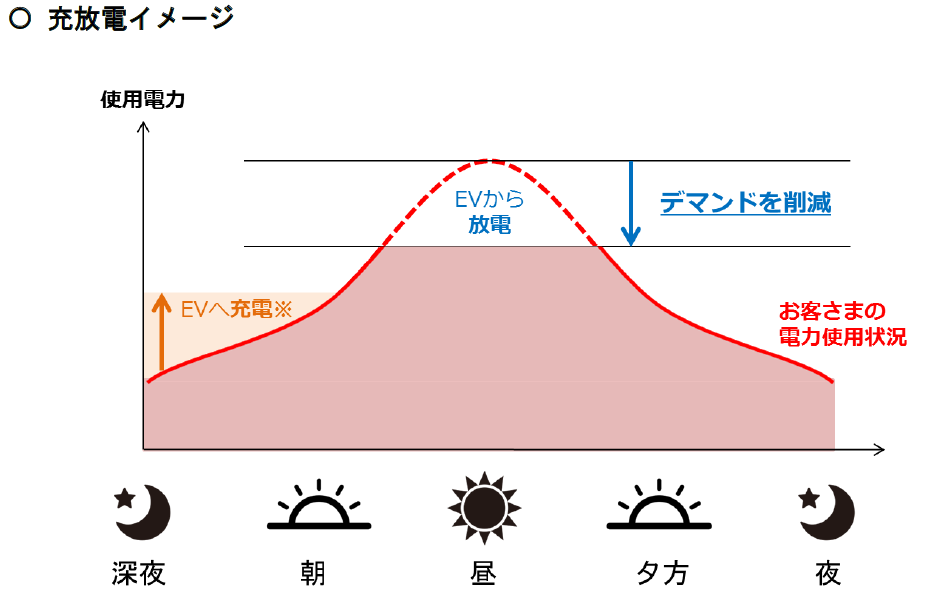
It looks as though peak shaving is the name of the game:

Nissan-Kyushu-02

Please watch this space for any further English language news about the project.

Nissan LEAF V2G Qualifies as a “Power Station” in Germany

In a press release earlier today Nissan proudly announced that:

An important milestone on the road to emission-free energy and mobility has been achieved by technology company The Mobility House, energy supplier ENERVIE, transmission system operator Amprion and car maker Nissan. With the Nissan Leaf and an innovative charging and energy management technology, the project partners have now succeeded in qualifying an electric car for all the TSO regulatory requirements for primary power regulation. This means that the car can be integrated as a regulating reserve for the German electricity grid – a breakthrough in the establishment of Vehicle-to-Grid (V2G) technology in Germany.

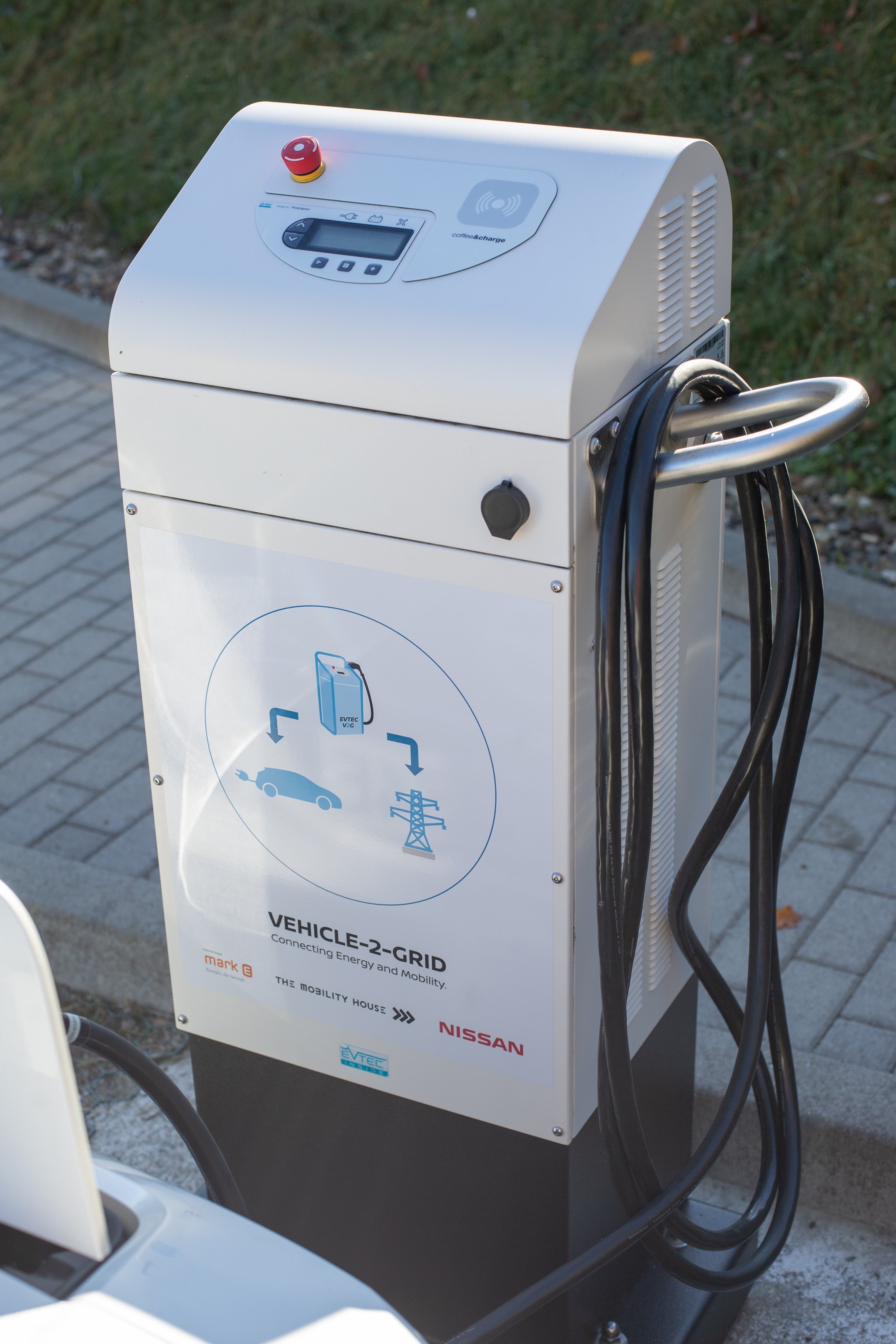
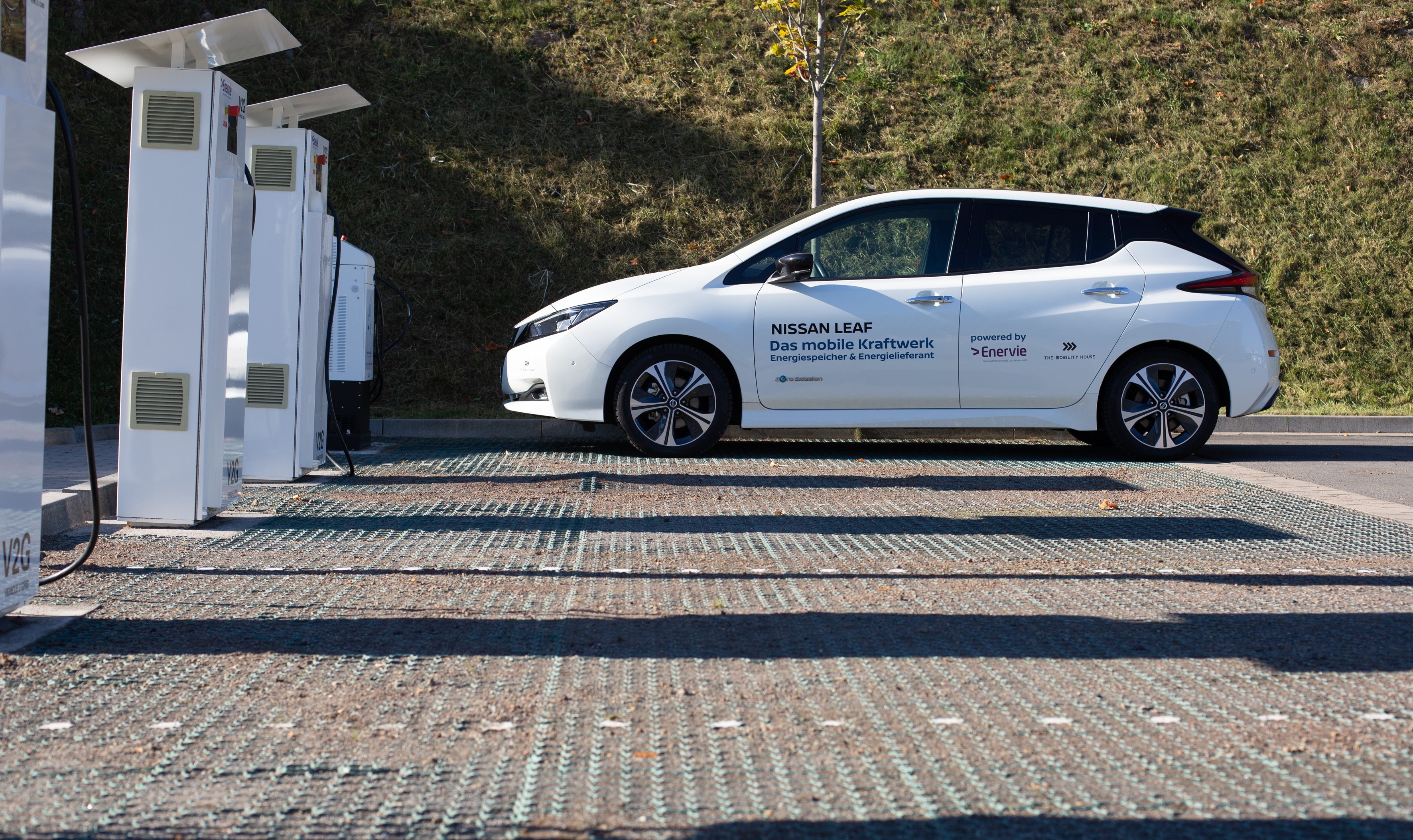
For some strange reason Nissan don’t mention the manufacturer of the V2G capable electric vehicle charging station displayed in their publicity pictures:

Nissan LEAF

Nissan 2018 LEAF and EVTEC V2G charging station

Those pretty white boxes look a lot like the EVTEC units we have mentioned previously here on the V2G UK blog. Nissan’s press release continues:

To meet the universal desire for a transition to decentralised energy generation from renewable sources here in Germany, new and innovative solutions for stabilising the electricity grid are necessary. The increasing use of renewable energy leads to fluctuations in the grid, which must be initially balanced by primary regulation, able to prevent impending power cuts at a second’s notice.

Electric cars such as the Nissan Leaf, with integrated bidirectional charging technology, could play an important part in this. With its CHAdeMO charging connector, the Leaf is able not only to extract power from the grid and store it in its traction battery, but, if necessary, also to feed power back. This is called the Vehicle-to-Grid (V2G) concept.

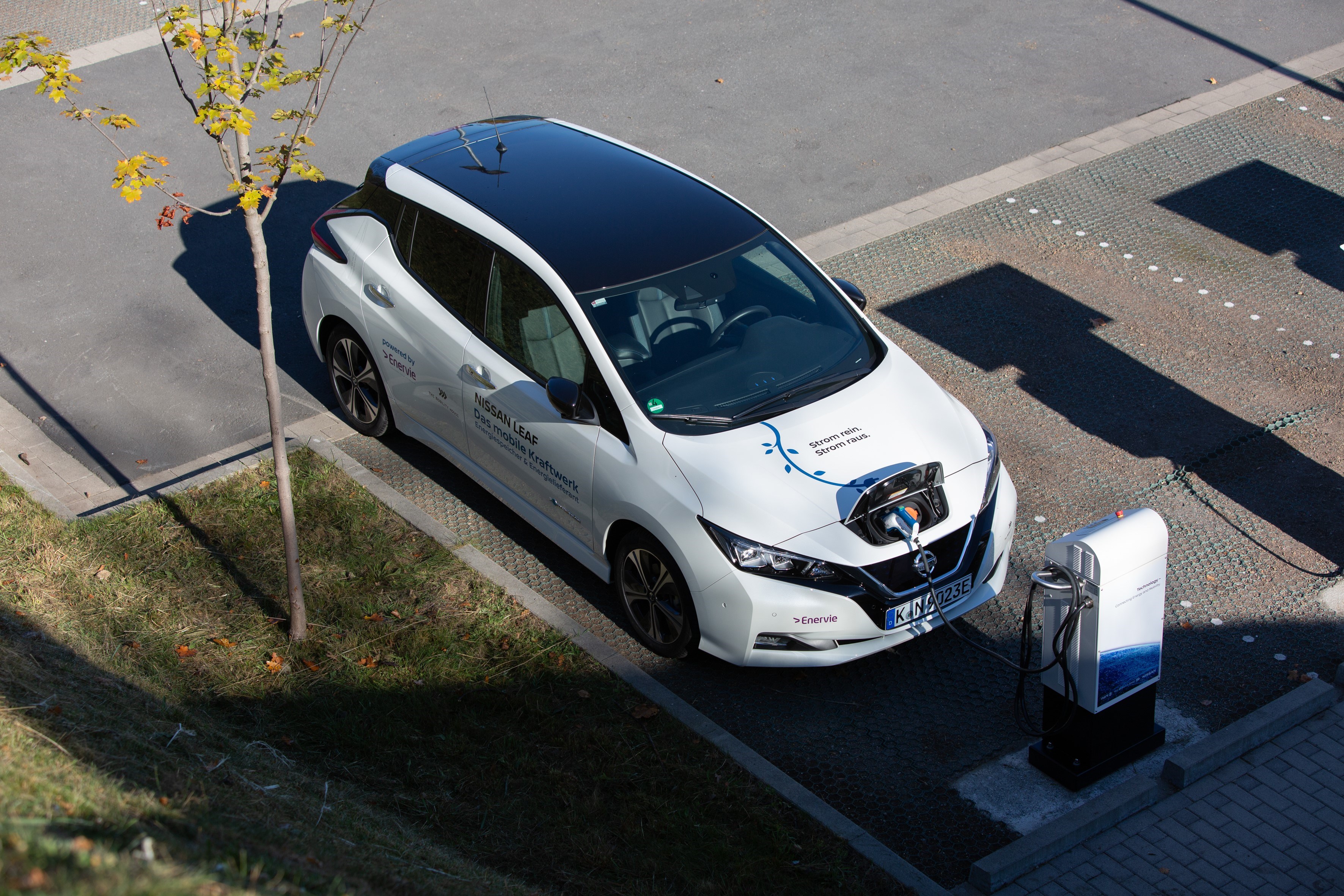
As luck would have it here at V2G UK we are very familiar with the V2G concept and CHAdeMO connectors. In fact our V2G EVSE subsidiary has recently received an Office for Low Emission Vehicles (OLEV for short) grant to assess the feasibility of using such technology on the streets of Plymouth, Exeter and Falmouth in order to provide flexibility services to Western Power Distribution’s electricity grid over here, and thereby defer expensive reinforcement of South West England’s distribution grid. Here’s a close up of the Vehicle-to-Grid Electric Vehicle Supply Equipment for (V2G EVSE for short) in ENERVIE‘s car park over in Hagen:

Nissan LEAF

EVTEC Vehicle-to-Grid capable charging station

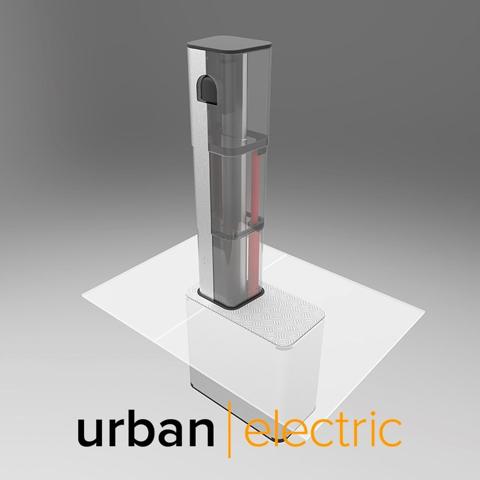
whilst here’s our concept for the inner city streets of Devon and Cornwall, Urban Electric‘s UEone “pop up” charging post:

UEone-Concept

According to Guillaume Pelletreau, the Vice President and Managing Director of Nissan Center Europe:

We strongly believe in an emission-free future. Accordingly, we are also very proud that the Nissan Leaf has, as the first electric car ever, been approved as suitable for stabilising grid frequencies. LEAF batteries could make an important contribution to energy transition in Germany and a sustainable future.

Nissan LEAF

Nissan LEAF in ENERVIE’s car park in Hagen

Here at V2G UK we strongly believe that Nissan LEAF traction batteries could make an important contribution to the energy transition and a sustainable future here in the United Kingdom.

Wallbox Announces the “First ever DC charger for the home”

I don’t recall ever being quite so excited reading a press release. I’m afraid I’ve been far too busy here in the UK to travel to China this week to work on EV charging station standards, as I originally planned a few months ago. I’m still far too busy even to travel to the eMove360° conference and trade fair in Munich today. Which is something of a pity since I’d like to take a very close look at this device in the flesh, so to speak:

DC-Wallbox

The Wallbox press release I’ve recently been reading contains a few interesting pieces of background information for we V2G watchers here in the UK, such as:

Research, technical development, product testing and manufacturing take place in Barcelona, where Wallbox has strong engineering resource and capacity to produce 100,000 chargers per year.

The company is Spanish but the brand is international. Wallbox operations are solely conducted in English. It began UK operations in September 2018.

not to mention:

Wallbox operates in 30 markets around Europe and overseas as far as New Zealand and China. Wallbox is partner to major automotive OEMs and energy companies. The company is approaching 20,000 installations across all markets and sees the UK as one of its most important growth opportunities. The company is 80-strong and growing, with over half of the workforce involved in software and hardware development. Many employees have made the transition from IT to automotive, coming from the likes of Apple and Tesla, which in part accounts for the unique design quality.

Moving on to Wallbox’s shiny new black box pictured above, let’s take a look at the basic specification first. According to the press release:

All Wallbox chargers are rated up to 22 kW, suitable for domestic and commercial installation and connect to the myWallbox energy management platform. This enables scheduling to take advantage of time and use tariffs, energy balancing between vehicle and the home, and a host of other easily accessible features. Wallbox chargers have connectivity through WiFi, Ethernet or Bluetooth.

Presumably that 22 kW applies to the DC black box as well in which case it can handle three phase, and if the entire Wallbox range can connect to an energy management system (EMS for short) somewhere in the clouds I’d like to take a very close look at all the other AC boxes as well! Sticking with DC for now though:

The new DC charger puts energy created and stored in the home, straight into the electric vehicle through a CCS or ChaDeMo connector. Home generation and storage are now becoming much more cost effective considerations as electric vehicle range and battery size increase and reduce ROI timescales.

The charger’s unique bi-directional power electronics reconcile the alternating (AC) and direct (DC) energy that flows between vehicle charging, rooftop PV generation or garden wind turbines, and home battery storage.

Wallbox are talking just the sort of language we like to hear when discussing our “Static & Mobile Distributed Energy Storage” (SaMDES) project, and they have even uttered the magic words “bi-directional power electronics”. This sounds like pukka vehicle-to-home capable kit, so the next obvious question from our North Cornwall perspective is “when will it start shipping to the UK?”

First sales are planned for mid 2019

A minor disappointment there then, but yesterday I did manage to speak at length with Stewart Mckee who is Director of Wallbox UK. He assures me that the black box on display in Munich today isn’t just an empty shell. It is in fact “production ready”. That being the case I cannot wait to experiment with plugging one into the CHAdeMO connector at the front of one of Nissan’s new 40 kWh e-NV200 vans, which we test drove for three days following the recent Cornwall New Energy EV event in Wadebridge:

2018-09-21_11-45-21_174

As if all that wasn’t exciting enough there’s more where that came from!

Wallbox is also making it easier to manage electric vehicle charging at home. The company is introducing software that allows spoken commands, and cognitive intelligence that learns about an owner’s charging behaviour and preferences, in order to predict optimum energy balance with home and grid.

This unique two-tier combination of software technologies means that you can speak directly to your home charging system and it will interpret your requirements in the most energy efficient manner. For instance, you can simply say: ‘I need my car fully charged for the morning’ and Wallbox will take care of the rest, with consideration for all other home energy demands during the same period of charging.

The ability for Wallbox software to automatically manage charging in this way adds another smart layer to dynamic load balancing between between vehicle and the home, and vehicles parked in the same area.

Please forgive me, but after all that excitement I need to go and lie down now. However make sure to watch this space, because we’re hoping to have a chat with Wallbox’s CEO Enric Asunción real soon now.