Nissan Unveil Solar PV Integrated Static xStorage for UK

In two separate press releases there have been two interesting announcements from Nissan on the ex EV battery storage front. In the first there’s a football connection!

Nissan, power management leader Eaton and The Mobility House today signed a ground-breaking 10-year deal with Amsterdam ArenA – home of Ajax Football Club and world-famous entertainment venue – to provide back-up power from second life Nissan LEAF batteries.

The xStorage Buildings system efficiently stores and distributes energy when it’s needed, ensuring that the lights never go out at the renowned 55,000-seater stadium, which has played host to numerous high profile concerts and sporting events over the years.

By repurposing batteries from previously used electric vehicles, the xStorage Buildings system can draw energy from the grid, providing businesses with more control, better value and a more sustainable choice for their energy consumption.

Using 280 Nissan LEAF batteries, the system designed for the Amsterdam ArenA will be the largest energy storage system powered by second-life batteries used by a commercial business in Europe and will have four Megawatts of power and four Megawatts (sic) of storage capacity.

As well as providing vital back-up power services to the ArenA, xStorage Buildings also enables the Amsterdam ArenA to power the surrounding neighbourhood when necessary and protect the grid.

We’ll excuse Nissan PR the misprint because they’ve provided this nice video accompaniment to their announcement, which doesn’t make the same mistake:

In the second announcement it is revealed that:

Nissan and power management leader Eaton are broadening their portfolio of xStorage Home residential energy storage solutions by introducing a range of six product configurations, giving consumers greater choice to meet their energy needs. This announcement comes as pre-orders of xStorage Home begin today in the United Kingdom, Norway and Germany with other European markets to follow in the coming months.

The xStorage Home system can draw energy from the sun or from the grid, making energy consumption more affordable and encouraging home-owners to make a more sustainable choice. The cutting-edge technology in the xStorage Home system is also fit for the future, and can enable customers to sell energy back to the grid – an opportunity that is expected to be offered by energy companies in the future.

The system gives consumers greater control over how and when they use energy in their own homes enabling them to avoid expensive tariff periods. The expanded range will offer consumers greater choice over power capacity and price as well as units. Consumers can opt to purchase units powered by either second life batteries or new batteries.
xStorage Home units – which provide a sustainable second life for Nissan’s electric vehicle (EV) batteries after their first life in cars is over – will be priced competitively starting at €3,500 (excluding VAT and installation costs) for a power capacity of 3.5kW rising to just €3,900 for 6kW. Units powered by new Nissan batteries will start from €5,000 rising to €5,580 for the highest capacity and will come with an extended warranty period of ten years.

Connected to a residential power supply and/or renewable energy sources such as solar panels, the unit has the potential to revolutionise the way people manage energy usage in their own home, providing added flexibility.

xStorage Home comes with solar panel inverters already integrated meaning that if a home is equipped with solar panels, the consumer can connect directly to xStorage Home, storing and then powering their homes using clean, renewable energy. It can also save customers money on their utility bills by charging up when renewable energy is available or cheaper, and releasing that stored energy when demand and costs are high.

The xStorage Home unit also has the capability to provide energy back to the grid in countries where the conditions enable customers to do so. This provides another potential revenue stream as customers will be able to sell stored energy back to the grid when demand and costs are high.

The system also provides the ultimate back-up energy solution to consumers, ideal at a time when energy grids are coming under significant strain. With smartphone connectivity, it allows consumers to switch between energy sources at the touch of a button.

I wonder if Eaton have solved all the Great British G83 issues yet, and whether they will incorporate V2H functionality into their xStorage offering? I also cannot help but wonder how many Great British Pounds that €3,500 will translate to by the time UK deliveries eventually commence?
Solar Smart Charging in Utrecht with 150 Renault ZOEs

In a press release earlier today Renault announced that:

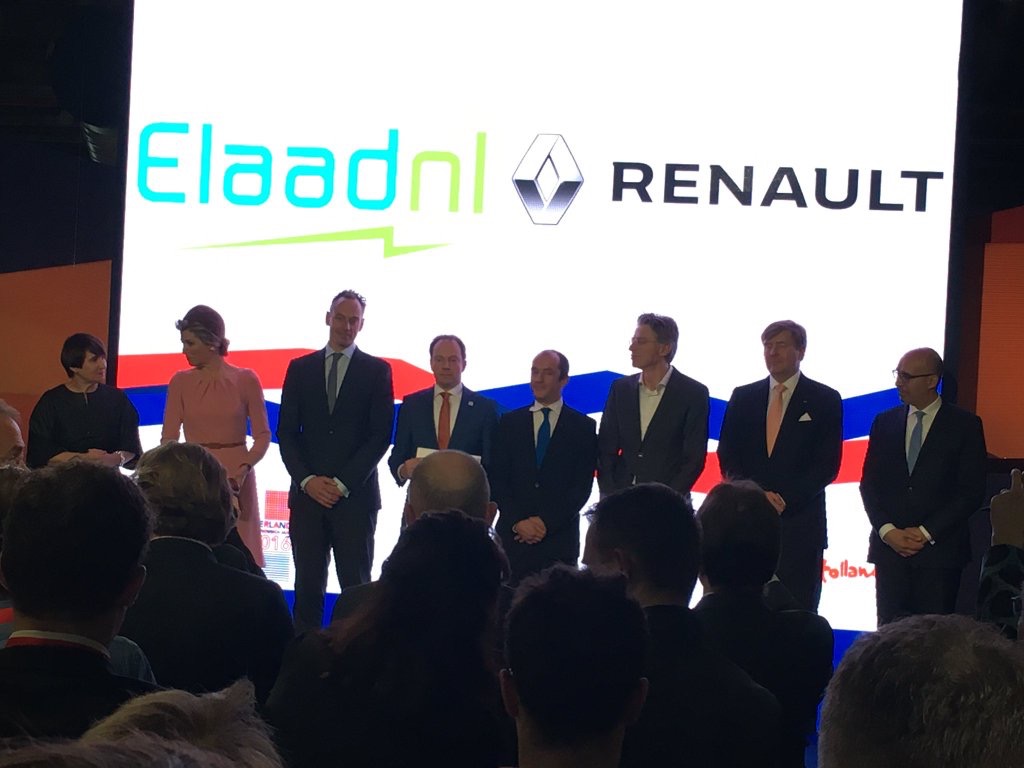
Renault has signed a letter of intent with the Dutch Utrecht City Council, ElaadNL and LomboXnet on Smart Solar Charging for electric vehicles.

The signature took place during the state visit to Paris of King Willem-Alexander and Queen Máxima of the Netherlands.

According to the letter of intent, the city of Utrecht could be the testing ground for the solar smart-charge project. Renault, Europe’s leader in electric vehicles, would supply a fleet of 150 Renault ZOE models through 2017 to the city. ElaadNL would handle management of infrastructures and the smart-charge standard, and LomboXnet would take charge of installing the network of unique public charging terminals powered by a 44 kW grid connection. Grid operator Stedin would be involved to balance supply and demand of the grid.

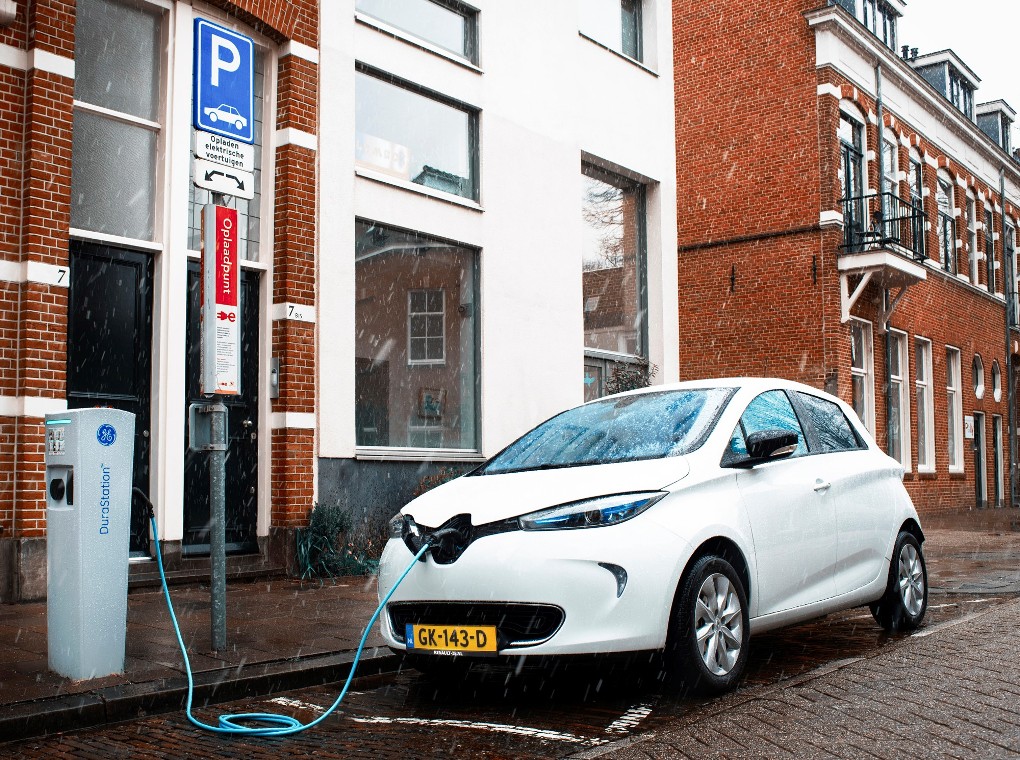
The Royal Family might have left better weather behind during their trip to Paris, but here’s a Renault ZOE charging outside the LomboXnet offices in Utrecht, in the rain:

Moving on to some more technical details of the Utrecht project:

Phase one of the project would involve setting up 1,000 smart solar-charge stations, powered by 10,000 photovoltaic panels in the Utrecht region. Infrastructure installation would run side by side with development of a car-share service of electric cars, powered by renewable energy, for Utrecht residents. The Renault ZOE R.Access connectivity and 22 kW charging make it ideal for car-share and smart charging applications.

So far so good, and then comes phase 2!

Phase two of the project would proceed with the partners developing a vehicle-to-grid ecosystem, with the network of solar chargers capable of both charging the electric cars and of feeding energy stored in the batteries of parked cars onto the grid to meet demand peaks. This could be the starting point for a new system storing renewably sourced energy.

As always at this juncture, one cannot help but wonder where and when the first “vehicle-to-grid ecosystem” will evolve here in the United Kingdom!

What Should Be In SEWTHA 2.0?

In case the six letter acronym (SLA for short) in our title for today means nothing to you it stands for “Sustainable Energy Without The Hot Air“, the title of a 2008 book by David MacKay, who amongst other things is Regius Professor of Engineering at the University of Cambridge. We first mentioned SEWTHA back in 2012, when Bill Gates praised it in an interview with the Wall Street Journal. I mention it again today because my attention was drawn by a bit of a barney (BoB for short) on Twitter between Prof. MacKay and Jeremy Leggett, who amongst other things is a founding director of solar PV company Solarcentury.

First of all here’s the BoB in question, including the V2G UK addendum!


In case you would like to listen to the edition of Evan Davies’ “The Bottom Line” on the topic of “Renewable Energy” under discussion, here it is:

http://bbc.in/1PIZD9G

Evan’s guests were Jeremy Leggett, Juliet Davenport of Good Energy and Paul Cowley, managing director of RWE Energy UK. Here are of few of my own “edited highlights”:

01:30 JD – One of the examples is Wyke Farm Cheeses. When they wash down the dairy every night and when they make the cheese, that they then anaerobically digest which creates a gas and they generate power. That’s one of our generators.

02:37 JL – A small cottage with bespoke solar tiles. these are different from the modules you use in solar farms or on a big installation on a commercial roof because they really are tiles. They go straight on the battens of the house. They generate electricity. They’re waterproof.

08:45 ED – I also wanted to talk about the physical constraints on whether you can get, in a country like ours, to 100% renewables. I’ve been very influenced by a particular book called SEWTHA by David MacKay.

09:30 JL – That book was published a good few years ago now. It’s out of date and I don’t think Dr. MacKay even believes that any more.

10:18 JD – We did some work, following David MacKay’s book actually, and used the work that he did. He went on to be the scientific advisor to DECC. He developed these pathways/models and we used them to look at how hard can you push the system to get it 100%. The UK has sufficient resource, whether it’s wind, whether it’s solar, to get to 100% on the current usage. [My emphasis!]

One of the things about climate change, it’s going to change the way we use power as well. So we saw last year energy usage in the domestic gas market dropped by 10%. 2014 one of the warmest years ever. You’ve also had the highest ever wind power production this winter. We’ve seen a lot of storms come through… So the parameters that David used in that book, I think we’re now looking for Hot Air 2.0.

11:30 ED – To give another example from the book, taking that it’s out of date, to get 50 kWh per day per person, and we’re currently using 125 kWh per day, to get 50 from offshore wind would mean filling a sea area twice the size of Wales. It would be expensive. It would be a very big deal.

One of things here, and it’s been much under-discussed in this area, is not only do we need to get our current electricity decarbonised, but we’re talking about decarbonising the transport industry to a large degree, and David MacKay’s good on this. You’ve got to almost double or triple your electricity generation, so not only do we have to replace the nuclear power and the coal that’s falling out of use over the next decade. You’ve got to replace that and add in plug-in cars. [My emphasis!]

12:59 JD – That’s what really exciting about right now. We’ve got a different problem on our hands. We’re going to have different technologies coming through, and we’re going to have to figure out how consumers use that. And actually the car storage part is really interesting because each car has a battery in it, and suddenly you’ve got a flexible power source that you can either use for transport or potentially use within people’s homes. And that piece of technology hasn’t really been thought through, about what that can really deliver [Juliet’s emphasis!]

13:45 PC – We see it in the press all the time. Wind turbines not running because the wind’s not blowing! The reality is that turbines generate around 85% of the time. They start generating at a very low wind speed… and then builds up to an optimum wind speed.

14:13 ED – We haven’t got yet a very efficient mechanism for storing electricity have we?

14:25 JL – Things are moving so fast. Let’s not forget, Apple is going to be mass producing electric vehicles four years from now. That is their stated intent. Each one of those is going to be a little power plant, and who knows how they’re all going to be hooked up to each other? It’s going to move so fast Evan, and I think this is the criticism that people like me have of, you know good guys like David MacKay with his book. They’re still flogging the idea of these vast centralised, humongously expensive centralised power plants, nuclear in particular, that take 10 years to construct.

The upshot of all this, apart from the BoB? More and more people are mentioning the concept of vehicle-to-grid technology in public pronouncements here in the UK. Andrea Leadsom at DECC assures us that she’s “as keen as mustard” on energy storage. That is of course nice to hear, but what do Physics & Chemistry have to tell us about the hard realities of distributed energy storage? And what about DECC & Ofgem too, with their assorted rules and regulations?

I might also have a minor quibble about Juliet’s “hasn’t really been thought through” remark. Some people have been thinking quite hard about V2H and V2G for quite some time!

Solar PV Powered Public V2G Charging Launched in Utrecht

Earlier this week I attended a vehicle-to-grid workshop organised by Nissan Europe. This one was held in Utrecht in The Netherlands, where I discovered that the workshop coincided with the announcement of a new partnership between the City of Utrecht and a number of Dutch companies to ultimately deliver 120 “smart charging stations” across Utrecht. There’ll be more from me on the workshop itself in due course, but for now let’s take a close look at the world’s first publicly available solar powered V2G capable AC electric vehicle charging station:

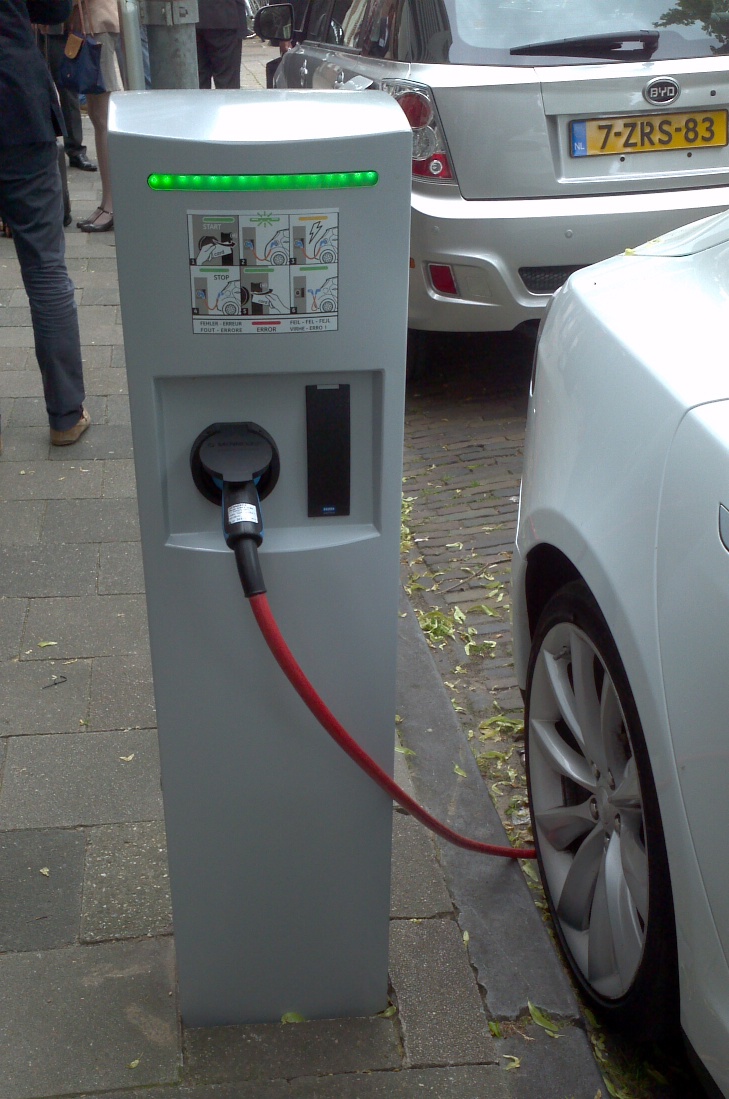
The charging station itself is a GE DuraStation with added bi-directional capability. Sadly my wish of a few weeks ago has not yet come true, and the Tesla model S you can see in the foreground is still only capable of being charged by the DuraStation, which is IEC 61851/62196 mode 3 compliant. However the BYD e6 visible in the background IS able to discharge its batteries back to the local distribution grid.

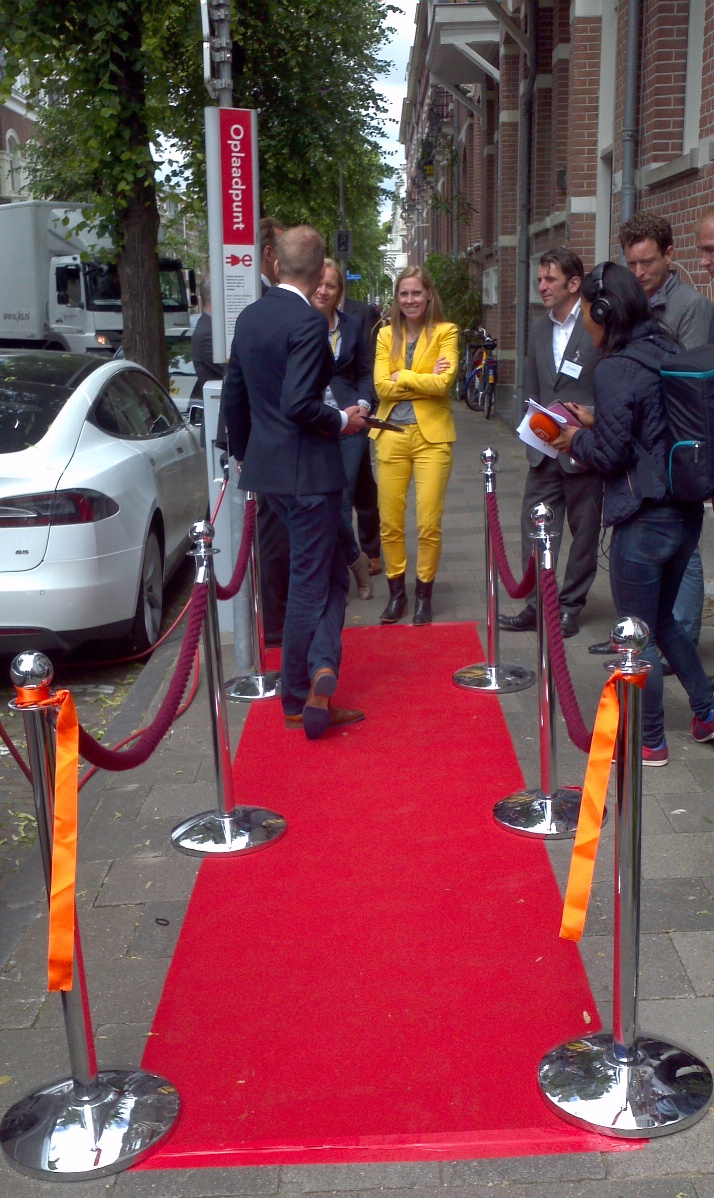
This particular charger is situated outside the offices of LomboXnet, and hence integrated with the CHAdeMO compliant V2G system we reported on back in March, which stores the excess energy generated by the Solar PV installation at a nearby primary school. Here’s another angle on the event, showing Councillor Lot van Hooijdonk shortly after she cut the ribbon to officially open the charging station:

Another part of my wish from last month has also yet to come true. In Utrecht as in the United Kingdom, and despite the red carpet, whether you own an electric vehicle manufactured by Nissan, BYD or Tesla, and whether it prefers to be charged via CHAdeMO, IEC 62196 or a Supercharger, you still won’t get paid for allowing your battery pack to be used to provide an extremely useful service to the local distribution grid. However, perhaps mighty oaks from little acorns do eventually grow?

Whilst we wait to discover if/when/how that happens, here’s the video that Robin Berg of LomboXnet showed the attendees of the 3rd Nissan V2G workshop:

Tesla Energy Launches the Powerwall

In a much anticipated announcement last week Elon Musk told the world that Tesla Motors now had a sister business entitled “Tesla Energy” which would start delivering a new product called the Powerwall later this year. Here’s a video of Mr. Musk’s presentation:

Note that at around 2 minutes 25 seconds Elon points out that:

We have this handy fusion reactor in the sky called the Sun. You don’t have to do anything, it just works. It shows up every day and produces ridiculous amounts of power. Now a lot of people aren’t clear on how much surface area is needed to generate enough power to completely get the United States off of fossil fuels….

It’s really not much, and most of that area is going to be on rooftops. You won’t need to disturb land. You won’t need to find new areas. It’s mostly going to be on the roofs of existing homes and buildings.

Now the obvious problem with solar power is that the sun does not shine at night. This problem needs to be solved! we need to store the energy that is generated during the day so that we can use it at night.

I recommend watching the whole show, but if you’re the impatient sort then skip to 11 minutes 40 seconds and listen to this bit:

What about something that scales to much, much larger levels? For that we have something else. We have the Powerpack. The Tesla Powerpack is designed to scale infinitely. You can literally make this into a GWh solution. We already have one utility that wants to do a 250 MWh installation.

According to the Tesla Energy launch press pack:

Tesla is not just an automotive company, it’s an energy innovation company. Tesla Energy is a critical step in this mission to enable zero emission power generation.

With Tesla Energy, Tesla is amplifying its efforts to accelerate the move away from fossil fuels to a sustainable energy future with Tesla batteries, enabling homes, business, and utilities to store sustainable and renewable energy to manage power demand, provide backup power and increase grid resilience.

Tesla is already working with utilities and other renewable power partners around the world to deploy storage on the grid to improve resiliency and cleanliness of the grid as a whole.

Here’s a picture of the combination of Tesla’s two businesses:

Tesla Energy reveals a Model S in close proximity to a Powerwall

Tesla Energy reveals a Model S in close proximity to a Powerwall

and here’s their description of the Powerwall:

Tesla Powerwall is a rechargeable lithium-ion battery designed to store energy at a residential level for load shifting, backup power and self-consumption of solar power generation. Powerwall consists of Tesla’s lithium-ion battery pack, liquid thermal control system and software that receives dispatch commands from a solar inverter. The unit mounts seamlessly on a wall and is integrated with the local grid to harness excess power and give customers the flexibility to draw energy from their own reserve.

The battery can provide a number of different benefits to the customer including:

  • Load shifting – The battery can provide financial savings to its owner by charging during low rate periods when demand for electricity is lower and discharging during more expensive rate periods when electricity demand is higher
  • Increasing self-consumption of solar power generation – The battery can store surplus solar energy not used at the time it is generated and use that energy later when the sun is not shining
  • Back-up power – Assures power in the event of an outage

Powerwall increases the capacity for a household’s solar consumption, while also offering backup functionality during grid outages.

Powerwall is available in 10kWh, optimized for backup applications or 7kWh optimized for daily use applications. Both can be connected with solar or grid and both can provide backup power. The 10kWh Powerwall is optimized to provide backup when the grid goes down, providing power for your home when you need it most. When paired with solar power, the 7kWh Powerwall can be used in daily cycling to extend the environmental and cost benefits of solar into the night when sunlight is unavailable.

Since we are big fans of distributed energy storage here at V2G UK this is all music to our ears, but some things are strangely lacking from Tesla’s publicity.  Apparently:

Tesla’s selling price to installers is $3500 for 10kWh and $3000 for 7kWh. (Price excludes inverter and installation.) Deliveries begin in late Summer.

It looks as though inverters to attach to Powerwalls will be supplied by third parties and the pretty picture above notwithstanding connecting a Tesla Model S to one or more Powerwalls and thence to the local electricity distribution grid is a problem that has yet to be addressed by Tesla themselves.

There have been some associated press releases, such as this one from SolarEdge:

SolarEdge Technologies, Inc., a global leader in PV inverters, power optimizers, and module-level monitoring services, announced its collaboration with Tesla Motors to provide an inverter solution that will allow for grid and photovoltaic integration with Tesla’s home battery solution, the Powerwall.

The joint development by SolarEdge and Tesla builds on SolarEdge’s DC optimized inverter solution and Tesla’s automotive-grade energy storage technology to enable more cost-effective residential solar generation, storage, and consumption for the global market.

Designed to manage both functions with just one SolarEdge DC optimized inverter, the solution will allow for outdoor installation and will include remote monitoring and troubleshooting to keep operations and maintenance costs low. The solution will also support upgrading existing SolarEdge systems with the storage solution.

The SolarEdge solution is expected to be available by the end of 2015.

Once again, however, whilst the phrase “grid integration” is mentioned “vehicle to grid” is not. I cannot help but wonder when (and how) it will become possible for a Model S to earn its proud owner a modest income by feeding some of the energy stored in its battery pack back into the local grid at its times of greatest need.

Used Nissan EV Batteries Now Provide Grid Scale Storage

Nissan have recently announced that:

The manmade island of Yumeshima in western Japan’s Osaka is now home to the world’s first large-scale energy storage system, a project that also highlights the potential to reuse electric vehicle batteries.

Hikari-no-Mori – or Forest of Light – is a mega-solar project of 36,000 solar panels built on top of a landfill and managed by Sumitomo Corporation.

The first paragraph is not strictly accurate, since as we reported a couple of years ago, such things have been in use in Spain for a while now. Sumitomo’s press release about the project was nearer the mark stating instead that:

Sumitomo Corporation has developed and installed the world’s first large-scale power storage system which utilizes used batteries collected from electric vehicles.

Nissan did however also release the following video, so we can see for ourselves what the partnership has in fact developed:

According to Sumitomo once more:

Over the next three years, the system will measure the smoothing effect of energy output fluctuation from the nearby “Hikari-no-mori,” solar farm, and will aim to establish a large-scale power storage technology by safely and effectively utilizing the huge quantities of discarded used EV batteries which will become available in the future. This project has been selected as a model project for “Verification of the battery storage control to promote renewable energy” for the fiscal year 2013 by the Ministry of the Environment of Japan.

Sumitomo Corporation created the joint venture company, “4R Energy Corporation”, in collaboration with Nissan Motor Co., Ltd. in September 2010, to address the secondary use of EV lithium-ion batteries. The used EV batteries that will be recycled into this large-scale storage system have been recovered and have gone through thorough inspection and maintenance at 4R, to confirm safety and performance. This prototype system (600kW/400kWh) consists of sixteen used EV batteries.

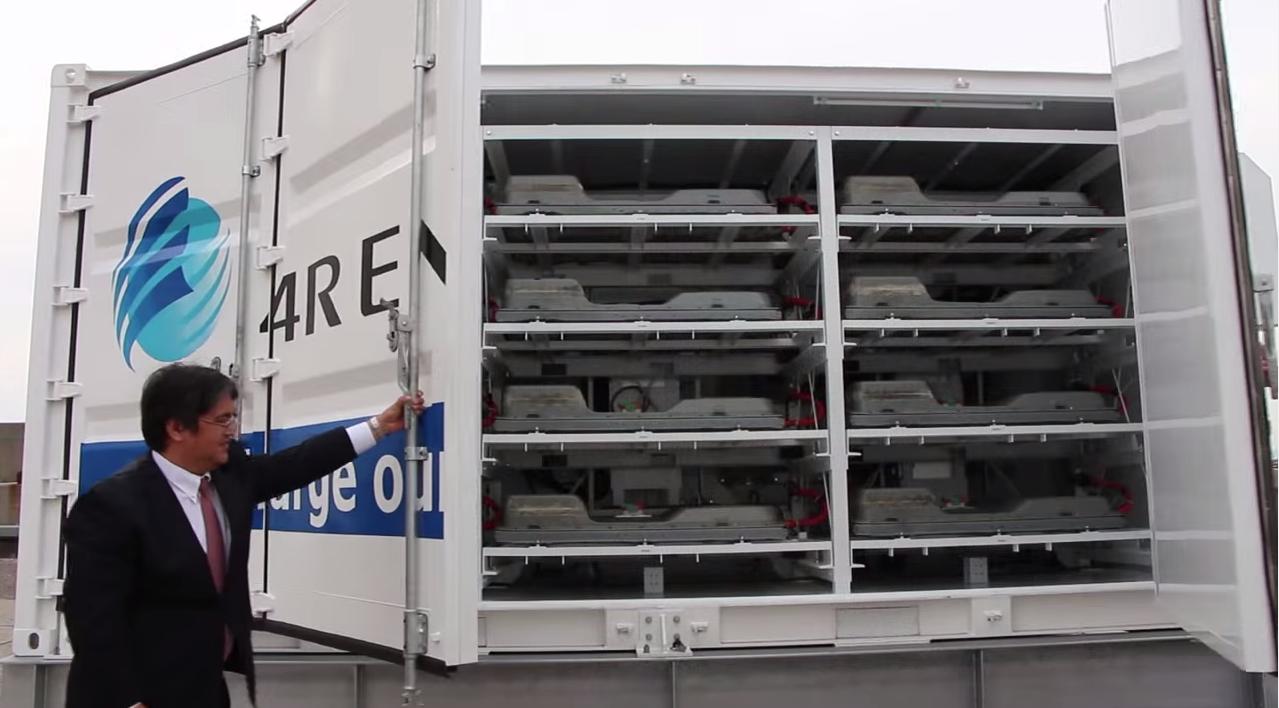
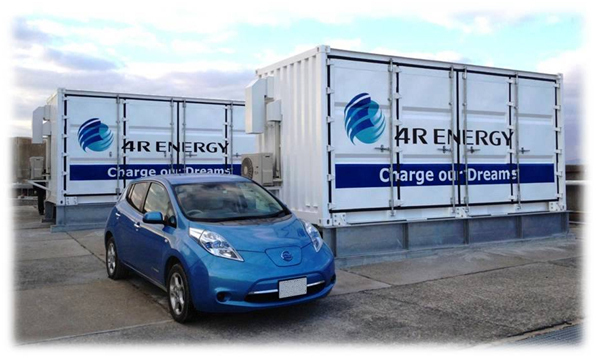
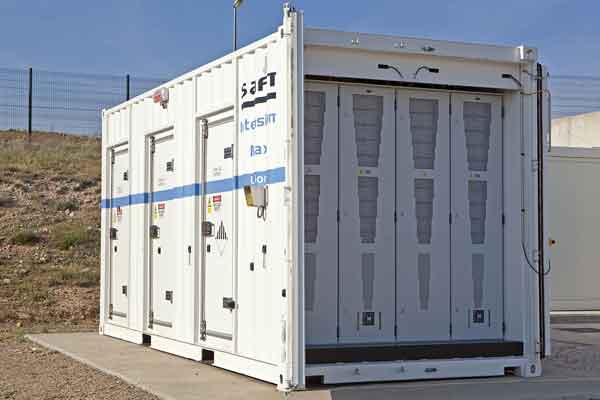
The 600kW/400kWh rating of the Japanese energy storage system compares unfavourably with the 1.1MW/560kWh of the lithium-ion battery Saft system installed in Spain, so it can’t even claim to be the largest such system in the world, but the French system uses new batteries rather than ones that are no longer up to the job of powering an electric vehicle. Here’s what the 4R system looks like:

A glimpse inside a 4R Energy used EV battery storage system

A glimpse inside a 4R Energy used EV battery storage system

It seems to have 12 battery packs per container, although Nissan claim that:

A joint venture between Sumitomo and Nissan called 4R Energy – Reuse, Resell, Refabricate and Recycle – uses 16 lithium-ion batteries from EVs to help monitor energy fluctuations and store the solar farm’s energy output.

Judging by both Nissan’s video and Sumitomo’s picture there looks to be two of those on the man-made island, so maybe the actual number is in fact 24?

Continuing with some further (hopefully accurate!) quotes from Nissan’s press release:

Natural energy sources, such as solar and wind, vary in strength and frequency, and the innovative battery management system developed by 4R is the first of its kind, says the firm’s President Eiji Makino.

“Depending on use, a battery’s degree and rate of deterioration and the battery’s condition vary by vehicle,” says Makino. “So 4R has created a technology that allows us to have optimal control in regulating those conditions.”

The project is part of a three-year test under Japan’s Environment Ministry to expand renewable energy resources and power grid management. In Japan, electricity liberalization will be realized after 2016.

The batteries have up to 70% of capacity remaining – the average left after 100,000 kilometers or five years of driving.

Sumitomo General Manager Norihiko Nonaka said his company, in cooperation with 4R, expects to make the results of the project commercially viable in 5 years or so.

“The electricity-value-chain is divided into 3 sections: electricity generation, transmission and distribution. We would like to focus on electricity generation and transmission. If we rely on renewables to obtain energy – like solar and wind – they don’t always generate the necessary amount of energy and that may cause an issue with supply-and-demand,” said Nonaka.

“On the other hand, if the cost of batteries is too high and is economically inefficient, 4R will have to continue to work and investigate the situation and market in the long term, about 5 years or maybe after 2020.

In conclusion I fear I may have to disagree slightly with Sumitomo for a change. Why should “the electricity-value-chain” not also include community renewable energy projects such as the South Brent Community Energy Society’s 250 kW wind turbine, which is located a few miles down the A38 from the V2G offices, and of which I am a proud (albeit modest) shareholder?

Jaguar Land Rover Installs UK’s Largest Rooftop Solar Panel Array

We reported on Land Rover’s Defender EV project a few month’s ago,and now we have news about their use of renewable energy in the manufacture of internal combustion engines. Jaguar Land Rover have announced in a press release that:

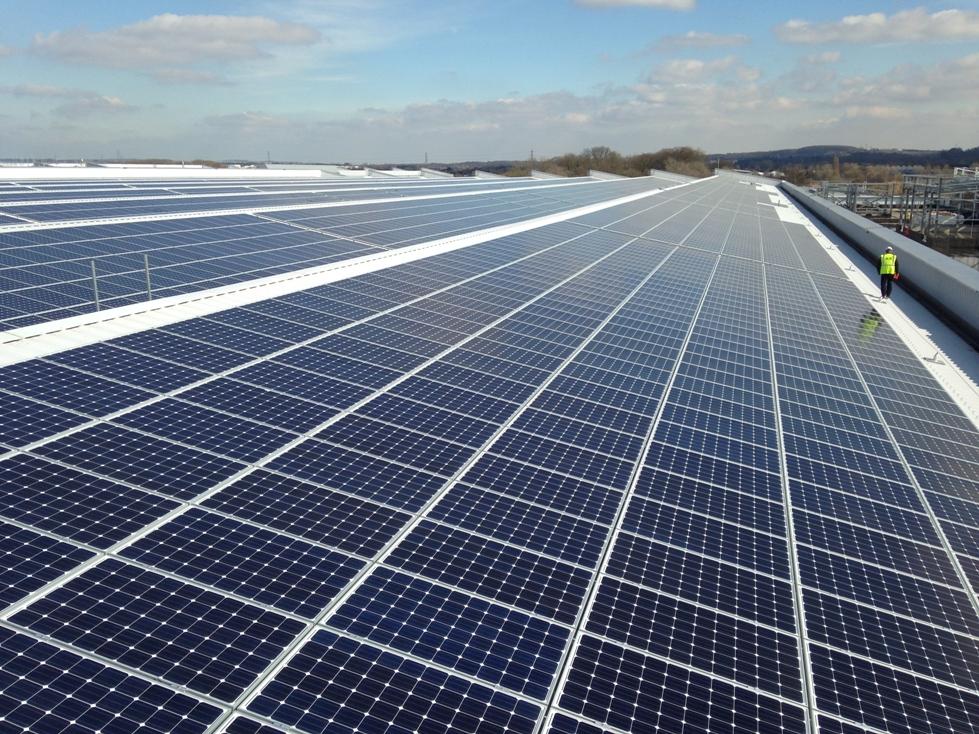
Jaguar Land Rover has completed the installation of the UK’s largest rooftop solar panel array at its new state-of-the art Engine Manufacturing Centre at i54 South Staffordshire. The new facility has been designed with sustainability embedded throughout and has recently been awarded BREEAM’s ‘Excellent’ rating for the design stage of the assessment for sustainable buildings.

More than 21,000 photovoltaic panels, with a capacity of 5.8MW, have been fixed to the roof of the Engine Manufacturing Centre, with plans to increase this to over 6.3MW by the end of the year. It is estimated that the system will generate more than 30% of the Engine Manufacturing Centre’s energy requirements.

Here’s what just some of all those solar PV panels look like:

The Largest Rooftop Solar Panel Array in the UK

The Largest Rooftop Solar Panel Array in the UK

Trevor Leeks, the Operations Director of JLR’s Engine Manufacturing Centre said that:

Our world-class facility showcases the latest sustainable technologies and innovations. The completion of the UK’s largest rooftop solar panel installation here at the Engine Manufacturing Centre is just one example of this.

As the first manufacturer to win the ‘Responsible Business of the Year’ last year, environmental innovation lies at the heart of Jaguar Land Rover’s business.

The Electric Defender, however, is conspicuous only by its absence from the rest of the press release, which continues:

The state-of-the-art Engine Manufacturing Centre is the first new plant that Jaguar Land Rover has built from the ground up. The site represents an investment of more than £500 million and will create almost 1400 new jobs by the time the plant reaches full capacity. The world-class plant will manufacture the first family of premium, advanced technology engines, Ingenium, to be entirely designed and built in-house by Jaguar Land Rover for exclusive use in the company’s future vehicles. The Jaguar XE, debuting in 2015, will be the first vehicle equipped with these four-cylinder engines.

Jaguar Land Rover’s Engine Manufacturing Centre uses cutting-edge heating and lighting systems designed to minimise energy demand through the use of insulated cladding, to maximise daylight through the roof design and to harness natural ventilation through the use of automatic louvers. Extensive energy monitoring facilities in the plant continually analyse the amount of energy being used and identify opportunities to reduce that energy consumption, for both electricity and natural gas.

Building 30% of a range of 4 cylinder engines using renewable energy is a step in the right direction. One cannot help but wonder, however, when the day might arrive that Electric Defenders are constructed using 100% renewable energy?

Fort Carson Microgrid Adds Bidirectional Chargers

Burns & McDonnell say they are “a full-service engineering, architecture, construction, environmental and consulting solutions firm” and they have announced that:

A team of Burns & McDonnell engineers, along with subcontractor Coritech Services, has developed a system of bidirectional, fast-charging stations for a fleet of plug-in electric vehicles at Fort Carson, Colorado. This first-of-its-kind system will push power back to the base microgrid when needed to meet installation demand or improve overall power quality.

On Aug. 29, the team successfully commissioned five bidirectional chargers and the aggregating control system as part of the Smart Power Infrastructure Demonstration for Energy Reliability and Security (SPIDERS) microgrid project at Fort Carson. Commissioning was performed using both Boulder Electric Vehicle and Smith Electric trucks, which are being provided for use on SPIDERS under separate agreements with the U.S. Army’s Construction Engineering Research Laboratory (CERL) and Tank Automotive Research, Development and Engineering Center (TARDEC).
Commissioning of the vehicle charging stations represents an important milestone of the Fort Carson SPIDERS project, which is nearing completion. The project is managed by the U.S. Army Corps of Engineers (USACE), Omaha District, and includes technical guidance from CERL and TARDEC.

The bidirectional charging units are capable of providing up to 300 kilowatts (kW) of power to plug-in electric vehicles and also can discharge a like amount of stored energy from the vehicle batteries to the grid or microgrid via Society of Automotive Engineers (SAE) standard J1772-compliant bidirectional charging cables. The vehicle-to-grid (V2G) charging includes power factor correction, which is a growing concern at locations such as Fort Carson that are experiencing a growth in on-site solar power generation, resulting in utility rate penalties.

Here’s what a Smith Electric Vehicle looks like, both inside and out:

ACCIONA Energy Announce Grid Connected Solar PV Storage

Spanish renewable energy company ACCIONA Energy have just announced (in a slightly strange translation into English) that they have:

Materialized the first European experience of real operation of a grid-connected photovoltaic plant on an industrial scale with energy storage in batteries.

In somewhat plainer English, ACCIONA have installed a 1.1 MW / 560 kWh modular lithium-ion battery system supplied by French battery manufacturer Saft at their existing 1.18 MWp solar photovoltaic site at Tudela in the Navarre region of northern Spain. Please note that Navarre currently obtains most of its electricity from renewable sources, unlike the rest of Europe!

Saft 560 kWh modular lithium-ion battery system

Saft 560 kWh modular lithium-ion battery system

Continue reading →

Renewable Energy is the Work of Generations of Engineers?

Fresh from bemoaning the lack of grid-scale energy storage to support all the large scale solar PV parks currently being proposed here in not so sunny South West England, the latest edition of the IEEE Spectrum magazine landed on my doormat this morning.  In all the circumstances it would have been very handy if it had arrived this time last week, since it contains all sorts of statistics and arguments derived therefrom that support my position on that locally contentious issue!

In an article entitled “A Skeptic Looks at Alternative Energy” Vaclav Smil, a distinguished professor in the department of environment and geography at the University of Manitoba, bemoans (amongst other things) solar PV subsidies here in Northern Europe:

In June 2004 the editor of an energy journal called to ask me to comment on a just-announced plan to build the world’s largest photovoltaic electric generating plant. Where would it be, I asked—Arizona? Spain? North Africa? No, it was to be spread among three locations in rural Bavaria, southeast of Nuremberg.

I said there must be some mistake. I grew up not far from that place, just across the border with the Czech Republic, and I will never forget those seemingly endless days of summer spent inside while it rained incessantly. Bavaria is like Seattle in the United States or Sichuan province in China. You don’t want to put a solar plant in Bavaria, but that is exactly where the Germans put it. It happened for the best reason there is in politics: money. Welcome to the world of new renewable energies, where the subsidies rule—and consumers pay.

After laying his cards on the table at the outset Vaclav then lays into a wide range of renewable energy subsidies, making only two exceptions:

Without these subsidies, renewable energy plants other than hydroelectric and geothermal ones can’t yet compete with conventional generators. There are several reasons, starting with relatively low capacity factors—the most electricity a plant can actually produce divided by what it would produce if it could be run full time. The capacity factor of a typical nuclear power plant is more than 90 percent; for a coal-fired generating plant it’s about 65 to 70 percent. A photovoltaic installation can get close to 20 percent—in sunny Spain—and a wind turbine, well placed on dry land, from 25 to 30 percent. Put it offshore and it may even reach 40 percent. To convert to either of the latter two technologies, you must also figure in the need to string entirely new transmission lines to places where sun and wind abound, as well as the need to manage a more variable system load, due to the intermittent nature of the power.

I couldn’t have put it better myself, and I couldn’t have fitted it all into 5 minutes last Monday  either. If you have any interest in learning how to discern the difference between Green Energy and GreenWash I heartily recommend you read the article in full. Several times if necessary, until Vaclav’s message makes sense to you. To summarise, here’s his closing remark:

It is impossible to displace [the world’s fossil-fuel-based energy system] in a decade or two—or five, for that matter. Replacing it with an equally extensive and reliable alternative based on renewable energy flows is a task that will require decades of expensive commitment. It is the work of generations of engineers.

As if all that wasn’t enough, here’s a 45 minute video in which Bill Gates presents his views on energy policy in general, and Vaclav Smil in particular:

Finally here’s David MacKay’s “brilliant book” that Bill refers to around 18 minutes into his presentation. Sustainable energy, without the hot air.