A Nissan press release has just landed in my in box, and I’m now so excited I’m going to reproduce it in reverse order! The final bullet point reads as follows:
Earlier in the release the following points are also mentioned:
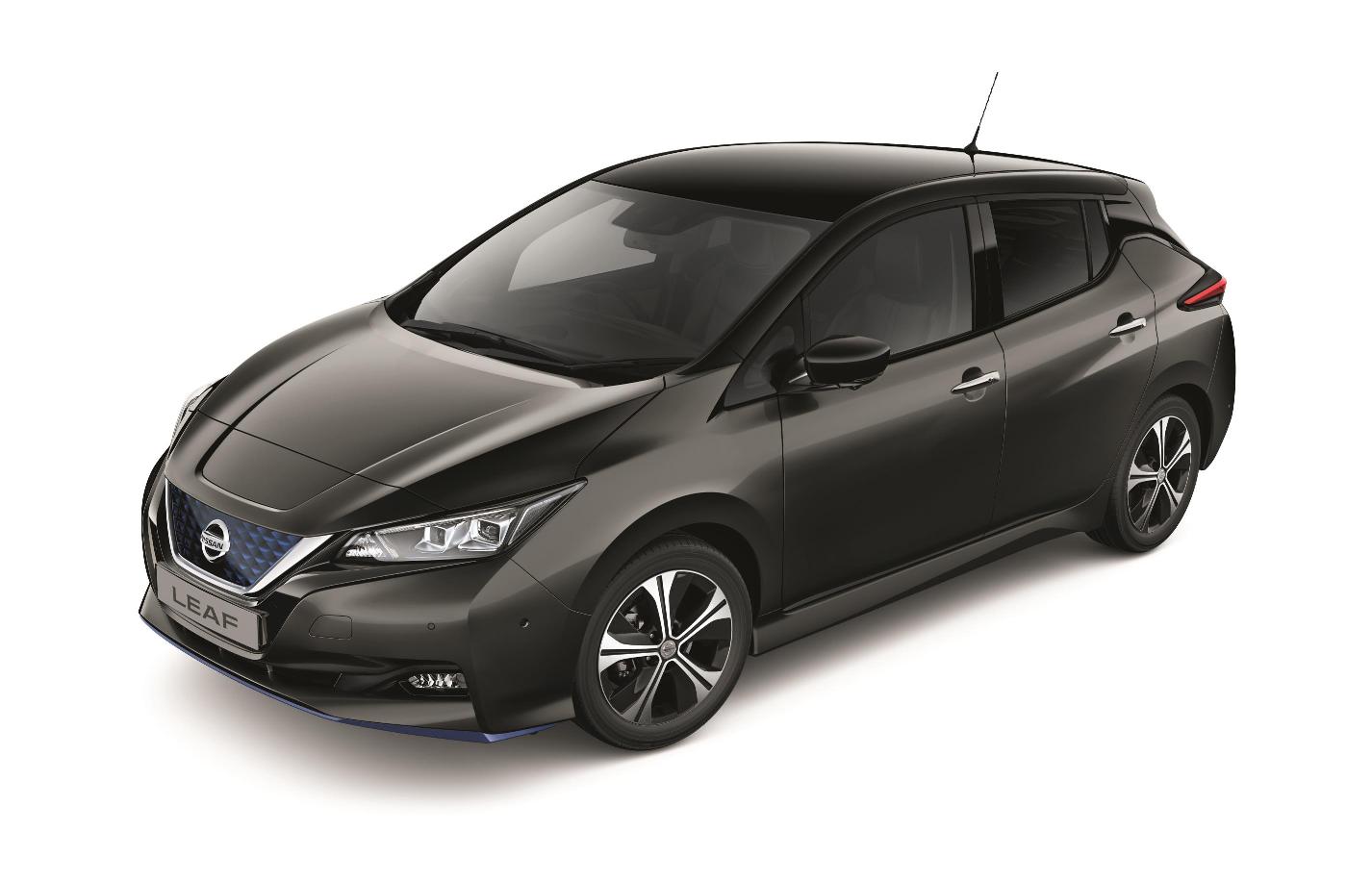
Nissan has confirmed the all-electric LEAF range will benefit from a new N-TEC limited edition, joining the cross car line N-TEC versions of Micra, Qashqai and X-Trail, which were launched in January.
Priced at £32,795 OTR (including the £3,500 Government Grant) the LEAF e+ N-TEC creates a new accessible price point for the higher 62kWh capacity battery drivetrain. Launched in summer 2019, the e+ version of LEAF delivers 217PS of power, 340Nm of torque and up to 239 miles of range (WLTP combined) on a single charge.
The LEAF e+ was previously available as a range-topping Tekna version. The new N-TEC edition, limited to just 1,000 examples, is based on the N-Connecta grade of the 40kWh line-up, but with added technology and styling, complementing the higher capacity 62kWh battery.
The N-TEC specification adds:
LED Pack and LED fog lights with cornering function (usually £495 option)
ProPILOT with Lane Keep Assist & Traffic Jam Pilot (usually £595 option)
Electronic Parking Brake
Metallic Blue Front Splitter
Revised e+ suspension set-up
It seems as though the “free” OVO vehicle-to-grid wallbox comes as part of Nissan’s finance campaign, available until 31st March 2020 as part of Nissan’s Red Tag Event.
I have endeavoured to contact both Nissan UK and OVO for comment, but they have yet to get back to me.
P.S. Nissan UK have been in touch. They assure me that the 62 kWh LEAF N-TEC is already in production, and if the 1000 special edition vehicles haven’t all been sold by March 31st a new finance offer will be made available. Based on that conversation it sounds as though the “free” V2G wallbox is available as part of OVO Energy’s continuing V2G trial, and is not dependent on Nissan’s finance. Full details can be seen at:
Our V2G Charger stores electricity in your Nissan electric vehicle battery when it’s cheaper and more likely to have been produced by renewable sources, then sells energy back to the grid when it’s in demand.
Sign up to OVO Energy, join the trial and you’ll get a groundbreaking charger for free. You will also get a £75 credit on your OVO Energy bill and a payment of up to 30p per kWh of energy exported back to the grid.
Watch this space for more news as and when we receive it.
UPS today said its venture capital arm, UPS Ventures, has completed a minority investment in Arrival, which makes electric vehicle (EV) platforms and purpose-built vehicles that offer a highly competitive value proposition when compared with both traditional internal combustion engine vehicles, as well as existing EVs. Along with the investment in Arrival, UPS also announced a commitment to purchase 10,000 electric vehicles to be built for UPS with priority access to purchase additional electric vehicles.
One thing that other news reports seem to have missed is that ARRIVAL are members of the Innovate UK Vehicle to Grid Oxford consortium (V2GO for short):
Arrival is a technology company fuelled by the ambition to make EVs the new normal. Driven by a team curated from the world’s most renowned technology and automotive brands, Arrival have taken a blank canvas and turned it into something extraordinary. Designed from the ground up, Arrival has created electric vehicles as they should be – simple, smart, modular. One skateboard platform, easily scaled, easily manufactured, easily turned into multiple vehicle types. This completely unique approach is what will pave the way to delivering premium, autonomous ready, electric vehicles on mass without a premium price tag.
Arrival will be developing the vehicle-to-grid enabled light commercial vehicle for project V2GO. This will be used for the real life assessment of V2G.
Here’s Katherine Collett from the University of Oxford explaining the benefits of combining vehicle-to-grid technology with a fleet of electric delivery vans:
Hence one cannot help but wonder whether any of the thousands of ARRIVAL vans that UPS have just ordered will be equipped with V2G capabilities? If so we have just the thing for charging and discharging them in our car park:
Perhaps UPS would like to order a few of those for research purposes?
Honda is installing five bi-directional electric vehicle charging points at Islington Town Hall in London, in partnership with smart charging specialists, Moixa. The initiative will help Islington Council electrify its entire vehicle fleet; part of its efforts to achieve net-zero emissions by 2030.
This is the first project resulting from the collaboration between Honda and Moixa, which was announced at Geneva Motor Show in 2019. The strategic partnership forms a significant part of Honda’s Electric Vision strategy to deliver industry-leading innovation through a portfolio of energy management products and services in Europe.
The bi-directional vehicle-to-grid (V2G) chargers incorporate Moixa’s GridShare smart software, which optimises EV battery charging when grid power is cheapest and cleanest. The software can also aggregate groups of plugged-in EVs to provide battery power to the grid when it is most expensive and carbon intensive. When EVs are plugged in to all the chargers, the smart technology can provide enough energy to power the base load of Islington Town Hall.
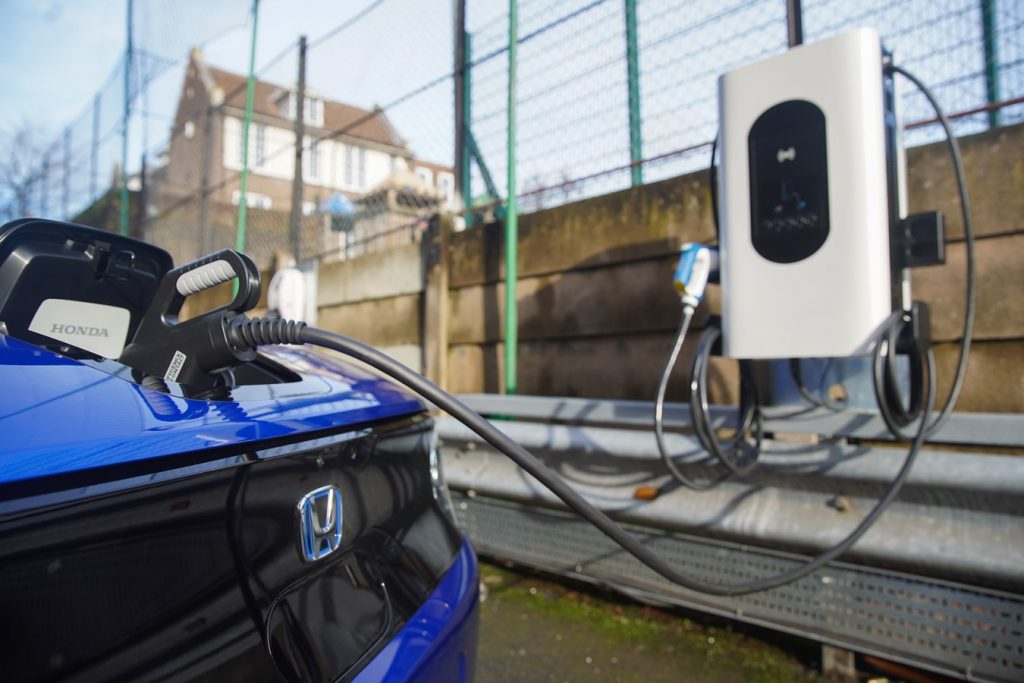
The press release was accompanied by an image showing a CCS connector plugged into the front of an anonymous vehicle with a Honda badge:
However a Moixa press release about the Islington project had a somewhat different emphasis:
At Moixa, we’ve hit the ground running in 2020, unveiling a new smart EV charging project to optimise Islington Council’s fleet at the town hall. This is an exciting first step in our partnership with Honda, to deploy smart EV charging and management solutions across Europe.
We’re working with Honda to support Islington Council achieve its ultra-low emissions zone (ULEZ) standard across its fleet of 500+ vehicles. The council’s goal is to electrify its entire fleet, cutting 1,400 tonnes of dangerous carbon dioxide (CO2) emissions every year. This project will reduce harmful air pollution, save money for essential services and help Islington achieve its 2030 net-zero carbon emissions target.
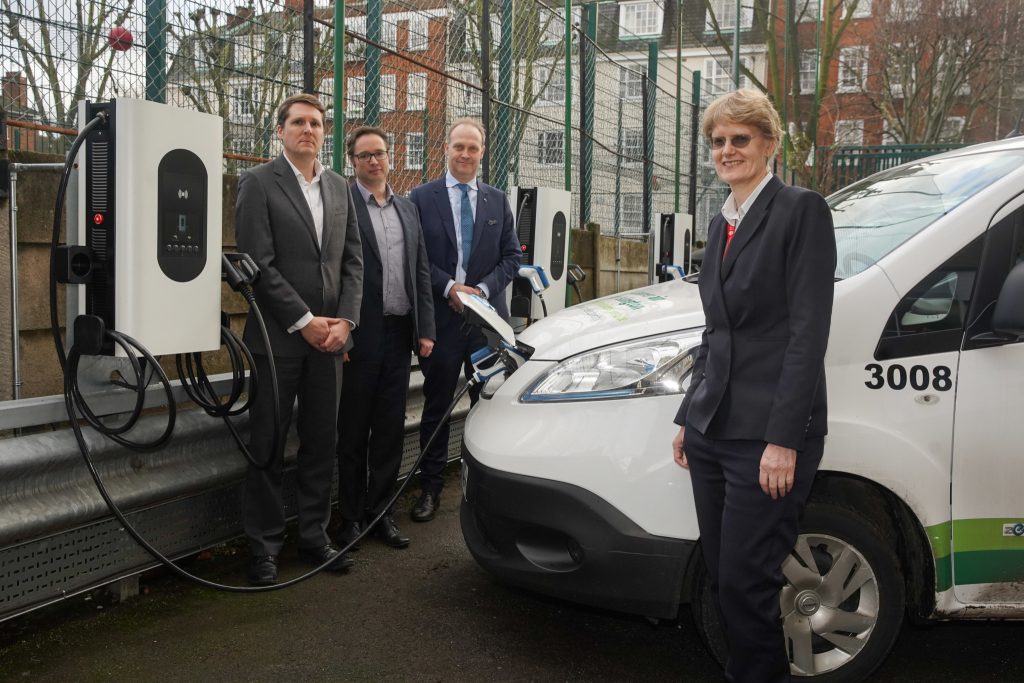
and a rather different image:
That looks suspiciously like a CHAdeMO connector plugged into the front of a Nissan e-NV200 van, with Simon Daniel and Chris Wright from Moixa looking on in the background!
According to Chris, who is Moixa’s Chief Technology Officer:
The EV revolution will put millions of ‘batteries on wheels’ on our roads in the next decade. By using AI-driven charging technology, we can intelligently manage these fleets of batteries, securing lowest-cost charging and highest-impact carbon savings. Our project with Honda and Islington shows what is possible and provides a blueprint for all large organisations to follow.
Whilst according to Honda Motor Europe’s Project Leader of Energy Management, Jørgen Pluym:
As the shift towards electrification accelerates, we must continue to innovate with projects like these – helping to drive awareness and uptake of charging solutions and advanced vehicle-to-grid technologies. Honda is committed to promoting sustainable future energy management in Europe, and this project in Islington represents an important part of our vision for future energy solutions.
It looks to me as if Islington Council already possesses one or more Nissan e-NV200’s, but I suspect they will have to wait quite a while for a V2G enabled Honda, especially if it’s vans that they’re after!
The United Kingdom’s Labour Party has issued two related press releases recently. According to the first one from September 21st:
Speaking on the Today programme, Shadow Chancellor John McDonnell announced that Labour will introduce 2.5 million interest free loans for the purchase of electric cars.
The loans of up to £33,000 will allow low to income households, those living in rural areas and independent contractors and SMEs middle to save on new electric cars. The government will cover the £1,500 cost of interest on a loan, with individuals saving up to £5,000 over time.
The scheme will ensure that access to the Electric Car Revolution is broadened beyond elites, as part of Labour’s vision of clean transport for everyone.
The interest-free loans will require participation in a mass trial of Vehicle-2-Grid technology which will allow the UK to transition to renewable energy.
This new technology will allow electric cars to store excess energy from the national grid, smoothing energy supply from renewable sources.
The scheme will boost the British automobile industry and support the UK’s transition away from petrol and diesel cars.
In order to jumpstart the transition to electric cars and tackle the climate emergency Labour will invest £3.6 billion into a mammoth expansion of the UK’s electric vehicle (EV) charging networks.
Labour’s rapid roll out of charging stations will eliminate concerns over driving range and lack of electric car charging infrastructure by providing enough electric charge points for 21.5 million electric cars – 65% of the UK’s fleet – by 2030. This would double the number of electric cars that the Conservatives are planning for by 2030.
The networks will be made up of ‘en-route’ Ultra-Fast charge stations along motorways, and a mixture of ‘about town’ Rapid and Ultra-Fast charge stations in more urban environments.
Electricity will be generated from renewable sources and distributed by Labour’s publicly owned grid and newly created National and Regional Energy Agencies. These bodies will also oversee the roll out of the EV charging networks and create up to 3,000 new jobs for electricians and network engineers.
These plans will create the infrastructure necessary to transition the UK away from fossil fuel driven cars to low-carbon electric cars – tackling climate change and boosting the UK’s automobile industry.
On the expansion of the UK’s EV charging networks charging Shadow Secretary for BEIS, Rebecca Long Bailey said:
“The Tories have sat on their hands as air pollution poisons our children and the climate emergency intensifies. Their inaction on electric charging infrastructure has held back the transition to cleaner vehicles and put our industry behind the curve.
“Labour is ready to jumpstart an Electric Car Revolution. We will roll out electric vehicle charging infrastructure to every city, town and village, and along our motorways.
“Under Labour, nobody buying an electric car needs to worry about running out of fuel.”
All of which is of course sweet music to our ears. Now all we need is for the Labour Party to win the forthcoming election! Failing that presumably a coalition with the Lib Dems and/or the Green Party would also approve of similar plans? Here’s our local Lib Dem candidate, Danny Chambers, inspecting the AC V2G charging post currently installed in our North Cornwall car park:
Today we are finally able to bring you exciting news of a large vehicle-to-grid installation in the Netherlands, with some unusual twists apart from the sheer number of charging stations.
In a thankfully English language article in PlaceTech it was reported earlier this week that:
Edge has delivered an office building for Triodos Bank in the Netherlands engineered to be sustainable inside and out with the latest circular construction principles designed throughout. The 135,000 sq ft office in Driebergen-Zeist, Netherlands was built with the intention to harmonise with the surrounding fauna and flora, on a construction level and beyond.
Please bear in mind that the article is referring to EDGE Technologies which is part of Dutch developer OVG Real Estate, and not the U2 guitarist!
After further description of the office building itself the article eventually gets to the part of the project of most interest to us. The solar PV covered car park:
The extensive use of renewable energy, reflected in over 3,000 m² of solar panels, as well as heat and cold storage, contributes to the energy neutrality of the building. The project encompasses ‘smart charging’ electric cars from solar energy and ‘Vehicle2grid’ technology. Vehicle2grid means that the cars cannot only be charged with solar energy but also discharged, which is called bi-directional charging. The cars become an active part of a ‘smart net’, which includes such benefits as being able to store solar energy.
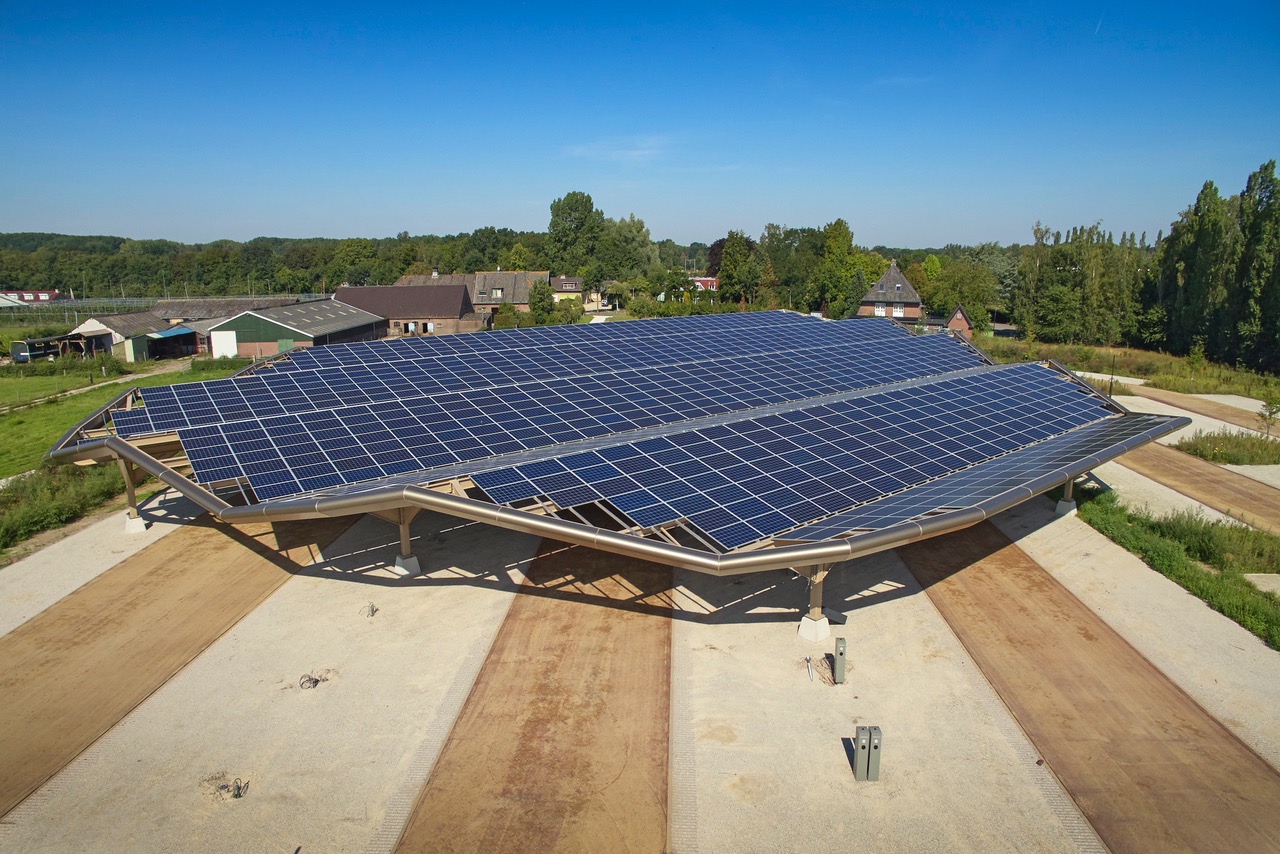
The PlaceTech article doesn’t go into any more detail than that but we certainly intend to, not least because the aerial view of the solar PV canopy reveals a number of electric vehicle charging stations that look identical to the one we have installed in our “wall to wall” V2G “living lab”:
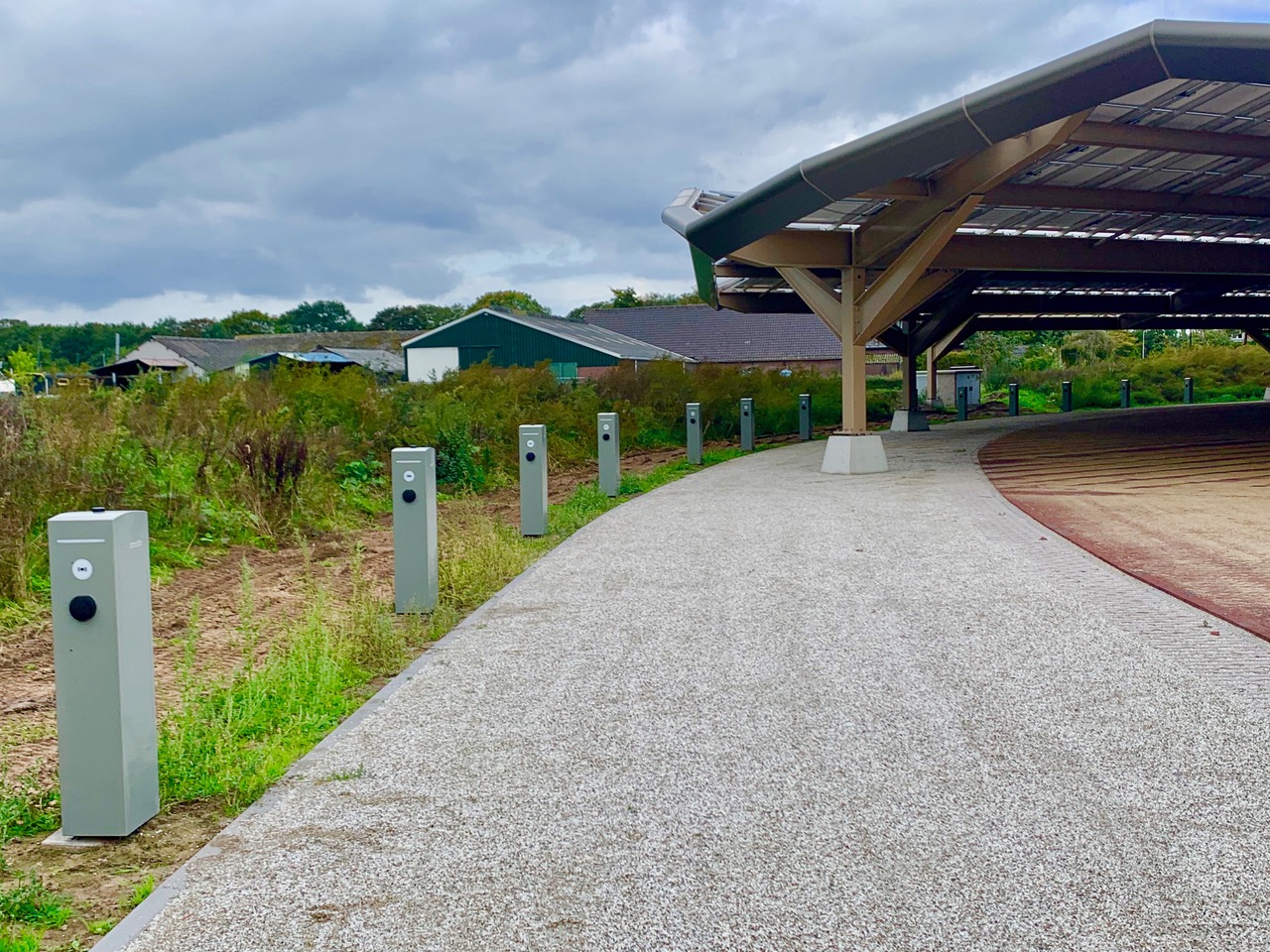
Taking a look at the new Triodos car park from ground level it becomes apparent that a large array of AC V2G capable charging stations are currently being installed, both under and around the solar PV canopy:
To find out more about what’s going on we’ve had to resort to Google Translate. According to a Dutch language article on the Triodos Bank web site from earlier this year:
The largest bidirectional charging plaza in the world is under construction at the new office building of Triodos Bank next to Driebergen-Zeist station. From this Autumn, 120 smart chargers will be able to store solar energy in the batteries of shared electric cars.
Triodos Bank have realised the project in close collaboration with developer EDGE Technologies and We Drive Solar. The bidirectional chargers are directly connected to 3,253 m² of solar panels and have a triple function. Electric cars can charge here. Cars whose battery is full enough can also supply power, so that the energy can be used in the office building or be fed back into the electricity grid.
Part of the plan is that Triodos Bank will replace its pool cars with 100% electric cars, so that they become part of the bidirectional charging ecosystem. Triodos Bank will investigate how, in addition to Triodos Bank employees, the residents of Zeist and the surrounding area can also use its shared electric cars. According to Triodos Bank director Matthijs Bierman “The plan fits in with our new ambitions in the field of sustainable mobility. We want to make car sharing as sustainable and attractive as possible. Not only for our employees, but also for the local community.”
Now 120 AC V2G charging stations sounds amazing, but where are 120 or more AC V2G capable electric cars going to come from? I can help answer that question, since I attended the launch of the We Drive Solar bi-directional ecosystem in Utrecht earlier this year. According to Renault:
A fleet of fifteen Zoe vehicles with vehicle-to-grid charging will be introduced in Europe over the course of 2019 to develop our future offerings in reversible charging and lay the groundwork for the future standards —with our partners’ help. These pilot schemes will begin today in Utrecht (the Netherlands) in an ecosystem developed by We Drive Solar and on Porto Santo Island (in the archipelago of Madeira, Portugal) with Empresa de Electricidade da Madeira, an energy supplier. Following these, more pilot schemes will be introduced in France, Germany, Switzerland, Sweden and Denmark.
So that explains 15 prototype AC V2G capable Renault ZOE’s across Europe in 2019, but that’s a lot less than 120 in the Triodos car park! As far as I am aware Renault have not announced when V2G enabled ZOEs will go into production, but when ultimately they do Triodos Bank will be ready! In the meantime I’m sure that plenty of “smart charging” will be going on in Driebergen-Zeist and across the Netherlands
All in all the project sounds a lot like a combination of our “Camelford Electric Car Club” and “Static and Mobile Distributed Energy Storage” projects, albeit on a much grander scale! That probably explains this remark by Robin Berg of We Drive Solar to Bobby Llewellyn at the recent Fully Charged LIVE event at Silverstone in the summer?
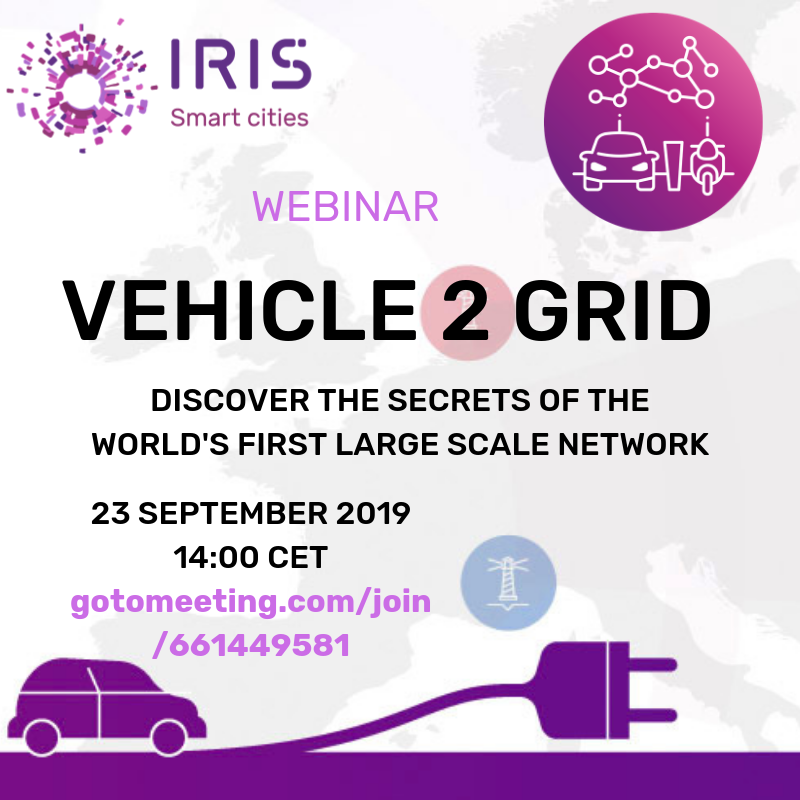
If you want to discover more about the We Drive Solar bi-directional ecosystem then please feel free to attend this webinar on September 23rd at 13:00 British Summer Time:
Today in Turin, the CEO and General Manager of Terna, Luigi Ferraris, and the Chief Operating Officer of Fiat Chrysler Automobiles in EMEA, Pietro Gorlier, signed a Memorandum of Understanding for the joint trialling of sustainability mobility services and technologies, such as Vehicle-to-Grid (V2G), which enables electric vehicles to interact with the grid via ‘smart’ charging infrastructure.
The partnership between the companies will involve the realisation at the Terna location in Turin of the E-mobility Lab, an innovative technology laboratory which will allow trials on the performances and capacities of electric cars for the provision of services to support the flexibility and stabilisation of the electricity grid, and their one-way and two-way interaction with the grid via a dedicated charging infrastructure. Feasibility studies will also be launched for an experimental demonstration fleet of electric cars connected to the grid via a V2G infrastructure, to be built in an area inside the FCA Mirafiori industrial complex.
Please read on to discover the latest news from the smoke filled back offices of the International Electrotechnical Commission’s (IEC for short) electric vehicle standards development committees.
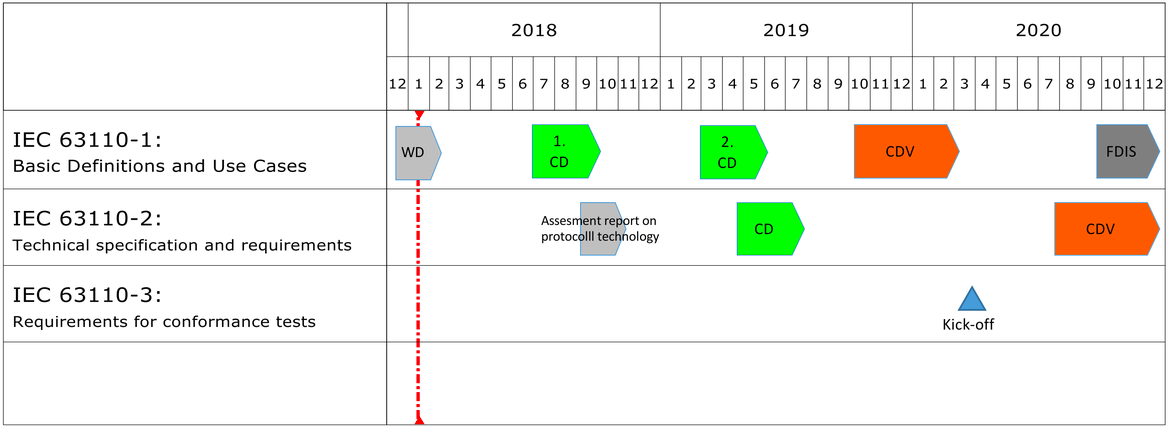
Here once again is the roadmap for the development of the IEC 63110 international standard defining a protocol for the management of electric vehicles charging and discharging infrastructures:
Part 1 of the standard (IEC 63110-1 for short) concerns itself with potential EV charging and discharging use cases. As we have previously mentioned the committee produced a draft document for comment many months ago. The original draft has now been modified to incorporate the suggestions contained in several hundred comments received from around the world. A grand total of zero of those comments emanated from the United Kingdom. The committee is issuing one final call for informal suggestions for further vehicle-to-grid use cases before their next face to face meeting which will be held in Seoul, South Korea starting on June 18th 2019. At that meeting the Committee Draft for Vote (CDV) document for 63110-1 will be finalised, following which the assorted national committees that make up the IEC will vote on the committee’s proposals.
Meanwhile the IEC 63110 part 2 (IEC 63110-2) task force looking into possible options for “message encoding and transmission technology” to be included in the standard are also currently completing their work. It was agreed on the IEC Technical Committee 69 Joint Working Group 11 (TC 69/JWG 11 PT1 and PT2 web conference calls earlier this week that the Seoul meeting should be extended by a day in order to finalise this aspect of part 2 of the standard. By way of example, version 2 of the Open Charge Point Protocol (OCPP 2.0) specifies using JSON encoding over RFC 6455 WebSockets transport, but the task force have been considering a wide range of other possibilities.
Should you have any thoughts on these thorny eMobility topics then please do not hesitate to get in touch at your earliest convenience. After the TC 69/JWG 11 meeting in Seoul these matters will be starting to be set in stone (SSS for short).
Groupe Renault, the European leader in electric vehicles, is beginning the first large-scale pilot schemes in reversible electric charging. Our alternating-current technology has the particularity of placing the reversible charger inside vehicles, so it just requires a simple, inexpensive adaptation of the existing charging terminals.
A fleet of fifteen Zoe vehicles with vehicle-to-grid charging will be introduced in Europe over the course of 2019 to develop our future offerings in reversible charging and lay the groundwork for the future standards —with our partners’ help. These pilot schemes will begin today in Utrecht (the Netherlands) in an ecosystem developed by We Drive Solar and on Porto Santo Island (in the archipelago of Madeira, Portugal) with Empresa de Electricidade da Madeira, an energy supplier. Following these, more pilot schemes will be introduced in France, Germany, Switzerland, Sweden and Denmark.
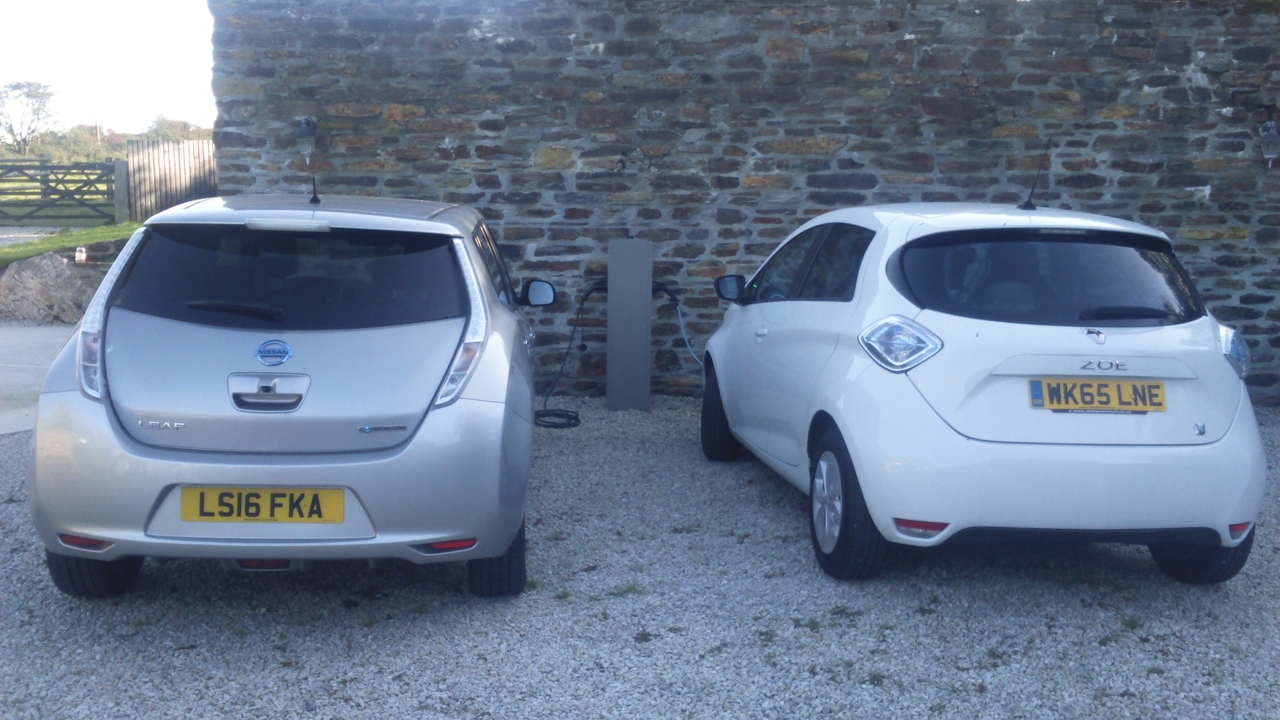
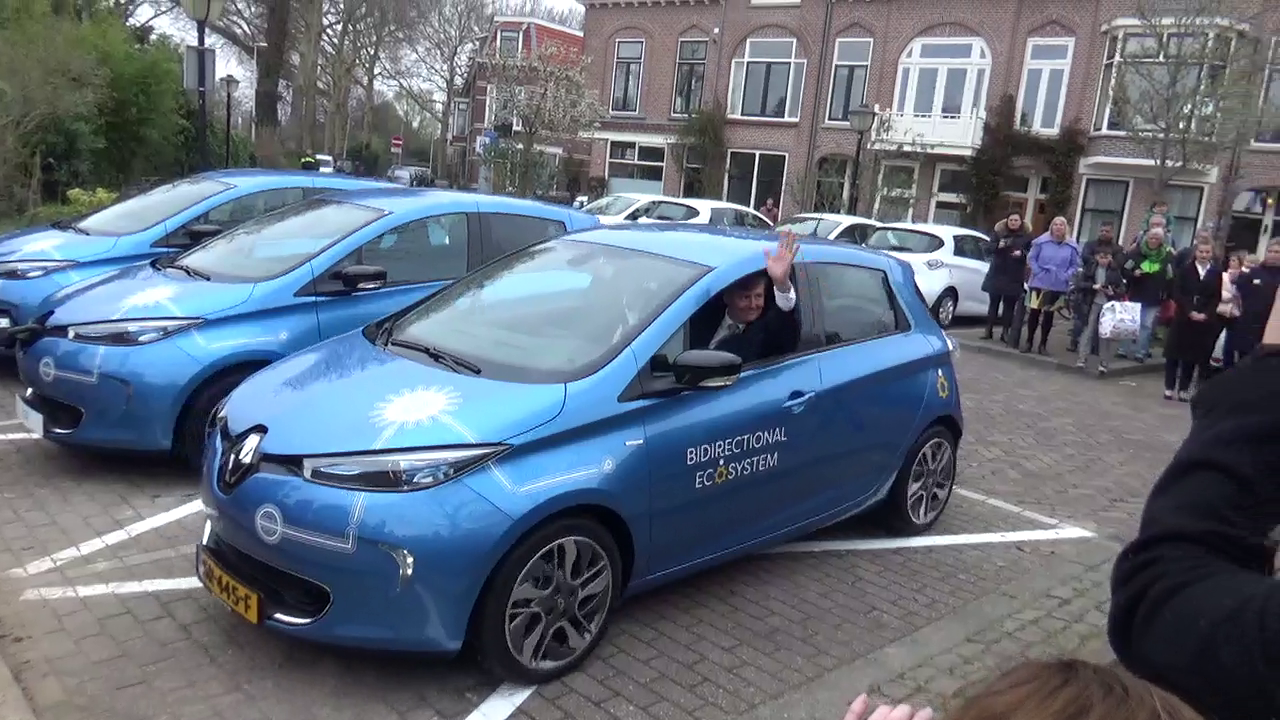
It looks like we’ll have to (metaphorically of course) twist someone’s arm at Renault to let us try one or more of their modified Zoes with AC V2G capability! I was at the launch in Utrecht today and spoke to a variety of representatives from Renault Netherlands and Renault France, who by and large seemed amenable to the idea of a suitably funded UK pilot project. Renault’s press release was of course accompanied by a variety of images. However I took lots of pictures of my own, and a fair few videos too. Here’s the three Zoes that were lined up in Utrecht today:
and here’s King Willem-Alexander of the Netherlands driving away in one of them, accompanied by Robin Berg of We Drive Solar:
Here too is a video recording of some of the excellent entertainment at the event, provided by the Hillsback Brassband:
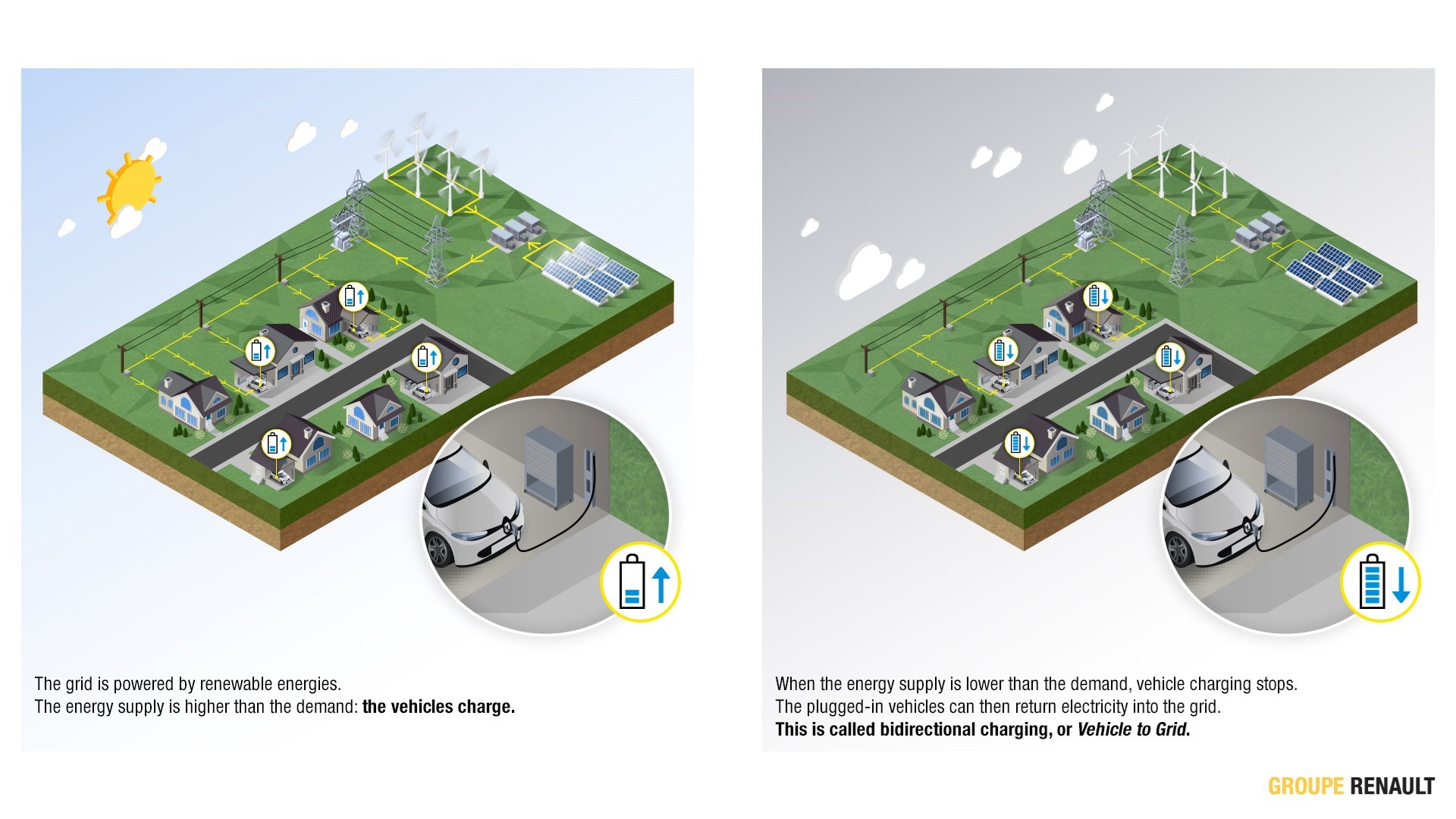
Invigorated by the brilliant brass section here’s one of the press release infographics that I couldn’t snap for myself. Renault’s visualisation of vehicle-to-grid technology in action:
2019 – Recharge bidirectionnelle
Charging during the day on the left. Discharging during the night on the right. Much like our very own V2G UK banner above! Renault’s press release continues:
Vehicle-to-grid charging — also called reversible charging — modulates the charging and discharging of electric-vehicle batteries in accordance with users’ needs and the grid’s supply of available electricity. Charging reaches its maximum level when the electricity supply exceeds demand, notably during peaks in production of renewable energy. But vehicles are also capable of injecting electricity into the grid during peaks in consumption. Electric vehicles can therefore serve units of temporary energy storage and become key drivers in the development of renewable energy. In this way, the electricity grid optimizes the supply of local renewable energy and reduces infrastructure costs. At the same time, customers enjoy greener, more economical consumption of electricity and are financially rewarded for serving the electricity grid.
Reversible charging will be piloted in several projects (electric ecosystems or mobility services) through seven countries and alongside various partners to lay the groundwork for Groupe Renault’s future offering. The aim is twofold: to measure large-scale feasibility and potential gains. In particular, these pilot schemes will help us:
Underline the technical and economic advantages of an onboard solution in electric vehicles
Demonstrate—in concrete terms—the value of services provided for the local and national electricity grid, such as encouraging consumption of solar and wind energy, checking the grid’s frequency or tension, and reducing infrastructure costs
Work on the regulatory frameworks of a mobile energy-storage scheme, detecting any pitfalls in it and offering concrete solutions
Establish common standards, the basic requirement for an industrial-scale roll-out.
I now have a few more videos of the event to go away and edit, but whilst those are being prepared here’s one that Renault provided earlier, illustrating both “Smart charging” and “Bidirectional smart charging”:
We have been following the development of the Sono Motors Sion “solar powered” electric vehicle with much interest for a while now. Here’s a new video from Robert Llewellyn’s “Fully Charged” series revealing recent progress by the Sono team:
Note in particular that at 10:35 into the video Jonny Smith says “It’s just so obvious you wonder whay it hasn’t been done before, followed by Fabian Duensing of Sion saying “This is, I would say, the secret weapon of this car”:
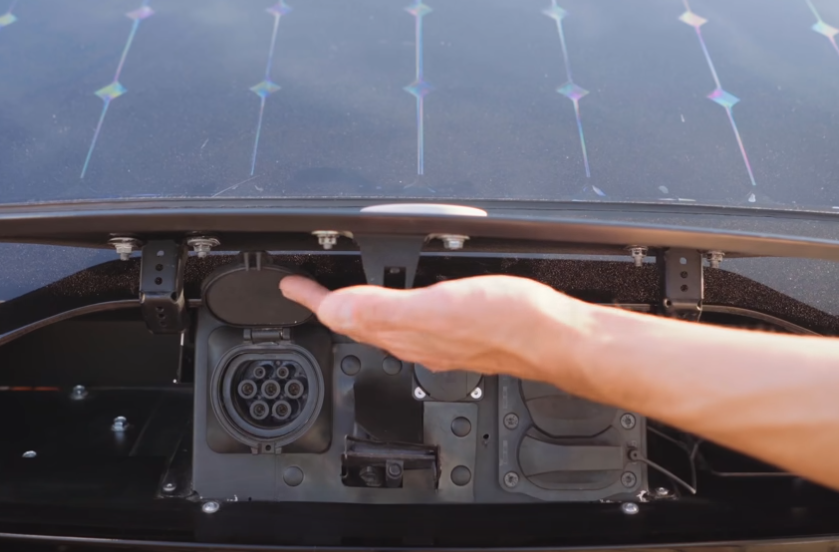
Through this one, the type 2 outlet, you can take back the energy from the battery of the car, not only to devices but to the grid.
Jonny clarifies:
So vehicle to grid?
To which Fabian responds:
So vehicle to grid! It’s not just hardware, it’s a lot of software as well, to make it able to actually do it.
Note also that under the other side of the charging flap there is a CCS socket for DC rapid charging of the Sion’s battery pack on those long trips from the city into the countryside.
In a press release earlier today Nissan proudly announced that:
An important milestone on the road to emission-free energy and mobility has been achieved by technology company The Mobility House, energy supplier ENERVIE, transmission system operator Amprion and car maker Nissan. With the Nissan Leaf and an innovative charging and energy management technology, the project partners have now succeeded in qualifying an electric car for all the TSO regulatory requirements for primary power regulation. This means that the car can be integrated as a regulating reserve for the German electricity grid – a breakthrough in the establishment of Vehicle-to-Grid (V2G) technology in Germany.
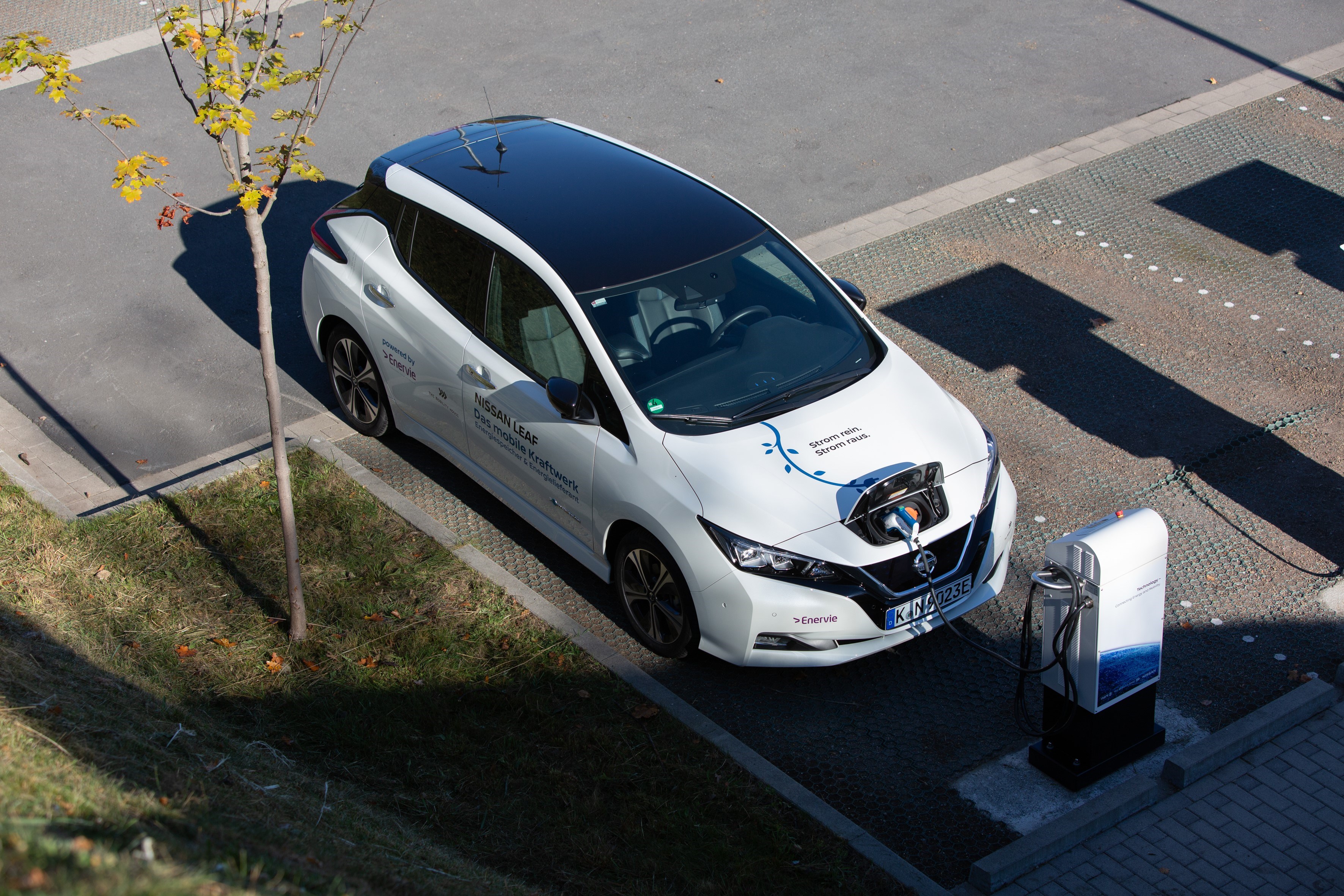
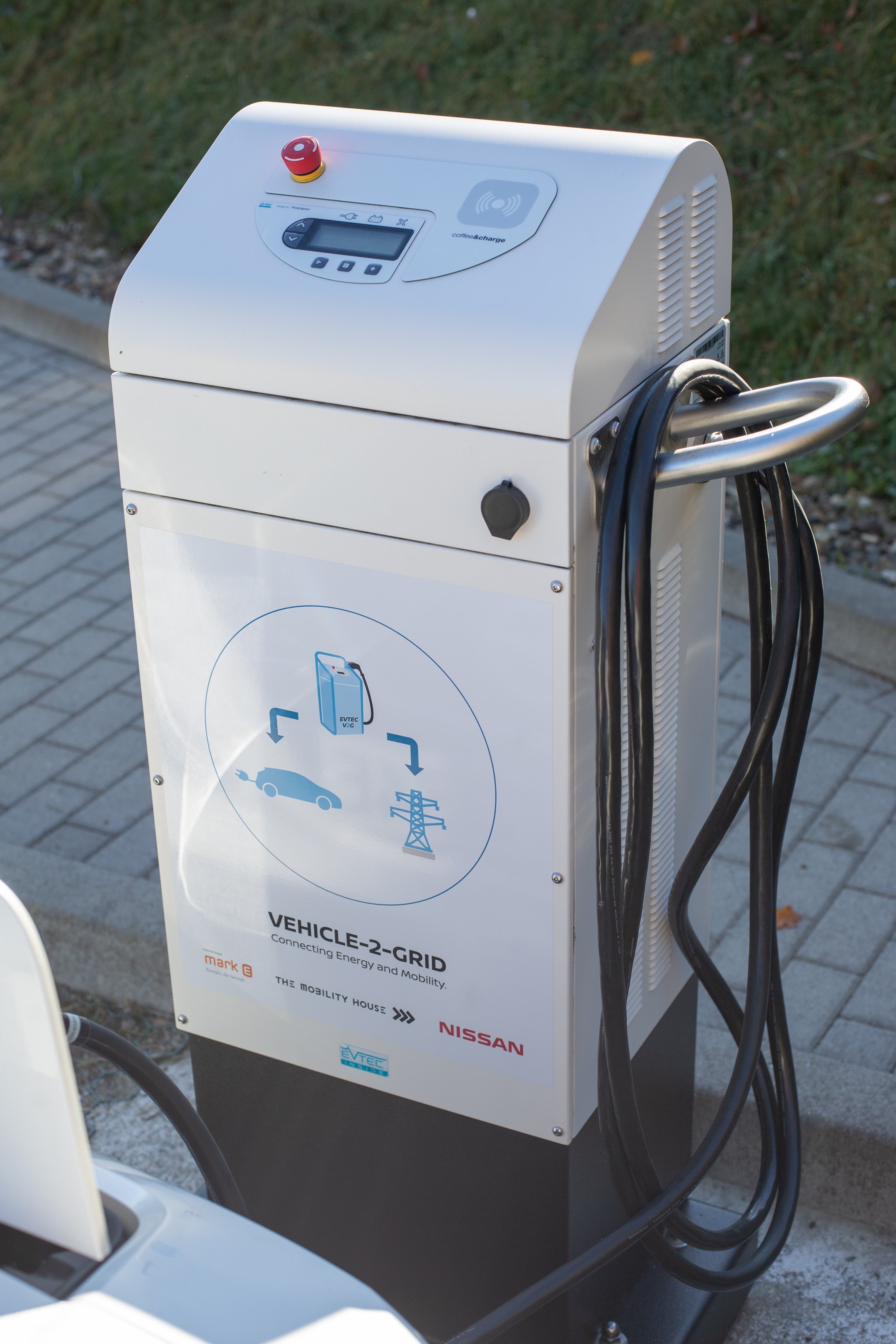
For some strange reason Nissan don’t mention the manufacturer of the V2G capable electric vehicle charging station displayed in their publicity pictures:
Nissan 2018 LEAF and EVTEC V2G charging station
Those pretty white boxes look a lot like the EVTEC units we have mentioned previously here on the V2G UK blog. Nissan’s press release continues:
To meet the universal desire for a transition to decentralised energy generation from renewable sources here in Germany, new and innovative solutions for stabilising the electricity grid are necessary. The increasing use of renewable energy leads to fluctuations in the grid, which must be initially balanced by primary regulation, able to prevent impending power cuts at a second’s notice.
Electric cars such as the Nissan Leaf, with integrated bidirectional charging technology, could play an important part in this. With its CHAdeMO charging connector, the Leaf is able not only to extract power from the grid and store it in its traction battery, but, if necessary, also to feed power back. This is called the Vehicle-to-Grid (V2G) concept.
As luck would have it here at V2G UK we are very familiar with the V2G concept and CHAdeMO connectors. In fact our V2G EVSE subsidiary has recently received an Office for Low Emission Vehicles (OLEV for short) grant to assess the feasibility of using such technology on the streets of Plymouth, Exeter and Falmouth in order to provide flexibility services to Western Power Distribution’s electricity grid over here, and thereby defer expensive reinforcement of South West England’s distribution grid. Here’s a close up of the Vehicle-to-Grid Electric Vehicle Supply Equipment for (V2G EVSE for short) in ENERVIE‘s car park over in Hagen:
EVTEC Vehicle-to-Grid capable charging station
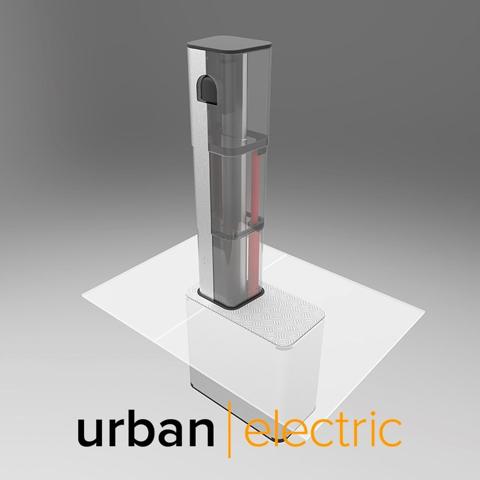
whilst here’s our concept for the inner city streets of Devon and Cornwall, Urban Electric‘s UEone “pop up” charging post:
According to Guillaume Pelletreau, the Vice President and Managing Director of Nissan Center Europe:
We strongly believe in an emission-free future. Accordingly, we are also very proud that the Nissan Leaf has, as the first electric car ever, been approved as suitable for stabilising grid frequencies. LEAF batteries could make an important contribution to energy transition in Germany and a sustainable future.
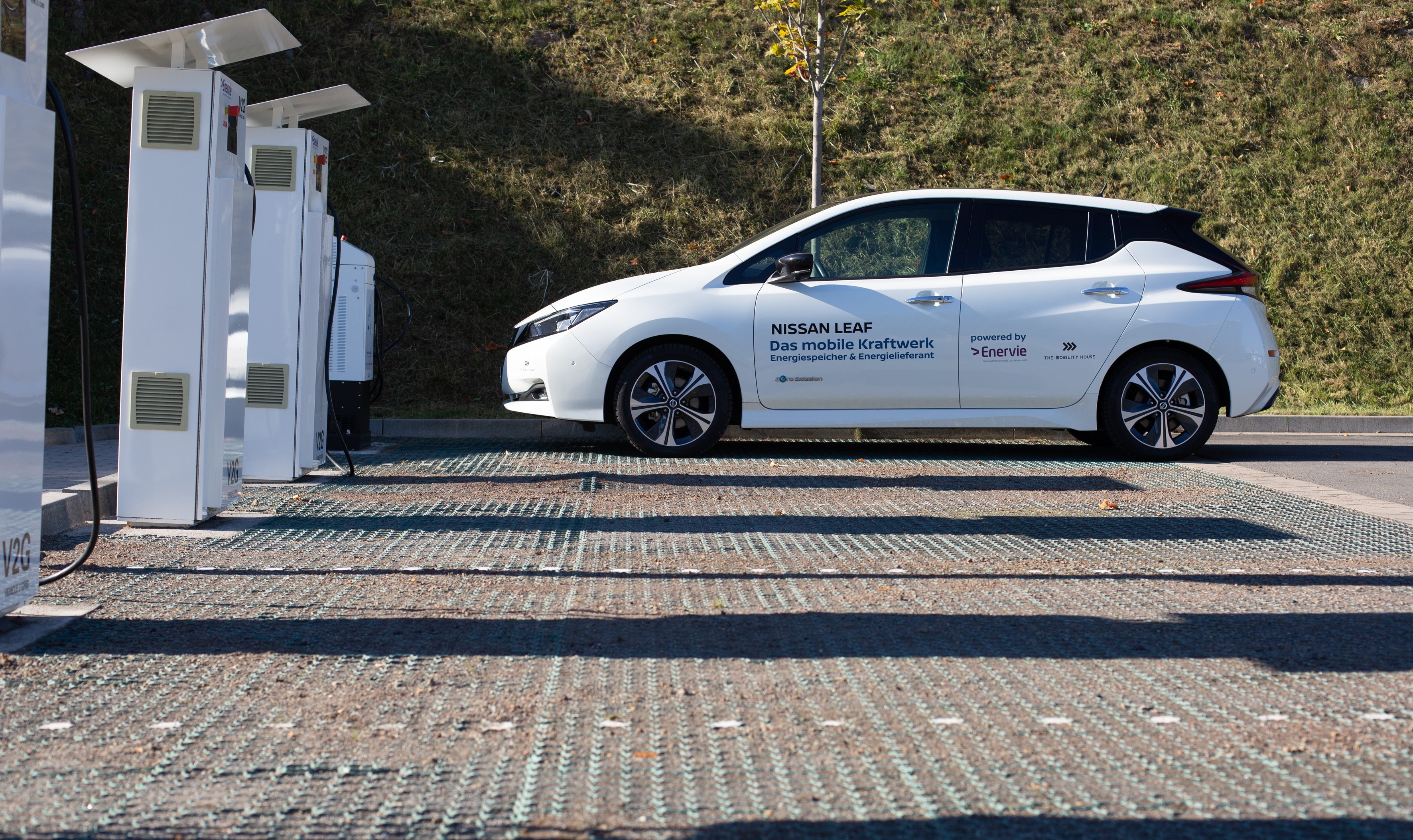
Nissan LEAF in ENERVIE’s car park in Hagen
Here at V2G UK we strongly believe that Nissan LEAF traction batteries could make an important contribution to the energy transition and a sustainable future here in the United Kingdom.