The Resilience of the UK’s Electricity System

Coincident with yesterday’s “Fuelling the Debate” report by the House of Commons Energy and Climate Change Select Committee, the House of Lords Science and Technology Select Committee published a report of their own, entitled “The Resilience of the Electricity System“. The Committee say in their overview of the report that:

The Government should not be congratulated on keeping the lights on. It is not acceptable for an advanced economy, hugely dependent on electricity, to sail so close to the wind. It found that we have been forced to generate extra capacity in the system, using expensive measures with heavy reliance on fossil fuel generation. The report urges the Government to improve its long-term planning to avoid squeezing the capacity margin like this.

The Chair of the Committee, Lord Selborne, commented that:

We chose to look at this issue because, such is our increasing reliance on electricity, any blackouts have the potential to bring our communications and vital services to a grinding halt.

The encouraging finding from our investigation is that overall, the resilience of the electricity system is robust, and witnesses told us we have the most reliable transmission network in Europe. But our report found that the Government sailed too close to the wind, allowing the capacity margin, its safety net, to be squeezed too tightly before taking last minute measures. Moreover these measures, which came at a cost to the taxpayer, were in conflict with the Government’s wider aims to decarbonise electricity generation.

We’re entering new and unchartered territory. As we strive for more decarbonised electricity provision, it will become harder and harder to keep electricity affordable and to guarantee security of supply. These are the three irreconcilable pressures of the ‘energy trilemma’, and we feel that there is more the Government needs to do to inform the public about potential higher prices.

We found that new technologies mean that our electricity system is undergoing immense and radical change. The report stresses that the Government must stay ahead of the game, with dedicated investment into research and development across a wide range of technologies, and constant alertness to cyber‑threats. Only then can the Government ensure that it can weather any storm, and continue to keep the lights on in the long‑term.

Delving deep into the report itself, chapter 5 concerns itself with “Changing demand”, and paragraph 143 even mentions vehicle to grid technology, albeit not using that name:

Electric vehicles and electric heat pumps are two technologies that are expected to increase demand for electricity.

If electric vehicles are widely taken up then they will increase electricity demand, though this could be concentrated during off peak hours. On the other hand, a smart grid could allow battery-powered electric vehicles to supply power to the grid, e.g. during peak times when prices are high, and then to recharge during off peak hours. They could also further contribute to electricity security by providing a backup supply during power outages. Electric vehicles are not the only low carbon option for road transport – hydrogen and biofuels (2nd or 3rd generation) also offer potential.

Paragraph 144  goes on to point out that:

Electrification of large parts of the energy used for heating or transport “would change its time-of-use profile, placing ever increasing pressures on the electricity system.” Charging electric vehicles will bring complexity and it will be important that vehicle
charging management systems and standards are carefully designed. Vehicle charging is a manageable problem, since the overnight load can be fitted into the available system capacity. However simplistic charging management solutions will create unfortunate effects, such as cliffs of coordinated switch-on and switch-off. There are other issues that need to be addressed in designing an effective charging system. Unmanaged systems will contribute significantly to peak load, since people naturally
plug in at the point of arrival home and then charge through the evening peak. It is therefore critical that carefully designed vehicle charging management systems and standards at the national level are developed and incorporated into any large scale demonstrations and early roll-outs. These systems need to address both the capacity of the national system and also the local distribution system.

Plenty of sensible suggestions then, which at the end of the day leaves us coming to much the same conclusion as the House of Lords Select Committee:

We recommend that the Government supports research, development, demonstration and early deployment across a diverse range of technologies. This should include electricity supply, demand side response, storage and smarter networks [and V2G!].
Particular attention should be paid to technologies that could strengthen electricity system resilience and how these technologies fit together in systems.

Given budgetary constraints, there will be a need to prioritise some technologies over others. We recommend that the rationale for these choices is clear, transparent and made publicly available.

Implementing that final sentence would certainly be a big improvement over the current state of affairs!

Utrecht Gets V2G Based Energy Storage

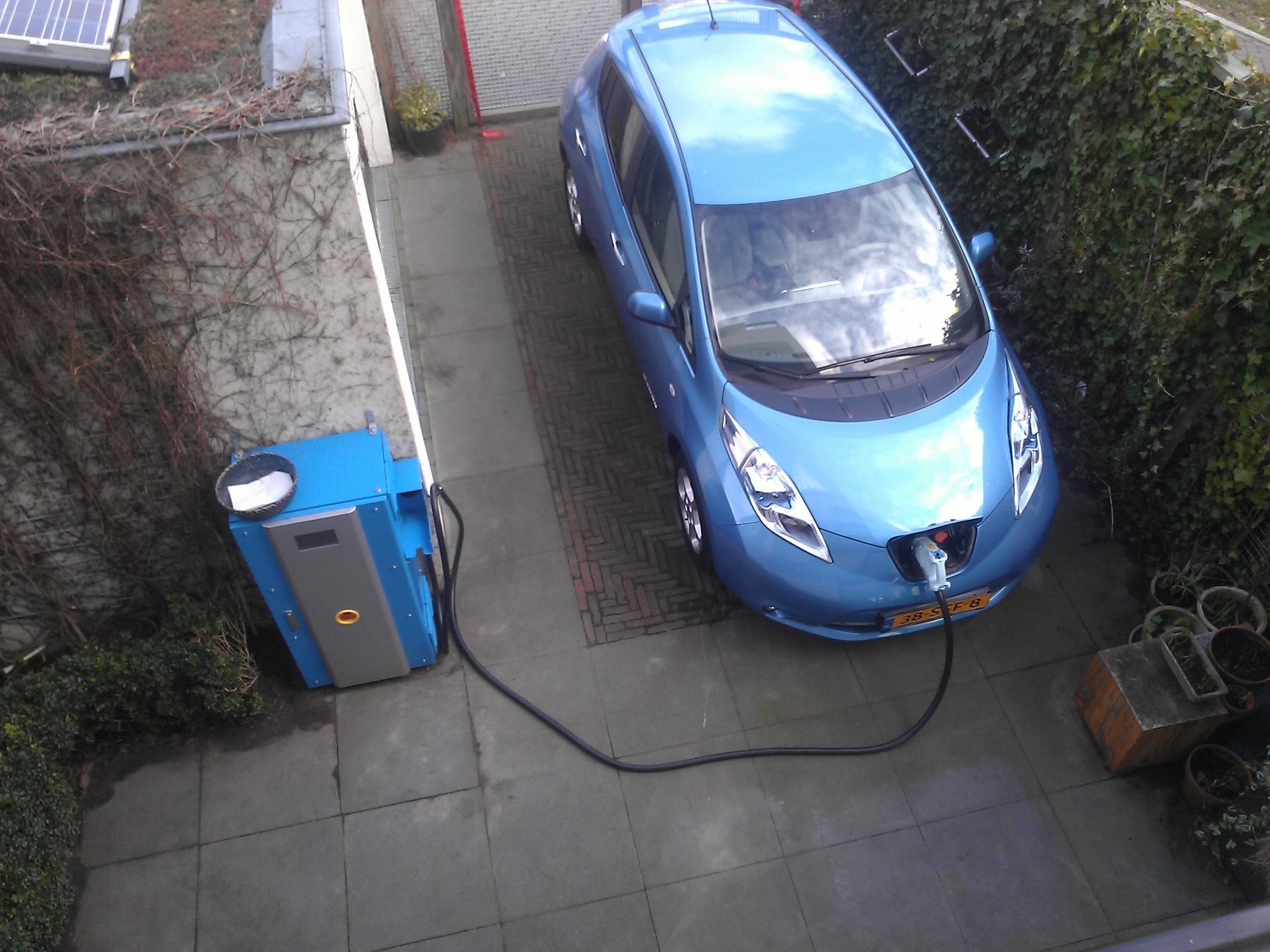
In a ceremony at the Parkschool in the Lombok district of Utrecht on March 4th deputy Remco van Lunteren, officially opened the first Vehicle to Grid (V2G) energy storage system in Europe. The event was recorded for posterity:


The solar energy storage system supplied by Nissan charges electric cars but can also discharge their batteries in order to power houses. It helps to provide a higher return on solar power, reduces peak current on the grid and helps promote electric vehicles.  The opening of the V2G system is a sequel to the opening by Councillor Lot van Hooijdonk of a smart charging station from General Electric in Lombok on December 2nd 2014. The first charging station was unique because it had some built-in intelligence, and the V2G system adds an energy storage capability to it. Together, these are the first building blocks of Lombok’s Smart Solar Charging pilot project.

As the “Storage4all” project page puts it:

To create a truly smart grid using renewable energy, it is necessary to find a solution to the existing time differentials between generation and demand. The storage of energy is one way of achieving that.

Electric cars have a large storage capacity and are a major consumer of  future electric power generation. By making use of the storage facility of electric cars the “Smart Grid” can be made more sustainable.

In order to utilize the battery of an electric car for energy storage, it is necessary for the car batteries to be able to be discharged. In many cases this is not possible and the majority of EVs have internal protection against this. Only the Nissan LEAF currently has this possibility because of the Japanese market demand for storage (to protect against disruptions and power failures caused by earthquakes). The pilot project therefore initiated discussions with Nissan Europe and the provider of such a bi-directional charging system to achieve this in ​​Lombok.

Simulations show that there is much potential for storage of renewable energy in Smart Grids. Economically, it is not yet possible under current market conditions. The pilot project has ensured international recognition for this initiative, the development of the first European bi-directional charging station and a possible big roll out of them in Utrecht in the coming years.

Unfortunately market conditions here in the UK are currently also not economically favourable to this type of initiative.

Nissan and Endesa Pledge to Promote V2G in Europe

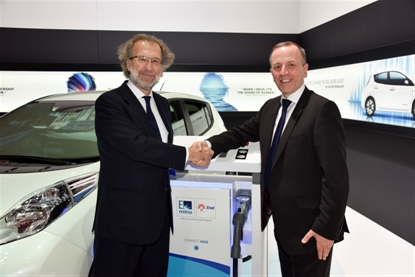
Nissan and Spanish utility Endesa have announced in a press release that they

Signed a ground-breaking agreement at the 85th Geneva International Motor Show that paves the way for a mass-market vehicle-to-grid (V2G) system.

The two companies have pledged to work together to deliver a V2G system and an innovative business model designed to leverage this technology.

If that sounds a touch unlikely to you, here’s the proof:

The press release goes on to explain that:

The two companies have agreed to collaborate on the following activities:

  • Introduction of V2G services in the European market;
  • Exploring the use of ‘second life’ EV batteries for stationary applications (including households, buildings, grid);
  • Designing and evaluating potential affordable energy and mobility pack offers;

One of the main challenges for electricity management systems is to assure grid stability. This situation is especially relevant in countries with a high level of renewable energy generation, and this will only increase in the future. The longer term zero-emission vision is for EVs to be at the center of a fully integrated system whereby owners can participate in wholesale energy markets using the power stored in the batteries of their electric vehicles, and thus significantly reduce their cost of operation. In a not-so-distant scenario, the EV user not only decides when and where they want to charge their EV, but how best they spend and re-sell the energy stored in their EV; receiving tangible financial benefits in terms of energy savings, while at the same time maximizing the use of green energy.

As is customary on these occasions the press release quotes executives from the two companies. Paul Willcox, Chairman of Nissan Europe said that:

We believe this innovation represents a significant development for Nissan Leaf and e-NV200 customers. Every Nissan electric vehicle battery contains a power storage capability that will prove useful in contributing towards smarter and responsible management of the power demand & supply of local power grids, thus reducing our EV total cost of ownership. Not only does this represent an opportunity for Nissan’s EV private and fleet owners, it could also support grid stability and fully demonstrate that each Nissan EV represents a tangible social asset.

whereas Javier Uriarte, Head of Market Iberia at Endesa, pointed out that:

The flexibility offered by V2G implementation in terms of storing and releasing green energy into the grid will further enhance the already significant and tangible benefits of electric mobility. This is why Endesa, together with its parent company Enel and partner Nissan, have decided to join efforts in promoting this technology.

Moving on to the technology employed:

The Vehicle to Grid (V2G) system consists of the Endesa two-way charger and an energy management system that can also integrate such off-grid, and renewable, power generation as solar panels and wind turbines. Using this equipment, a Nissan LEAF or e-NV200 owner can connect to charge at low-demand, and cheap tariff periods, with an option to then use the electricity stored in the vehicle’s battery at home when costs are higher, or even feed back to the grid with a net financial benefit. Electricity generated by solar panels or wind turbines can be used to charge a vehicle, to power the home or business, or to feed back to the grid.

This unprecedented agreement between Nissan and Endesa means that European countries can now review their current energy management policies in order to respond to the technological innovation of the V2G system.

Endesa has developed the ultimate low-cost V2G technology ready for the mass market after years of real-life testing. The company first showcased its V2G technology in 2008 in Smartcity Malaga, the Enel Group testing ground for smart cities. Later on, in 2012, Endesa presented the evolution of such technology at the ZEM2ALL demonstrator.

On March 12, 2015, as the culmination of the V2G system development, together with Nissan as automotive partner, Endesa will host a full demonstration of the market-ready and low cost system in Madrid.

Of course we’re not content with merely reading press releases here at V2G UK, and we have conducted an in depth interview with Olivier Paturet, who is General Manager of Nissan Europe’s zero emission strategy. Here’s a 2013 recording of Olivier outlining the raison d’être of Nissan’s ZEV plans:


Watch this space!

California Invests $2.3 million in V2G Technology

The California Energy Commission have announced that they have awarded:

A $2.3 million contract to the U.S. Department of Energy’s Lawrence Berkeley National Laboratory will help fund demonstration of an all-electric, heavy duty, non-tactical vehicle-to-grid (V2G) fleet at Moffett Field near San Jose. The vehicles will explore the revenue-generating capability of V2G technology to participate in California’s electricity markets, where the vehicles can both get charged by the grid and send energy back to the grid to help meet demand.

The money comes from the Energy Commission’s Alternative and Renewable Fuel and Vehicle Technology Program (ARFVTP)

The Great Dunchideock Blackout Saga

We recently suffered a power outage, or power cut as we prefer to call such things here in the UK. This wasn’t any old power outage either. Let me explain.

The lights went out at 17:44 on Friday April 11th 2014. I hurriedly powered down everything in the lab and office except my laptop and our broadband router, which was by then being powered from the battery in an uninterruptible power supply. When the lights hadn’t come back on a few minutes later I telephoned our local Distribution Network Operator (DNO for short), Western Power Distribution, to enquire what the problem was, and when it might be fixed. WPD’s automated system suggested that our power should be restored by about 21:00 that evening.

9 o’clock came and went, by which time the batteries in my laptop and UPS were flat. I called WPD again, to be informed that the latest estimate for the time at which I would be able to get connected to the internet once again would be 01:00 on Saturday morning. I figured I’d allow WPD a bit of leeway, and eventually went to bed having set the alarm on my smartphone for 02:00. The alarm went off, but the lights still hadn’t come back on.  I phoned Western Power again to be informed that things should be back to normal in an hour or so. Bleary eyed I returned to bed.

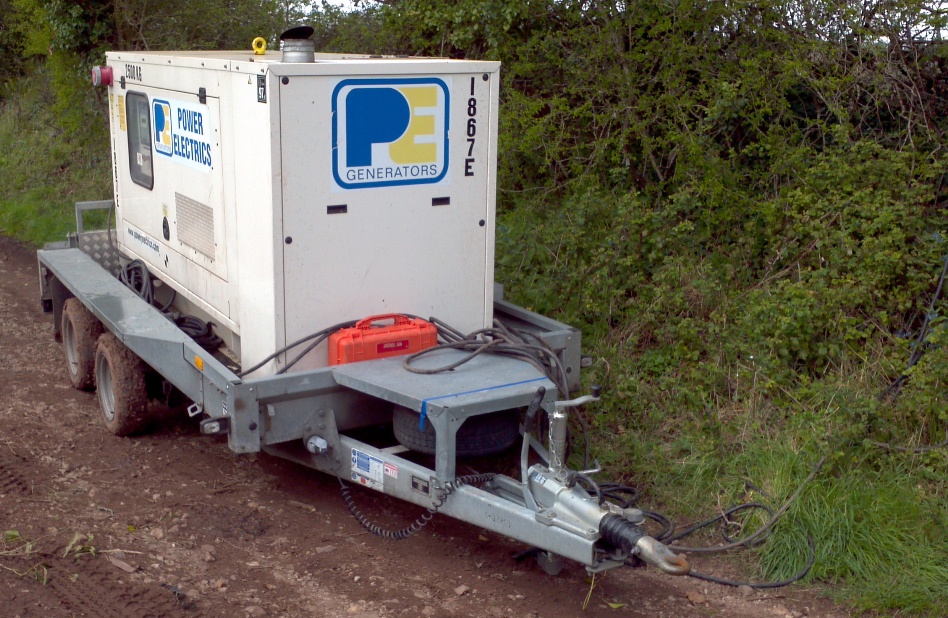
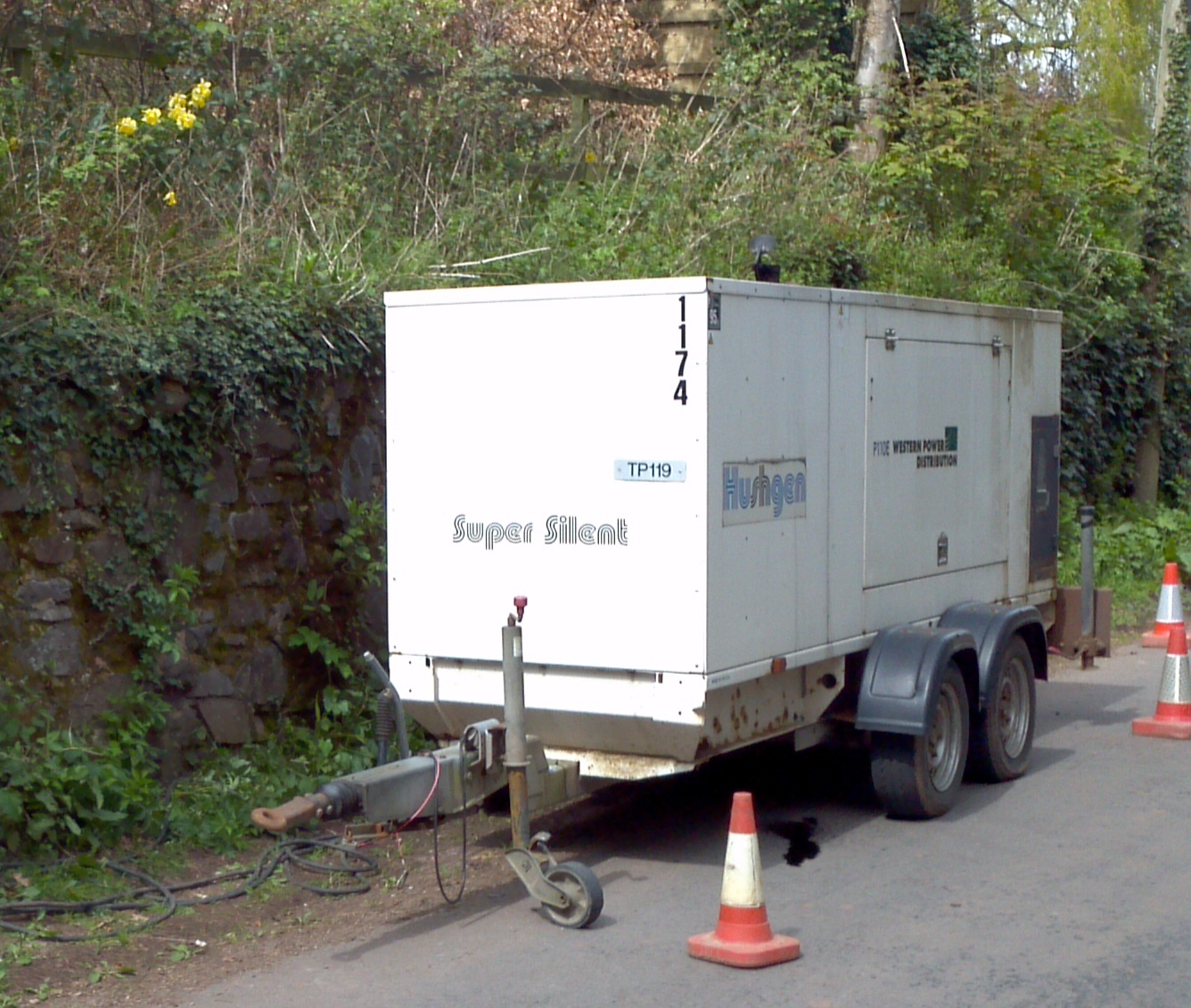
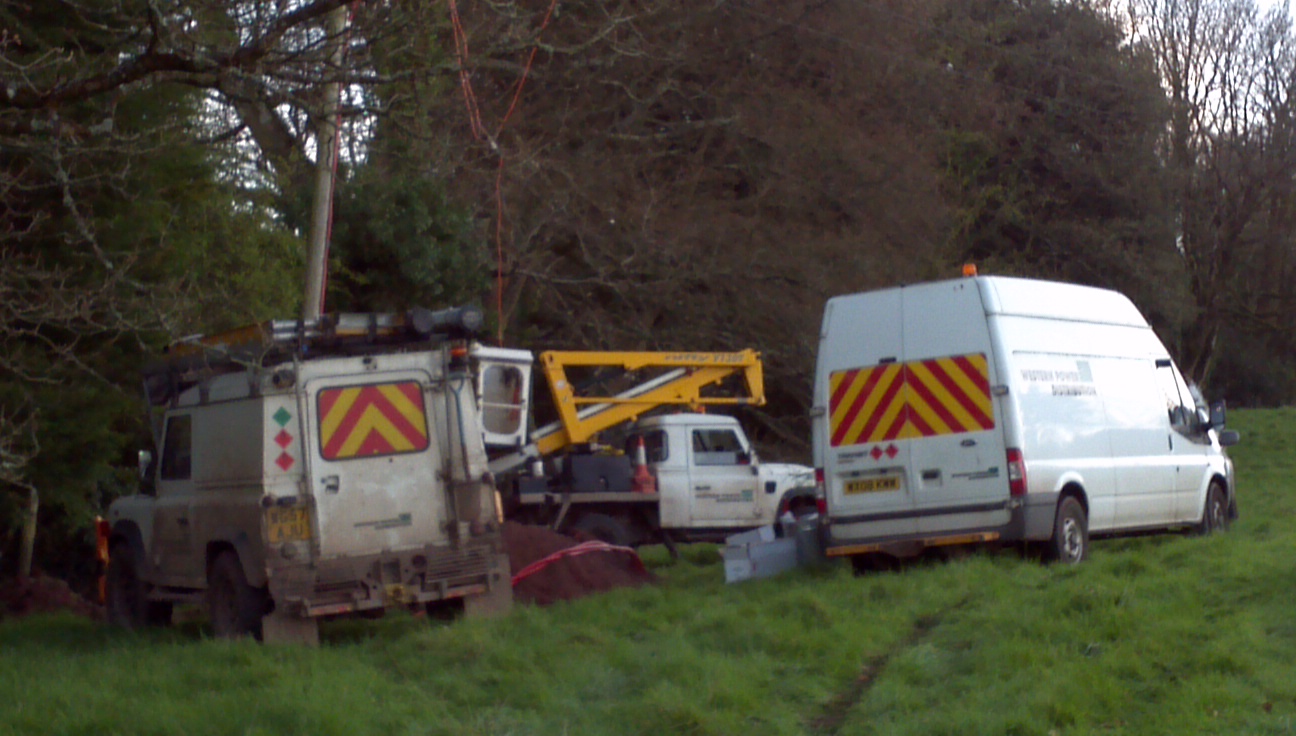
When I arose next morning I wasn’t in need of any lights, but my router and laptop were working once again. There was, however, the continuous drone of an engine audible not too far away so I set out to investigate by following the sound, and here is what I discovered:

Generator on the track to Haldon Belvedere on April 12th 2014

Diesel generator on the track to Haldon Belvedere on April 12th 2014

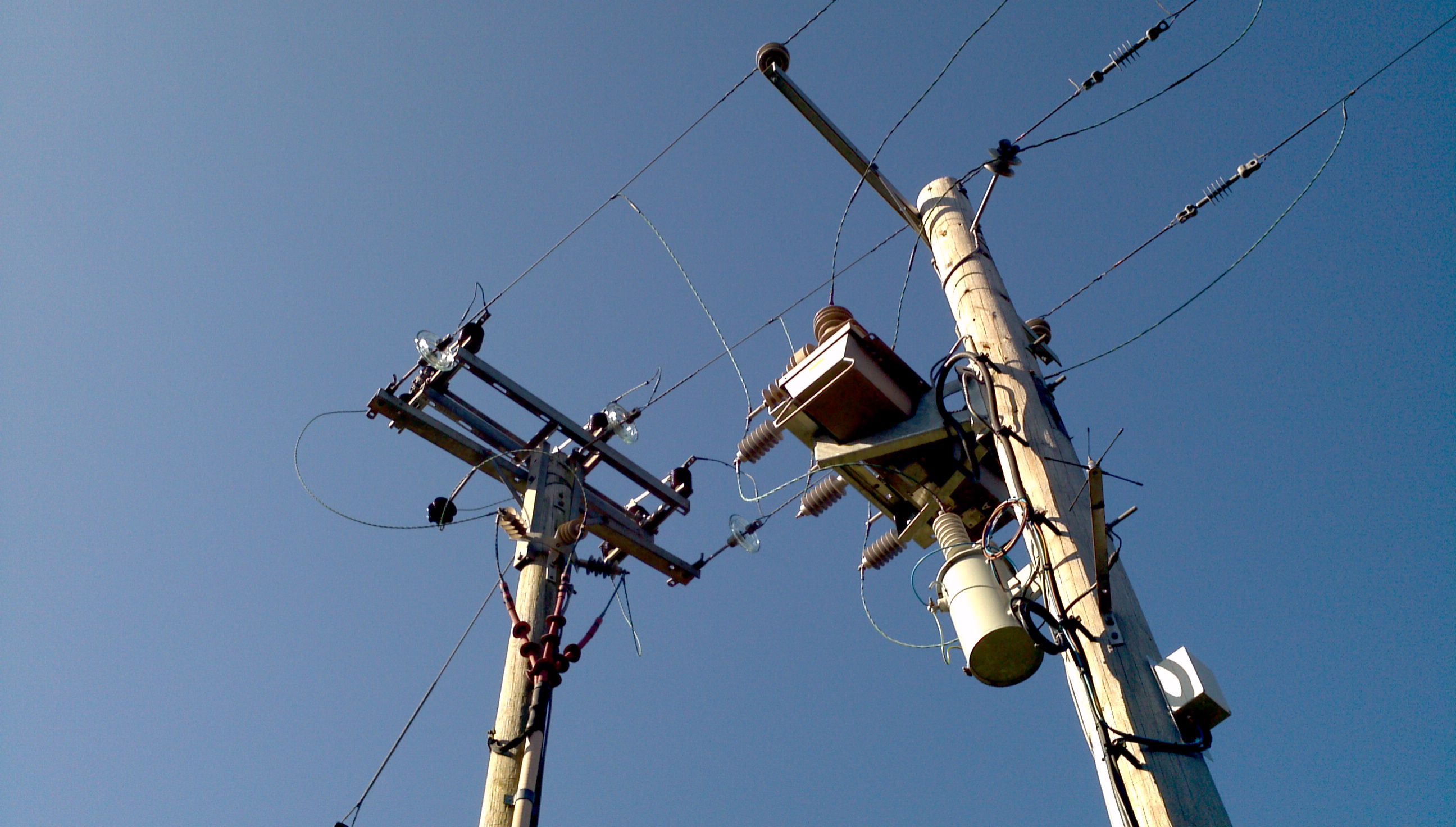
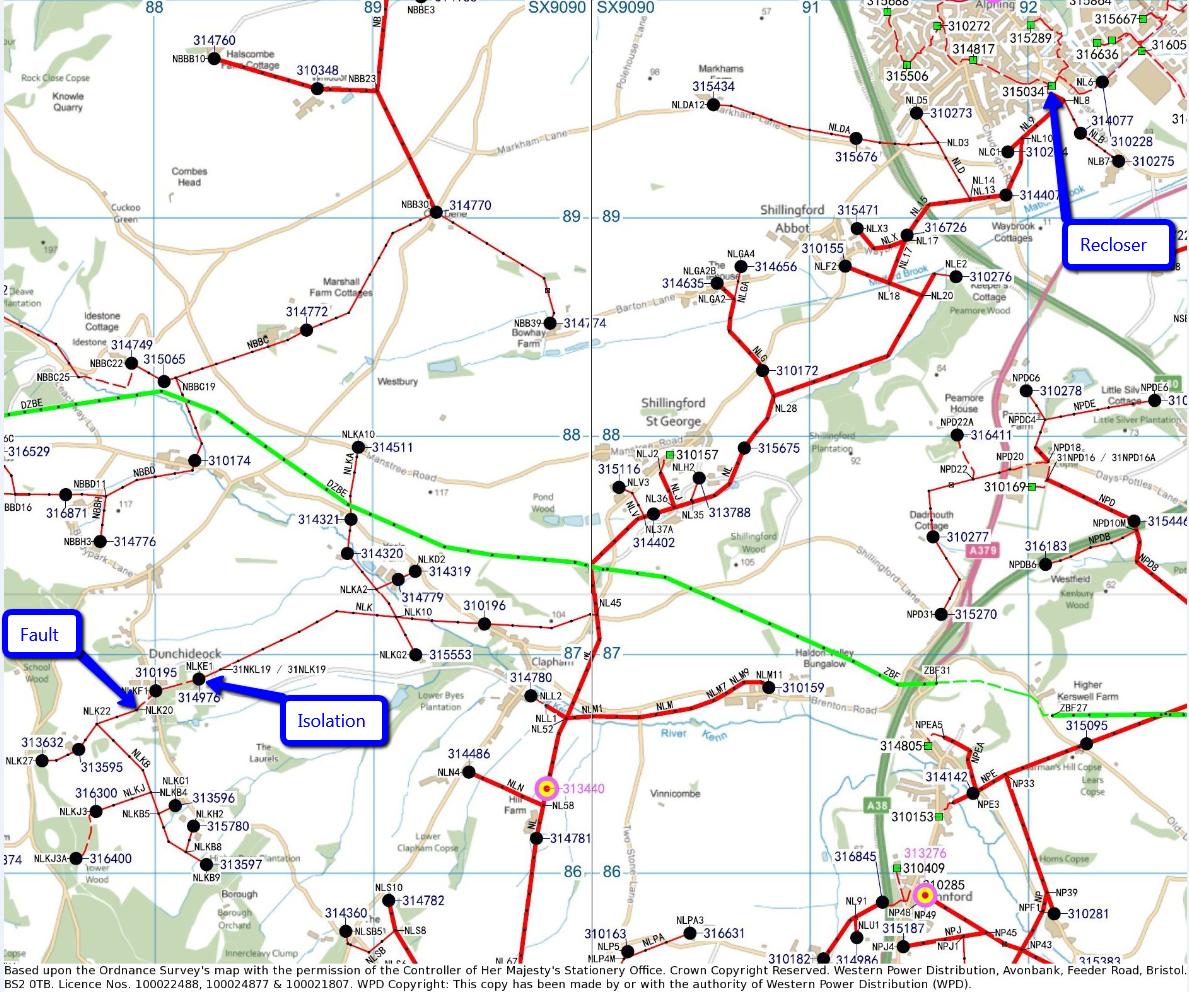
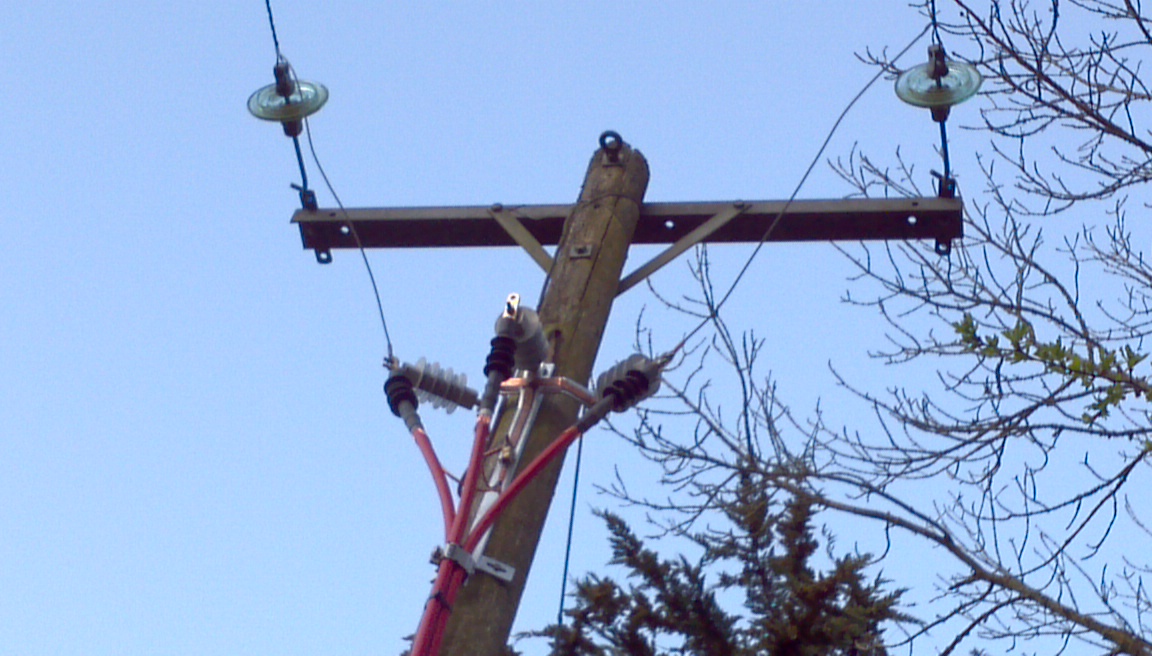
Another call to Western Power Distribution elicited some further information. I managed to speak to WPD’s standby manager for the day, who explained what had happened the previous evening. Initally over 300 properties had been without electricity following the operation of an automatic circuit recloser mounted on pole NLT1M in Alphington, as shown at the top right of the map of WPD’s network below (click the image for a larger version), and in this photo I took subsequently:

Schneider pole mounted recloser and air break isolator in Alphington

Schneider U-Series pole mounted recloser and an air break isolator in Alphington

WPD map of 11 kV and 33 kV cables Southwest of Exeter

WPD map of 11 kV (red) and 33 kV (green) cables south west of Exeter

At that point everything powered via the 11 kV 3 phase (thick red) cables running from top right to bottom left of WPD’s map was without electricity. By around 21:00 the problem had been isolated to somewhere in the bottom left corner of the map, and power now reached as far as pole NLK19, near the north east corner of The Lord Haldon Hotel car park.

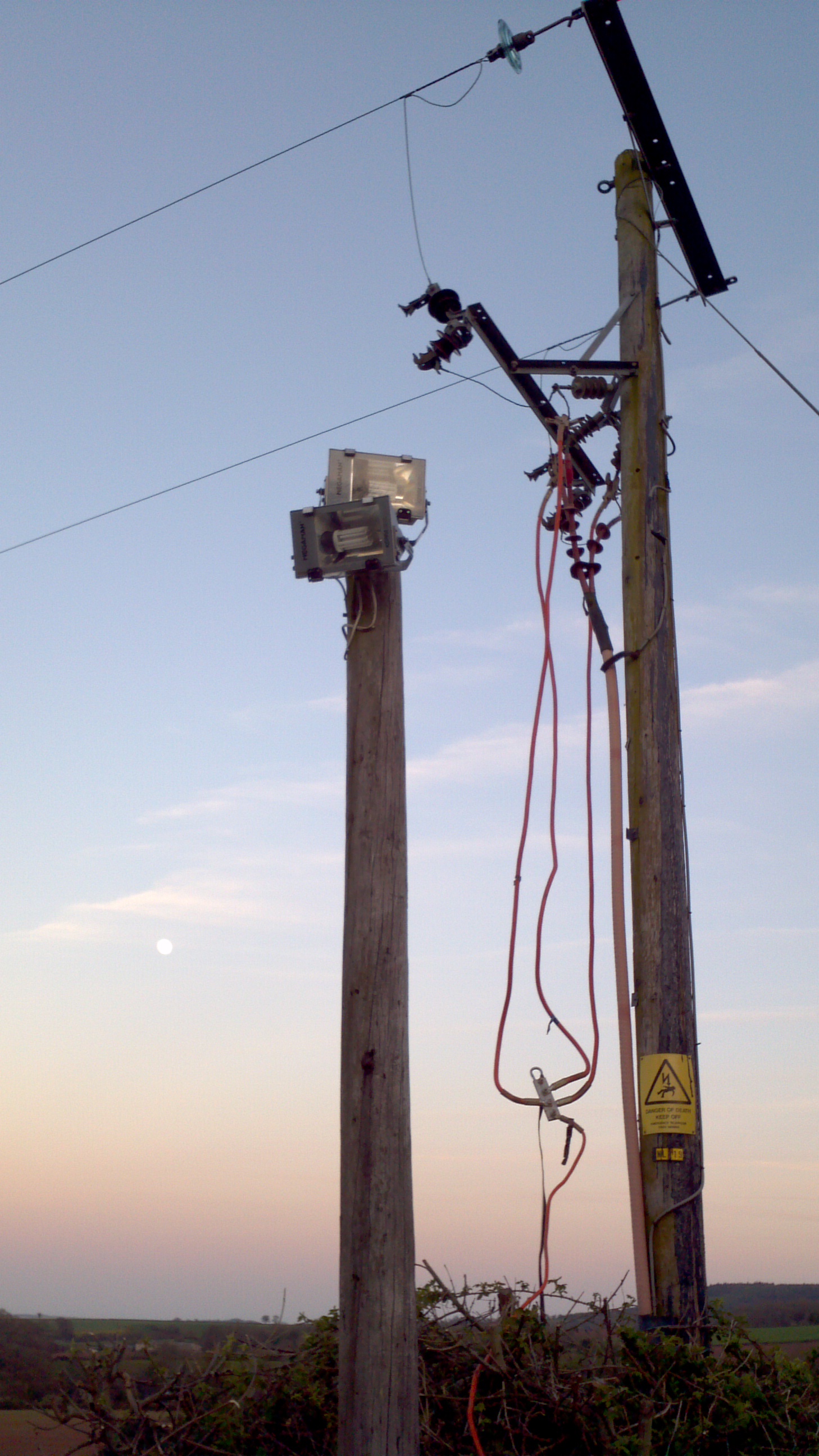
Pole 31NLK19, whilst The Lord Haldon Hotel and The Haldon Belvedere were running from WPD generators

Pole 31NLK19, draped with extra cables, whilst The Lord Haldon Hotel and The Haldon Belvedere were running from WPD generators

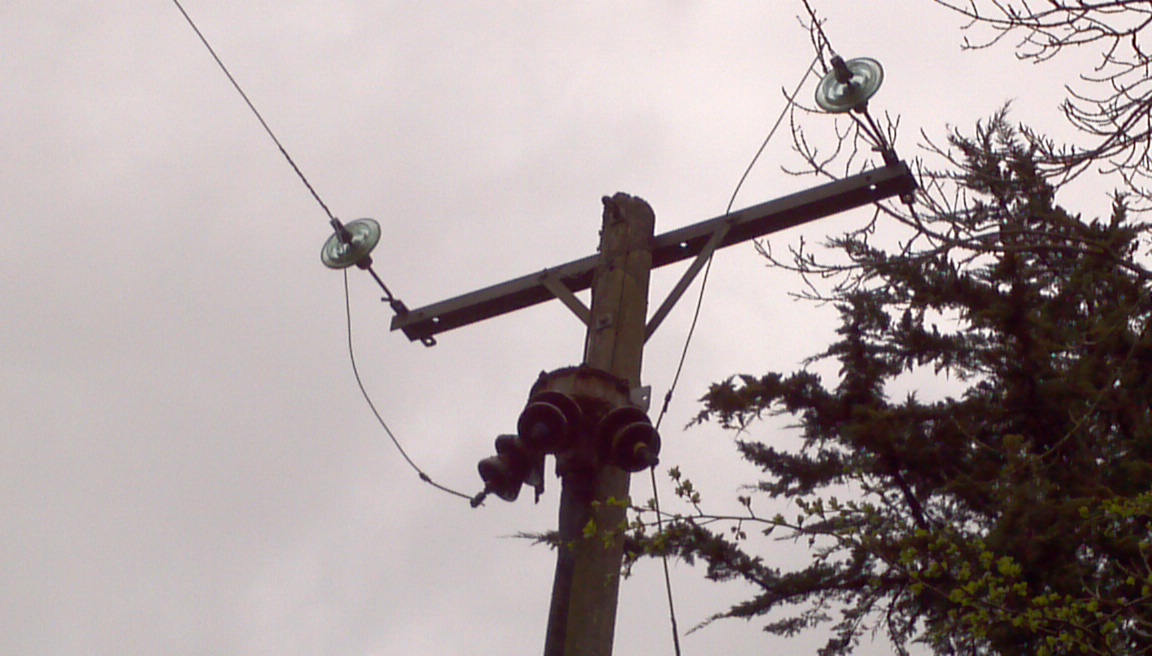
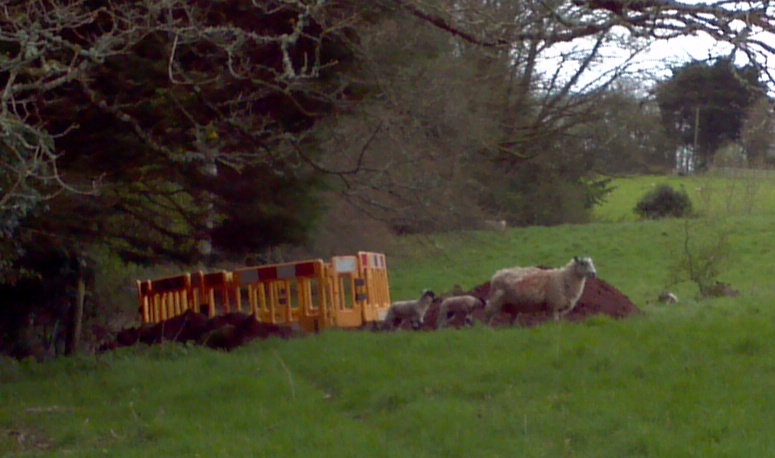
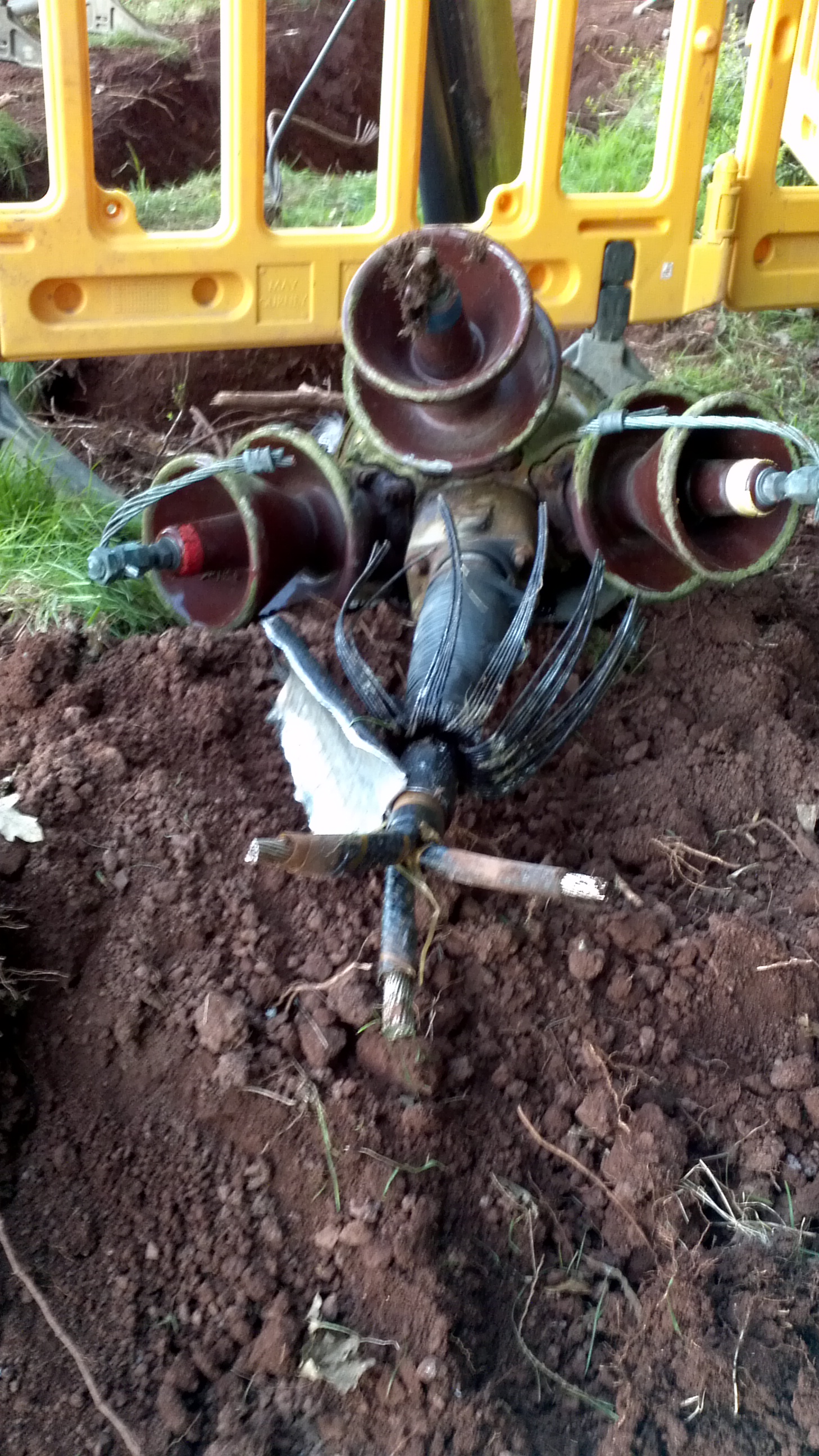
Unfortunately the hotel itself, which had a wedding reception booked that night, and everyone else in our corner of the village of Dunchideock and Haldon Hill were still without power, and WPD still didn’t know where the fault was. I am assured by a local resident that once it had got dark his wife noticed some arcing at the top of an electricity pole in a field behind his house, so he drove to the hotel car park and informed the WPD engineers gathered there about her discovery. The problem ultimately proved to be a faulty pole top cable termination, shown below in situ together with some inquisitive lambs:

A 48 year old cable termination at the top of pole NLK20

Youthful interest is shown in a big hole in the ground

Some youthful interest is shown in a big hole in the ground

By the time the likelihood that this was indeed the ultimate cause of the problem had been established time was pressing. According to WPD they have a self imposed 12 hour time limit on turning the power back on after any interruption in supply, and there was no way this problem would be fixed within that timeframe. That being the case some generators would be required, which presented WPD with another big headache. It seems there had been some other problems in Devon on the same day, and there weren’t enough generators in Exeter to go around, so WPD brought some more in from Torbay. That still wasn’t adequate for the scale of the problem, so they brought some more in from Taunton. Even that wasn’t sufficient, so finally they had to hire a few more from Bristol, one of which was emitting the dulcet tones that greeted me on Saturday morning. Here’s one of WPD’s own generators, that was located a bit further up the road near the entrance to the hotel:

WPD Generator hard at work outside Pen Hill Cottage

WPD diesel generator hard at work outside Pen Hill Cottage

All in all, by the time everyone affected had their electricity supply restored, which in our case seems to have been at around 3:30 on Saturday morning, 9 diesel generators were scattered across the north side and ridge of Haldon Hill. WPD assured me there was no danger of any further power cuts, since every 12 hours or so they would be hauling a bowser around the local vicinity to top up the tanks of any generator that might be running low on diesel fuel.

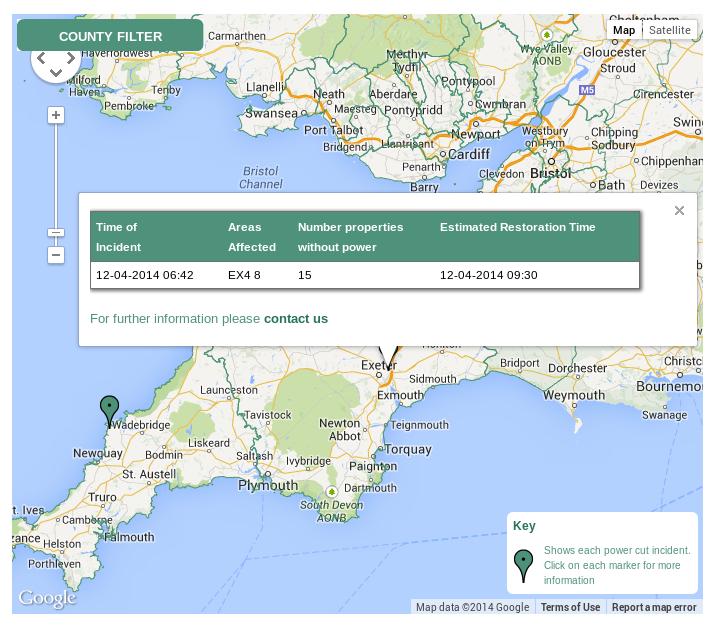
Whilst they didn’t have such a thing last time I checked, during the recent winter storms, I was also informed that Western Power now provide an online power cut map. This is how it looked on the morning of Saturday April 12th 2014:

Western Power Distribution power cut map at 08:39 BST on Saturday April 12th

Western Power Distribution power cut map at 08:39 BST on Saturday April 12th


It seems as though “running off a generator” doesn’t count as a “power cut”, because Dunchideock isn’t on that map, all of which meant that WPD could now fix the problem as and when time permitted. Here’s how things were looking by Sunday evening:

By Monday morning the epoxy resin in the Lovink red box had set, the big hole in the ground was filled in, and we were all back on mains power once again. All of which raises a few questions, in my mind at least.

In my conversations with WPD’s duty engineers I enquired whether this particular failure might be in any way attributable to the recent wet and windy winter weather here in South West England I alluded to earlier. I was told that while a causal link with any single failure was impossible to establish, it was conceivable that WPD’s electricity distribution network had suffered additional “stress” due to increased lightning strikes and the potential for trees to be more easily toppled by strong winds whilst their roots were sitting in sodden soil. I also idly enquired about the stresses placed on the network by renewable generation in the South West, but that story will require an article of its own at the very least.

In the meantime I’ve been pondering how this saga would have panned out if some of the homes in Dunchideock had already been in possession of an electric vehicle and some vehicle to home or even vehicle to grid technology. Since the powers that be here in the UK don’t seem to be wild about either of those concepts maybe a pile of shiny new lithium ion batteries from Tesla in the corner of each garage in Dunchideock might be more realistic to speculate about, or at the very least some second user EV batteries that are at least receiving some R&D funding on this side of the Atlantic? In that case perhaps we should add distributed storage to grid (or S2G for short) to our list of TLAs under consideration?

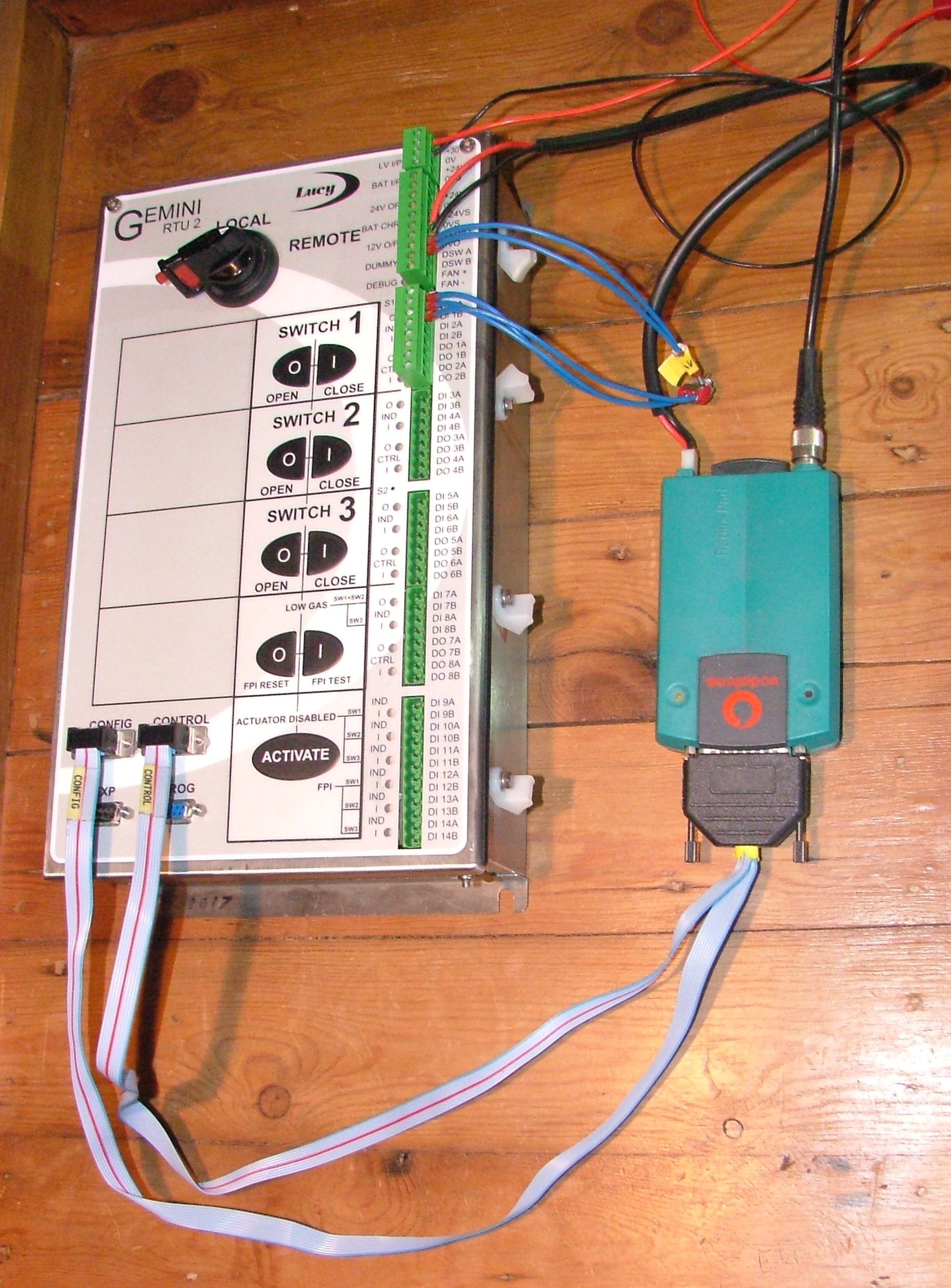
The lights wouldn’t have gone out in any V2H or storage equipped home. Their broadband would have kept on working too, so information about the failure could have been swiftly despatched to WPD’s control centre to enable the location of the fault to be pinpointed more swiftly. If some people had V2G and/or S2G installed as well, and subject to being suitably reimbursed for their public spiritedness, they could have kept their neighbours’ lights on as well as their own provided that WPD’s equipment was capable of sectionalising their network with greater granularity than at present. As luck would have it there is a pile of such equipment already in Dunchideock, although it’s only in the V2G lab at the moment rather than attached to any of the WPD poles I’ve mentioned apart from the one in Alphington, or in the corner of anyone else’s garage in Dunchideock. Here’s what a remote terminal unit looks like from the outside:

A Lucy Switchgear Gemini Remote Terminal Unit plus PakNet PAD

A Lucy Switchgear Gemini Remote Terminal Unit plus PakNet PAD

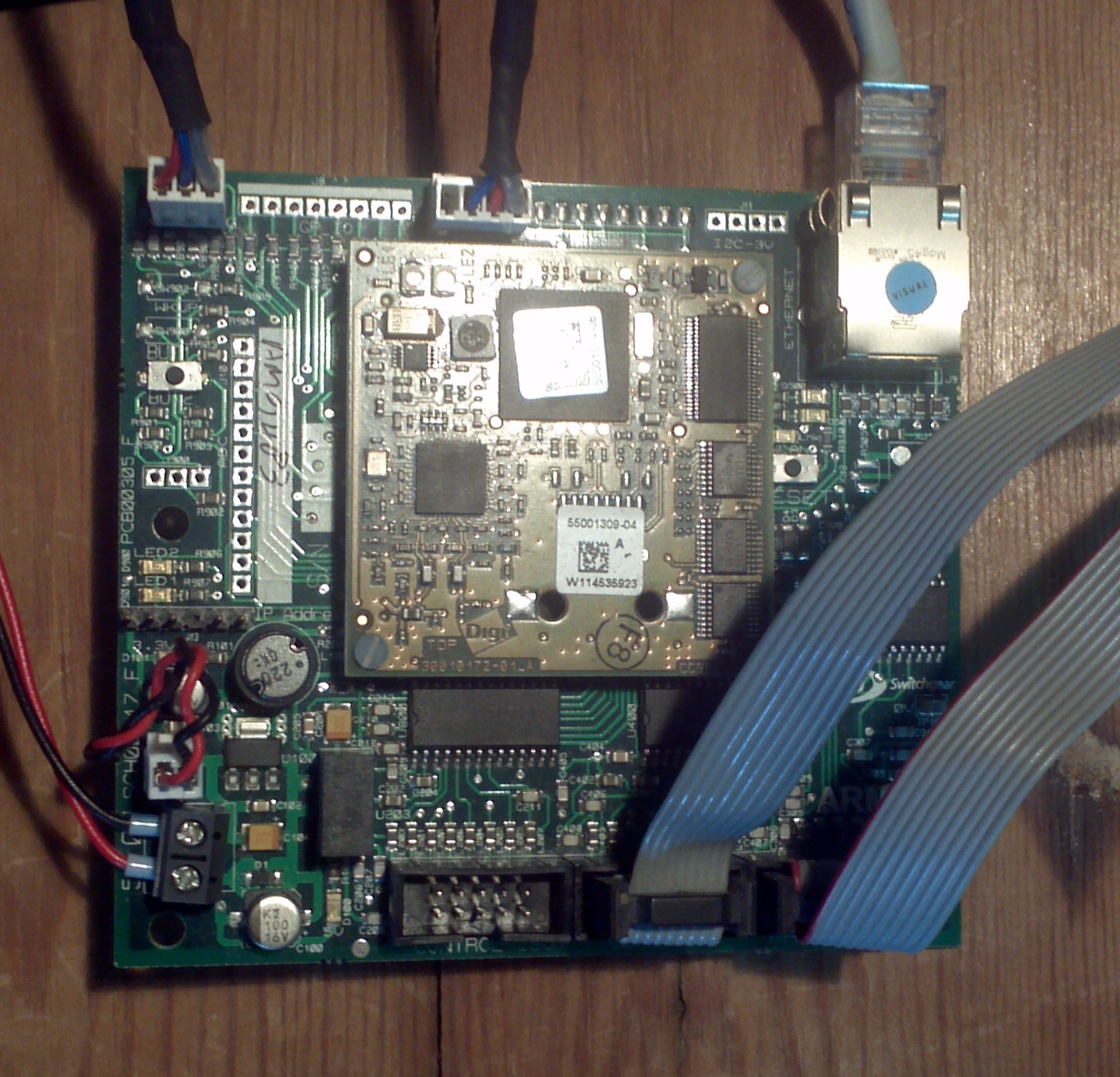
and here’s what the ARM powered CPU board on the inside looks like:

Gemini ARM CPU card

A Lucy Switchgear Gemini ARM CPU card, connected to the internet

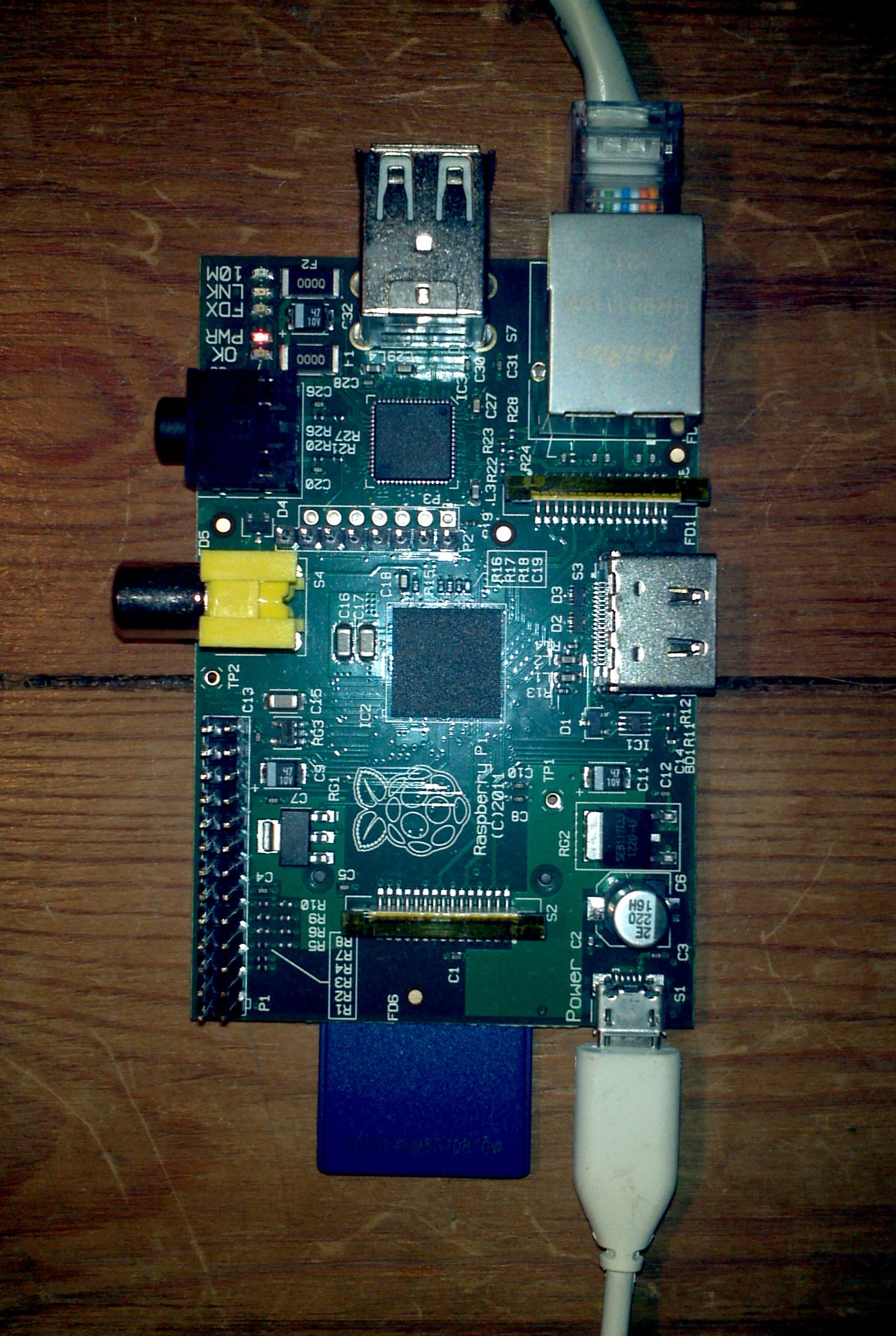
As you can see, in actual fact it’s not a whole lot different to a Raspberry Pi, or the guts of the average smartphone for that matter:

A Raspberry Pi model B, connected to the internet

A Raspberry Pi model B, connected to the internet

Hence such a piece of electronics wouldn’t in and of itself add a whole lot to the price of an electric vehicle and/or a garage in Dunchideock, or anywhere else on the planet for that matter.

In conclusion, I also cannot help but wonder how much the Great Dunchideock Blackout cost Western Power Distribution, how much the evidently changing climate in this part of the world is costing and will cost them, and how their electricity distribution network is coping with the assorted stresses and strains generated by all the renewable power sources currently being tacked onto it down here in not so Sunny South West England that do not currently have any form of energy storage associated with them.

UK Smart Grid Vision Lukewarm on V2G

Last week the United Kingdom’s Department of Energy & Climate Change published their new “Smart Grid Vision and Routemap“. According to DECC’s introduction to the document it:

Sets out the wide ranging benefits that smart grids will bring, for example: minimising consumer bills; allowing consumers to play a more active role in managing the energy system; increasing energy security; helping to facilitate the integration of low carbon technologies; and supporting economic growth.


Great Britain is already recognised as a European leader with respect to the investment in smart grid research and demonstration projects and has begun the nationwide rollout of smart meters, which will help improve network management and facilitate demand response. The Smart Grid Vision and Routemap outlines what action is now needed to build on this initial success to ensure the benefits are realised as soon as possible.

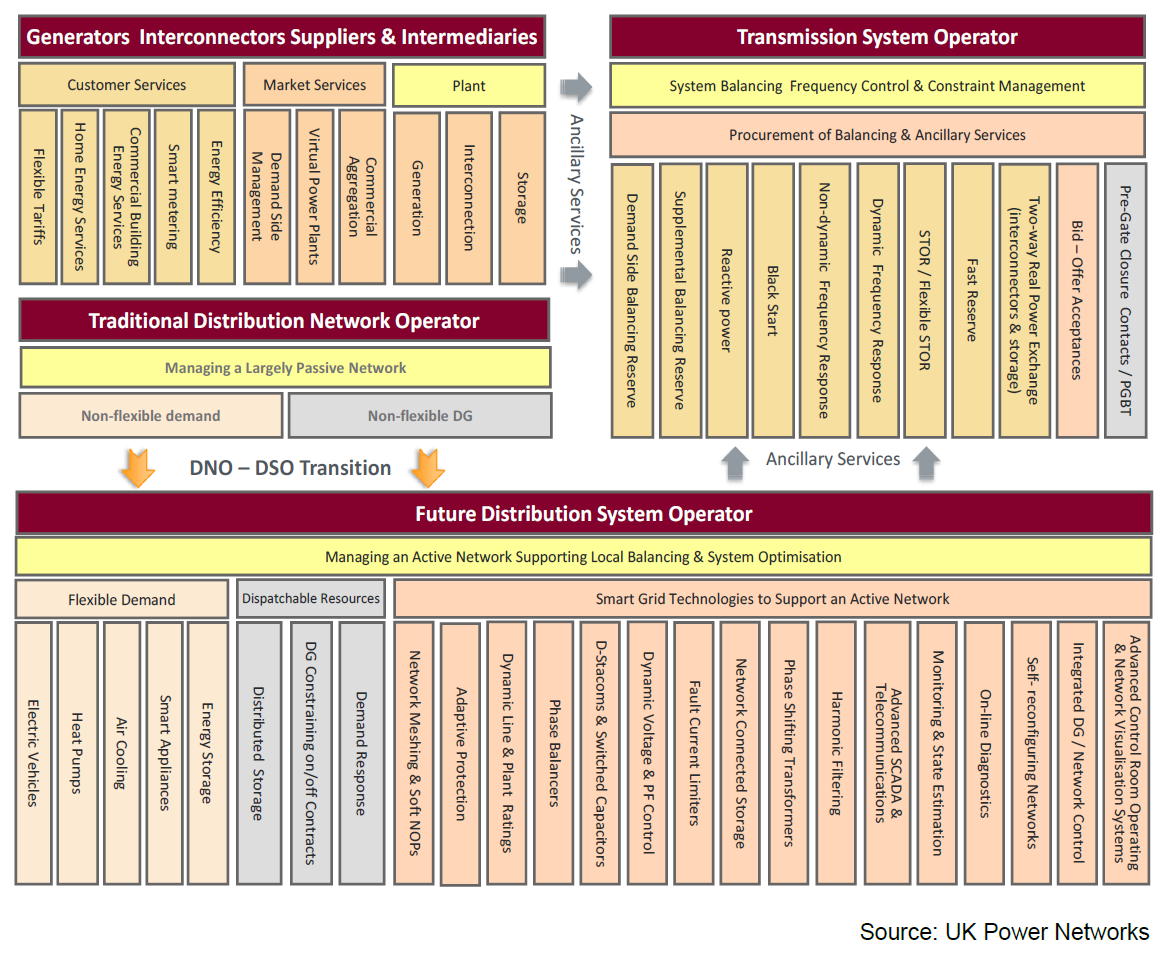
Delving into the routemap itself, I searched for any substantive reference to electric vehicles in general, or vehicle to grid technology in particular. Here’s what I managed to dig up. Firstly a diagram illustrating where EVs fit into the grand design of the future Great British Smart Grid:

February 2014 UK "Smart Grid Vision and Routemap" graphic

February 2014 UK "Smart Grid Vision and Routemap" graphic

Click on the image to see a larger version, where you will note it is anticipated that the “Traditional Distribution Network Operator, managing a largely passive network” will be transformed into a “Future Distribution System Operator, managing an active network supporting local balancing & system optimisation”. Electric vehicles are down in the extreme bottom left hand corner, under the heading of “Flexible Demand”, apparently totally separate from either “Energy Storage” or even “Distributed Storage”.

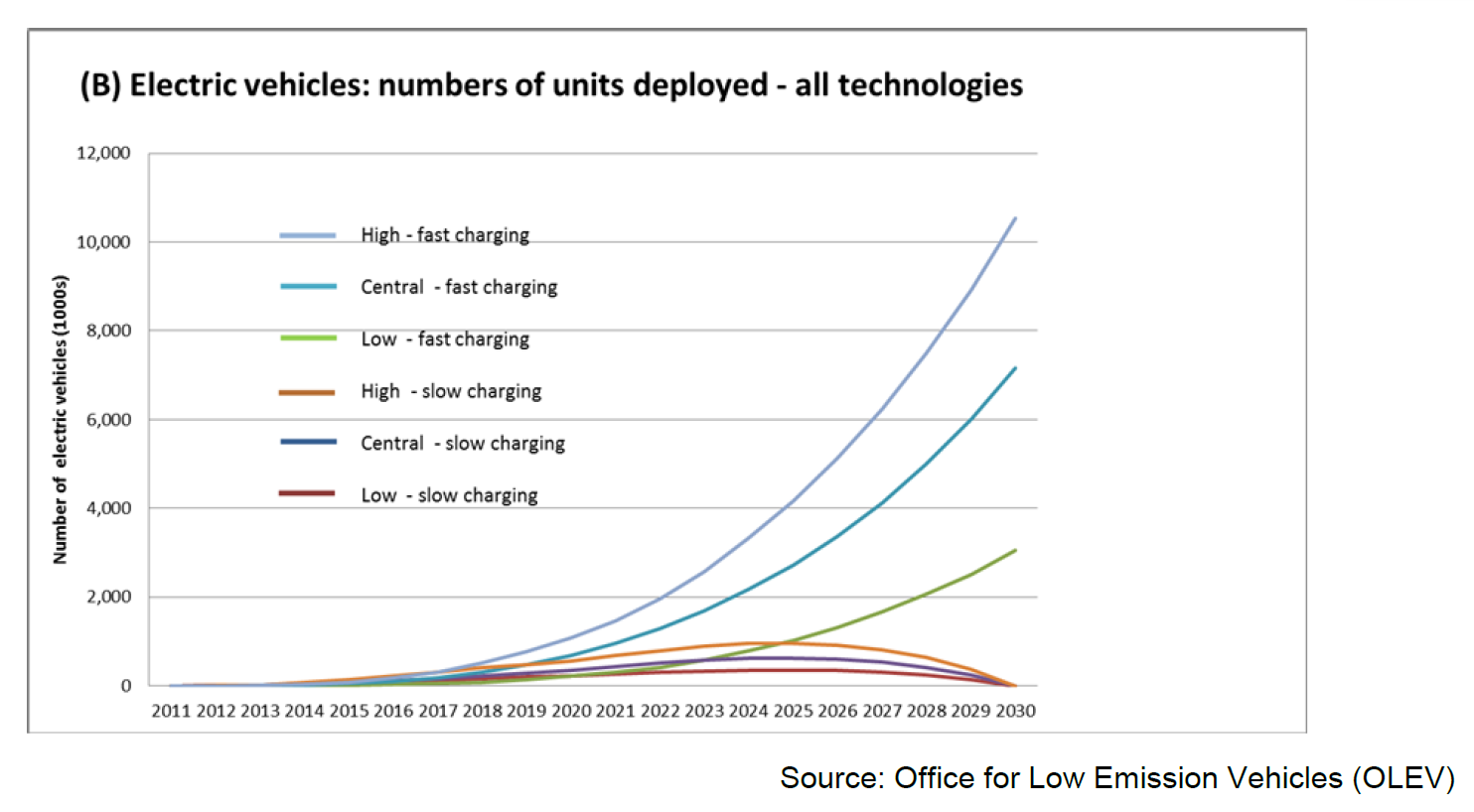
Secondly there is a forecast for the future growth in the number of EVs humming along the UK’s highways and byways, which looks like this:

February 2014 OLEV projection for number of electric vehicles deployed in the UK

February 2014 OLEV projection for number of electric vehicles deployed in the UK

The significant bullet points in the document that mention electric vehicles seem to think that an EV is much like a heat pump. A future British smart grid will:

  • Minimise consumer bills – more efficient use of network assets helps reduce the need to invest in costly infrastructure and ultimately reduces the costs passed through to consumer bills. It is estimated that by 2050, smart grids will reduce the cost of additional distribution reinforcement needed to accommodate the connection of low carbon technologies such as heat pumps, solar PV and electric vehicles by between £2.5bn and £12bn (a 20 to 30 per cent reduction)
  • Enable new low carbon technology to be deployed – heat pumps and electric vehicles will deliver significant carbon reductions, but will increase demand on the electricity network. Using smart grid technology to phase operating times, these devices can be incorporated into the network in conjunction with distributed generation to balance supply and demand, reducing the need for costly network reinforcement.

Finally there is a reference to another document, “Driving the future today – a strategy for ultra-low emission vehicles in the UK” from the Office for Low Emission Vehicles, which contains a few more bullet points about electric vehicles combined with smart grids:

  • The mass adoption of ULEVs will have significant implications for the energy sector at both a local and a national level. As the number of plug-in vehicles on our roads increases, so will the demand for electricity, placing additional pressures on the electricity system.
  • However, ULEVs can also help to balance the demand for electricity at peak periods and support the efficient use of energy by consumers. This will be facilitated by the introduction of intelligent power supply networks (smart grids) and the roll out of electricity smart meters across all domestic properties in the UK by 2020.
  • The majority of plug-in vehicle owners will charge their vehicles at home, at night time, during the off-peak period. This is not only most convenient for drivers, but also maximises the environmental and economic benefits of plug-in vehicles by using cheaper, lower carbon night-time electricity generation.
  • To help people charge at home as easily as possible, the Government is ensuring that smart metering in Great Britain includes the functionality to support charging of plug-in vehicles. This will allow recharging to happen when it is cheapest for consumers and the energy system (subject to appropriate technology in the chargepoint or plug-in vehicle).
  • Plug-in vehicles could also act as distributed energy storage during periods when renewable (or nuclear) electricity generation exceeds demand. This could happen during the life of the vehicle or as a potential end-of-life use for batteries. There may even be the potential for these vehicles to be used as an energy store, to power the house or feed electricity back to the grid at peak periods.

At long last a reference to something resembling V2G, or at the very least V2H! Moving on to page 71 of “Driving the future today” I finally found what I was searching for, an explicit (if somewhat grudging) reference to V2G technology. I reproduce it here in full:

Vehicle to home and vehicle to grid

As the smart grid and battery technologies develop, there may be the potential for plug-in vehicles to act as backup energy sources for homes and supplement the grid during peak demand periods. Nissan already offers a ‘power control system’ to its customers in Japan which allows their LEAF car to power a house for up to two days from its battery pack. Development of this technology was brought forward following the Fukushima nuclear reactor disaster.


There remain issues about the potential impact of taking charge from vehicles on battery life and the investment necessary to facilitate this on a large scale. However, Government will continue to talk to industry and researchers in this area and monitor developments.

Storage has the technical ability to provide a number of benefits to the electricity system – for example, smoothing supply profiles from variable generation and potentially reducing constraint costs by allowing generation to run during periods of low demand. It can also potentially save or defer network upgrade costs that may be required in the future to meet peak demand. Sixteen organisations have recently been awarded a share of £2 million by Government to help develop innovative storage solutions for energy. This funding is helping to drive forward innovation and encourage private sector investment.

The only trouble then is that none of those sixteen projects mention V2G or V2H, although both the the EVEREST project and Aston University’s Hybrid Batteries to Grid project refer to “‘Second Life’ EV batteries” but unfortunately not to EV batteries in situ. It rather sounds as though “Storage to Grid” (or S2G for short) is a more likely prospect here in the United Kingdom than fully fledged V2G.

Honda Joins Delaware Vehicle to Grid Project

Earlier this year we reported that the University of Delaware were running a pilot project in which a fleet of BMW Minis were actually earning money by providing a useful service to PJM Interconnection‘s electricity grid over the pond in North America.

Now comes news that Honda are taking part in the self same project. According to their press release:

Honda has joined a demonstration project for experimental vehicle-to-grid (V2G) technology aimed at providing a potentially valuable energy storage resource to the nation’s electrical grid while providing for more cost-effective ownership of plug-in electric vehicles.

The Honda technology builds off of the research conducted by the University of Delaware and now supported by NRG Energy, Inc.  NRG and the University of Delaware, through their eV2g joint venture, came online early in 2013 with the world’s first revenue-generating vehicle-to-grid project, demonstrating the controls, regulatory requirements, and market participation rules for selling energy storage from vehicles into the PJM Interconnection Regulation Market. Honda is supplying an Accord Plug-In Hybrid with added V2G capabilities to the University’s Science, Technology and Advanced Research (STAR) Campus to jointly investigate the potential of this technology to benefit the electrical grid, vehicle owners and society.

There were of course also a number of quotes from senior managers of the companies involved. Steven Center, vice president of the Environmental Business Development Office of American Honda Motor Co., Inc said that:

This technology has the potential to support both a cleaner and more efficient power grid and a more positive ownership experience for EV customers. With V2G technology, a network of PEVs becomes essentially a distributed energy storage system. It makes for an even stronger value equation for plug-in vehicles, with benefits for both the community and the vehicle user.

Willett Kempton, professor in the College of Earth, Ocean, and Environment and Research Director of the University of Delaware’s Center for Carbon-Free Power Integration said that:

The participation of global automakers like Honda will help demonstrate and refine the technology. The University of Delaware has been developing the technology so that vehicle batteries can be used not only for mobility but also for grid services.  It is a big step toward a future with widespread availability of the technology to have Honda join our demonstration with their V2G-capable car.

Finally Denise Wilson, NRG Executive Vice President and President, New Businesses said that:

As the U.S. adds more intermittent resources to the grid, finding a lower cost energy storage technology that also benefits electric vehicle drivers is a great opportunity. We see this demonstration by Honda as an important step in the development of vehicle to grid technology.

Much the same sort of sentiments apply here in the UK as we too “add more intermittent resources to the grid”. However I could not help but notice that once again nobody mentioned international standards!

Fort Carson Microgrid Adds Bidirectional Chargers

Burns & McDonnell say they are “a full-service engineering, architecture, construction, environmental and consulting solutions firm” and they have announced that:

A team of Burns & McDonnell engineers, along with subcontractor Coritech Services, has developed a system of bidirectional, fast-charging stations for a fleet of plug-in electric vehicles at Fort Carson, Colorado. This first-of-its-kind system will push power back to the base microgrid when needed to meet installation demand or improve overall power quality.

On Aug. 29, the team successfully commissioned five bidirectional chargers and the aggregating control system as part of the Smart Power Infrastructure Demonstration for Energy Reliability and Security (SPIDERS) microgrid project at Fort Carson. Commissioning was performed using both Boulder Electric Vehicle and Smith Electric trucks, which are being provided for use on SPIDERS under separate agreements with the U.S. Army’s Construction Engineering Research Laboratory (CERL) and Tank Automotive Research, Development and Engineering Center (TARDEC).

Commissioning of the vehicle charging stations represents an important milestone of the Fort Carson SPIDERS project, which is nearing completion. The project is managed by the U.S. Army Corps of Engineers (USACE), Omaha District, and includes technical guidance from CERL and TARDEC.

The bidirectional charging units are capable of providing up to 300 kilowatts (kW) of power to plug-in electric vehicles and also can discharge a like amount of stored energy from the vehicle batteries to the grid or microgrid via Society of Automotive Engineers (SAE) standard J1772-compliant bidirectional charging cables. The vehicle-to-grid (V2G) charging includes power factor correction, which is a growing concern at locations such as Fort Carson that are experiencing a growth in on-site solar power generation, resulting in utility rate penalties.

Here’s what a Smith Electric Vehicle looks like, both inside and out:

Europe’s PowerUp Project Releases V2G Conformance Testing Suite

Almost exactly a year since they first released their V2G interface specification the EU funded PowerUp project has now released a V2G interface conformance testing suite. According to the announcement on their web site:

The PowerUp project has published the TTCN-3 based implementation of the conformance test cases which it has developed for testing ISO/IEC 15118-2 protocol implementations, i.e. the V2G application protocol.

With this publication, a V2G standards compliance testing suite has been made available for the first time. The PowerUp team believes that this testing suite will prove to be valuable for the validation and maturing of V2G system implementations which incorporate the ISO/IEC 15118 standards.

Further extensions of this TTCN-3 suite, along with its incorporation into the ISO/IEC 15118-4 V2G testing standard are possible.

The conformance testing suite and associated documentation can be downloaded from the PowerUp web site.

In Delaware at Least, Electric Vehicles Earn Money From the Grid

Vehicle to grid technology is making money at last, and it’s mainstream news too. In a press release earlier today NRG Energy said that:

Joined by government and industry leaders, the University of Delaware and NRG Energy are celebrating an important milestone for its eV2g project today: becoming an official resource of PJM Interconnection and proving for the first time that electric vehicle-to-grid technology can sell electricity from electric vehicles (EVs) to the power grid.

Cameras were on hand to record those celebrations, and here is the resulting video:

According to NRG’s press release, Delaware Governor Jack Markell said that:

Moving innovative ideas out of the classroom and into the marketplace is critical to growing our economy. The partnership between NRG and University of Delaware perfectly illustrates the potential for research institutions to spur economic development

whilst NRG Executive Vice President Denise Wilson said that:

This demonstrates that EVs can provide both mobility and stationary power while helping making the grid more resilient and ultimately generating revenue for electric vehicle owners.

and University of Delaware President Patrick Harker said that:

I thank all of the industry and policy leaders who have come together around a project that incorporates clean transportation, stable energy and profitable sustainability. And I thank Prof. Willett Kempton and his fellow scientists for leading the way. It might be a few more years before a grid-integrated vehicle sits in every American driveway, but I’m excited to continue the journey.

Personally I suspect it might be a few more years before a grid-integrated vehicle sits in any American driveway, let alone in any British driveway. One of the reasons I say that is covered next in the press release. NRG briefly mention the raison d’être of V2G:

For grid operators, the technology serves as an innovative new approach to energy storage. It has the potential to balance the power provided by intermittent renewable resources such as wind and solar. Energy storage, such as large-scale batteries or those in a fleet of vehicles, can take the wind’s power generated at night and store it to use when demand is higher.

Whilst that potential may well exist, here’s the rub when it comes to reality. Michael J. Kormos, who is senior vice president of operations at PJM pointed out that:

PJM changed rules for participation in the regulation service market to decrease the minimum amount of power needed to participate and we implemented new rules that recognize and compensate faster, more accurately responding resources, such as batteries. We knew that by doing so would attract innovation and would find potential for energy storage or other technologies. We’re glad to be a part of this project and hope that this inspires continued innovation among our partners and others in the industry.

How many other “grid operators” like PJM, whether in the United States or over here in Europe, are going to be willing to change their rules and lower their thresholds for entry into wholesale electricity markets to include an EV sat in a driveway overnight, or even a fleet of 15 Mini EVs as in this project? If the answer turns out to be “none”, then who’s going to do the necessary aggregation and sit in the middle between the EVs in every driveway and the PJM’s of this world?

Be all that as it may, and no doubt having read the same press release as me, the New York Times put a slightly different spin on the story. They point out that:

The scale of this project, using 15 two-passenger Mini E models, donated by BMW, is indeed minuscule compared with the task of keeping the grid system that serves two-thirds of North America in balance, making sure that supply matches demand as precisely as possible.

and quote Michehl Gent, former president of the North American Electric Reliability Corporation (or NERC for short) as saying that:

The Delaware idea is tiny but promising. If we can get our electric vehicles to do more than just be electric vehicles, it will be very well received.

It would certainly be well received by your humble author, although at this juncture in history I cannot help but wonder which of all the currently competing international standards will ultimately ensure that all the electrical, mechanical and financial components of a future smart grid, produced by a plethora of international vendors, will all happily co-exist. There are still a long list of hurdles to be jumped before the realisation of Professor Kempton’s vision of:

[Seeing] the electric car and the wind machine as complementary tools for a low-carbon energy system.

is turned into electrical, mechanical and financial reality.