The 361 Energy Fair is back in Barnstaple on September 29th. The 2024 event starts at 10 AM in the Pannier Market with an introduction by Ian Roome, the newly elected Liberal Democrat MP for North Devon.
To give you a better idea of what to expect, here’s a video with extracts from previous 361 energy fairs:
For the first time this year’s fair includes a series of talks on a variety of topics. Our very own Jim Hunt will be giving a presentation on the topic of “An introduction to V2x, making greater use of EV batteries”, and the emphasis will be on vehicle-to-home and vehicle-to-building rather than fully fledged vehicle-to-grid.
I was fortunate enough to find myself on stage for two different panel sessions at the Everything Electric NORTH show in Harrogate last weekend. We recorded those two sessions in full for posterity, but there were plenty of other interesting topics apart from V2x. Some extracts from those can also be found below.
My first panel on Saturday was on the topic of “Vehicle to Everything? What’s the true potential?”, held in the EEN “Giga Theatre”. The tagline for the session was “We believe that V2X could be the biggest benefit of all in a world with battery electric vehicles, but how do we go ‘bidirectional’?”:
As you can see from the video below, I found myself sat next to Robert Llewellyn of Fully Charged fame as a last minute replacement for host Dan Caesar:
Mark Potter from 3ti explained the full suite of V2x three letter acronyms (TLAs for short).
In a press release yesterday Ford announced that the:
F-150 Lightning with available Ford Intelligent Backup Power can provide power and security during an electrical outage – the first electric truck in the U.S. to offer this capability; in the future, new features will offer additional ways to manage energy use and potentially save on energy costs.
Truck owners are used to tapping a variety of features – torque, towing capability and more – to get things done. Now, with the all-electric F-150® Lightning™ pickup, Ford is the first in the U.S. to offer the ability for customers to power their homes with an electric truck when the grid goes dark, providing innovative new capabilities that enhance the energy independence of its customers.
Ford and F-Series, America’s best-selling trucks for 45 years*, are partnering with Sunrun, the nation’s leading solar company, to enhance home energy management, leveraging the substantial onboard battery capability of the all-electric F-150 Lightning. Americans experienced the most power interruptions on record in 2020, according to the U.S. Energy Information Administration; and with F-150 Lightning, homeowners can use their truck to maintain their routines during brief or extended outages.
The press release was accompanied by this video:
https://youtu.be/oc3sQ2UcTlg
As the narrator puts it:
What if the next time the power went out, your pickup truck could electrify your home
A very good question! Which we here at V2G UK have been pondering for many a year.
Note that the narrator also points out that:
You’ll need a Ford Charge Station Pro, which comes with an F-150 Lightning Extended Range truck, and an available home integration system….
Siemens Smart Infrastructure announced it has worked with Ford on the Ford Charge Station Pro, a custom electric vehicle (EV) charger for the Ford F-150 Lightning. This innovative charger is the first bidirectional-ready EV solution set for release at retail customer scale to receive certification under the newly expanded Underwriters Laboratories (UL) 9741, an important industry-wide benchmark that ensures products meet safety standards. The new charge station also features a peak power of 19.2kW, achieving the maximum power rating currently available for a Level 2 charge station.
The Ford Charge Station Pro is needed to enable Ford Intelligent Backup Power, a system that allows the Ford-150 Lightning to become an interactive part of the home and be used as a power generation source during outages, the first electric truck to do so. In the future, additional features will be made available with firmware updates to the charger that will help customers interact even further with the grid.
“Together with Ford, Siemens is not only helping accelerate electric vehicle adoption in the residential space but is also empowering drivers to take more ownership of their energy future,” said John DeBoer, head of Siemens eMobility in North America. “The technology behind this charger is helping make charging at home more sustainable, more reliable, and more accessible. We’re incredibly proud to put our experience to work to help usher in a new era for electric vehicles and grid resiliency.”
Ford Charge Station Pro comes with the F-150 Lightning with extended-range battery. If your F-150 Lightning has a standard-range battery, it is available for purchase:
Price: $1,310.00 (plus shipping and installation)
As far as I can see there are no details available on the “home integration system” mentioned above.
P.S. It has come to our attention that at least one purveyor of EV “news” is peddling inaccurate information. Hence:
“On the ordering page of Ford’s website they have an inaccurate picture.”
Earlier this year I was on a couple of panel sessions on the topic of V2x technology at the Everything Electric NORTH event in Harrogate. Whilst there I took a look at the F-150 Lightning on show in the exhibition hall. Until now I have remained blissfully unaware that Everything Electric’s Robert Llewellyn recorded this exceedingly interesting interview with Ford CEO Jim Farley at the end of the previous year’s Fully Charged LIVE show in Harrogate:
Note in particular the part at 15:20 where Jim says:
The F-150, the main reason why people are buying the F-150, more than half the customers are new to a full size truck, is because it can power their house for 3 days. We didn’t know that a mobile battery on a work site was going to be that evocative as a reason to buy a vehicle. We thought it was going to be 0-60 4 seconds. We were wrong. So the exportable power turns out to be the main reason people are excited about the Lightning.
The press release is in Dutch, so I’m relying on Google Translate somewhat for this article! There is no explicit mention of V2x technology, but let’s read between the lines:
Hyundai and mobility provider We Drive Solar announced on April 13th a strategic partnership to provide housing projects with the energy system of the future.
I don’t know about you, but I’m getting a hint of vehicle-to-building already. Moving on:
Hyundai is well on its way to becoming a top 3 manufacturer of zero-emission vehicles worldwide, with a specific focus on 100% electric propulsion. By 2040, Hyundai aims to have its global car line-up fully electrified, aiming for a market share of 8 to 10 percent of the global EV market.
In addition to a leading role in electric driving, Hyundai also wants to accelerate the transition to sustainable mobility and optimally unburden customers with the help of innovative services, fully in line with the brand’s Progress for Humanity philosophy. In that context, Hyundai is expanding its e-mobility activities in the Netherlands significantly this year. Hyundai recently announced its partnership with Jedlix, the market leader in smart charging. Starting today, Hyundai is adding a new chapter in accelerating sustainable mobility by announcing its partnership with We Drive Solar.
Smart charging, sometimes referred to as V1G, is part of the equation but what about smart discharging? The press release continues:
FLATLINE, an industry led research project aiming to demonstrate the viability of a demand-side approach to energy management at domestic level, has reached a major milestone as residents move into three pilot homes at The Mill site in Cardiff.
Backed by the Department of Business, Energy & Industrial Strategy, the ‘Fixed Level Affordable Tariffs Led by Intelligently Networked Energy’ (FLATLINE) project aims to significantly reduce residents’ energy bills, using a combination of domestic Demand Side Response and demand shifting for both heat and electricity.
The specially built pilot homes at The Mill development site in Cardiff will be closely followed by a further 46 homes at a separate site, Parc Eirin in Tonyrefail – which will see first residents move in this autumn as the first phase of the 225 new home scheme is complete.
Every Sero Home is built ready for future generations, and that includes the future of travel.
Our homes are built with three phase electricity – the “broadband” of power – and electric vehicle (EV) fast charging points. You can recharge your car at a Sero Home in less than four hours, compared to around twelve hours in a traditional home (or about three days on a 13amp plug).
Sero Homes’ class-leading recharging times are only useful if you can afford the car in the first place. To tackle this, on most of our sites we offer our residents an option to take an EV lease with inclusive miles bundled in.
It’s probably no coincidence that today Robert Llewellyn announced a new edition of his Fully Charged Show. An introduction to the “Affordable Eco Housing” at The Mill and Parc Eirin:
We previously got quite excited about the Great British ARRIVAL electric (not diesel!) van. At that time there were some snarky comments on social media to the effect that “The van never moves in that video”. Well now it most certainly does! Take a look at the latest episode of Robert Llewellyn’s Fully Charged:
Of course we eagerly awaited some mention of our favourite three letter acronym – “V2G”. Unlike the recent launch of the new Ariya eSUV from Nissan, we were not disappointed by this update on the progress at ARRIVAL. Notice that at 4:00 into the video Robert Llewellyn asks:
Are these vehicles, for instance, vehicle-to-grid capable. Bi-directional charging is possible?
to which Patrick Bion, ARRIVAL’s head of product replies:
Absolutely!
Which is very good to hear from our admittedly biased perspective. A bit later on, at 7:30, Robert says:
I can see they have rapid charging capabilities, they have CCS charge sockets.
and Patrick confirms:
Yeah, that’s right.
Putting those two snippets of information together and you get the magic words “V2G [over] CCS”!
Here’s our take on this convoluted story from our Twitter feed:
How quickly can we get one of these in our car park for interoperability testing?https://t.co/XXXZELe86e
and here’s our (hopefully ARRIVAL compatible!) bi-directional charging station, which has been patiently waiting for an ARRIVAL van’s arrival in our more modest car park since this time last year:
Here too is a video of our “soft launch” during the V2G panel session at the Fully Charged Live show at Silverstone in 2019:
Watch this space!
For another year? Or perhaps even until 2025 as officially pronounced by CharIN not so very long ago?
In a press release earlier this week Nissan announced that it had:
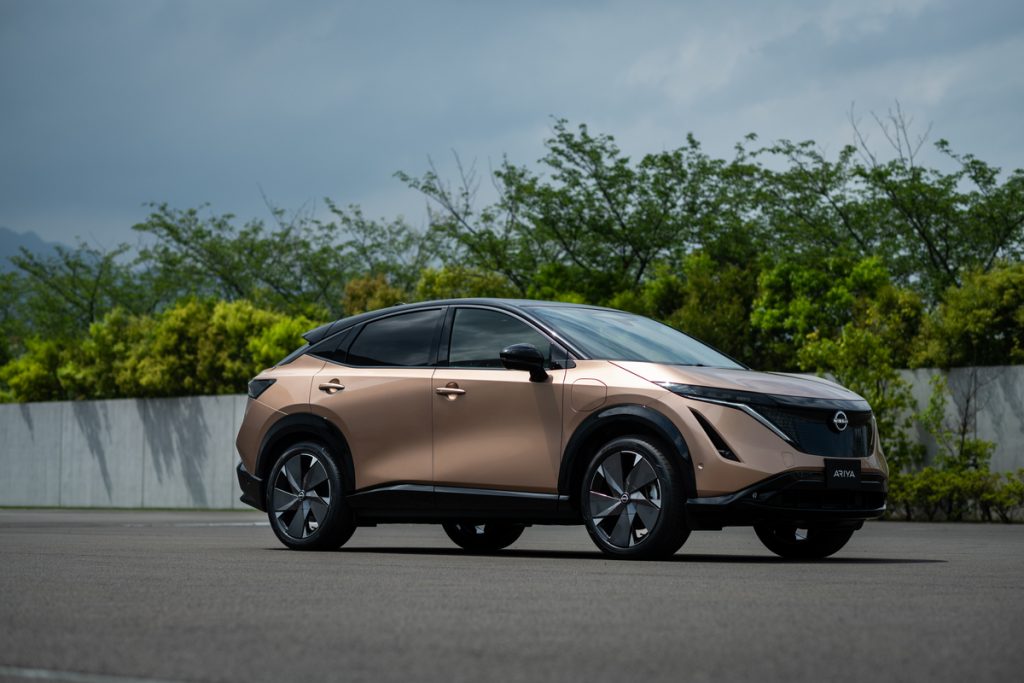
Revealed to the world the all-new Nissan Ariya electric coupé crossover, marking a new chapter for Nissan electric vehicles. The EV premiered globally through a virtual event hosted at the soon-to-open Nissan Pavilion in Yokohama.
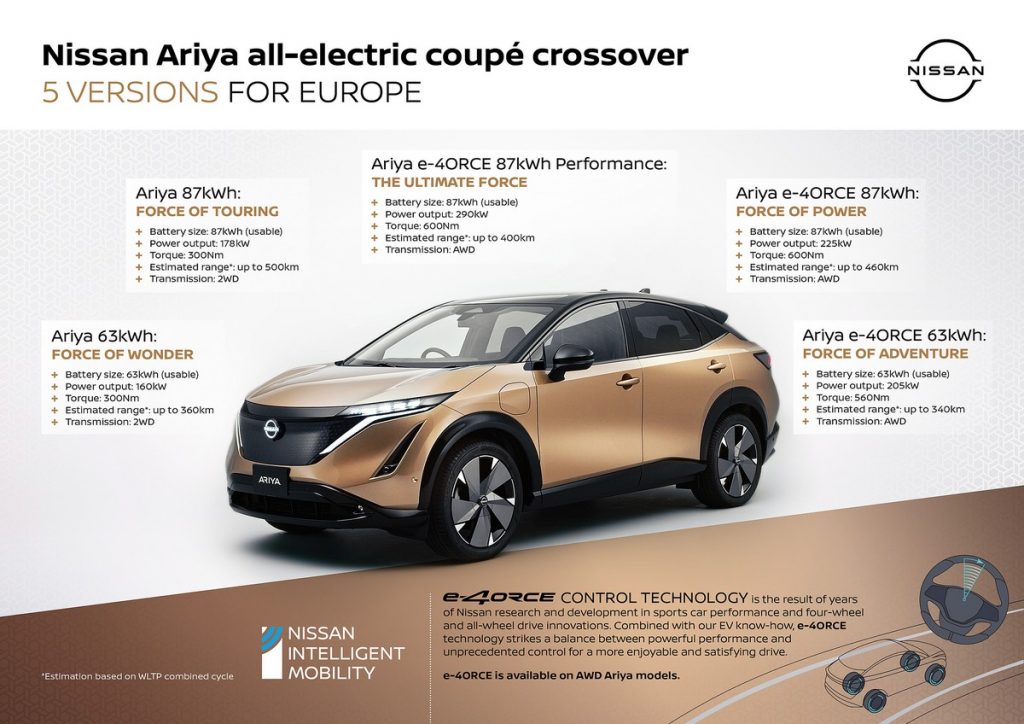
The Ariya – Nissan’s first all-electric coupé crossover– offers powerful acceleration and smooth, quiet operation, as well as an interior with a welcoming, luxurious lounge-like atmosphere. Its stress-free autonomous driving features, voice personal assistance and seamless connectivity heighten on-road confidence and provides a welcoming environment for the driver and passengers. And with an estimated range of up to 500 kilometers (based on WLTP combined cycle, subject to homologation), Ariya is the perfect partner for daily commutes and road trips alike.
The Nissan Ariya is heavily based on the similarly-named concept vehicle displayed at the 2019 Tokyo Motor Show and first hinted at with the IMx at the 2017 Tokyo Motor Show. It’s the first production model to represent Nissan’s new electrified brand identity, forging a path toward a new automotive era where electrification, optimized platform packaging and seamless vehicle AI technology will become standard.
A bit of a change from the venerable LEAF then, with a dual motor 4 wheel drive option accompanying the “new electrified brand identity”, which does reduce the range somewhat:
As you can see from Nissan’s Ariya infographic, the LEAF’s dual AC/DC charging connector has moved from front and centre to the nearside front wing. Nissan haven’t provided an image of what’s hiding under the cover, but the press release does mention in passing that:
Today we are finally able to bring you exciting news of a large vehicle-to-grid installation in the Netherlands, with some unusual twists apart from the sheer number of charging stations.
In a thankfully English language article in PlaceTech it was reported earlier this week that:
Edge has delivered an office building for Triodos Bank in the Netherlands engineered to be sustainable inside and out with the latest circular construction principles designed throughout. The 135,000 sq ft office in Driebergen-Zeist, Netherlands was built with the intention to harmonise with the surrounding fauna and flora, on a construction level and beyond.
Please bear in mind that the article is referring to EDGE Technologies which is part of Dutch developer OVG Real Estate, and not the U2 guitarist!
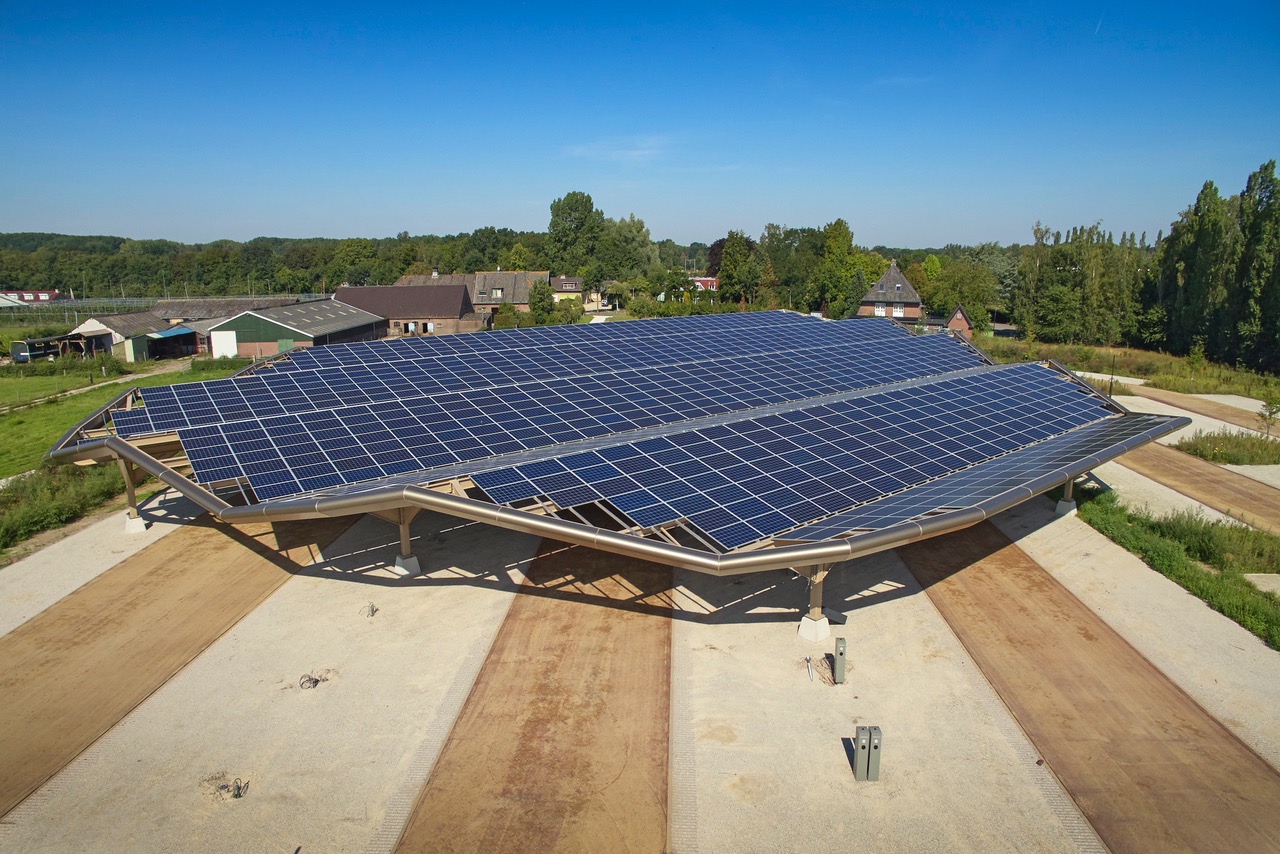
After further description of the office building itself the article eventually gets to the part of the project of most interest to us. The solar PV covered car park:
The extensive use of renewable energy, reflected in over 3,000 m² of solar panels, as well as heat and cold storage, contributes to the energy neutrality of the building. The project encompasses ‘smart charging’ electric cars from solar energy and ‘Vehicle2grid’ technology. Vehicle2grid means that the cars cannot only be charged with solar energy but also discharged, which is called bi-directional charging. The cars become an active part of a ‘smart net’, which includes such benefits as being able to store solar energy.
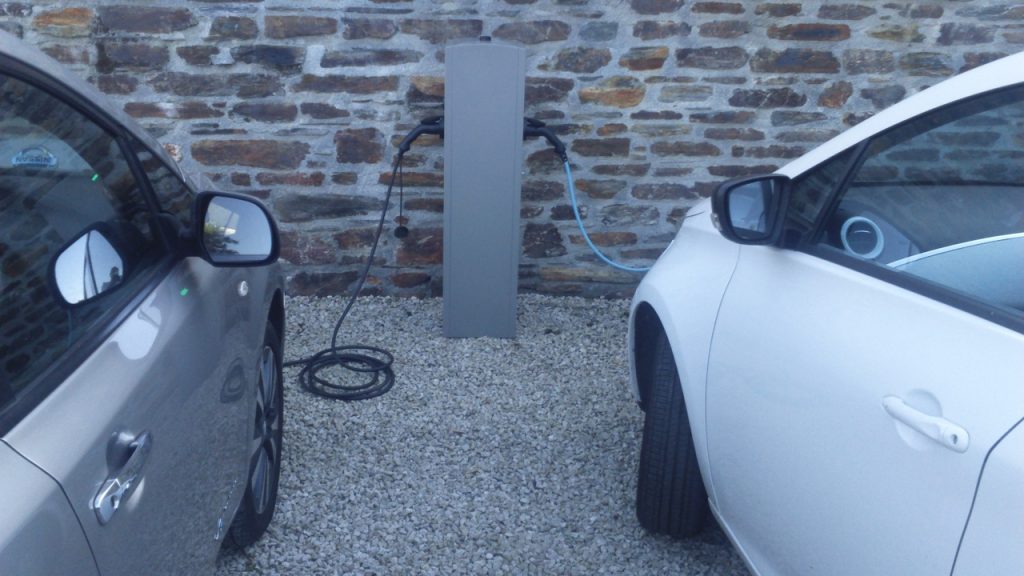
The PlaceTech article doesn’t go into any more detail than that but we certainly intend to, not least because the aerial view of the solar PV canopy reveals a number of electric vehicle charging stations that look identical to the one we have installed in our “wall to wall” V2G “living lab”:
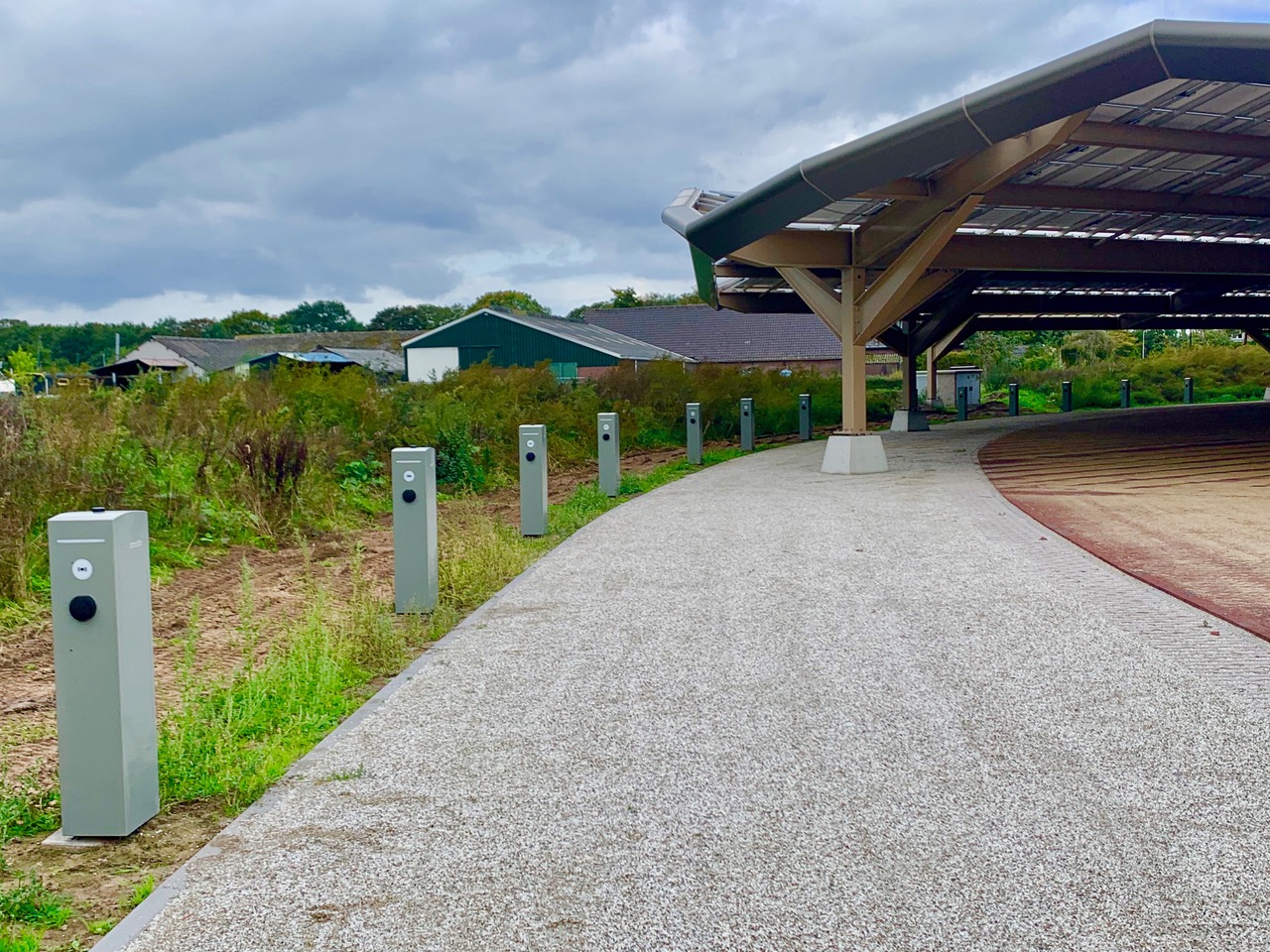
Taking a look at the new Triodos car park from ground level it becomes apparent that a large array of AC V2G capable charging stations are currently being installed, both under and around the solar PV canopy:
To find out more about what’s going on we’ve had to resort to Google Translate. According to a Dutch language article on the Triodos Bank web site from earlier this year:
The largest bidirectional charging plaza in the world is under construction at the new office building of Triodos Bank next to Driebergen-Zeist station. From this Autumn, 120 smart chargers will be able to store solar energy in the batteries of shared electric cars.
Triodos Bank have realised the project in close collaboration with developer EDGE Technologies and We Drive Solar. The bidirectional chargers are directly connected to 3,253 m² of solar panels and have a triple function. Electric cars can charge here. Cars whose battery is full enough can also supply power, so that the energy can be used in the office building or be fed back into the electricity grid.
Part of the plan is that Triodos Bank will replace its pool cars with 100% electric cars, so that they become part of the bidirectional charging ecosystem. Triodos Bank will investigate how, in addition to Triodos Bank employees, the residents of Zeist and the surrounding area can also use its shared electric cars. According to Triodos Bank director Matthijs Bierman “The plan fits in with our new ambitions in the field of sustainable mobility. We want to make car sharing as sustainable and attractive as possible. Not only for our employees, but also for the local community.”
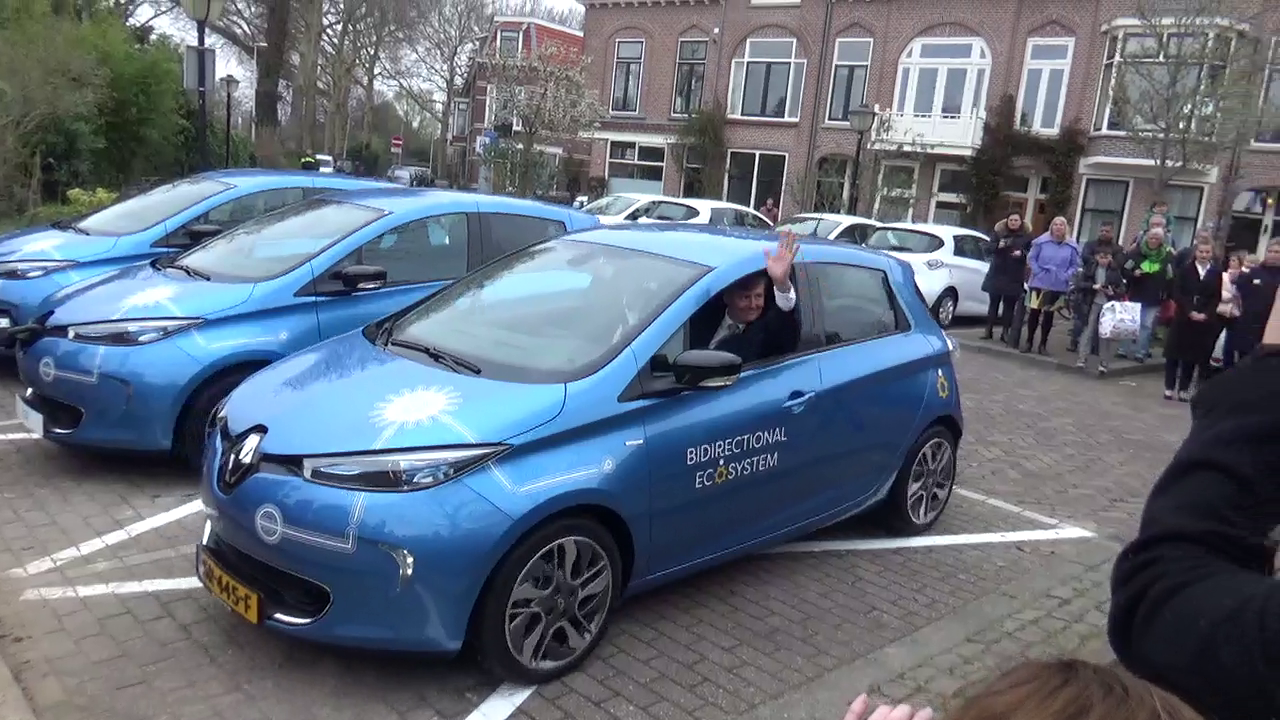
Now 120 AC V2G charging stations sounds amazing, but where are 120 or more AC V2G capable electric cars going to come from? I can help answer that question, since I attended the launch of the We Drive Solar bi-directional ecosystem in Utrecht earlier this year. According to Renault:
A fleet of fifteen Zoe vehicles with vehicle-to-grid charging will be introduced in Europe over the course of 2019 to develop our future offerings in reversible charging and lay the groundwork for the future standards —with our partners’ help. These pilot schemes will begin today in Utrecht (the Netherlands) in an ecosystem developed by We Drive Solar and on Porto Santo Island (in the archipelago of Madeira, Portugal) with Empresa de Electricidade da Madeira, an energy supplier. Following these, more pilot schemes will be introduced in France, Germany, Switzerland, Sweden and Denmark.
So that explains 15 prototype AC V2G capable Renault ZOE’s across Europe in 2019, but that’s a lot less than 120 in the Triodos car park! As far as I am aware Renault have not announced when V2G enabled ZOEs will go into production, but when ultimately they do Triodos Bank will be ready! In the meantime I’m sure that plenty of “smart charging” will be going on in Driebergen-Zeist and across the Netherlands
All in all the project sounds a lot like a combination of our “Camelford Electric Car Club” and “Static and Mobile Distributed Energy Storage” projects, albeit on a much grander scale! That probably explains this remark by Robin Berg of We Drive Solar to Bobby Llewellyn at the recent Fully Charged LIVE event at Silverstone in the summer?
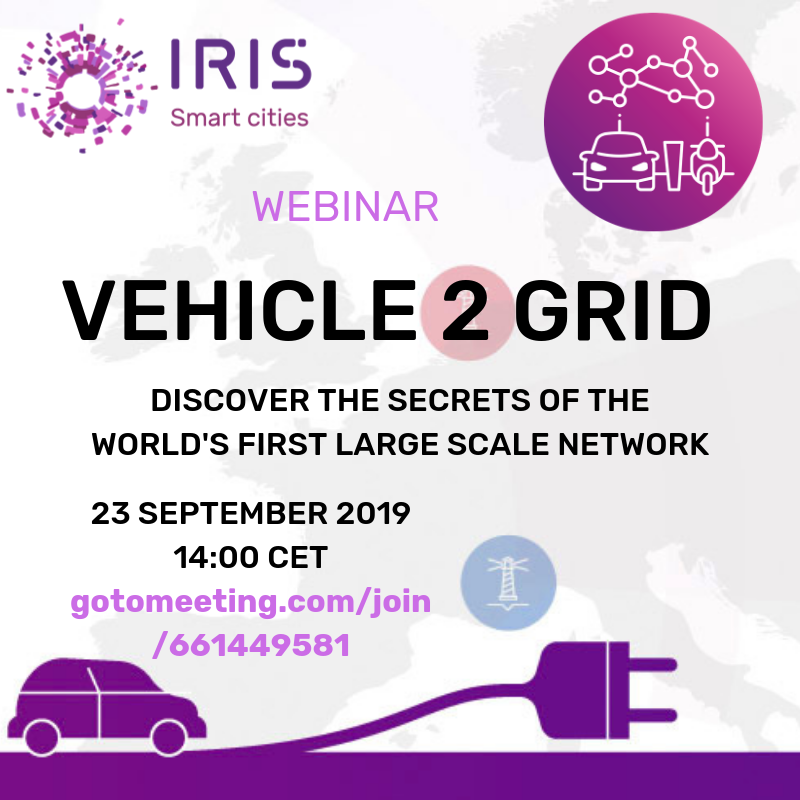
If you want to discover more about the We Drive Solar bi-directional ecosystem then please feel free to attend this webinar on September 23rd at 13:00 British Summer Time:
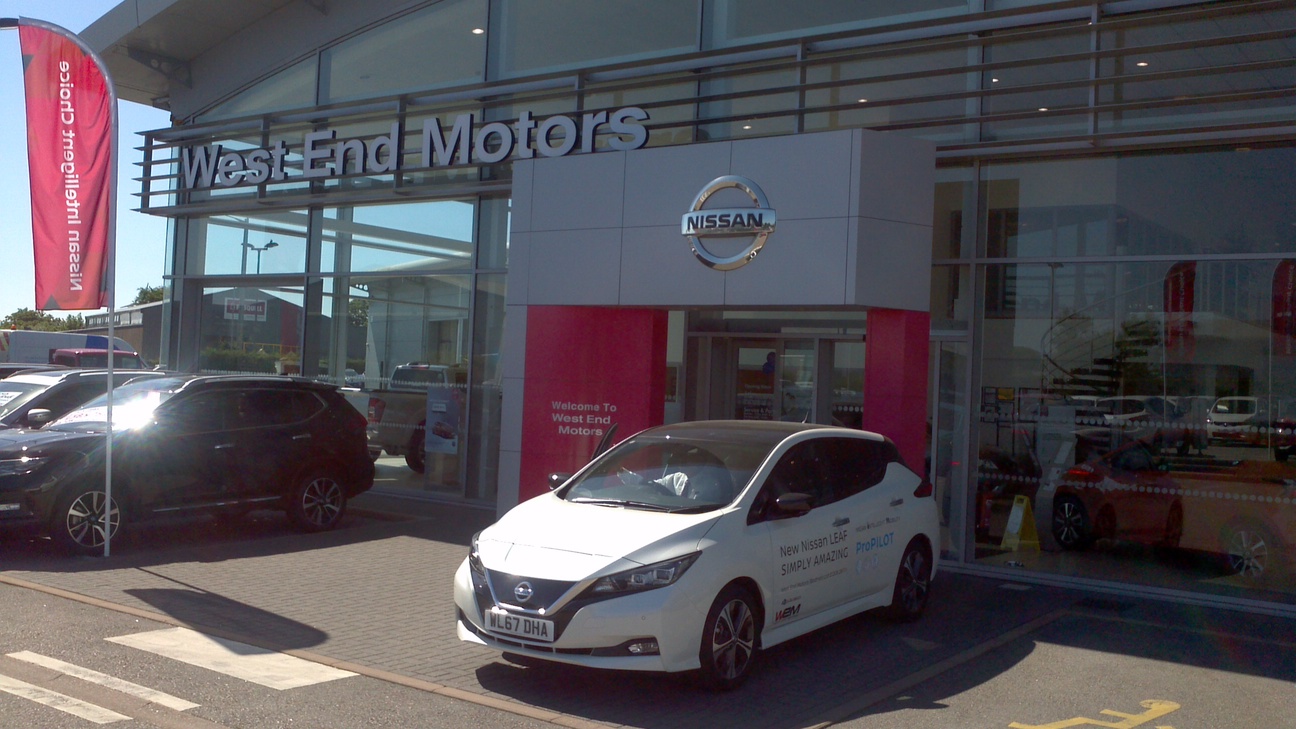
Here at V2G UK we’ve finally managed to complete an extended test drive of the 2018 model Nissan LEAF 2.0! We’d booked a 2 day test a couple of months ago, but had to cry off thanks to yours truly suffering a dose of the “man flu”. This time around my health held up and we picked up our two tone LEAF from West End Motors just down the A30 from here in Bodmin:
Our test drive was timed to coincide with the Welsh Government’s Connected and Autonomous Vehicles briefing in Cardiff. More on that in due course, but amongst many other things we wanted to discover if there was any truth to the so called “#RapidGate” rumours flying around on Twitter and elsewhere. If that is double Dutch to you then please watch this explanation of the term from the inimitable Bobby Llewellyn:
When the “kerfuffle” started Nissan issued the following “news release” on Twitter:
Hi, thanks for your tweet. Before launch, the 40 kWh Nissan LEAF went through rigorous testing procedures where development vehicles were driven in numerous European countries for more than 100,000 kms. 1/3
We found LEAF performed well in a range of both rapid and standard charging scenarios and was firmly in line with our expectations. We are aware of two isolated cases where customers have experienced issues with a public rapid charging unit. 2/3
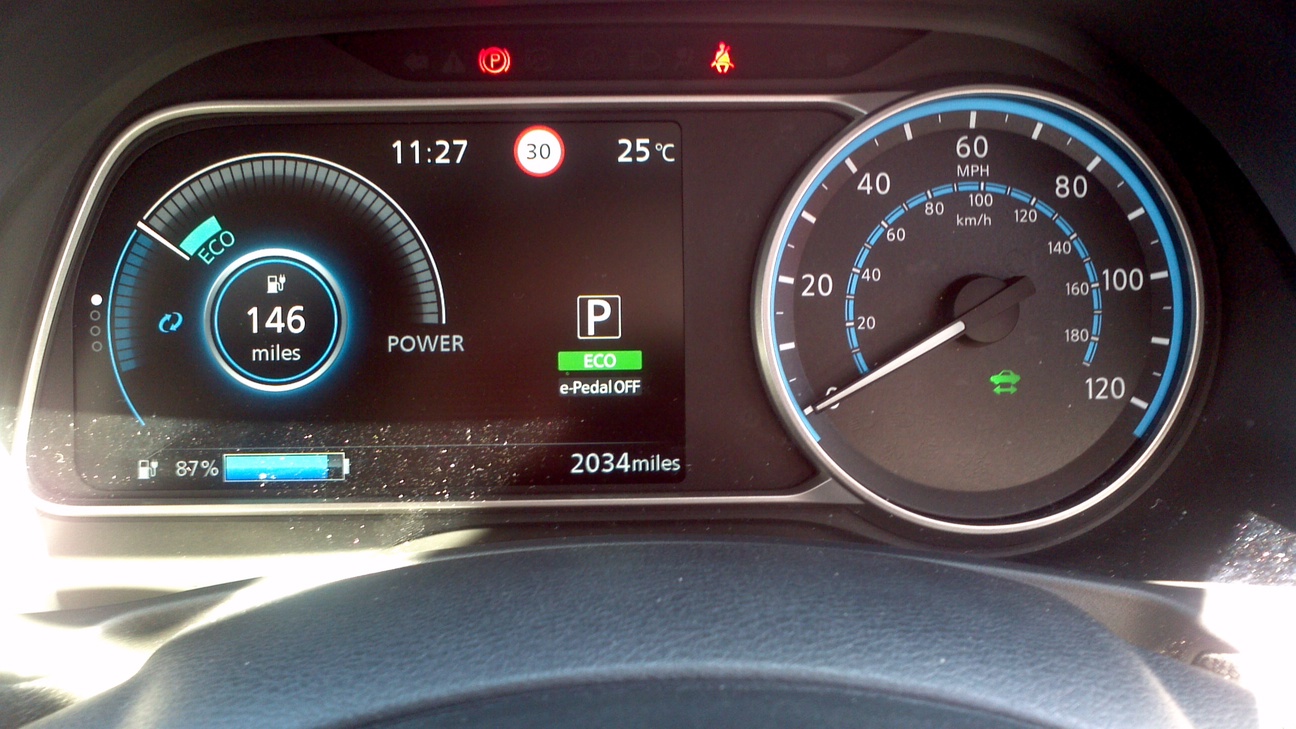
During our trip we intended to do a lot of motorway driving at 70 mph, including a cross country trip to visit Platinum Nissan in Trowbridge. Much more on proPILOT in due course as well, but we set off up the A30 from Bodmin and engaged Nissan’s by now somewhat autonomous version of “cruise control” with a target speed of 70 mph:
We still had some juice left in “the tank” by the time we reached Taunton Deane Services. According to the LEAF’s clock a distance of 90 miles:
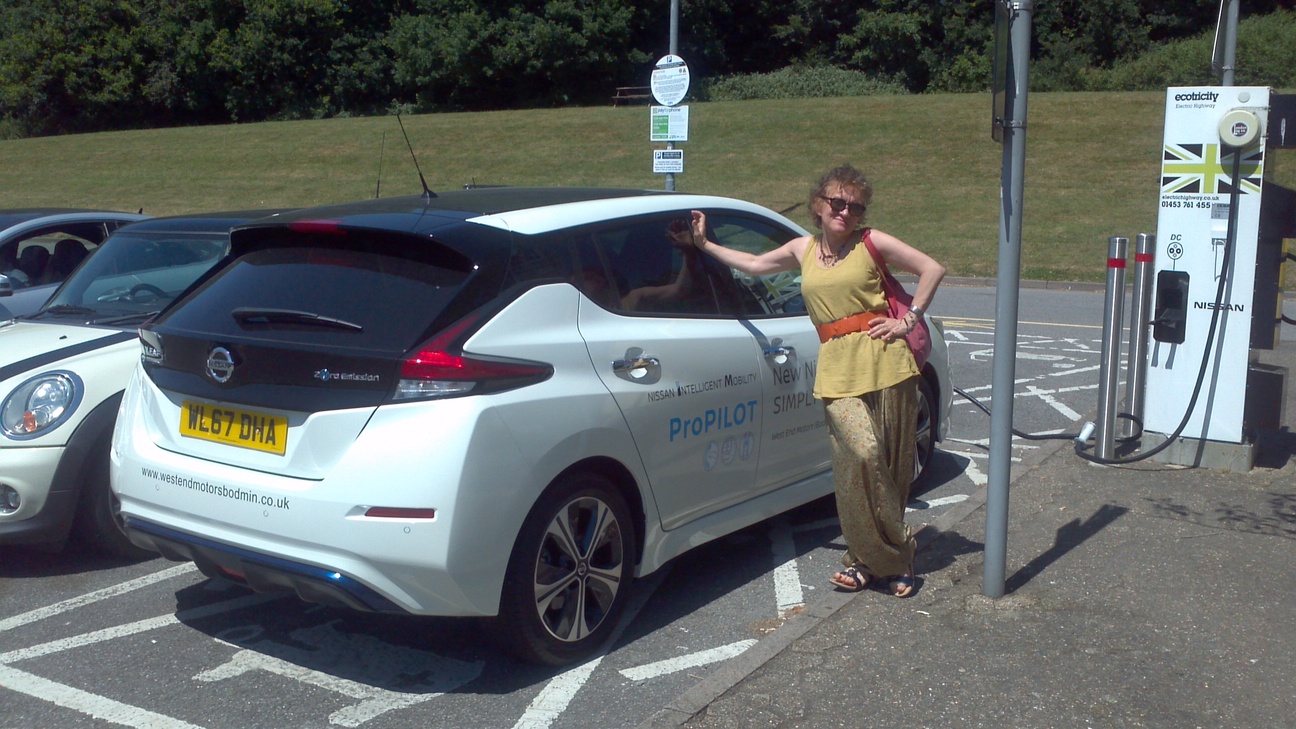
Before heading cross country we plugged in to the Ecotricity charging station:
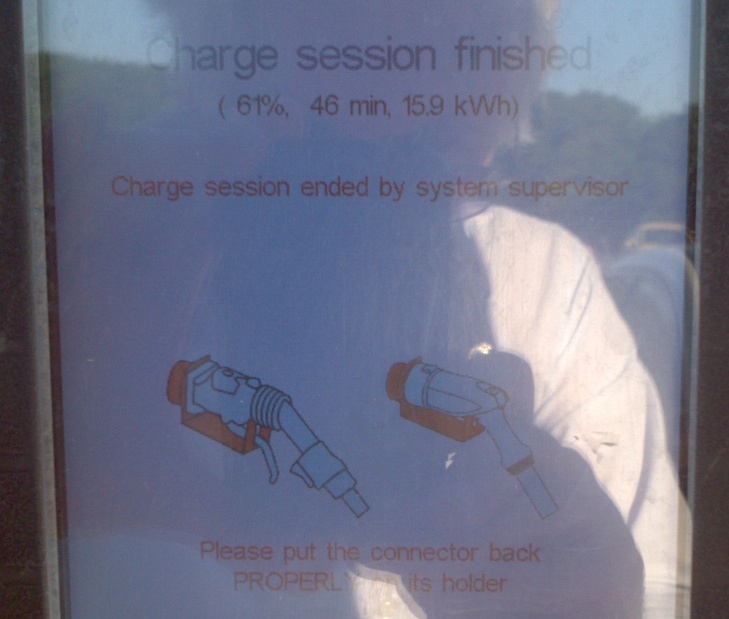
Having set things in motion we grabbed some lunch, then returned to discover this:
We certainly weren’t “fully charged”, and 25.2 kWh over 48 minutes is rather less than the advertised 50 kW rapid charging. We called Platinum to inform them we’d be arriving late, and enquired whether they had a “rapid” charger. They haven’t!
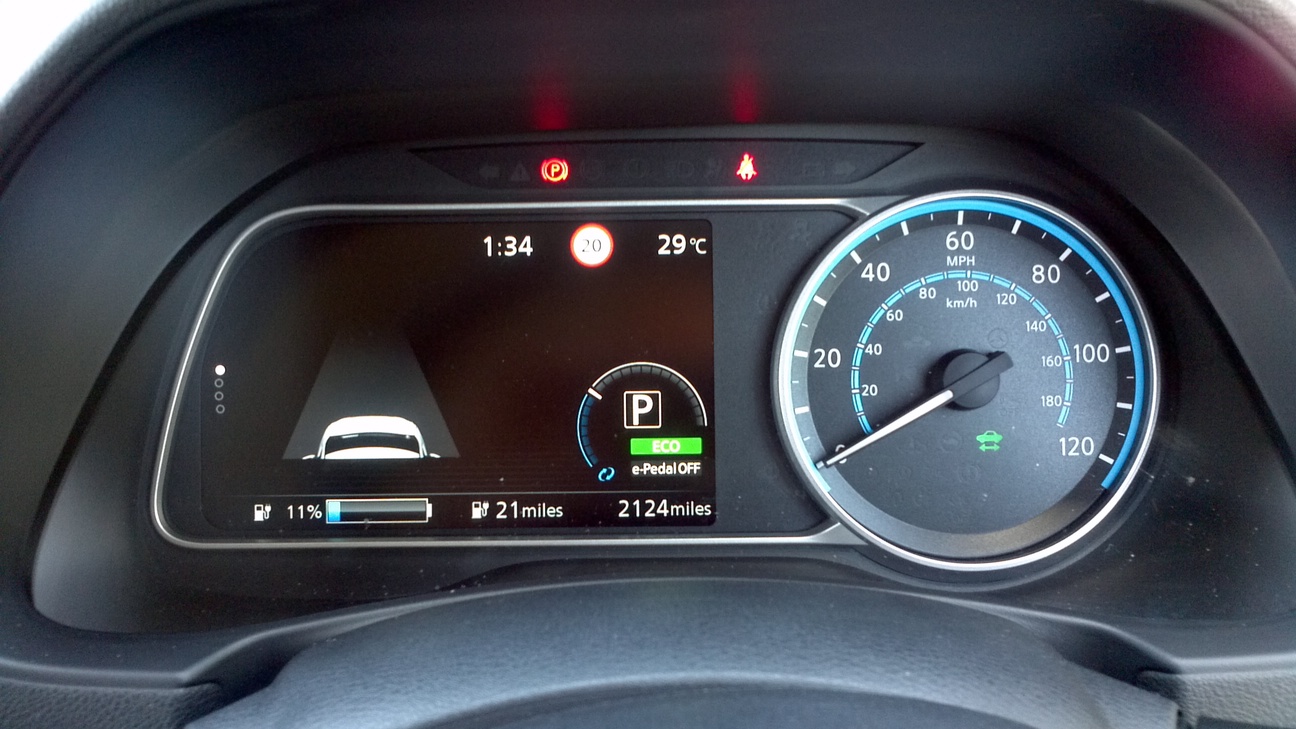
The LEAF’s satellite navigation system directed us to Trowbridge via the A303, and we followed its instructions. Certainly not the shortest route, but arguably the quickest? Once at Platinum we plugged in quickly and topped up “slowly”. Discretion being the better part of valour we departed an hour or so later and headed for Leigh Delamere Services for what we hoped would be a “rapid” charge. We were sadly disappointed:
Our own experience suggests that the #RapidGate rumours are not without foundation, and what is more the issue is not confined to the third “rapid” charging session of the day and beyond.