Nissan Unveil Solar PV Integrated Static xStorage for UK

In two separate press releases there have been two interesting announcements from Nissan on the ex EV battery storage front. In the first there’s a football connection!

Nissan, power management leader Eaton and The Mobility House today signed a ground-breaking 10-year deal with Amsterdam ArenA – home of Ajax Football Club and world-famous entertainment venue – to provide back-up power from second life Nissan LEAF batteries.

The xStorage Buildings system efficiently stores and distributes energy when it’s needed, ensuring that the lights never go out at the renowned 55,000-seater stadium, which has played host to numerous high profile concerts and sporting events over the years.

By repurposing batteries from previously used electric vehicles, the xStorage Buildings system can draw energy from the grid, providing businesses with more control, better value and a more sustainable choice for their energy consumption.

Using 280 Nissan LEAF batteries, the system designed for the Amsterdam ArenA will be the largest energy storage system powered by second-life batteries used by a commercial business in Europe and will have four Megawatts of power and four Megawatts (sic) of storage capacity.

As well as providing vital back-up power services to the ArenA, xStorage Buildings also enables the Amsterdam ArenA to power the surrounding neighbourhood when necessary and protect the grid.

We’ll excuse Nissan PR the misprint because they’ve provided this nice video accompaniment to their announcement, which doesn’t make the same mistake:

In the second announcement it is revealed that:

Nissan and power management leader Eaton are broadening their portfolio of xStorage Home residential energy storage solutions by introducing a range of six product configurations, giving consumers greater choice to meet their energy needs. This announcement comes as pre-orders of xStorage Home begin today in the United Kingdom, Norway and Germany with other European markets to follow in the coming months.

The xStorage Home system can draw energy from the sun or from the grid, making energy consumption more affordable and encouraging home-owners to make a more sustainable choice. The cutting-edge technology in the xStorage Home system is also fit for the future, and can enable customers to sell energy back to the grid – an opportunity that is expected to be offered by energy companies in the future.

The system gives consumers greater control over how and when they use energy in their own homes enabling them to avoid expensive tariff periods. The expanded range will offer consumers greater choice over power capacity and price as well as units. Consumers can opt to purchase units powered by either second life batteries or new batteries.
xStorage Home units – which provide a sustainable second life for Nissan’s electric vehicle (EV) batteries after their first life in cars is over – will be priced competitively starting at €3,500 (excluding VAT and installation costs) for a power capacity of 3.5kW rising to just €3,900 for 6kW. Units powered by new Nissan batteries will start from €5,000 rising to €5,580 for the highest capacity and will come with an extended warranty period of ten years.

Connected to a residential power supply and/or renewable energy sources such as solar panels, the unit has the potential to revolutionise the way people manage energy usage in their own home, providing added flexibility.

xStorage Home comes with solar panel inverters already integrated meaning that if a home is equipped with solar panels, the consumer can connect directly to xStorage Home, storing and then powering their homes using clean, renewable energy. It can also save customers money on their utility bills by charging up when renewable energy is available or cheaper, and releasing that stored energy when demand and costs are high.

The xStorage Home unit also has the capability to provide energy back to the grid in countries where the conditions enable customers to do so. This provides another potential revenue stream as customers will be able to sell stored energy back to the grid when demand and costs are high.

The system also provides the ultimate back-up energy solution to consumers, ideal at a time when energy grids are coming under significant strain. With smartphone connectivity, it allows consumers to switch between energy sources at the touch of a button.

I wonder if Eaton have solved all the Great British G83 issues yet, and whether they will incorporate V2H functionality into their xStorage offering? I also cannot help but wonder how many Great British Pounds that €3,500 will translate to by the time UK deliveries eventually commence?
Nissan Installs V2G Chargers in the UK

There’s some extremely interesting news in my inbox this morning! According to a Nissan press release:

Nissan has announced today that its UK-based European R&D facility, Nissan Technical Centre Europe (NTCE) has become the first Nissan entity in the company’s network of European facilities to install vehicle-to-grid technology.

That does rather suggest that Nissan’s previously announced V2G equipped French regional office has yet to materialise. The press release continues:

Developed by Nissan in partnership with multinational energy provider Enel, eight V2G chargers have been installed at the site and will be available for all NTCE employees to use. The V2G chargers work with Nissan’s electric vehicles (EVs) to provide an intelligent energy management system capable of both charging the vehicles and allowing the cars to give stored energy from the vehicle’s battery back to the grid to help stabilise demand.

The move marks an important step in the company’s plans to make its Intelligent Mobility vision a reality in Europe. The integration of V2G technology brings to life Nissan’s Intelligent Mobility vision, demonstrating how zero-emission vehicles such as the 100 percent electric Nissan Leaf and e-NV200 and energy management technologies can work in tandem to create a cleaner, more efficient energy network.

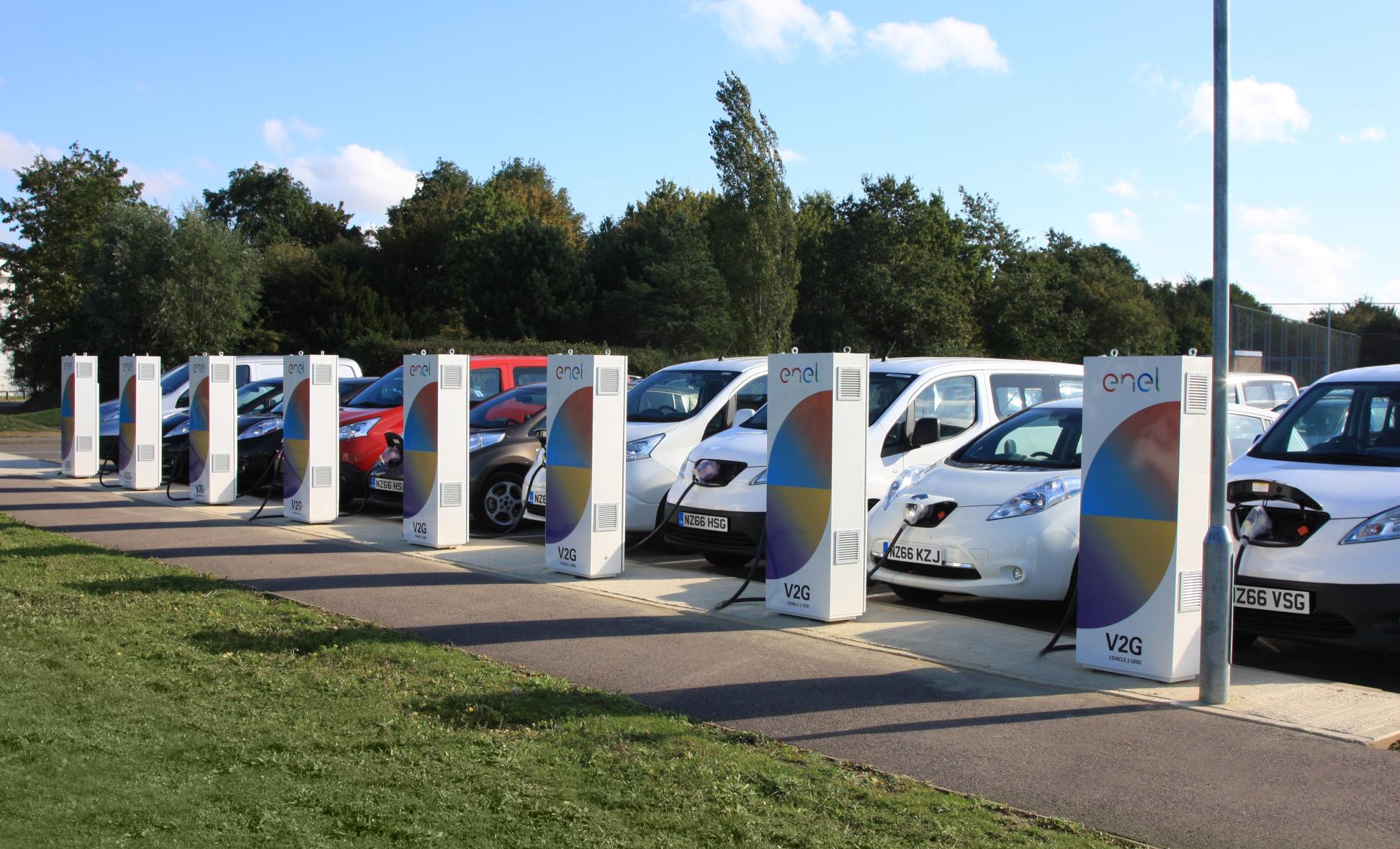
Here’s a view of Nissan’s V2G equipped Cranfield car park:

There’s an interesting addendum as well, that I’d previously missed:

Today’s news follows the announcement in August that Nissan and Enel secured their first commercial V2G customer in Europe. Enel has installed ten V2G units at the headquarters of Danish utility company, Frederiksberg Forsyning, making it the first business to commercially integrate and host the V2G units.

Nissan, Enel and National Grid Announce UK V2G Trial

Things seem to be looking up for vehicle-to-grid technology here in the United Kingdom! In a press release Nissan have just announced that:

Automotive industry leader Nissan and multinational power company Enel, today confirmed plans to launch a major vehicle-to-grid (V2G) trial – the first ever carried out in the UK. The trial will work by installing and connecting one hundred V2G units at locations agreed by private and fleet owners of the Nissan LEAF and e-NV200 electric van. By giving Nissan electric vehicle owners the ability to plug their vehicles into the V2G system, owners will have the flexibility and power to sell stored energy from their vehicle battery back to the National Grid.

Technical details of the trial are however conspicuous only by their absence from the announcement. I for one would love to know exactly how “sell[ing] stored energy from [a] vehicle battery back to the National Grid” is going to work in practice. The press release continues:

Today’s announcement heralds an exciting era for energy management in the UK. Not only will Nissan electric vehicle owners be able to play an active role in grid stability, providing an alternate source of income, but it will revolutionise how energy is supplied to the grid. Once scaled up, the V2G technology can become a game-changer for owners of Nissan EV in the UK as they become fully fledged and active participants in the UK energy market.

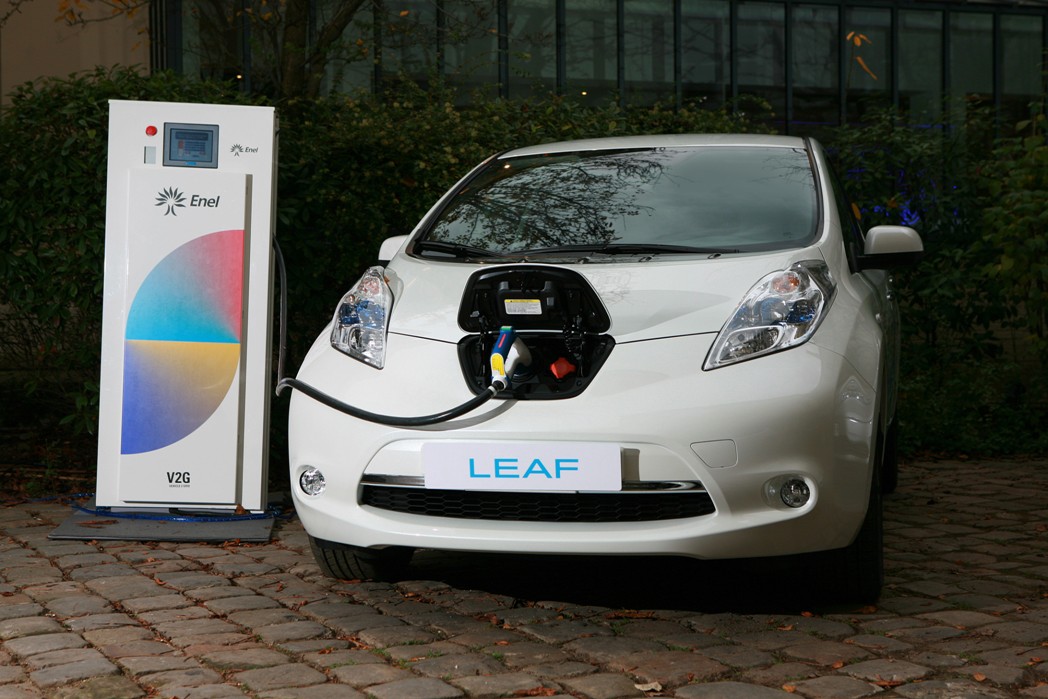
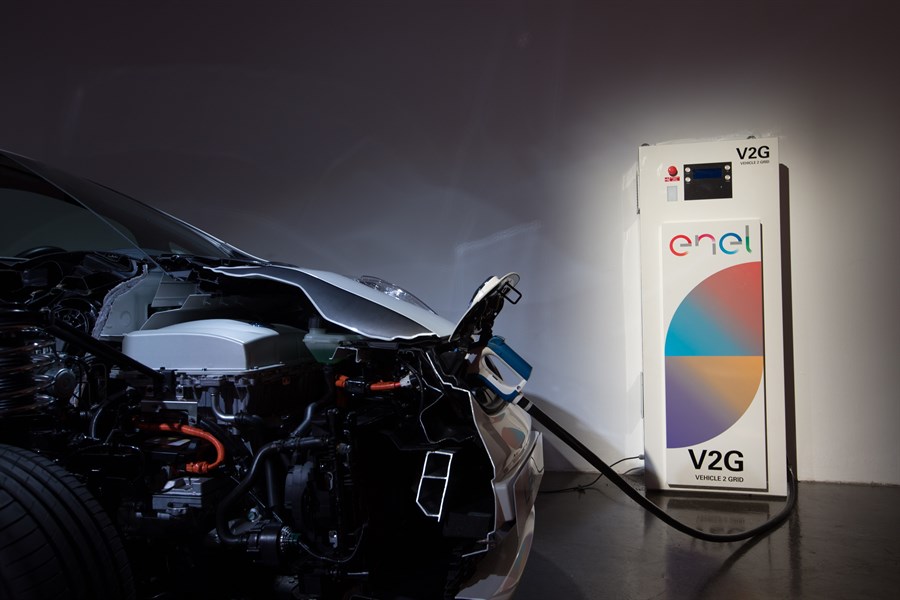
Personally I’d love to be the owner of an electric vehicle that is a “fully fledged and active participant in the UK energy market” but I don’t foresee that happening any time soon. I cannot help but wonder what Nissan UK and National Grid know that I don’t? Whilst I wait to find out the answer to that particular UK energy market conundrum, here’s a publicity picture of the associated hardware:

Perhaps the most pertinent comment in the announcement comes from Steven Holliday, the former CEO of National Grid plc, who points out that:

At National Grid we are constantly looking to the future to ensure we have the capacity to meet national energy demand – it’s our job to future proof the national transmission network.

The rapid uptake of Electric Vehicles is certainly positive yet could also be challenging if we don’t plan ahead to understand precisely what effect this new technology will have on the electricity system. Our Future Energy team predict that there could be up to 700,000 Electric Vehicles in 2020 requiring an extra 500MW of energy. That’s why we support innovative technologies and pioneering projects such as this one that have the potential to make a real difference to the way we manage energy supply and demand.

The press release concludes:

Today’s announcement follows the signing of a partnership agreement between Nissan and Enel in Paris in December 2015 during the 21st UN Conference on Climate Change (COP21) to trial V2G technology in Europe. A trial comprising 40 V2G units began in Denmark in January 2016.

I wonder if any Nissan LEAF owners are already active participants in the Danish energy market?

Nissan Electric Vehicles Prove Popular at UK Universities

In a news release today Nissan UK point out that:

The all-electric Nissan e-NV200 van has graduated with flying colours to become one of the most popular new vehicle choices for university fleets in the UK.

The multi award-winning van, which costs from just two pence per mile to run and offers zero emissions mobility whilst driving, is now in service on the fleets at more than 20 of the nation’s leading academic institutions.

University of Birmingham was the first fleet operator in the country to take delivery of the model when it added two to its fleet in 2014.

Since then, the University has added four more and the e-NV200 has moved to the top of the of the list for universities and colleges the length and breadth of the UK.

e-NV200s are now in service at universities including Bath, Brighton, Coventry, Dundee, Edinburgh, Exeter, Leicester, Leeds, Manchester, Manchester Metropolitan, Newcastle, Oxford, Sheffield, St Andrews, Swansea, the University of Central Lancashire and the University of Wales.

In addition, a number of other universities across the UK are currently trialling the e-NV200 as they explore the environmental and financial benefits it could have for their fleets.

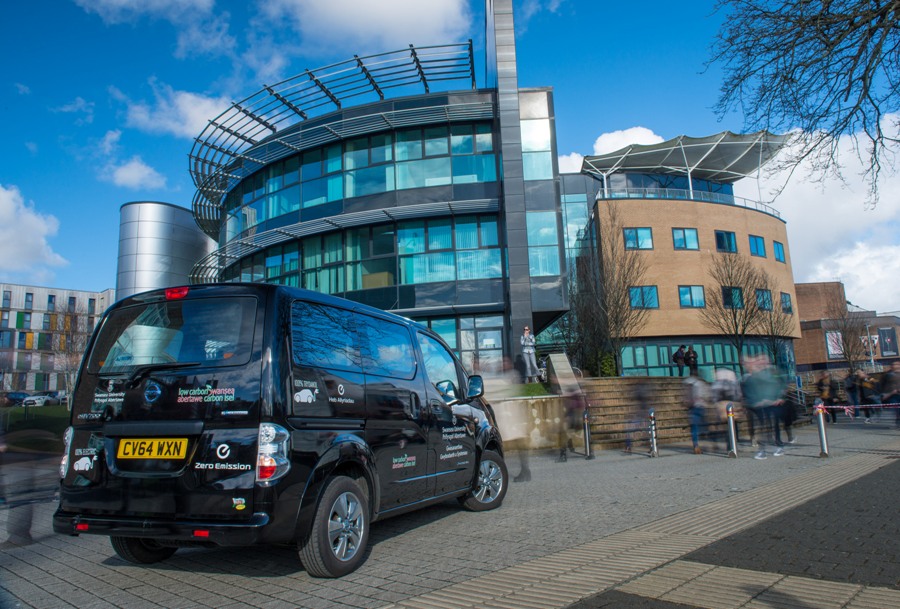
Many moons ago I lived in Mayals and I’ve studied at Swansea University:

Nissan point out that in Swansea:

The e-NV200 Combi has been introduced as part of a broader commitment to sustainability and is operated as a pool vehicle, available on a booking system, by the information services and systems team.

As part of a seven-strong EV fleet, which also includes four Nissan LEAFs, the e-NV200 has proved a popular choice thanks to its size, flexibility and car-like driving dynamics.

Nigel Morris from the information services and systems team at Swansea University said:
 “Our EV fleet has already been a big success, cutting our carbon emissions by 4.5 metric tons and saving around several thousand pounds in fuel so far.

“The e-NV200 has made a terrific contribution to those figures as it’s proved so popular with staff. It’s a big vehicle that’s got lots of space for cargo or people but it’s very easy to drive.”

This news is all very encouraging of course, but I cannot help but wonder about something Nissan didn’t reveal to us this morning. Which of their long list of UK universities might actively be researching the application of vehicle-to-building or even fully fledged vehicle-to grid technology?

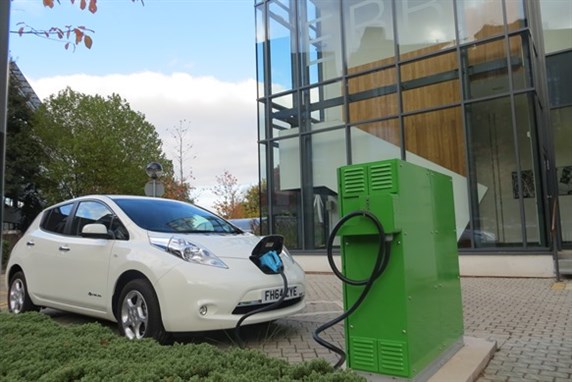
Perhaps the answer is “none of them”, but I am able to reveal that a UK University not mentioned by Nissan is in fact already so doing. Here’s an exterior view of the European Bioenergy Research Institute (EBRI for short) at Aston University:

and here’s what EBRI’s press release from a month or more ago has to say about the bright green box attached to the 24 kWh battery equipped 2014 model year Nissan LEAF pictured above:

Aston University has successfully commissioned the UK’s first permanent electric vehicle to grid (V2G) charging system.

This next generation of electric vehicle charging infrastructure allows power to flow both in the traditional way (grid to vehicle) and in reverse (vehicle to grid). The technology, developed in Japan to improve electricity supply reliability in the wake of the Fukushima disaster, is being investigated in collaboration with our leading industry partners, as a new method for energy storage and grid balancing services in Europe.

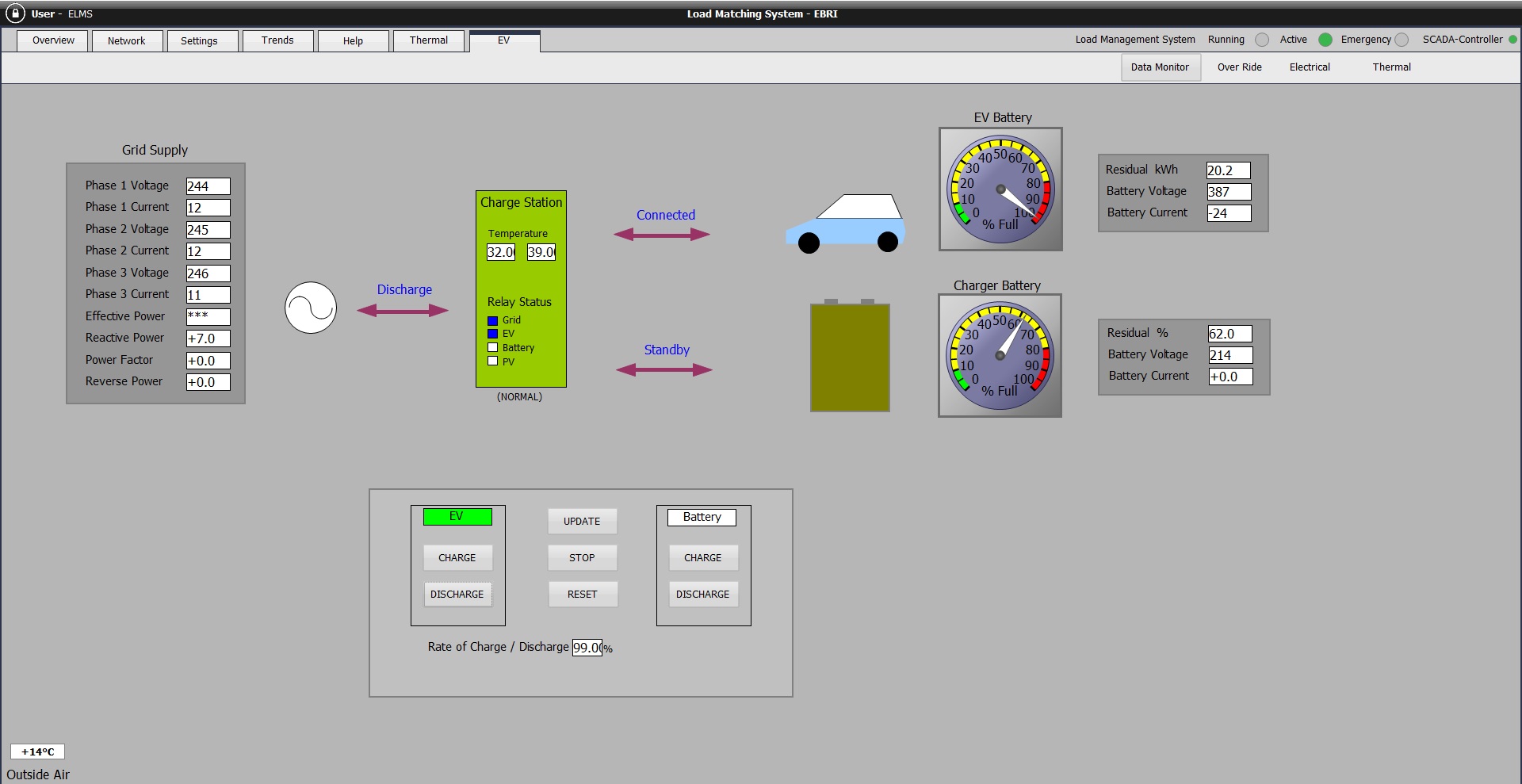
Please do read the press release in it’s entirety, and when you’ve done that also take a good look at the user interface of EBRI’s “load matching system”:

Exciting times for V2G enthusiasts here in the United Kingdom! Now that this pilot project is up and running there’s a few more urgent things to be ticked off on the to do list. How about OCPP 2.0 or even fully fledged British and international standards for “smart charging”, V2B and ultimately pukka V2G protocols for starters?

Here’s how the Open Charge Alliance explain the need for “Open Standards”:

The specification for version 2.0 of the Open Charge Point Protocol still seems to be absent from their web site however!

A Nissan LEAF Goes Surfing

Our apologies for the delay in publishing this article, but at this juncture it appears as though British Telecom have pushed out a firmware upgrade which has broken some (or all?) of their “business hubs” in the UK:

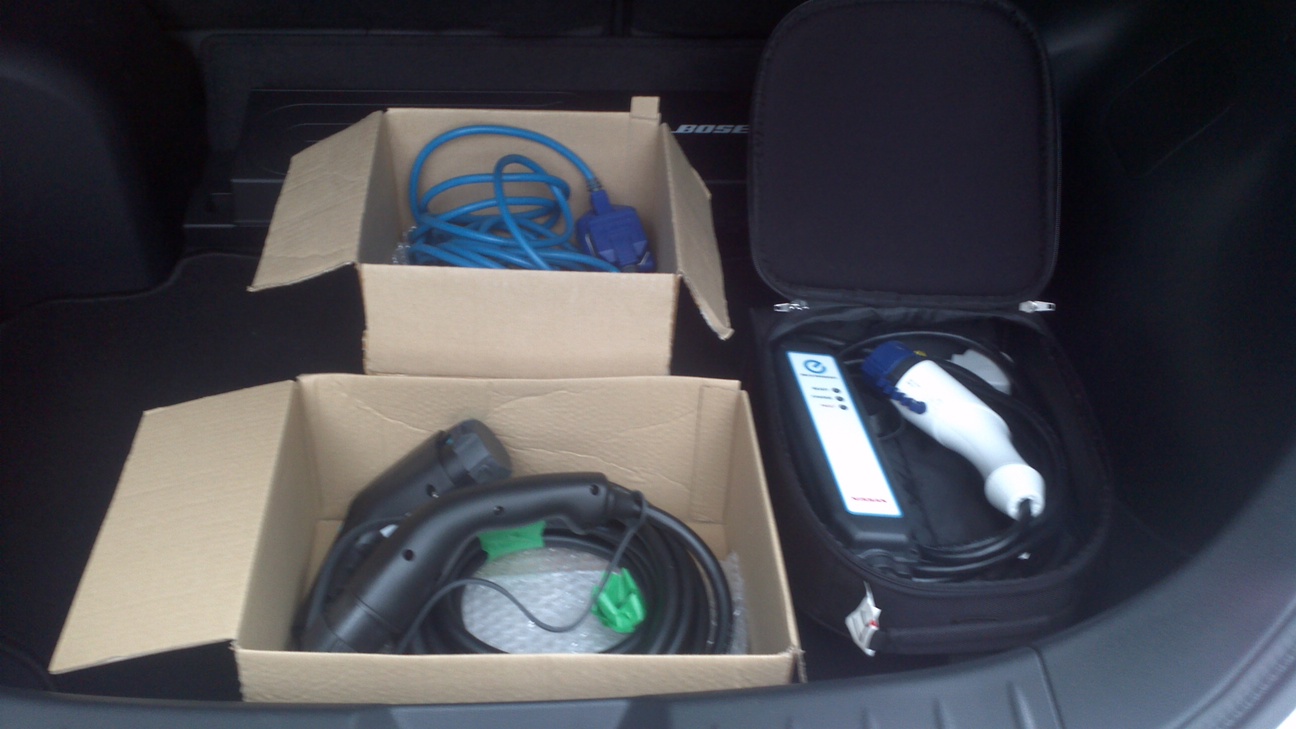
Whilst we wait for them to sort out the problem, which hit us 2 days ago, we’ve reverted to an ancient “2Wire” WiFi router that was gathering dust on one of our shelves. Having intended to head for North Cornwall at 9:30 on Saturday at the latest we eventually hit the road shortly after 11:00. Here’s our set of charging cables:

The blue one is a 10 meter 13 amp extension cable, just in case none of our planned rapid charging stations en route proved to be fully functional! When packing our bodyboarding gear Kasia’s 36″ board fitted in the boot easily:

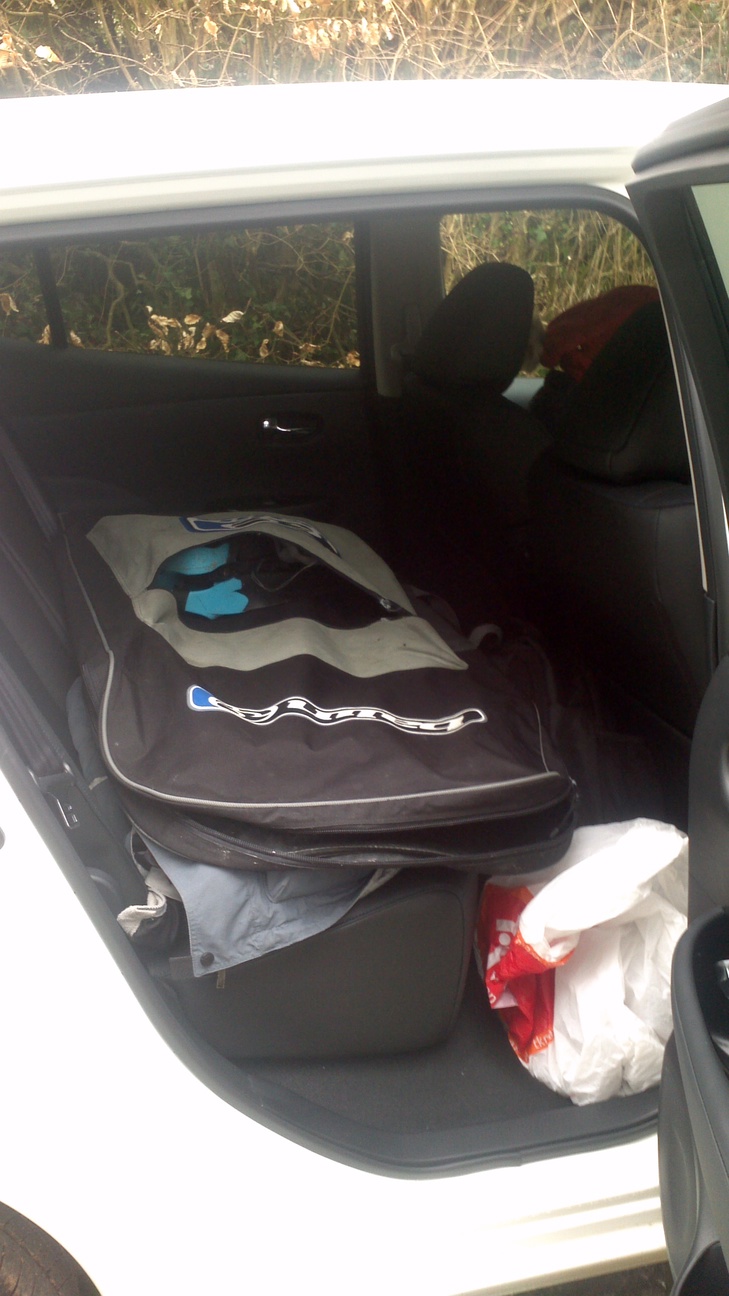
whereas my 42″ bat tail was just too long and had to sit on the back seat:

The LEAF also has a split rear seat so if there had been three of us on the trip we could have used that to fit everyone and everything in. Finally we were ready to leave!

The Nissan sat nav planned a route past Whitehouse Services near Okehampton which suited us perfectly, and the open road beckoned:

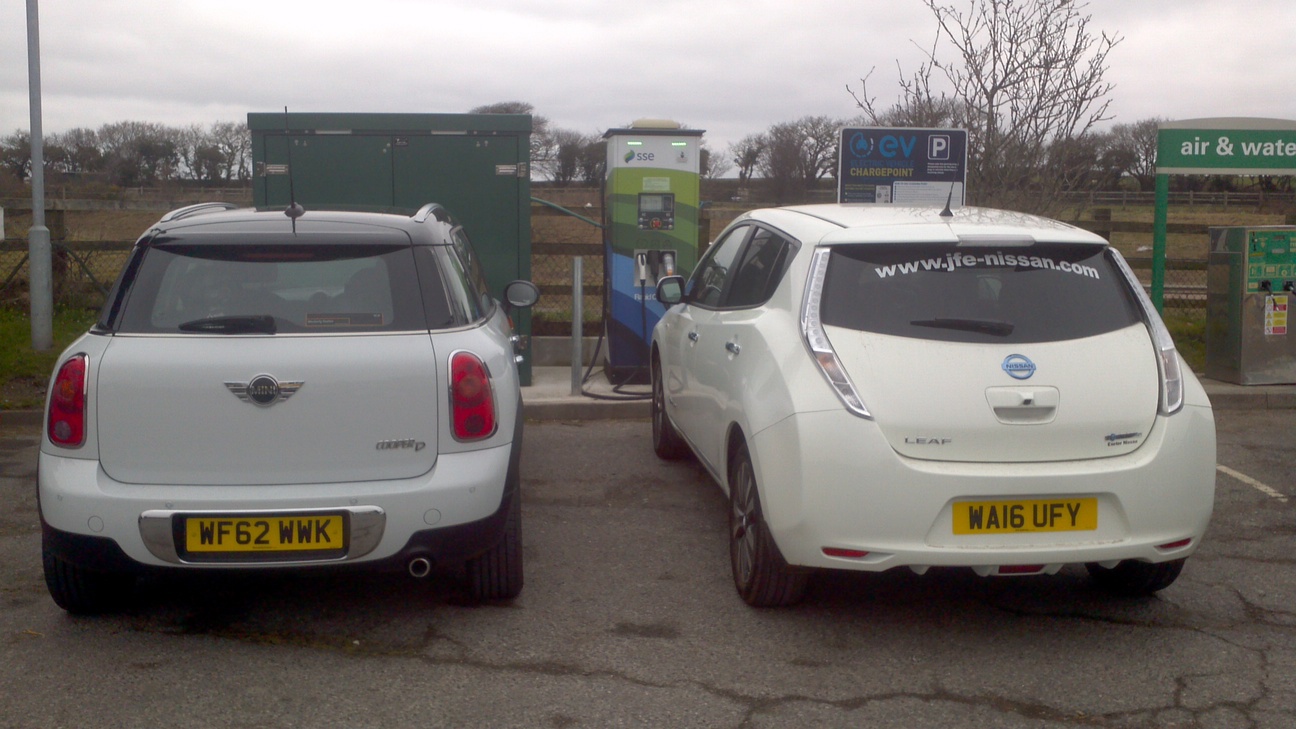
This is the sight that greeted us when we arrived at Whitehouse Services:

Just in case you’re wondering, the vehicle on the left does not incorporate an electric drive train!

To be continued….

30 kWh Nissan LEAF Extended Test Drive

We have mentioned the new “go further” Nissan LEAF previously on the V2G blog, and now thanks to JFE Nissan in Exeter we have the chance to test the new 30 kWh battery pack equipped 2016 LEAF for ourselves. According to the Nissan UK web site:

Every full charge will give you a range of up to 155 miles.

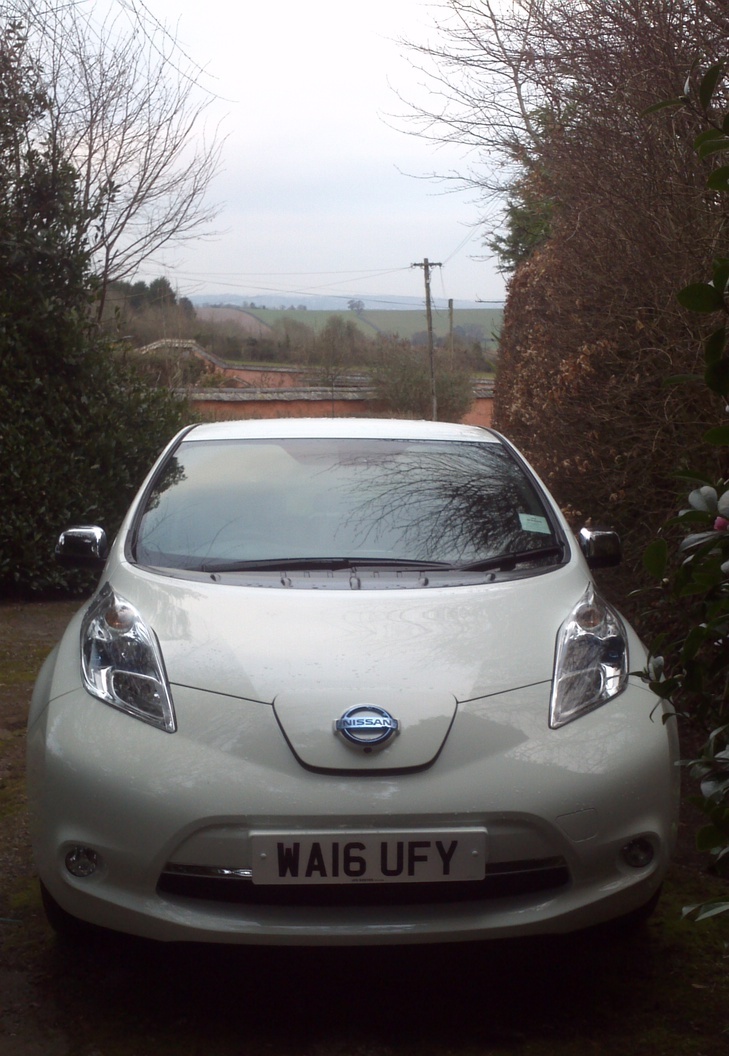
I don’t know about you, but we’d like to check that claim for ourselves! At the very start of our test the odometer on the bright white LEAF we were borrowing read 6 miles as we collected it earlier today, and had advanced to 11 miles by the time we got back to base:

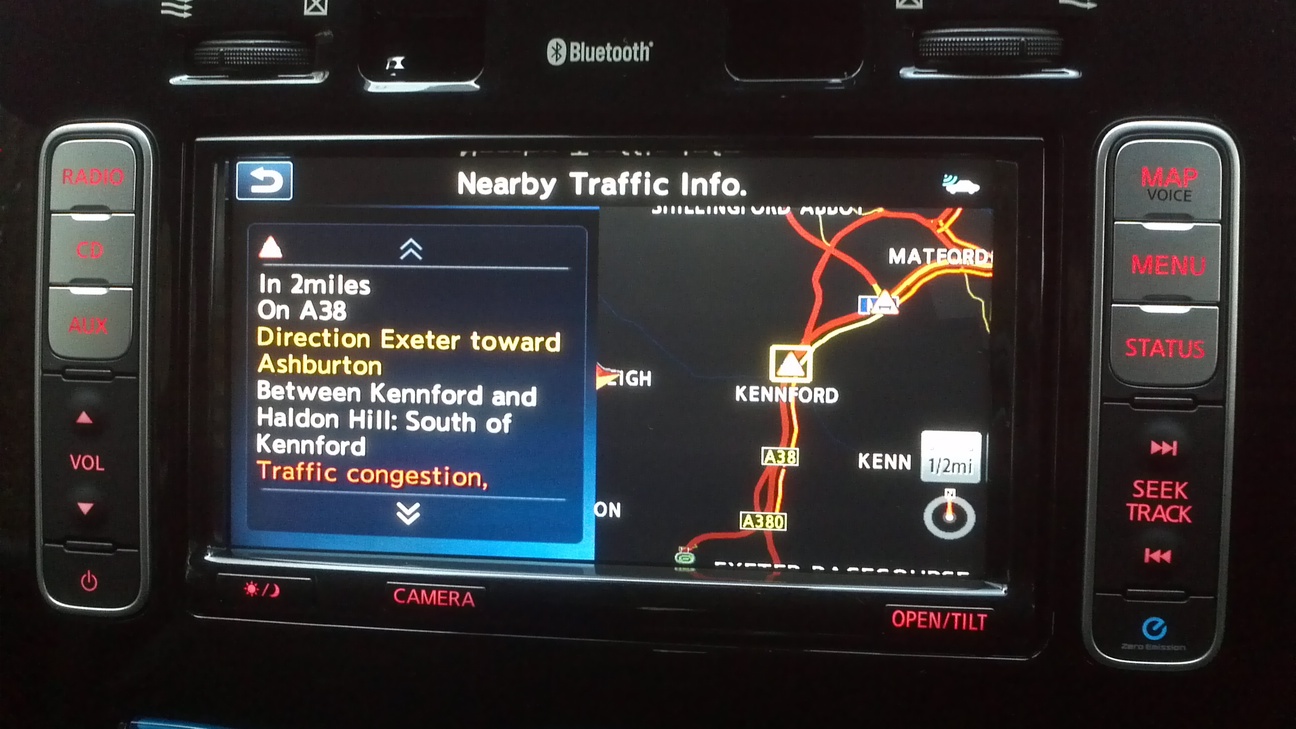
We had intended returning from Exeter to the wilds of the Haldon Hills via a main road. However before we left the Marsh Barton trading estate we consulted the LEAF’s handy traffic news feed, which revealed this:

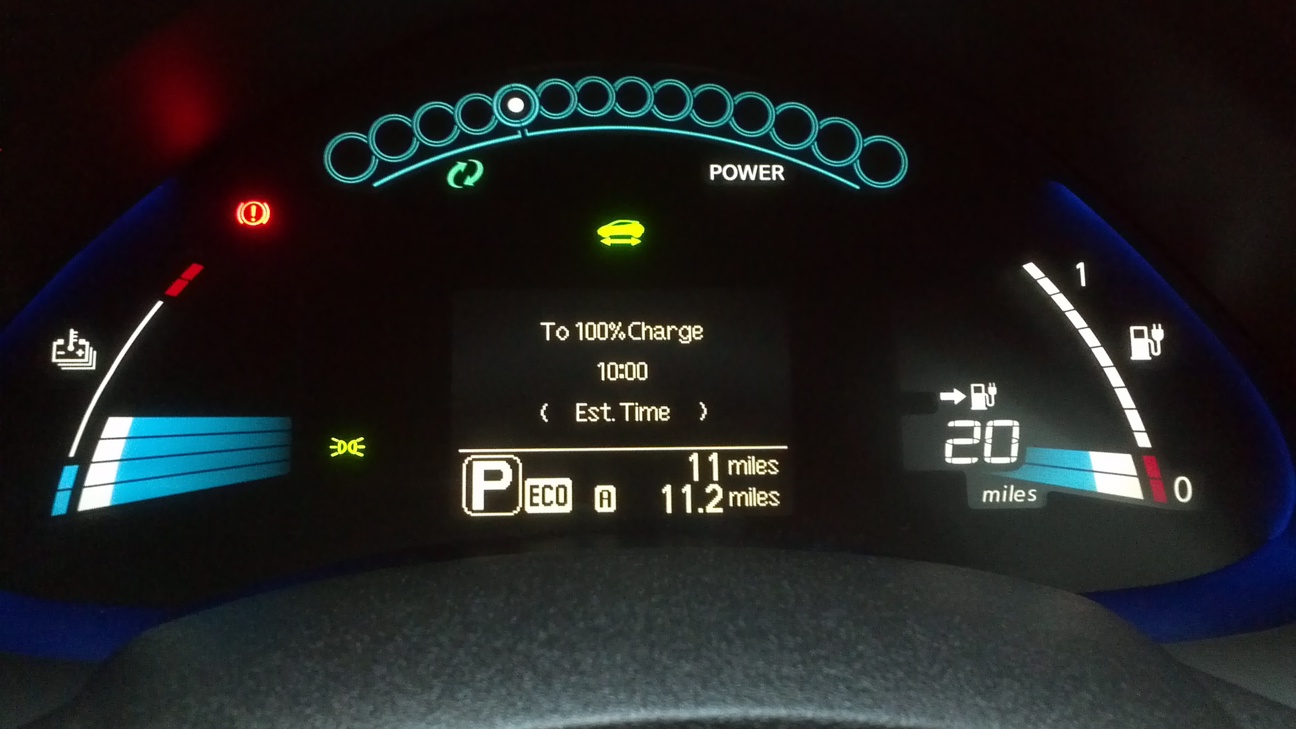
According to Radio Devon “a caravan’s been abandoned in the inside lane on Telegraph Hill”! Hence we took the scenic route through some narrow Devon country lanes, and ended up with 20 miles worth of range left in the traction battery pack, according to the LEAF’s dashboard at least:

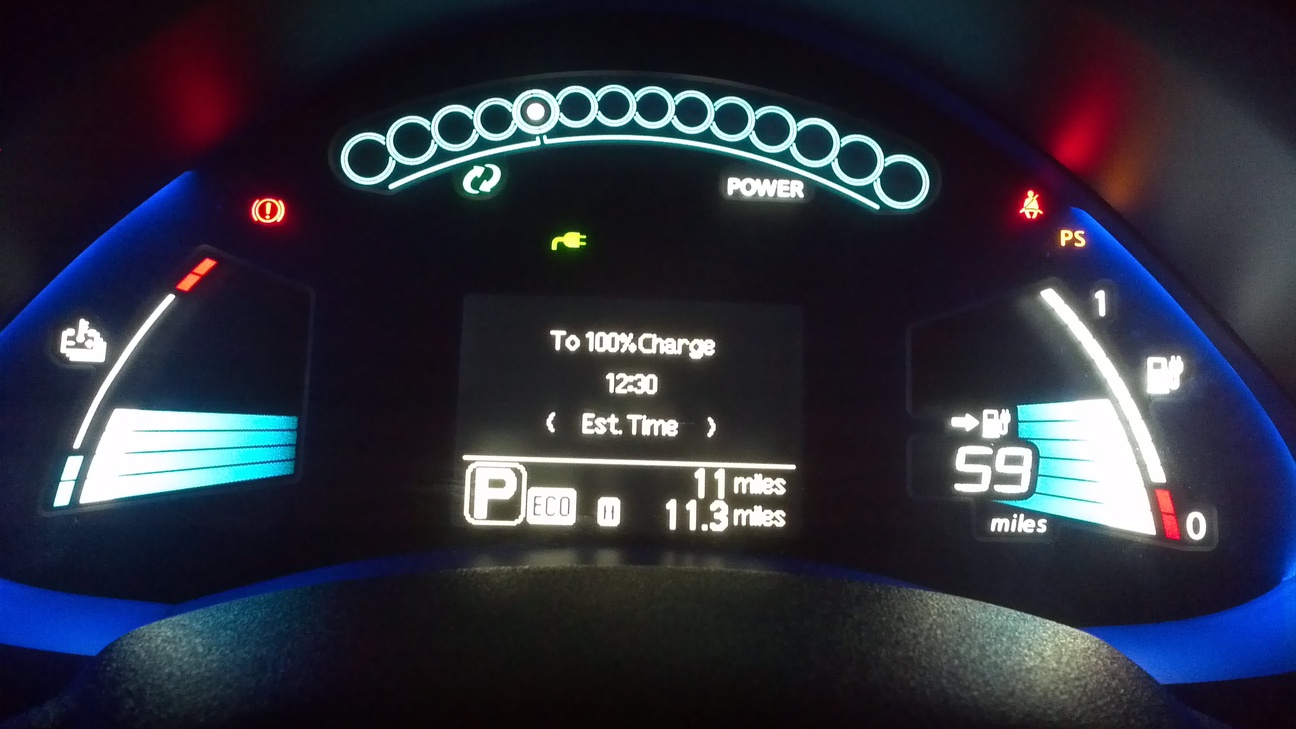
Having previously had some trouble using the rapid charger at Exeter Services, and having to avoid the motorway for other reasons on this occasion, we were in the perfect position to test the LEAF’s 13 amp “Electric Vehicle Supply Equipment” charging lead. We plugged it in at 18:30, and by 22:30 tonight the dashboard told us this:

More from us tomorrow on our Spring 2016 LEAF test, but for now we leave you with the inimitable Robert Llewellyn’s take on the new LEAF:

À bientôt, as I believe they say in France.

Nissan’s New Office Will Be Electric Vehicle Powered

Nissan announced at the Geneva Motor Show today that:

Its new regional office in France will house the largest grid-integrated electric vehicle (EV) system and second life battery storage unit ever installed in a building, anywhere in the world.

The new building will feature 100 vehicle-to-grid chargers, from Nissan’s partner ENEL, allowing Nissan’s range of EVs to plug in and draw down energy from the grid at off-peak periods with the ability to “sell back” the stored energy to the grid. It will also feature a 1 MWh energy storage system, from Nissan’s partner EATON, the battery storage experts, powered by 64 Nissan LEAF second life EV batteries combined with solar energy generation.

The company hopes to extend this innovative battery technology to other major Nissan sites and facilities around the world over the next few years. The systems which will be installed at Nissan’s new French office will serve as a live test case of what can be achieved when electric cars are used to their full potential.

By reducing grid dependency and using excess energy stored in EV batteries in a smart way, Nissan believes today’s announcement will be a game-changer in the way people and businesses utilise electric vehicle fleets.

The new technology is expected to slash energy costs at the new France office by reducing drawdown of energy during peak periods in favour of off-peak tariffs. The new energy management system will also decrease the amount of contracted power consumed from the local electricity supplier.

Nissan announced plans to create a viable long-term solution to environmental protection in relation to energy use and storage at the COP21 climate conference in Paris last year. This included a partnership between Nissan and EATON on giving electric vehicle batteries a second life as stationary energy storage units and a partnership with ENEL on vehicle-to-grid integration. Grid integration trials have already begun in Denmark.

Robin Berg’s TEDx talk on “A new local energy and transport system”

I had the pleasure of meeting Robin Berg in Utrecht last summer at the launch of the LomboXnet solar PV powered bi-directional vehicle to grid system. Here is a video of Robin’s recent presentation at TEDx Utrecht:

Robin says many interesting and enlightening things, but for the moment please consider this one:

Tomorrow your car will run electric. The day after it will power your house. It will be 100% renewable, it will be 100% clean, and it will be the end of coal, oil and gas.

V2G and Energy Storage are in the News. In the UK!

Spring is in the air here in the United Kingdom. Several of the people I debate the future of distributed energy storage with on a regular basis have been in the news this week!

First up was Mark Thompson of Innovate UK. According to the headline in an article in Utility Week:

EVs are stable energy storage asset, says Innovate UK

The article goes on to explain that:

Innovate UK has brushed aside ongoing fears around using electric and plug-in vehicles as an energy storage facility, insisting they present a “car park of energy storage” for UK network companies after 2025.

Innovate UK’s lead technologist for energy systems Mark Thompson said at a recent storage event that fears that using EV batteries for grid support will rapidly degrade the batteries are unfounded. Innovation projects already undertaken into EV charging reveal the batteries will be accessible to the grid 95 per cent of the time.

Thompson said “a lot of anxiety” around using EVs as energy storage centres on battery recycling, but tests show that using an EV battery to provide 7kW of grid support is equivalent to driving at just 20mph.

Mark went on to point out:

That is a modest amount of power but aggregated would be very useful for a distribution network operator. The stress level on that battery of sitting there continually pushing out 7kW compared to a 35 minute journey is a no-brainer, it’s an extremely calm and un-stressful environment for that vehicle. Car manufacturer Nissan has been very vocal on the potential benefits of using EVs for grid support because there really isn’t an issue compared to the complexities and stresses that the battery goes through for a pretty normal driving scenario.

If we can be clever and come up with the right business models to engage people in moving their charging and allow network operators to have some control, if we can be savvy about that then network investment costs are virtually zero until you are well into the 2020s

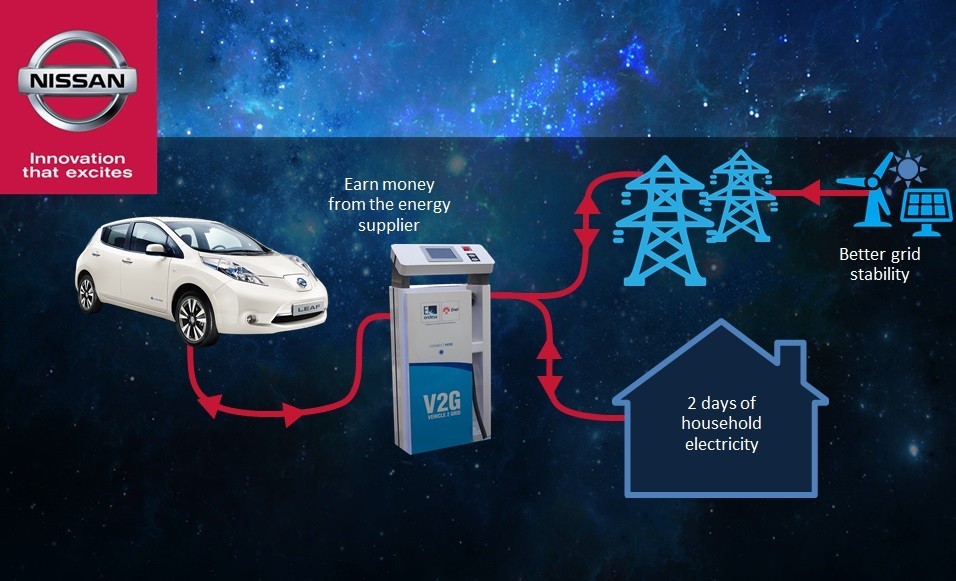
Here’s one of Nissan’s infographics showing how they see the technology working:

UK Plc “being savvy” and providing support for the “right business models” is another matter entirely however! Utility Week continued:

Projects such as My Electric Avenue have revealed that vehicles are sat stationary at either the home or workplace, both potential charging locations, 95 percent of the time making EVs a “stable storage asset”. Based on “very modest projections” there could be as many as 300,000 EV or hybrid vehicles on UK roads by 2025, presenting around 4GW of potential storage to the UK’s electricity system with very little network reinforcement required.

Having discussed the Utility Week article with Mark Thompson it seems they have misinterpreted a couple of points:

I didn’t wish to imply that cars would be 95% available, just that they are “parked for 95% of the time” but that data DNO projects such as My Electric Avenue and ETI analysis indicate that a “very healthy proportion” of plugins will be accessible over the 24 hour cycle for grid support given charging and use patterns. The 95% figure as currently illustrated is not of course realistic, but perhaps eventually grid “connected availability” may be in the region of 30-60% depending on the time of day, which in time will amount to a significant amount of grid connected resource.

Also, the 4GW figure should be 4GWh.

Here’s the original slide from Mark’s presentation, with the correct units clearly visible on the Y axis and in big letters towards the end of the headline:

Today the mainstream media picked up the story in the form of an article by Damian Carrington in The Guardian entitled “From liquid air to supercapacitors, energy storage is finally poised for a breakthrough”. Damian opens with a quote from Jill Cainey, director of the UK’s Electricity Storage Network.

It doesn’t always rain when you need water, so we have reservoirs – but we don’t have the same system for electricity.

A battery project can take 12-18 months from saying we will do it, to completion. California is aggressively pursuing a low-carbon agenda and they don’t want diesel [generator back-up] on the system. Amber Rudd is talking a lot about energy storage, but we need a clear regulatory steer. The planes are circling, but there is no runway to land on.

Next Mark Thompson is quoted once again, apparently from the Utility Week article rather than from his actual presentation:

Using electric car batteries as a smart storage network while still in the cars is a promising option in the future, according to Mark Thompson at Innovate UK, a government agency. He says there could be 4GW capacity – a nuclear power station is about 1GW – by 2025 across the 300,000 electric cars projected to be on UK roads by then. He says cars are stationary for 95% of the time and using them could save billions of pounds, removing the need for new power stations and power lines.

However the article continues:

While interest in energy storage projects in the UK is surging – a recent call from National Grid for 200MW of short-term storage was oversubscribed six times – it is starting from a low base: just 24MW has been installed compared to the 5,000MW the government’s official advisers, the Committee on Climate Change, envisages in a low-carbon nation in 2030.

In November, energy secretary Amber Rudd said: “Locally generated energy supported by storage, interconnection and demand response, offers the possibility of a radically different model… We are looking at removing regulations that are holding back smart solutions, such as demand side response and storage.”

Removing the regulations that are holding back smart solutions is one of the reasons Mark and Jill were already on my list of people to call this week. That’s because DECC’s current consultation about how to “Ensure Regulation in the Energy Sector Encourages Innovation” closes on February 11th!

Renault and Eneco Announce Smart Charging App at COP21

As we reported yesterday, the Nissan half of the Renault-Nissan Alliance made an interesting V2G announcement at the COP21 meeting in Paris. Now it’s Renault’s turn, although this one concerns “smart charging” rather than fully fledged vehicle-to-grid technology. In a December 7th press release they said that:

Renault & Eneco collaborate on smart charging solution for electric vehicles.

  • Agreement signed between electric vehicle leader Renault and energy supplier Eneco on December 7, 2015 at COP21 Paris conference
  • Eneco will develop smart charging app for ZOE, Renault’s 100% electric compact car
  • Renault ZOE users will be able to charge their car at lower costs using renewable energy

Eneco subsidiary Jedlix will develop a version of its existing smart charging app, to adapt it to Renault ZOE. This app makes it possible to charge electric cars using renewable energy at times when the market prices are most favourable. Like at night, when the production of sustainable wind energy exceeds demand in most European countries.

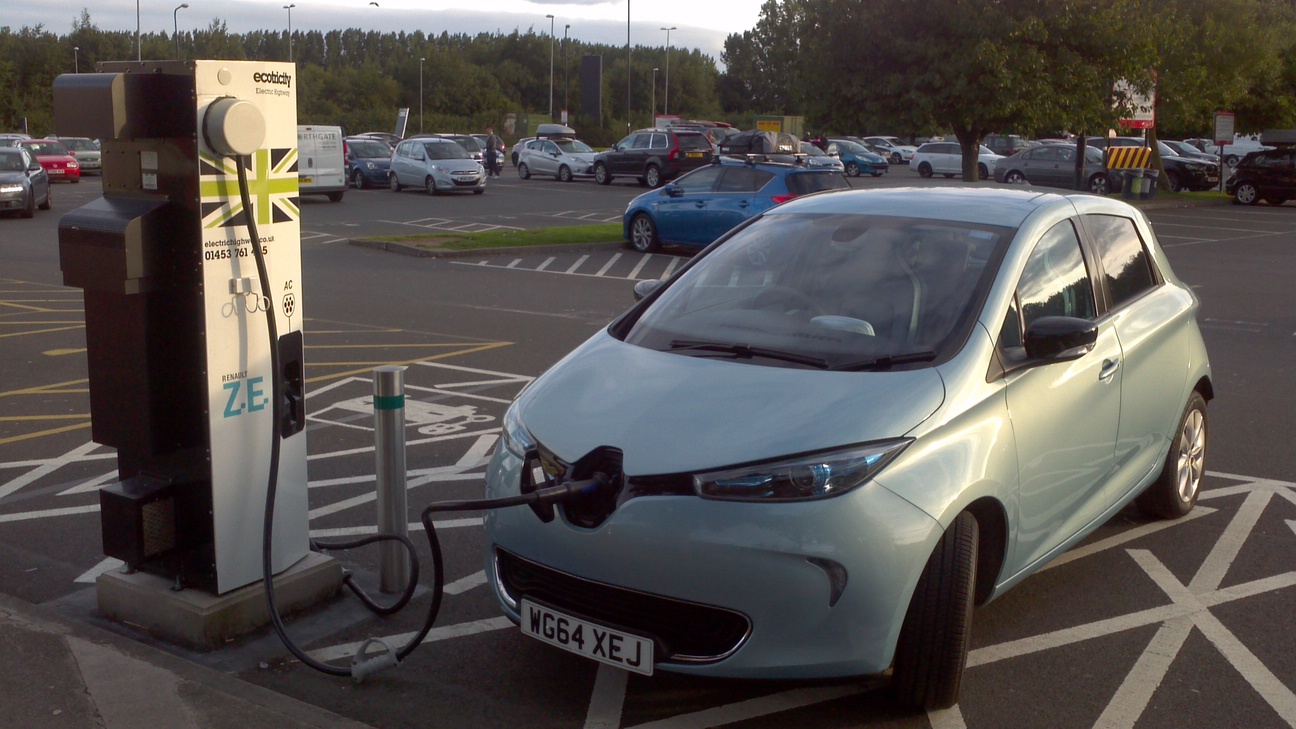
As far as “lower costs” go, here’s a glimpse of V2G UK filling up a Renault ZOE 100% electric compact car 100% free of charge using renewable energy in a UK motorway service station, courtesy of Nissan & Ecotricity:

Heading back to Paris, Eneco Executive Board member Marc van der Linden said :

It is expected that there will be three million electric vehicles in the whole of Europe by 2020. To reduce CO2 emissions, it is essential that this vehicle fleet will use green power. It is also important to prevent power grid overloads as a result of peaks in demand if all the cars would be charged at the same time. Our app forms a direct link between the electric vehicle and the supply of sustainably generated energy. Consequently, the energy used for charging is more sustainable, energy supply and demand is balanced and the costs of driving an electric vehicle are reduced because users charge their cars at lower rates.

Eric Feunteun, who is Electric Vehicle Program Director at Renault, added:

Renault electric cars support the energy transition in the automotive industry as they contribute to the replacement of fossil fuels by renewable energies. With smart charging systems like the one developed by Eneco, Renault electric vehicles make a big contribution to power systems’ stability and reliability: EVs turn into an asset for the grid rather than create overload. They can store and use electricity when it is less carbon-dependent and cheapest for their owners. Our partnership with Eneco is a move towards making driving a Renault ZOE more interesting and affordable and will contribute to an electric vehicles’ scale up.

Renault’s press release continues:

A pilot test carried out by Eneco in the Netherlands demonstrates that users can save up to 15% on their electricity costs by using the app. To achieve this, all they have to do is indicate by what time the car must be fully charged and the system will automatically determine the lowest price within this time frame. The app will first be available for ZOE users in the Netherlands and soon be available in other countries where Eneco operates.

Eneco do have a UK office, but quite how Renault ZOE drivers across the UK might be able to make use of “a flexible [electricity] price negotiated electronically by computers” to save a few quid on their fuel bills whilst “prevent[ing] power grid overloads” is a mystery to me at the moment, despite the fact that I sit on committees tasked with designing international standards for such things! However, here’s Eneco’s vision of “Everyone as an Energy Supplier in 2030”:

Make sure that, if nothing else, you watch the bit at 1 minute 20 seconds which mentions that “The car plays a pivotal role as an energy storage buffer”.